
LIFE SCIENCES GRADE 10 CAPS STRUCTURED CLEAR PRACTICAL


- Slides: 33
LIFE SCIENCES GRADE 10 CAPS: STRUCTURED, CLEAR, PRACTICAL HELPING TEACHERS UNLOCK THE POWER OF NCS KNOWLEDGE AREA: Environmental Studies Topic 10: Biosphere to ecosystem Abiotic factors
CAPS SPECIFIC AIMS 1. KNOWING LIFE SCIENCES 2. INVESTIGATING PHENOMENA IN LIFE SCIENCES 3. APPRECIATING AND UNDERSTANDING THE HISTORY, IMPORTANCE AND APPLICATIONS OF LIFE SCIENCES IN SOCIETY
SPECIFIC SKILLS � � � � � Access information Select key ideas Recall information Describe knowledge of NS Build a conceptual framework Organise or reorganise knowledge Write summaries Develop flow charts and mind maps Recognise patterns and trends � � � � Apply knowledge in new contexts Use knowledge in a new way Analyse information/data Critically evaluate scientific information Recognise relationships between existing knowledge and new ideas Identify assumptions Categorise information
ABIOTIC COMPONENTS: � Abiotic factors can be placed into 3 groups. Climatic factors: light, temperature, water and atmospheric gases Edaphic factors: soil Physiographic factors: aspect, slope and altitude
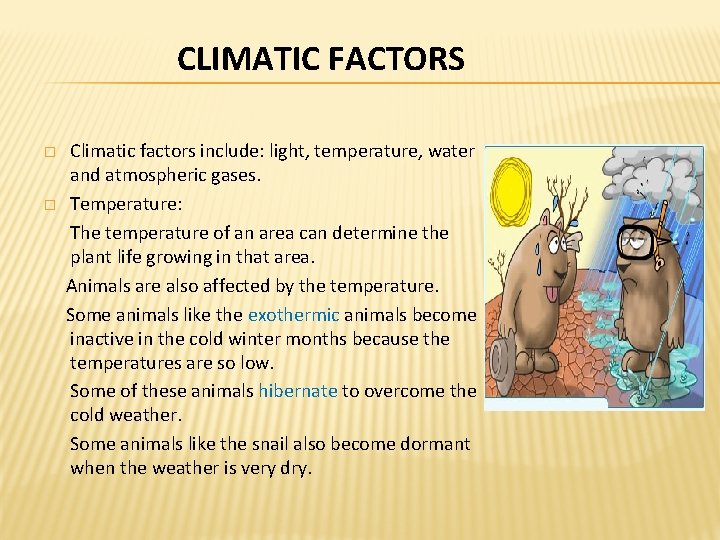
CLIMATIC FACTORS � � Climatic factors include: light, temperature, water and atmospheric gases. Temperature: The temperature of an area can determine the plant life growing in that area. Animals are also affected by the temperature. Some animals like the exothermic animals become inactive in the cold winter months because the temperatures are so low. Some of these animals hibernate to overcome the cold weather. Some animals like the snail also become dormant when the weather is very dry.
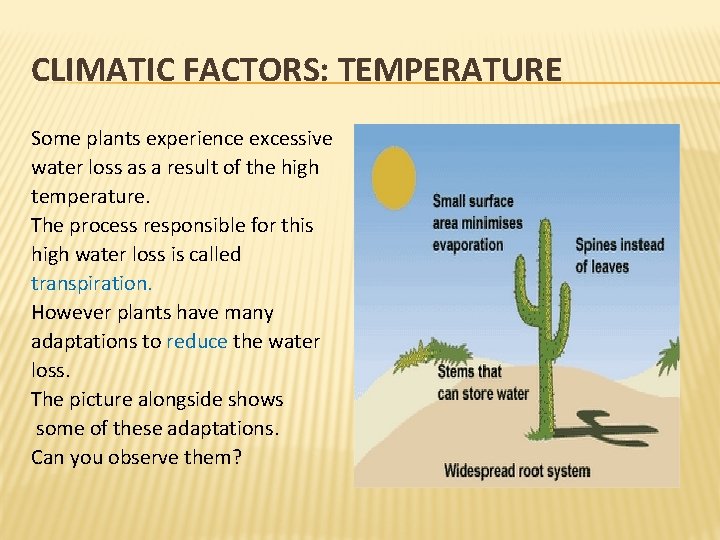
CLIMATIC FACTORS: TEMPERATURE Some plants experience excessive water loss as a result of the high temperature. The process responsible for this high water loss is called transpiration. However plants have many adaptations to reduce the water loss. The picture alongside shows some of these adaptations. Can you observe them?
Adaptation of plants to reduce water loss: � Leaves are long and thin to reduce the surface area to reduce water loss. � Leaves are covered with a thick cuticle to reduce water loss. � Leaves have more stomata on the lower surface to reduce water loss by transpiration and these stomata may be sunken. � Leaves may be covered by tiny white hairs to reflect the sunlight so that water loss can be reduced. � Some leaves maybe reduced to thorns to reduce the surface area exposed to the sun thereby reducing water loss. � Stems may be able to store water to survive the dry months.
SOMETHING FOR YOU TO DO: � 1. 2. 3. 4. 5. Define the following terms: Hibernation Aestivation Transpiration Exothermic Endothermic 2. Differentiate between the following terms Hibernate and aestivate Exothermic and endothermic � Explain how animals are able to overcome adverse weather conditions. � 1.
SOLUTION: � 1. 2. 3. 4. 5. Definitions: An inactive state that enables animals survive the cold winter months. An inactive state that enables animals survive the hot, dry months. The loss of water in the form of water vapour from the aerial parts of the plant especially the stomata. Animals whose body temperature changes with the temperature of the environment. Animals whose body temperature remains constant.
� Differences Hibernation is an inactive state to survive the cold winter months, while aestivation is and inactive state to survive the hot, dry months. Exothermic animals are animals whose body temperature changes with that of the surrounding while endothermic animals are those whose body temperature remains constant. � Adaptations to adverse conditions Some animals like a dog curl up in cold weather
� Adaptations to adverse conditions Some animals e. g. dog curl up in cold weather so that the long fur is exposed to the cold wind keeping them warm. Animals may aestivate to escape hot, dry conditions, while others mat hibernate to survive cold winter conditions. Some animals go into the burrows to escape the heat e. g. Ground squirrels.
CLIMATIC FACTORS: LIGHT � Light is needed by green plants for the process of photosynthesis. Plants will always be in competition with each other for light. Here are some examples: When plants are crowded together they will grow thin and tall in the hopes of receiving light. Some plants will climb on others in an attempt to reach the light. Example: vines Still others will grow on larger trees to reach the sunlight. Example: epiphytes
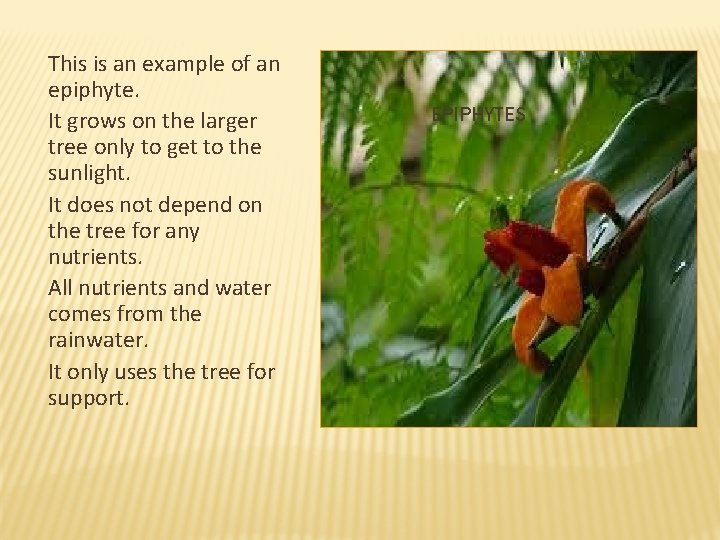
This is an example of an epiphyte. It grows on the larger tree only to get to the sunlight. It does not depend on the tree for any nutrients. All nutrients and water comes from the rainwater. It only uses the tree for support. EPIPHYTES
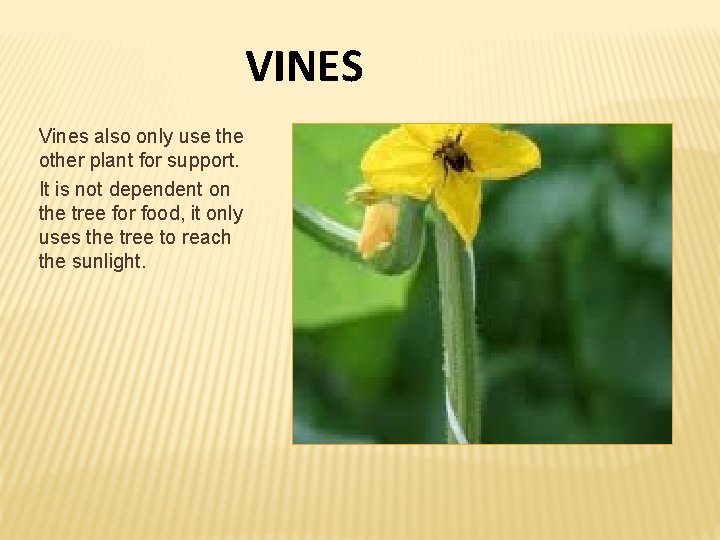
VINES Vines also only use the other plant for support. It is not dependent on the tree for food, it only uses the tree to reach the sunlight.
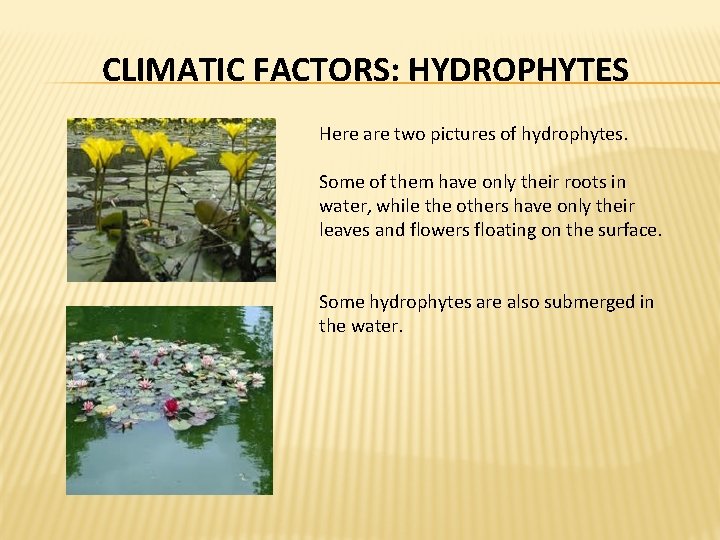
CLIMATIC FACTORS: HYDROPHYTES Here are two pictures of hydrophytes. Some of them have only their roots in water, while the others have only their leaves and flowers floating on the surface. Some hydrophytes are also submerged in the water.
CLIMATIC FACTORS: TERRESTRIAL PLANTS Terrestrial plants are plants that live on land. � The biggest problem facing these plants is the lack of water. � These plants have to be able to absorb water and keep the water they absorb. � Terrestrial plants can be grouped according to their water needs. � These plants can be placed into 3 groups. � These 3 groups are the: a. Hydrophytes: plants that need an abundance of water b. Mesophytes: plants that need a moderate amount of water c. Xerophytes: plants that can live with very little water. �
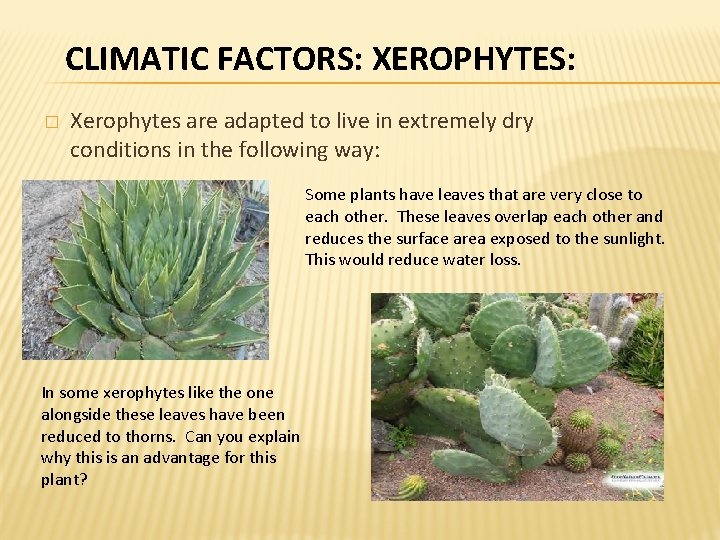
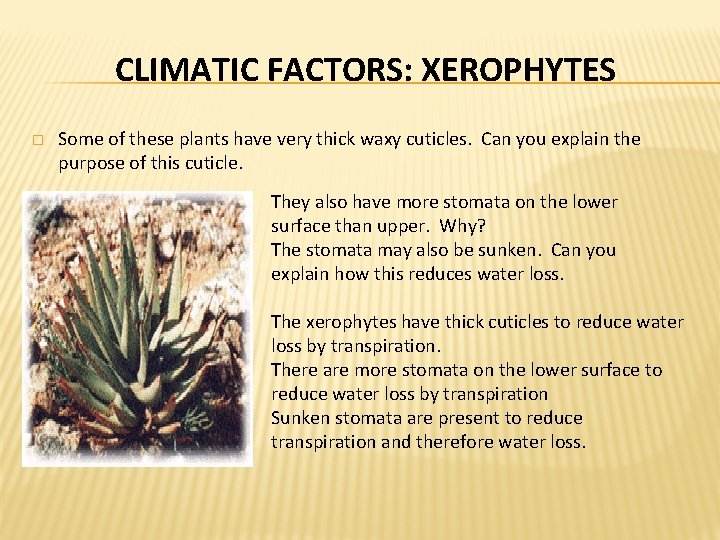
CLIMATIC FACTORS: XEROPHYTES: � Xerophytes are adapted to live in extremely dry conditions in the following way: Some plants have leaves that are very close to each other. These leaves overlap each other and reduces the surface area exposed to the sunlight. This would reduce water loss. In some xerophytes like the one alongside these leaves have been reduced to thorns. Can you explain why this is an advantage for this plant?
ATMOSPHERIC GASES: � Nitrogen is required by plants to manufacture proteins. � Plants cannot absorb nitrogen as the N 2 gas as it occurs in the atmosphere. � Plants are only able to absorb nitrogen as a nitrate, when it is soluble in the soil water. � Therefore the nitrogen has to be first converted to nitrate before it can be absorbed. � Remember animals get their nitrogen from the plants they eat or other animals that may have eaten plants.
CLIMATIC FACTORS: XEROPHYTES � Some of these plants have very thick waxy cuticles. Can you explain the purpose of this cuticle. They also have more stomata on the lower surface than upper. Why? The stomata may also be sunken. Can you explain how this reduces water loss. The xerophytes have thick cuticles to reduce water loss by transpiration. There are more stomata on the lower surface to reduce water loss by transpiration Sunken stomata are present to reduce transpiration and therefore water loss.
CLIMATIC FACTORS: ANIMAL ADAPTATIONS � Animals also show adaptations to the available water. � Animals are adapted to live in water and on land. � Aquatic animals are those animals that live in water. � Terrestrial animals are those animals that live on land. � These animals have special features, structures and behavior that enables them to live in their particular habitat.
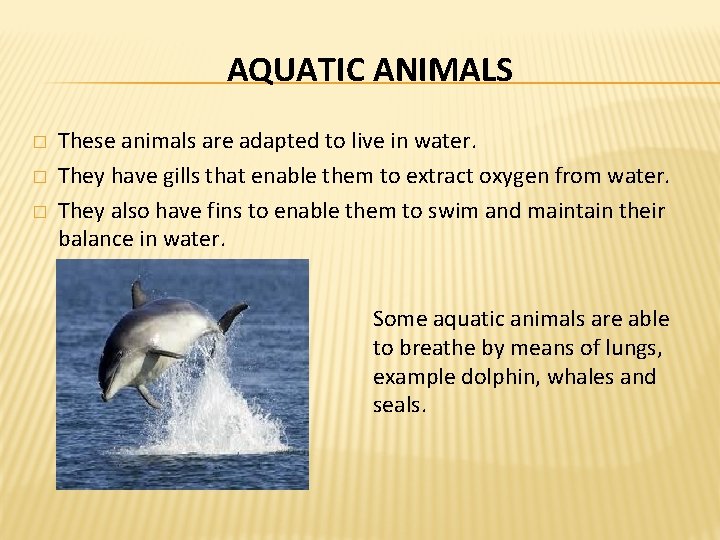
AQUATIC ANIMALS � � � These animals are adapted to live in water. They have gills that enable them to extract oxygen from water. They also have fins to enable them to swim and maintain their balance in water. Some aquatic animals are able to breathe by means of lungs, example dolphin, whales and seals.
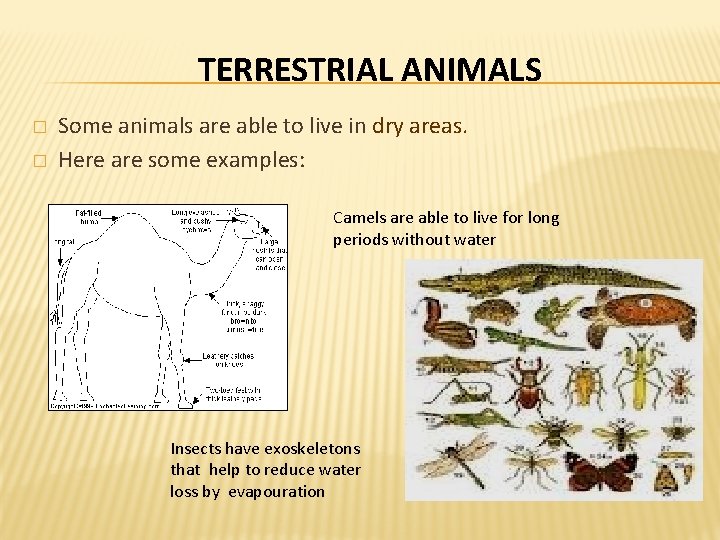
TERRESTRIAL ANIMALS � � Some animals are able to live in dry areas. Here are some examples: Camels are able to live for long periods without water Insects have exoskeletons that help to reduce water loss by evapouration
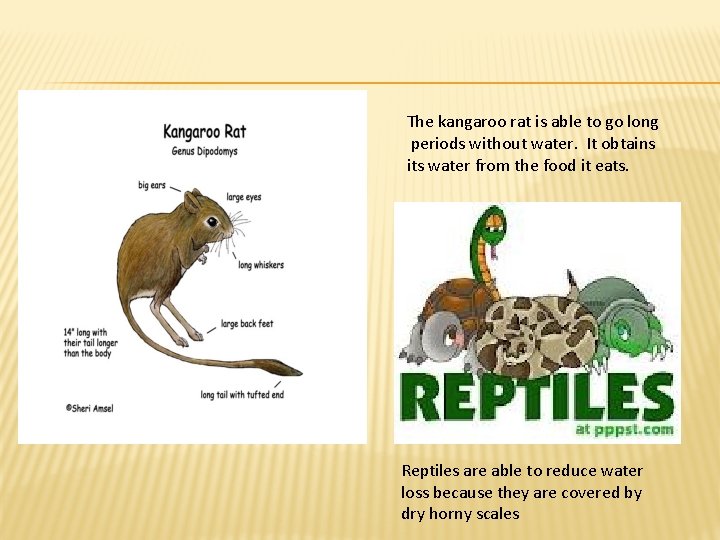
The kangaroo rat is able to go long periods without water. It obtains its water from the food it eats. Reptiles are able to reduce water loss because they are covered by dry horny scales
ATMOSPHERIC GASES: The atmosphere contains air. � Air is a mixture of gases. � Some of the more important gases that make up the air are: oxygen, carbon dioxide, nitrogen and water vapour. � The composition of these gases are about 78% nitrogen, 21% oxygen and 0. 03% carbon dioxide. � Oxygen is required by the both plants and animals for the process of cellular respiration. � During the process of photosynthesis plants absorb carbon dioxide, which is a requirement of photosynthesis. �
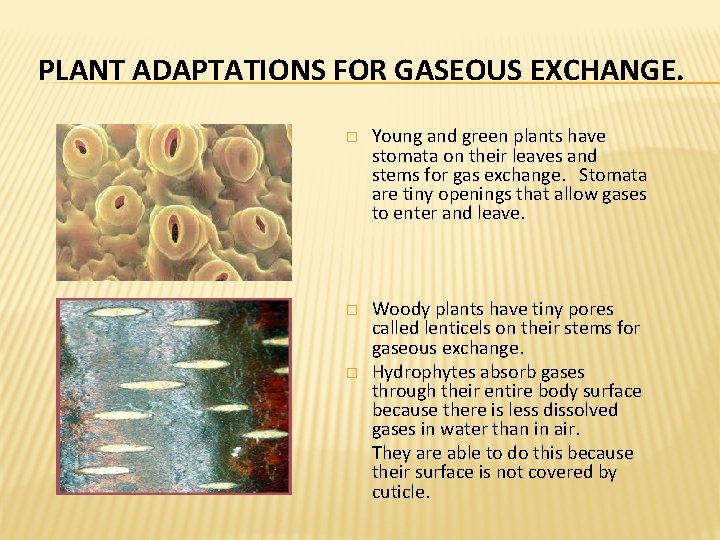
PLANT ADAPTATIONS FOR GASEOUS EXCHANGE. � Young and green plants have stomata on their leaves and stems for gas exchange. Stomata are tiny openings that allow gases to enter and leave. � Woody plants have tiny pores called lenticels on their stems for gaseous exchange. Hydrophytes absorb gases through their entire body surface because there is less dissolved gases in water than in air. They are able to do this because their surface is not covered by cuticle. �
SOMETHING FOR YOU TO DO � Explain how lenticels and stomata are similar in their function but different in their structure. � Both the lenticels and stomata are used for the exchange of gases in plants. But the stomata are pores that are found in the stems and leaves of herbaceous plants, while lenticels are pores found on the stems of plants that have undergone secondary thickening.
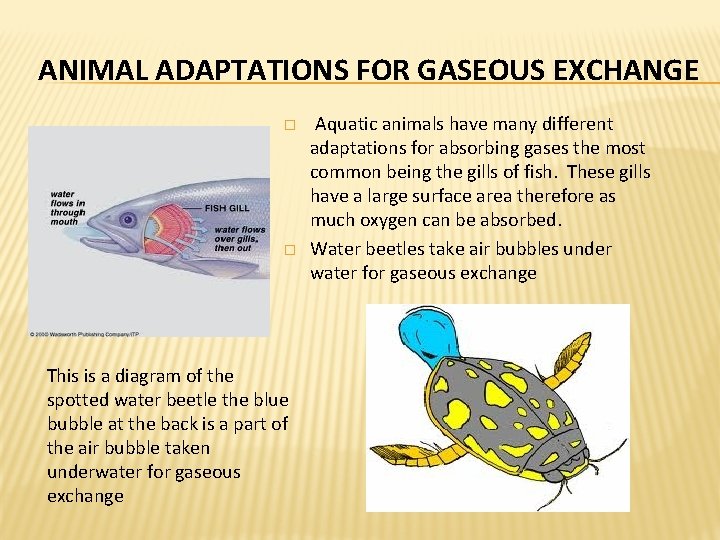
ANIMAL ADAPTATIONS FOR GASEOUS EXCHANGE � � This is a diagram of the spotted water beetle the blue bubble at the back is a part of the air bubble taken underwater for gaseous exchange Aquatic animals have many different adaptations for absorbing gases the most common being the gills of fish. These gills have a large surface area therefore as much oxygen can be absorbed. Water beetles take air bubbles under water for gaseous exchange
EDAPHIC FACTORS: SOIL TYPES � � � � � There are 3 types of soil. These 3 types are sand, loam and clay. Plants grow best in loam soil because it has a good water holding capacity, and is well aerated. It also has a high humus content. The loam soil has a good water holding capacity because it is made up of medium sized particles. Plants cannot grow in sandy soil because the soil is very loose and does not offer enough anchorage. The large particles of sandy soil provides it with a poor water holding capacity. Clay is made up of very fine particles that become sticky when wet. Therefore it has a poor water holding capacity. It is not good for plants because the roots can become waterlogged.
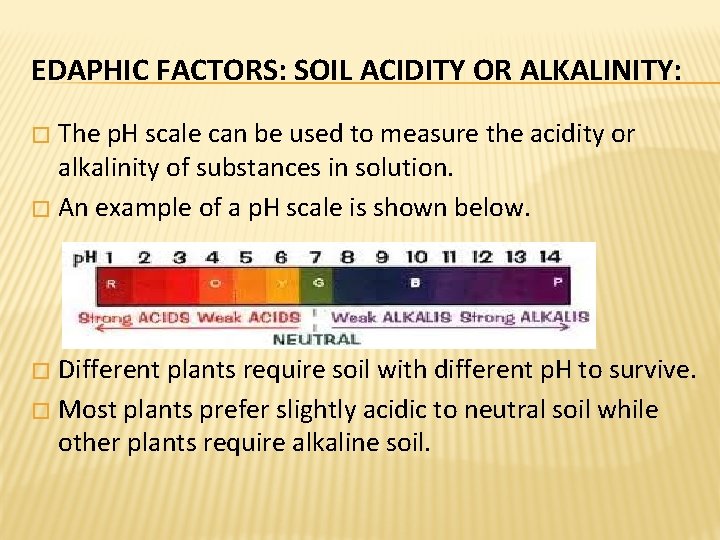
EDAPHIC FACTORS: SOIL ACIDITY OR ALKALINITY: The p. H scale can be used to measure the acidity or alkalinity of substances in solution. � An example of a p. H scale is shown below. � Different plants require soil with different p. H to survive. � Most plants prefer slightly acidic to neutral soil while other plants require alkaline soil. �
PHYSIOGRAPHIC FACTORS: � Physiographic factors are those factors that deal with the physical nature of the area. � Example of such factors are slope of land, altitude and for our studies position of area in relation to sun. � The physiographic factors that we will discuss are: a) Aspect b) Altitude.
PHYSIOGRAPHIC FACTORS: ASPECT � � � Aspect refers to the direction a slope faces. In the southern hemisphere the suns rays come from the north therefore the north facing areas receive more light than the south facing slopes. The north facing areas would be warmer and drier than south facing slopes. The north facing areas are drier because of increased evaporation. Therefore shade loving plants like ferns would be found on the south facing slopes and xerophytes would be found on the drier, warmer slopes. The south facing slopes would have more plant and animal life because more water is available.
PHYSIOGRAPHIC FACTORS: ALTITUDE Altitude refers to the height of the land above sea level. � The climate of areas found at higher altitudes is very different from places at lower altitude. � The areas at higher altitude have lower temperatures, atmospheric pressure and are exposed to stronger winds. � While those areas at lower altitudes have warmer temperatures, higher atmospheric pressures and lighter winds. � These differences means that the plant and animal life in these areas are very different from each other. �
PHYSIOGRAPHIC FACTORS: EFFECTS OF ALTITUDE ON LIVING ORGANISMS. Pine trees that grow on the slopes of mountains are cone shaped to allow the snow to fall off. They have very well developed roots to absorb whatever little water that may be available. � Green and black mambas are found in the warmer coastal areas while the Berg adder is found more commonly in the cooler mountainous areas. � Fish like the trout are found in rivers at high altitude because these waters are colder. � People living in the coastal areas have difficulty in breathing in the higher inland areas because of the lower pressure and therefore less oxygen at the higher altitudes. �