
Life sciences Grade 10 CAPS structured clear practical



- Slides: 60
Life sciences Grade 10 CAPS: structured, clear, practical Helping teachers unlock the power of NCS KNOWLEDGE AREA: Diversity, change and continuity Topic 12: History of life on Earth Fossil formation and dating methods, key events in life History and Fossil Tourism
CAPS SPECIFIC AIMS 1. Knowing Life Sciences 2. Investigating Phenomena in Life Sciences 3. Appreciating and Understanding the History, Importance and Applications of Life Sciences in Society
Specific Skills Access information Select key ideas Recall information Describe knowledge of NS Build a conceptual framework Organise or reorganise knowledge Write summaries Develop flow charts and mind maps Recognise patterns and trends Apply knowledge in new contexts Use knowledge in a new way Analyse information/data Critically evaluate scientific information Recognise relationships between existing knowledge and new ideas Identify assumptions Categorise information
Agenda or Summary Layout A summary of the presentation 1 Discussion Item One What are fossils? 5 Discussion Item Five 2 Discussion Item Two 6 Discussion Item Six 3 Discussion Item Three 4 Discussion Item Four Formation of Fossils Determining the age of the fossils Evidence for the key events in the history of life Human Impact on Biodiversity and Natural Environment Fossil tourism
What are Fossils? Fossils are remains of ancient life forms preserved in rock. They may also occur in ice, tar and dried sap of trees. The study of fossils is called paleontology.
Formation of Fossils The richest sources of fossils are found in sedimentary rock. Sand silt from the land is carried to the seas and swamps by rivers. The remains of dead organisms settle to the bottom. The mineral salts also settle to the bottom. The mineral salts then filter into the body of the dead organism. The organism becomes petrified, this means that it turns into stone.
Formation of Fossils Imprints An imprint is left behind when the organism starts to decay before it becomes petrified. Therefore some fossils are actual organisms or parts of the dead organism while other fossils are just impressions or imprints. Imprints are just outlines of the dead organism or parts of it left in the stone.
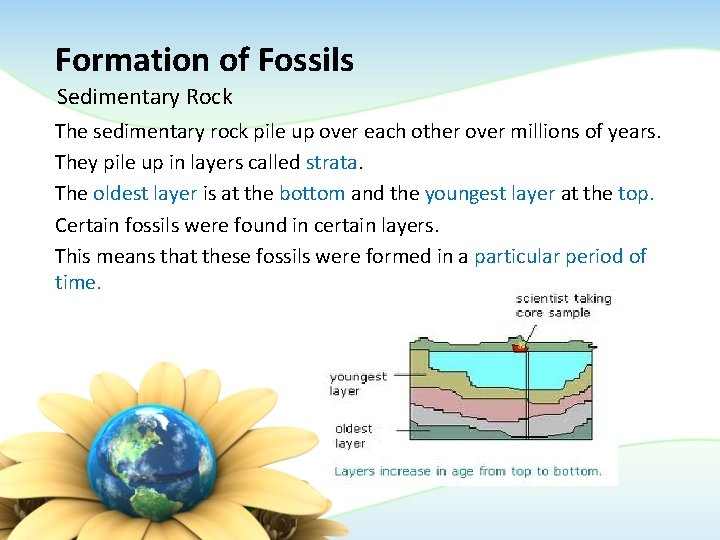
Formation of Fossils Sedimentary Rock The sedimentary rock pile up over each other over millions of years. They pile up in layers called strata. The oldest layer is at the bottom and the youngest layer at the top. Certain fossils were found in certain layers. This means that these fossils were formed in a particular period of time.
Formation of Fossils Index fossils Such fossils are called index fossils. Index fossils give an indication of the time period in which they were formed. The index fossils have a wide geographic distribution. This means that they are found in a large number of places.
Formation of Fossils Examples of Fossils Some examples of fossils are… Ø Ø Ø bones of vertebrates shells/exoskeletons of invertebrates tracks(footprints), burrows and hardened faeces of animals petrified tree trunks imprints of leaves and small animals
Formation of Fossils Examples of Fossils Remember fossils also occur in tar and ice. Here are some examples of such fossils… Ø fossils of the woolly mammoth were found frozen in ice. Ø pits of tar contained bones of the sabre toothed cats Ø some insects have been found in amber. Amber is the hardened form of liquid sap of plants.
Determining the Age of Fossils There are two methods used to determine the age of fossils. These are: Ø relative dating and Ø radiometric dating
Determining the Age of Fossils Relative dating In relative dating the age of the fossil is worked by comparing it to another fossil or geological event. Relative dating is able to tell us whether a fossil is formed before or after another fossil or geological event. It does not give the exact age of the fossil. An example of geological event is an volcanic eruption.
Determining the Age of Fossils Relative dating If the original stratification or layering in a rock is undisturbed scientists can tell that a fossil in a lower layer was formed before the one found in the upper layer. Remember this does not tell us the exact age of the fossil. If the original layering is upset it is not so easy to compare the age of one fossil to another. However Scientists are able to use index fossils.
Determining the Age of Fossils Relative dating If a new fossil and an index fossil is found in the upper most layer of rock then scientists can tell: Ø the rock actually came from a lower layer. Ø the original layering was upset by a geological event. Ø the new fossil was formed before the other fossils.
Determining the Age of Fossils Radiometric Dating Radiometric dating tries to find out how long ago a particular fossil was formed. Radiometric dating means: radio comes from the word radioactive. Radioactive is used to describe substances that give off nuclear radiation. Nuclear radiation is very useful because radioactive substances decay at a fixed rate. This means that they lose their radioactivity at a fixed rate. Metric simply refers to measurement. Dating refers to the process of finding out the age of the fossil.
Determining the Age of Fossils Radiometric dating – the process 1. 2. 3. 4. 5. Living organisms contain carbon -12 and carbon -14 Carbon -14 is radioactive. When the organism dies, the carbon -14 becomes nitrogen-14. Carbon-14 turns to nitrogen-14 at a fixed rate. Scientists are able to work out the age of the fossil by comparing the ratio of carbon -14 to total carbon and nitrogen-14.
Determining the Age of Fossils Both methods are used to determine the age of the fossil. For example: If a volcanic eruption occurred, then radiometric dating can be used to determine when the eruption occurred. Relative dating can be used to compare the fossils with the date of the eruption. If the fossil is found in the layer above the volcanic ash then it was formed after the eruption. If it is formed in the layer below the ash then it formed before the eruption.
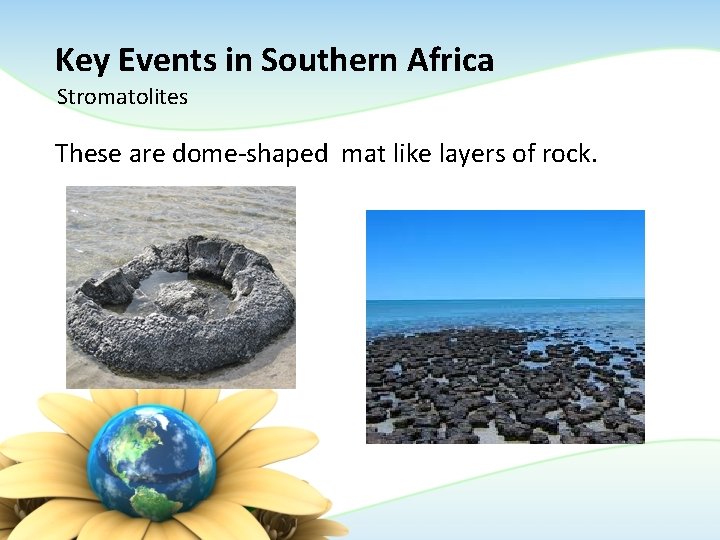
Key Events in Southern Africa Fossil Evidence One of the oldest evidence of life on Earth is found in Barberton in Mpumalanga. These are fossilized photosynthetic bacteria cells. These fossil are about 3400 million years old. The bacteria had jelly like substance around it. Fine rock particles became attached to the jelly like substance, this forces the bacteria to grow upward to search for light. This results in the formation of a structure called stromatolites.
Key Events in Southern Africa Stromatolites These are dome-shaped mat like layers of rock.
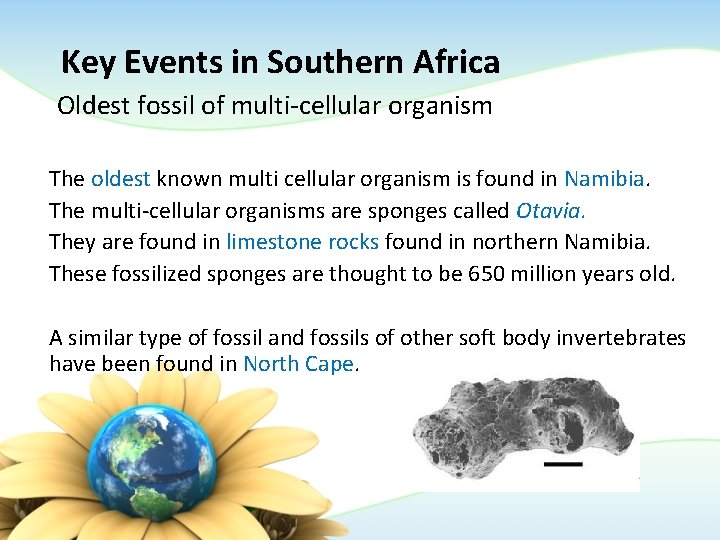
Key Events in Southern Africa Oldest fossil of multi-cellular organism The oldest known multi cellular organism is found in Namibia. The multi-cellular organisms are sponges called Otavia. They are found in limestone rocks found in northern Namibia. These fossilized sponges are thought to be 650 million years old. A similar type of fossil and fossils of other soft body invertebrates have been found in North Cape.
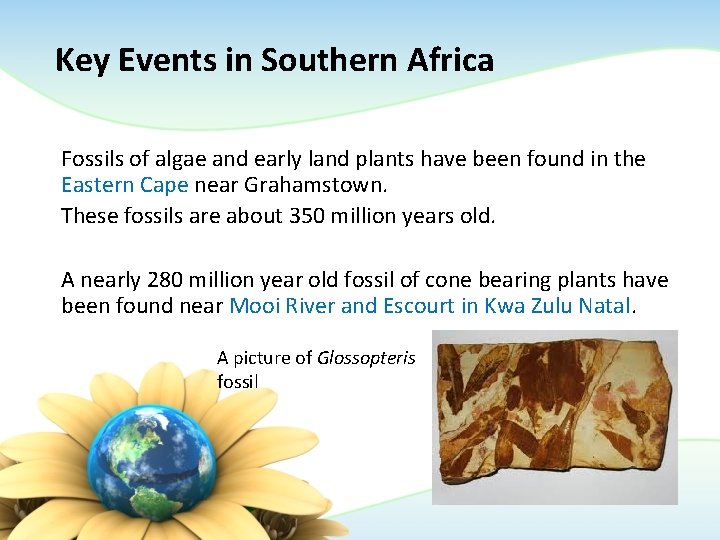
Key Events in Southern Africa Fossils of algae and early land plants have been found in the Eastern Cape near Grahamstown. These fossils are about 350 million years old. A nearly 280 million year old fossil of cone bearing plants have been found near Mooi River and Escourt in Kwa Zulu Natal. A picture of Glossopteris fossil
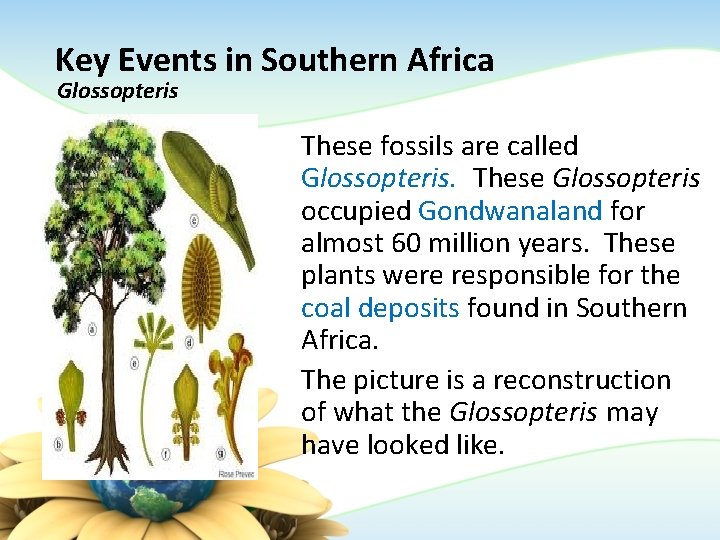
Key Events in Southern Africa Glossopteris These fossils are called Glossopteris. These Glossopteris occupied Gondwanaland for almost 60 million years. These plants were responsible for the coal deposits found in Southern Africa. The picture is a reconstruction of what the Glossopteris may have looked like.
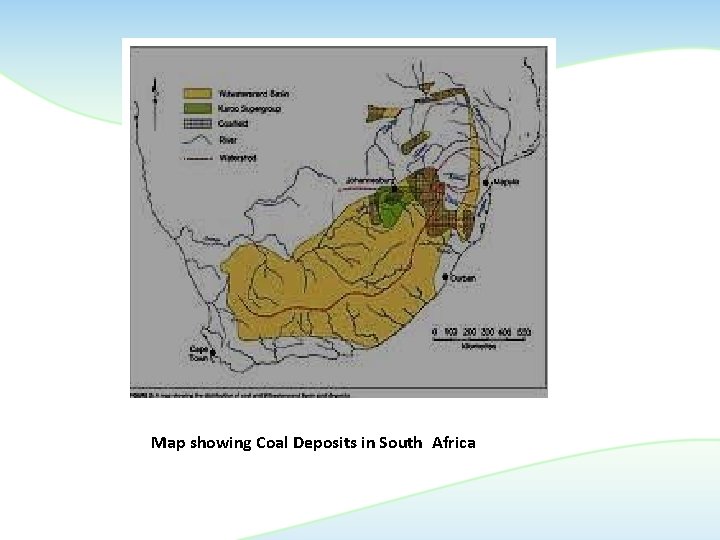
Map showing Coal Deposits in South Africa
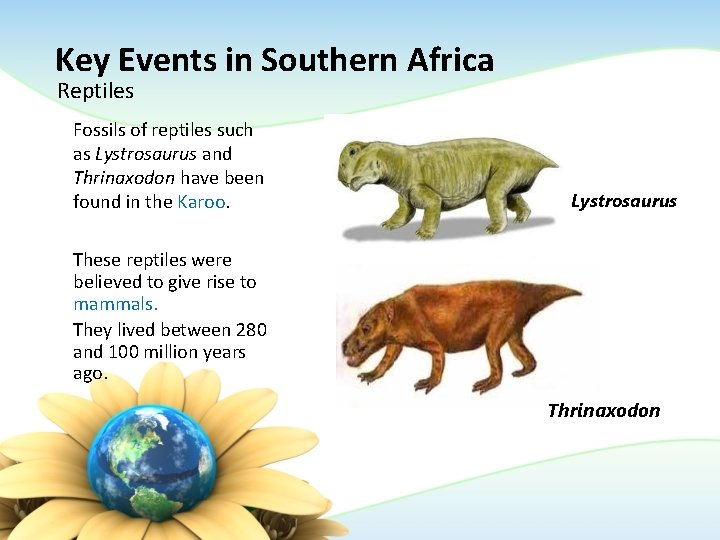
Key Events in Southern Africa Reptiles Fossils of reptiles such as Lystrosaurus and Thrinaxodon have been found in the Karoo. Lystrosaurus These reptiles were believed to give rise to mammals. They lived between 280 and 100 million years ago. Thrinaxodon
Key Events in Southern Africa Dinosaurs lived 210 million years ago in Lesotho, northeastern Free State, Kwa Zulu Natal and the north eastern parts of Eastern Cape. This is supported by findings of fossilized footprints of dinosaurs in these areas. Fossilized dinosaur bones have been found in Maluti and Drakensberg mountain ranges.
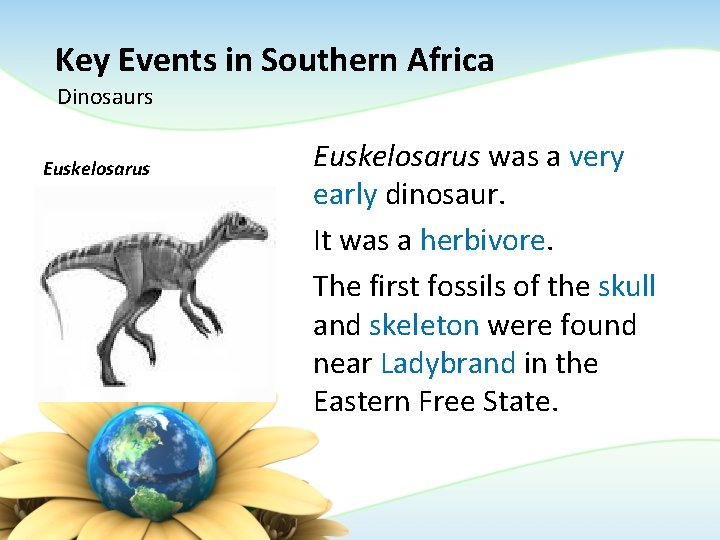
Key Events in Southern Africa Dinosaurs Euskelosarus was a very early dinosaur. It was a herbivore. The first fossils of the skull and skeleton were found near Ladybrand in the Eastern Free State.
Key Events in Southern Africa There is evidence of early mammals in Southern Africa. This is a shrew-sized mammal found in the Eastern Cape Province and Lesotho. The caves of the Cradle of Humankind contains most of the fossil evidence of early humans. Evidence of human existence can also be found in the Free State, Kwa Zulu Natal and Eastern Cape. This evidence is in the form of fossils and artefacts.
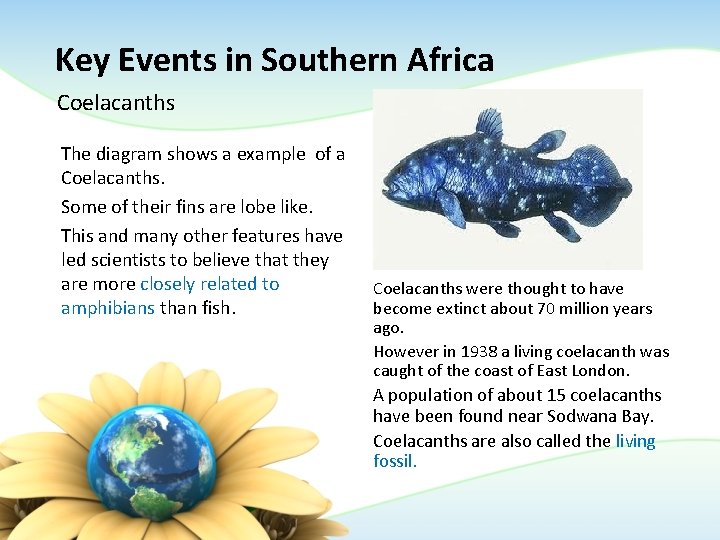
Key Events in Southern Africa Coelacanths The diagram shows a example of a Coelacanths. Some of their fins are lobe like. This and many other features have led scientists to believe that they are more closely related to amphibians than fish. Coelacanths were thought to have become extinct about 70 million years ago. However in 1938 a living coelacanth was caught of the coast of East London. A population of about 15 coelacanths have been found near Sodwana Bay. Coelacanths are also called the living fossil.
Human Impact on Biodiversity and the Natural Environment. Threats to Biodiversity and the Natural Environment Some of the treats are listed below: 1. Habitat destruction 2. Natural disasters 3. Over-exploitation 4. Pollution 5. Pesticides and fertilizers 6. Climate change 7. Alien invasive species 8. Disease
Fossil tourism is a type of ecotourism, but in fossil tourism the main attraction is its fossils. One of the most famous fossils sites is the Cradle of Humankind. The Cradle of Humankind is found in Gauteng and North West Province.
Fossil tourism Cradle of Humankind Found in Sterkfontein, Swartkrans, Kromdraai regions. It is a World Heritage Site since 1999. It is one of the richest source of fossils of early humans. Nearly half of all human-ancestor fossils have been found here.
Fossil tourism West Coast Fossil Park The West Coast Fossil Park is found in the Western Cape Province. It is found along the west coast, a few kilometers inland of the Langebaan Lagoon. This was once a phosphate mine. It has the greatest diversity of five million old fossils. It contained the fossils of the first bear ever found south of the Sahara. Fossils of the extinct true seal and four extinct species of penguins were found here.
Fossil tourism West Coast Fossil Park The many hand on activities at the park that makes it very exciting for the tourist. Tourists can sift in the sand looking for fossils, with the promise that if you find something new ( no one has found) then it will be named after you. Plans have been put into place to start a national fossil and rock art route, that joins the Fossil Park to the Cradle.
Fossil tourism Museums Important fossils have been moved to museums once they have been discovered. The dinosaur fossil found in the Karoo have been moved to the museum in Graaff-Reinet. The museums become important fossil tourist attractions.
Fossil tourism Advantages of Fossil Tourism Fossil tourism: 1. Creates jobs. 2. Generates income for people living in these areas. 3. Creates business opportunities for travel agents and tour operators.
Terminology: Fossils are remains of ancient life forms preserved in rock. Paleontology is the study of fossils. Petrify this means to turn into stone. Imprints are left behind when the organisms start to decay before it becomes petrified. Strata are the in layers in which sedimentary rock pile up. Index fossils are fossils which have occurred in a particular period of time and then can be used to determine the age of other fossils by comparison with them.
Terminology: Amber is the hardened form of liquid sap. Relative dating finds the age of the fossil by comparing it to another fossil or geological event. Radiometric dating tries to find out how long ago a particular fossil was formed. Stromatolites are dome-shaped mat like layers of rock. Fossil tourism is a type of ecotourism, where the main attraction is its fossils.
Something for your to do 1. The solid formed from the hardening of the liquid sap of trees is called… A. B. C. D. Amber Tar Sapped Ice
2. The process of finding out the ages of rocks and fossils using radioactive elements is… A. B. C. D. Relative dating Paleontology Timing Radiometric dating
3. The process of finding out the ages of fossils by comparison with another fossil or rock. A. B. C. D. Relative dating Paleontology Timing Radiometric dating
4. Substances which give of nuclear radiation and decay into other substances are called… A. B. C. D. Relative Radioactive Radiometric Reactive
5. The group name given to the first life forms, which developed on Earth about 3. 8 billion years ago is… A. B. C. D. Coelacanth Glossopteris Photosynthetic bacteria Euskelosaurus
6. The strange looking fish, once thought to be extinct over 70 million years ago. A. B. C. D. Coelacanth Glossopteris Photosynthetic bacteria Euskelosaurus
7. Cone bearing plants that were responsible for the formation of the coal deposits in southern Africa. A. B. C. D. Coelacanth Glossopteris Photosynthetic bacteria Euskelosaurus
8. The skull and skeleton of the Euskelosaurus is found in… A. B. C. D. Ladybrand Barberton Northern Cape Eastern Cape
9. The 359 million year old fossils of algae and early land plants such as club mosses are located in… A. B. C. D. Ladybrand Barberton Northern Cape Eastern Cape
10. Fossilized photosynthetic bacterial cells which are 3 400 million years old are found in… A. B. C. D. Ladybrand Barberton Northern Cape Eastern Cape
11. The fossils of soft bodied invertebrates have been found in… A. B. C. D. Ladybrand Barberton Northern Cape Eastern Cape
12. The fossils of the most primitive mammal like reptiles were found in… A. B. C. D. Maluti Karoo Northern Namibia Western Cape
13. Dinosaur bones were located in… A. B. C. D. Maluti Karoo Northern Namibia Western Cape
14. The world’s richest concentration of fossils occur in… A. B. C. D. Maluti Karoo Northern Namibia Western Cape
15. The fossils of 650 million year old sponges have been found in… A. B. C. D. Maluti Karoo Northern Namibia Western Cape
16. Early dinosaur found in Ladybrand that was a herbivore. A. B. C. D. Lystrosaurus Glossopteris Euskelosaurus Octavia
17. Name given to sponges found in the limestone rocks of northern Namibia 650 million years ago. A. B. C. D. Lystrosaurus Glossopteris Euskelosaurus Octavia
18. A reptile that gave rise to mammals. A. B. C. D. Lystrosaurus Glossopteris Euskelosaurus Octavia
19. Cone bearing plant found in Mooi River nearly 280 million years ago. A. B. C. D. Lystrosaurus Glossopteris Euskelosaurus Octavia
20. World heritage site… A. B. C. D. Cradle of Humankind West Coast Fossil Park Mooi River Durban
Solution: 1. A 2. D 3. A 4. B 5. C 6. A 7. B 8. A 9. D 10. B
Solution: 11 C 12 B 13 A 14 D 15 C 16 C 17 D 18 A 19 B 20 A