
Life sciences Grade 10 CAPS structured clear practical
- Slides: 50
Life sciences Grade 10 CAPS: structured, clear, practical Helping teachers unlock the power of NCS KNOWLEDGE AREA: Diversity, change and continuity Topic 12: History of life on Earth Life’s History: Change throughout the history of life on Earth
CAPS SPECIFIC AIMS 1. Knowing Life Sciences 2. Investigating Phenomena in Life Sciences 3. Appreciating and Understanding the History, Importance and Applications of Life Sciences in Society
Specific Skills Access information Select key ideas Recall information Describe knowledge of NS Build a conceptual framework Organise or reorganise knowledge Write summaries Develop flow charts and mind maps Recognise patterns and trends Apply knowledge in new contexts Use knowledge in a new way Analyse information/data Critically evaluate scientific information Recognise relationships between existing knowledge and new ideas Identify assumptions Categorise information
Change throughout the history of Life. 1 Discussion Item One Changes in the atmosphere 2 Discussion Item Two Changes in Climate 3 Discussion Item Three Geological events 4 Discussion Item Four Biogeography
Changes in the composition of the atmosphere Increase in the Oxygen Levels. It is believed that between 4 to 6 million years ago there was little or no oxygen on earth. The lack of oxygen allowed for the formation of organic molecules. Can you name some organic molecules? Prokaryotes developed about 3. 5 billion years ago. They did not need oxygen for their activities? They undergo anaerobic respiration. Can you explain what this means?
Different types of bacteria began to develop about 3. 5 to 2. 5 billion years ago. These bacteria included the blue-green bacteria. The blue –green bacteria are special because they can photosynthesis. Remember during photosynthesis carbon dioxide is taken in and oxygen is given off. This means that the levels of oxygen increased.
As the levels of oxygen increased more and more oxygen dependent organisms developed. These are organisms that respire aerobically. Can you explain what this means? Scientists believed that a lack of oxygen lead to the development of life, but the presence of oxygen lead to a diversity of organisms. This means that as the oxygen levels on Earth increased, more different types of organisms that needed oxygen for respiration developed.
Cooling of the Earth The Ice Ages The ice ages are described as long periods of time when the earth experienced extreme cold. Four ice ages have been identified since the formation of earth. These four ice ages occurred: a) 700 million years ago b) 320 million years ago c) 286 million years ago d) 3 million years ago ( this is the current ice age. )
Large sheets of ice were formed. These large sheets of ice are called glaciers The process during which these glaciers are formed is called glaciation. The glaciation and the sudden cooling lead to very low temperatures. These temperatures were so low that they did not support life. This lead to the death of many life forms.
Scientists believed that glaciation were caused by a number of factors. Some of these factors are: § the changing positions of continents , § the upward movement of the continent blocks, § the reduction of carbon dioxide in the atmosphere and § the changes in Earth’s orbit.
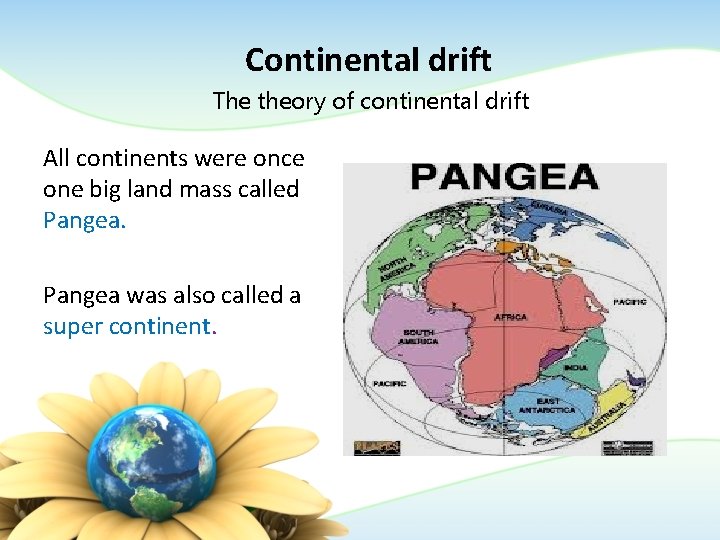
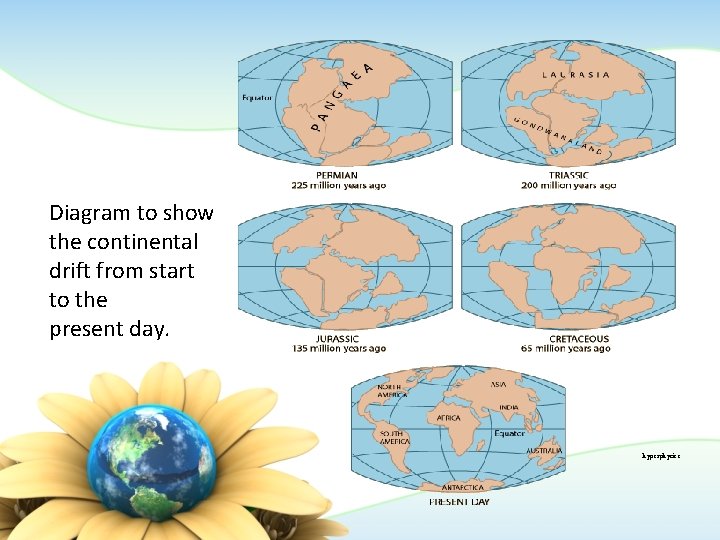
Continental drift The theory of continental drift All continents were once one big land mass called Pangea was also called a super continent.
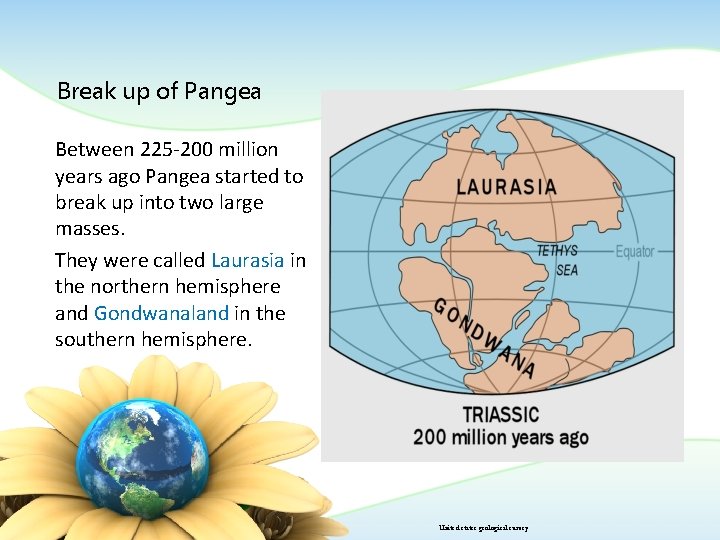
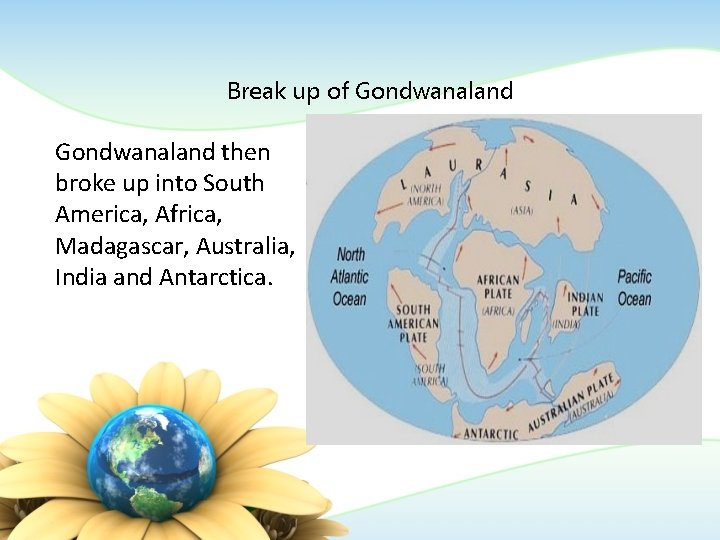
Break up of Pangea Between 225 -200 million years ago Pangea started to break up into two large masses. They were called Laurasia in the northern hemisphere and Gondwanaland in the southern hemisphere. United states geological survey
Break up of Gondwanaland then broke up into South America, Africa, Madagascar, Australia, India and Antarctica.
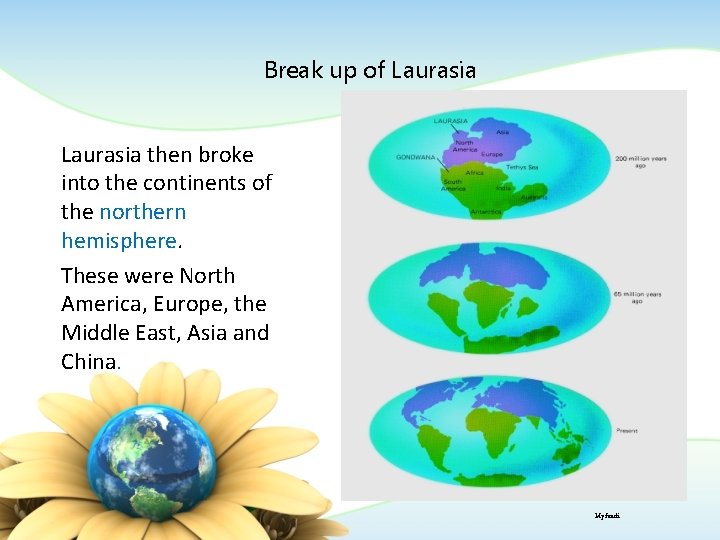
Break up of Laurasia then broke into the continents of the northern hemisphere. These were North America, Europe, the Middle East, Asia and China. Myfundi
Theory of Continental Drift. This theory also says that Antarctica was once close to the Equator. It had a temperate climate, with lush, swampy vegetation. Coal deposits found in Antarctica proved this idea, because these coal deposits came from tropical plants. The land mass underwent rapid cooling has it drifted towards the south pole. This rapid cooling led to the formation of large masses of ice. These masses of ice were called glaciers.
The life forms became extinct due to the lower temperatures. This was extinction on a large scale, called mass extinction. It is believed that the first large scale extinction took place 438 million years ago. This large scale extinction is associated with the rapid glaciation that occurred around that time.
Diagram to show the continental drift from start to the present day. hyperphysics
Evidence from Biogeography can be defined as the past and present distribution of individual species. Similar geological structures and identical plant and animal species in both Africa and South America is used as evidence that these continents were once joined. It is also believed that Madagascar and Africa were once joined because of similarities between some species.
The Theory of Plate Tectonics The theory of plate tectonics arose from theory of continental drift. According to this theory the Earth is made up of large plates that fit together like a jig saw puzzle. There about a dozen of these plates. These plates are able to move apart because they lie on top of hot material.
The Ice Ages The plate movement sometimes cause upward movements of the large continental blocks. It is believed that the continents rose about 600 meters over the past 15 million years. This upward movement caused climate changes which led to the extreme cold of the Ice Ages.
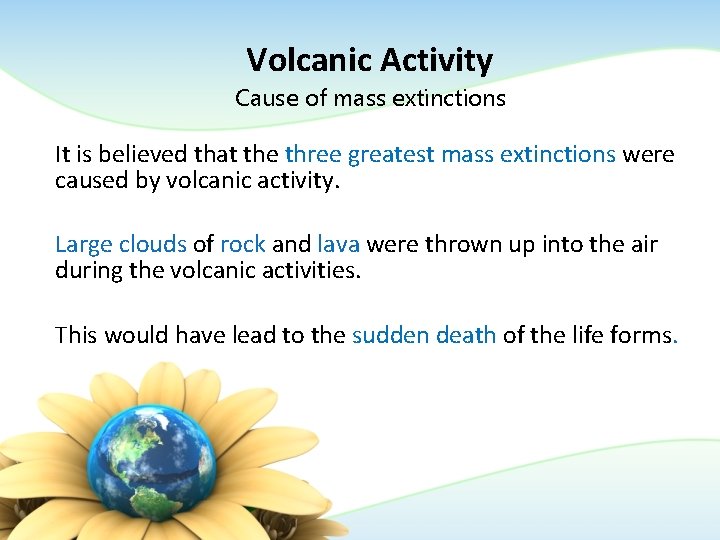
Volcanic Activity Cause of mass extinctions It is believed that the three greatest mass extinctions were caused by volcanic activity. Large clouds of rock and lava were thrown up into the air during the volcanic activities. This would have lead to the sudden death of the life forms.
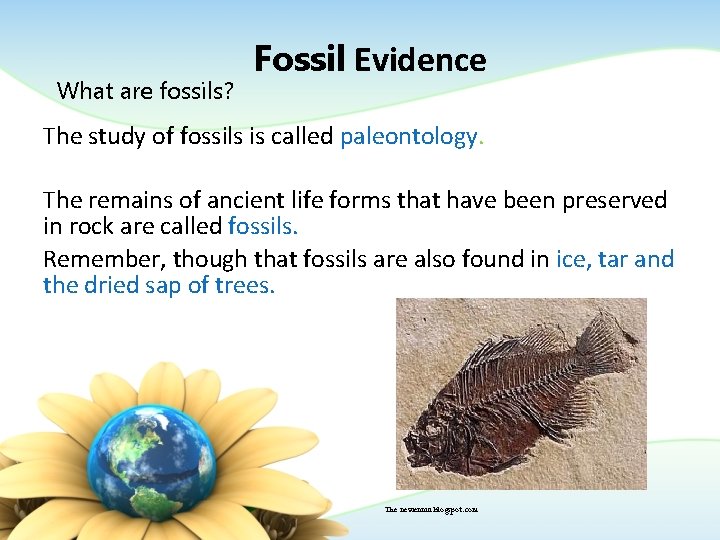
What are fossils? Fossil Evidence The study of fossils is called paleontology. The remains of ancient life forms that have been preserved in rock are called fossils. Remember, though that fossils are also found in ice, tar and the dried sap of trees. The newennui. blogspot. com
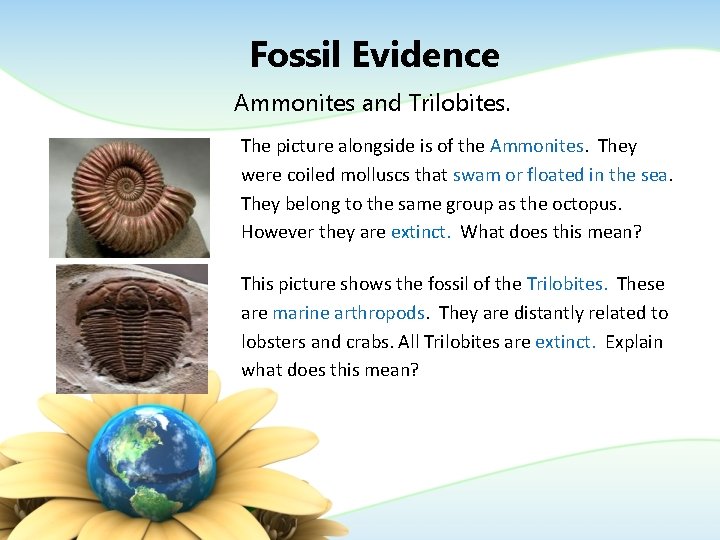
Fossil Evidence Ammonites and Trilobites. The picture alongside is of the Ammonites. They were coiled molluscs that swam or floated in the sea. They belong to the same group as the octopus. However they are extinct. What does this mean? This picture shows the fossil of the Trilobites. These are marine arthropods. They are distantly related to lobsters and crabs. All Trilobites are extinct. Explain what does this mean?
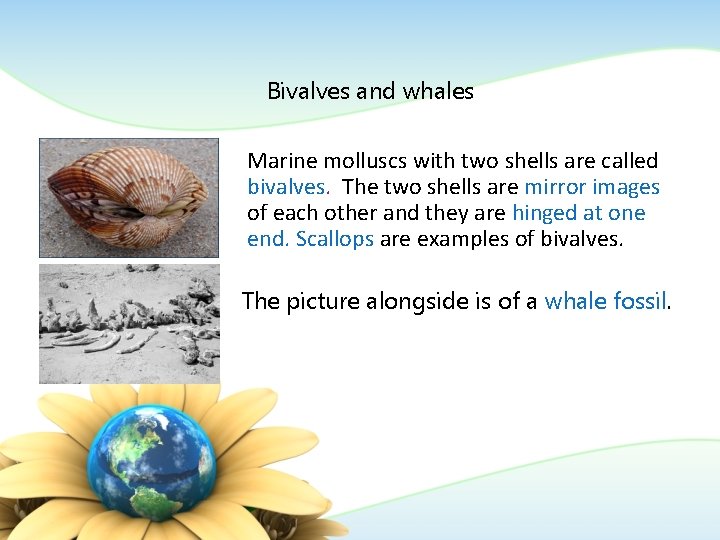
Bivalves and whales Marine molluscs with two shells are called bivalves. The two shells are mirror images of each other and they are hinged at one end. Scallops are examples of bivalves. The picture alongside is of a whale fossil.
Fossil evidence in South Africa. Fossils of bivalves and Ammonites have been found in the Makhatini Flats which are in Kwa Zulu Natal. Trilobite fossils have been found in the Karoo. Whale fossils have been found in the Sarah Desert.
What does the presence of these fossils in these areas mean? Remember that these are marine fossils, meaning that they were found in the oceans. It means that these areas in which these fossils were found were once covered by the ocean. The extinct organisms are no longer alive today and they may look very different from the present day organisms, examples of such extinct organisms are the Ammonites and Trilobites. Since the bivalves are still in existence today and existed millions of years ago it means that some organisms did not change much over millions of years.
Terminology Marine fossils, they were fossils that were found in the oceans Bivalves are marine molluscs with two shells. Trilobites are marine arthropods that are distantly related to lobsters and crabs. Ammonites are extinct coiled molluscs that swam or floated in the sea. Paleontology is the study of fossils. Fossils are the remains of ancient life forms that have been preserved in rock.
The theory of Plate Tectonics states that the Earth is made up of large plates that fit together like a jig saw puzzle. Biogeography can be defined as the past and present distribution of individual species. Extinct when there is no reasonable doubt that the last individual of the species has died. Extinction is the process by which plants or animals die off so that not even one individual member of the entire species exists. Mass extinction was extinction that took place on a large scale.
Glaciation is the process during which these glaciers are formed. Glaciers are large masses of ice. Pangea is the name given to the one big land mass that was made up of all the continents. Laurasia the large continent in the northern hemisphere that arose when Pangea broke up. Gondwanaland was the large continent in the southern hemisphere that was formed when Pangea broke up.
Ice ages are described as long periods of time when the earth experienced extreme cold. Aerobic respiration is respiration that occurs in the presence of oxygen. Anaerobic respiration is respiration that occurs in the absence of oxygen. Prokaryotes are organisms that do not have true nuclei.
Something for you to do: 1. The original land mass that spilt up into two continents is known as: A. B. C. D. Laurasia Pangea Gondwanaland Earth
2. The process of the formation of large sheets of ice is called… A. B. C. D. Glaciation Glaciers Iceation Ice age
3. The theory that suggests that the Earth is made up of large plates that fit together like a jig-saw puzzle… A. B. C. D. Continental drift Mass extinction Theory of Plate Tectonics Paleontology
5. The large continent in the northern hemisphere that arose when Pangea broke up. A. B. C. D. Gondwanaland Laurasia Pangea Earth
6. The marine arthropods that are distantly related to lobsters and crabs are called… A. B. C. D. Bivalves Ammonites Whales Trilobites
7. Type of respiration that occurs in the absence of oxygen is called… A. B. C. D. Aerobic Anaerobic Photosynthesis None of the above
8. The past and present distribution of individual species… A. B. C. D. Biogeography Continental drift Paleontology Ice age
9. The large continent in the southern hemisphere that was formed when Pangea broke up. A. B. C. D. Gondwanaland Laurasia Earth Africa
10. Extinct coiled molluscs that swam or floated in the sea. A. B. C. D. Bivalves Trilobites Whales Ammonites
11. Organisms that do not have true nuclei. A. B. C. D. Eukaryotes Prokaryotes Macro organisms Animals
12. Large masses of ice. A. B. C. D. Glaciers Ice caps Poles Antarctica
13. The remains of ancient life forms that have been preserved in rock. A. B. C. D. Amber Tar Skeleton Fossils
14. Fossils that were found in the oceans A. B. C. D. Marine Aquatic Terrestrial Ocean
15. Respiration that occurs in the presence of oxygen. A. B. C. D. Photosynthesis Respiration Aerobic Anaerobic
16. When there is no reasonable doubt that the last individual of the species has died. A. B. C. D. Extinction Mass extinction None of the above
17. The process by which plants or animals die off so that not even one individual member of the entire species exists. A. B. C. D. Mass extinction Extinct None of the above
18. The study of fossils… A. B. C. D. Paleontology Biogeography Mass extinction Both A and B
19. Fossils of ammonites and bivalves are found in… A. B. C. D. Makhatini Flats Karoo Sarah Namib
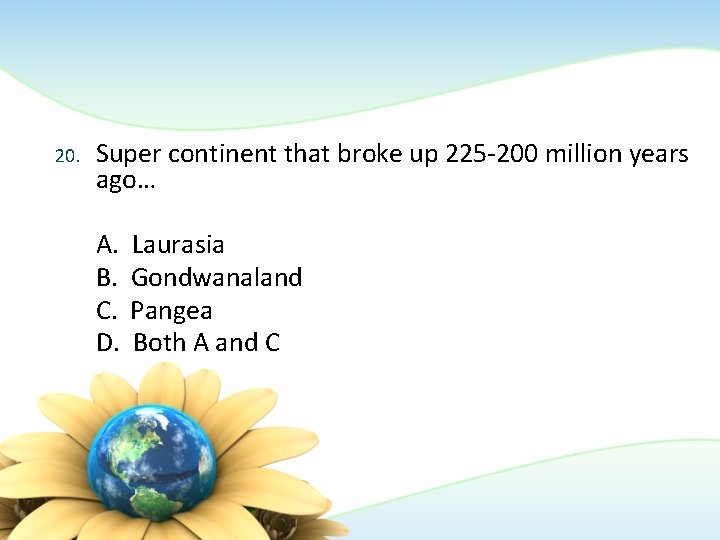
20. Super continent that broke up 225 -200 million years ago… A. B. C. D. Laurasia Gondwanaland Pangea Both A and C
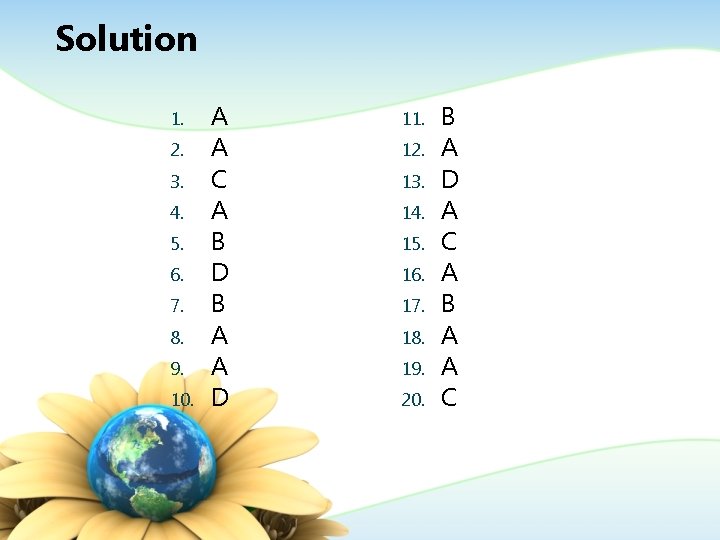
Solution 1. 2. 3. 4. 5. 6. 7. 8. 9. 10. A A C A B D B A A D 11. 12. 13. 14. 15. 16. 17. 18. 19. 20. B A D A C A B A A C