
Life Science Unit 2 Part 1 Inherited Genes


- Slides: 22
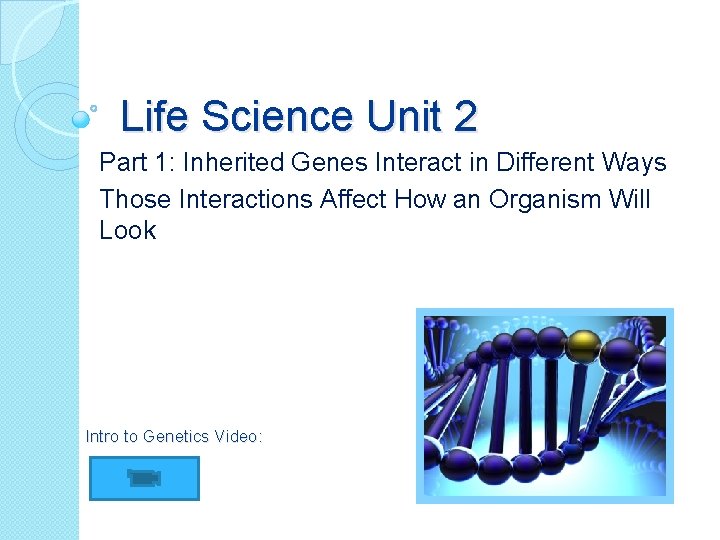
Life Science Unit 2 Part 1: Inherited Genes Interact in Different Ways Those Interactions Affect How an Organism Will Look Intro to Genetics Video:
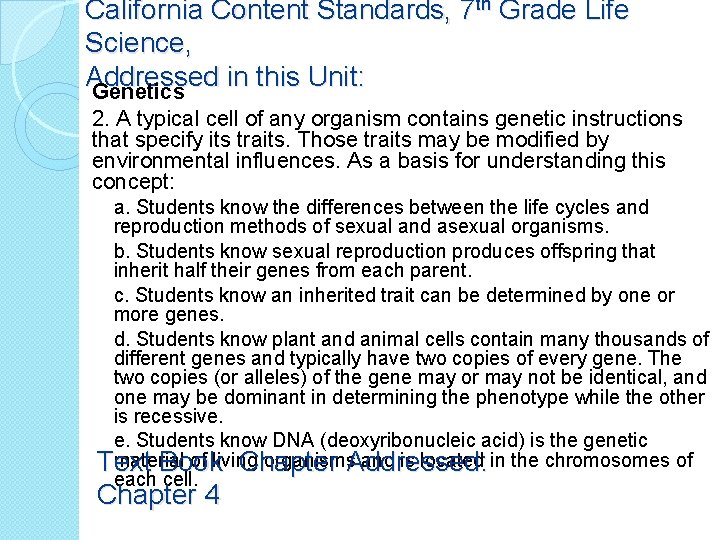
California Content Standards, 7 th Grade Life Science, Addressed in this Unit: Genetics 2. A typical cell of any organism contains genetic instructions that specify its traits. Those traits may be modified by environmental influences. As a basis for understanding this concept: a. Students know the differences between the life cycles and reproduction methods of sexual and asexual organisms. b. Students know sexual reproduction produces offspring that inherit half their genes from each parent. c. Students know an inherited trait can be determined by one or more genes. d. Students know plant and animal cells contain many thousands of different genes and typically have two copies of every gene. The two copies (or alleles) of the gene may or may not be identical, and one may be dominant in determining the phenotype while the other is recessive. e. Students know DNA (deoxyribonucleic acid) is the genetic material of living organisms. Addressed: and is located in the chromosomes of Text Book Chapter each cell. Chapter 4
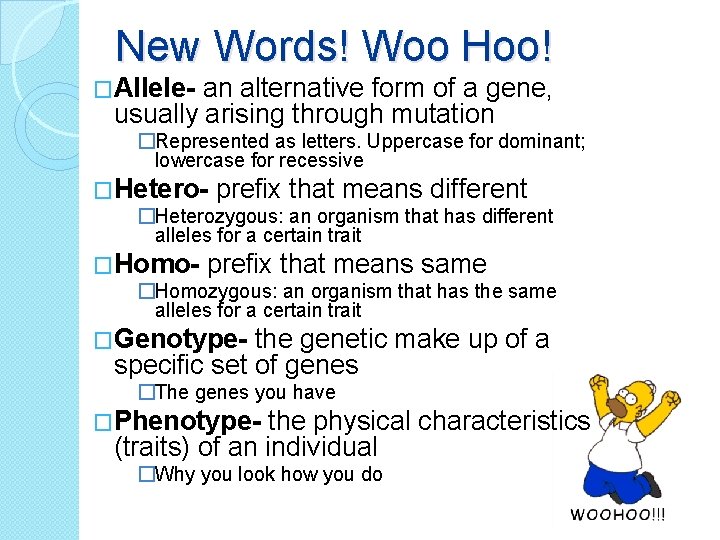
New Words! Woo Hoo! �Allele- an alternative form of a gene, usually arising through mutation �Represented as letters. Uppercase for dominant; lowercase for recessive �Hetero- prefix that means different �Heterozygous: an organism that has different alleles for a certain trait �Homo- prefix that means same �Homozygous: an organism that has the same alleles for a certain trait �Genotype- the genetic make up of a specific set of genes �The genes you have �Phenotype- the physical characteristics (traits) of an individual �Why you look how you do
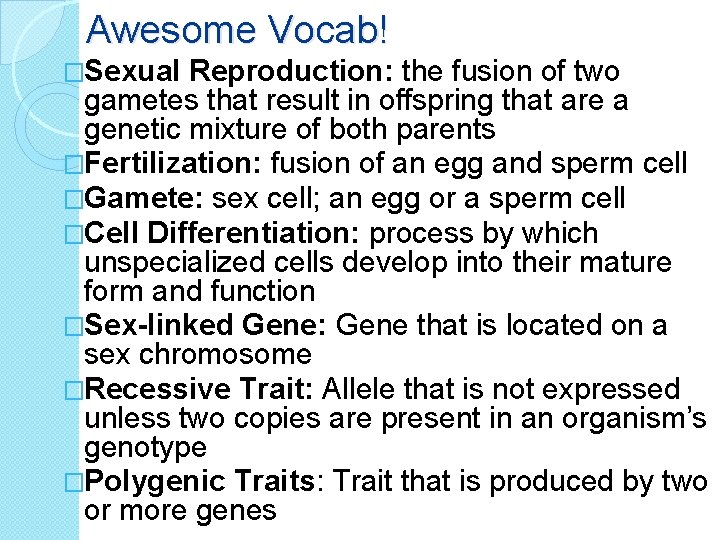
Awesome Vocab! �Sexual Reproduction: the fusion of two gametes that result in offspring that are a genetic mixture of both parents �Fertilization: fusion of an egg and sperm cell �Gamete: sex cell; an egg or a sperm cell �Cell Differentiation: process by which unspecialized cells develop into their mature form and function �Sex-linked Gene: Gene that is located on a sex chromosome �Recessive Trait: Allele that is not expressed unless two copies are present in an organism’s genotype �Polygenic Traits: Trait that is produced by two or more genes
Awesome Vocab! �Homologous Chromosomes: two chromosomes (one inherited from the mother, one from the father) that have the same length and general appearance �Trait: Characteristic that is inherited �Genome: All of an organism’s genetic material �Heterozygous: Characteristic of having two different alleles that appear at the same locus of sister chromatids �Monohybrid Cross: Cross, or mating, between organisms that involves only one pair of contrasting traits �Dihybrid Cross: Cross, or mating, between organisms involving two pairs of contrasting traits
Awesome Vocab! �Pedigree Chart: Chart of the phenotypes and genotypes in a family that is used to determine whether an individual is a carrier of a recessive allele �Law of Segregation: Mendel’s first law, stating that: (1) organisms inherit two copies of genes, one from each parent, and (2) organisms donate only one copy of each gene in their gametes because the genes separate during gamete formation �Test Cross: Cross between an organism with an unknown genotype and an organism with a
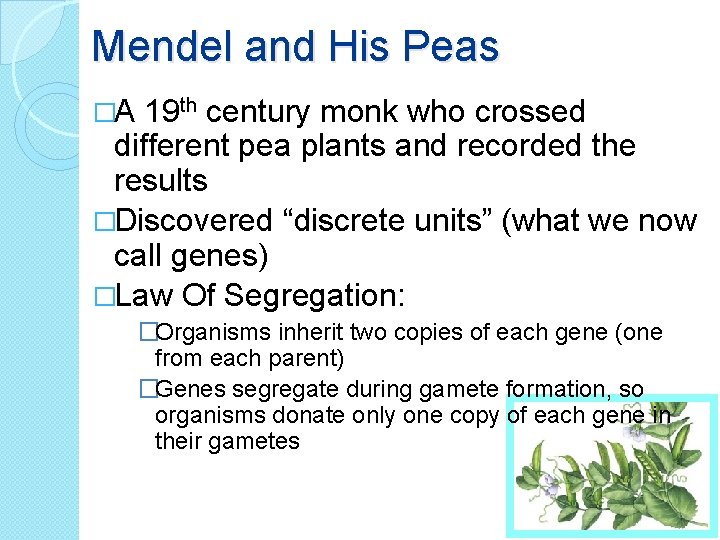
Mendel and His Peas �A 19 th century monk who crossed different pea plants and recorded the results �Discovered “discrete units” (what we now call genes) �Law Of Segregation: �Organisms inherit two copies of each gene (one from each parent) �Genes segregate during gamete formation, so organisms donate only one copy of each gene in their gametes
Understanding Probability and Genetics Allows for Predicting Inheritance Punnett Squares examine gene probability by looking at dominant and recessive
Genetic Testing: It’s no longer science fiction– it’s science fact!
Ethics: What do you think?
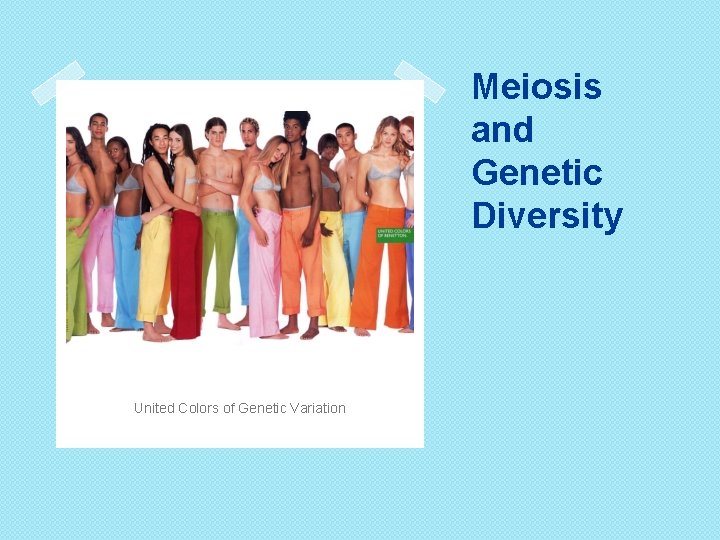
Meiosis and Genetic Diversity United Colors of Genetic Variation
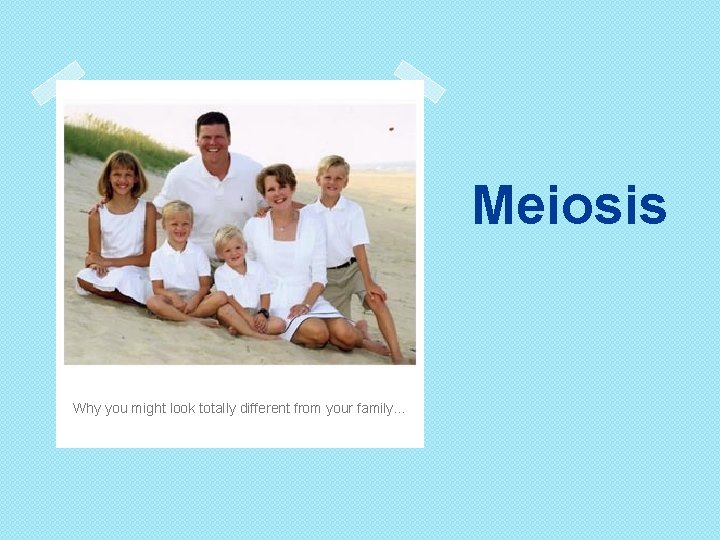
Meiosis Why you might look totally different from your family…
Meiosis Makes Sex Cells Sexual Reproduction: two gametes fuse which results in an offspring with a genetic mixture of both parents
Why? What? How? Why: Unique genetic combinations result in organisms with unique phenotypes, which increases the likelihood that some will survive under changing conditions What: An independent assortment of chromosomes, random fertilization, crossing over, and Mendel’s law of independent assortment contribute to genetic diversity (and similarities) How: During meiosis chromosome segments cross over. Gametes with approx. 8 million different combinations of chromosomes can be produced from one human cell.
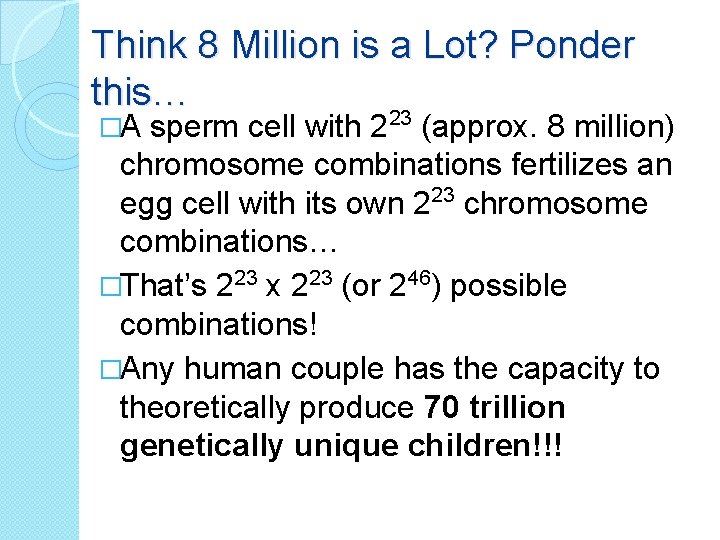
Think 8 Million is a Lot? Ponder this… 23 �A sperm cell with 2 (approx. 8 million) chromosome combinations fertilizes an egg cell with its own 223 chromosome combinations… �That’s 223 x 223 (or 246) possible combinations! �Any human couple has the capacity to theoretically produce 70 trillion genetically unique children!!!
LET’S TALK ABOUT SEX … LINKED TRAITS
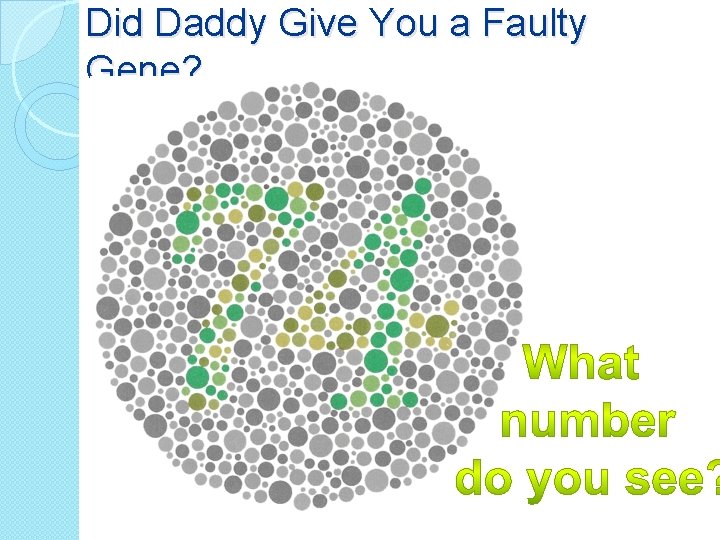
Did Daddy Give You a Faulty Gene?
How Sex Linked Traits Work
Let’s Practice!
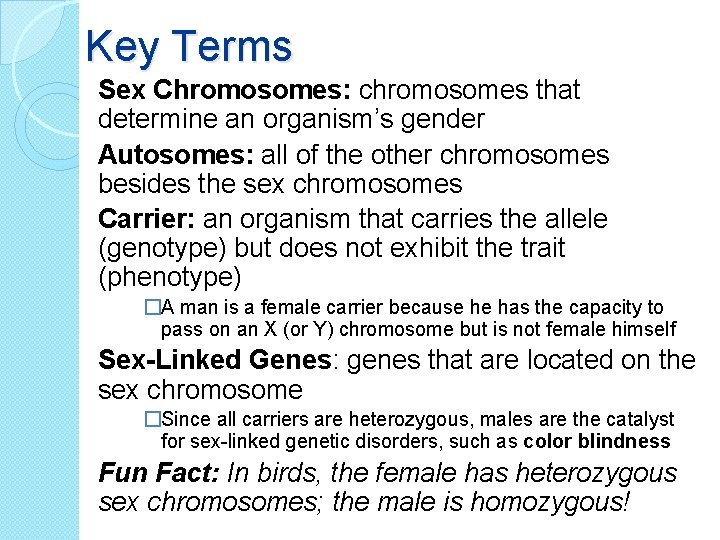
Key Terms Sex Chromosomes: chromosomes that determine an organism’s gender Autosomes: all of the other chromosomes besides the sex chromosomes Carrier: an organism that carries the allele (genotype) but does not exhibit the trait (phenotype) �A man is a female carrier because he has the capacity to pass on an X (or Y) chromosome but is not female himself Sex-Linked Genes: genes that are located on the sex chromosome �Since all carriers are heterozygous, males are the catalyst for sex-linked genetic disorders, such as color blindness Fun Fact: In birds, the female has heterozygous sex chromosomes; the male is homozygous!
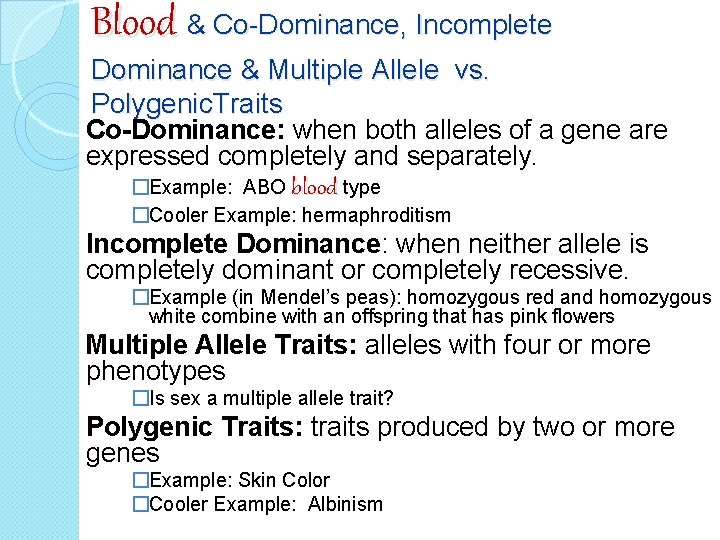
Blood & Co-Dominance, Incomplete Dominance & Multiple Allele vs. Polygenic. Traits Co-Dominance: when both alleles of a gene are expressed completely and separately. �Example: ABO blood type �Cooler Example: hermaphroditism Incomplete Dominance: when neither allele is completely dominant or completely recessive. �Example (in Mendel’s peas): homozygous red and homozygous white combine with an offspring that has pink flowers Multiple Allele Traits: alleles with four or more phenotypes �Is sex a multiple allele trait? Polygenic Traits: traits produced by two or more genes �Example: Skin Color �Cooler Example: Albinism