
LIFE SAFETY BUREAU Risk Based Inspection Program December

LIFE SAFETY BUREAU Risk Based Inspection Program December 5, 2017
2 HISTORIAL INSPECTION CHALLENGES • Legacy inspection application, ILMS, is difficult to use with limited reporting capabilities • Teams worked individual property lists that were not validated against a master list • LSB did not know when new businesses started or certificates of occupancy changed • Conduction of general inspections was random and coverage of several property types was poor • No consistent or measurable definition of property risk • Blitzes were used to respond to perceived changes in risk – creating inefficiency and confusion
3 RISK BASED INSPECTION GOALS • Develop a strategic plan for commercial property inspection • Create a consolidated data base of all occupancies required to be inspected on a periodic schedule • Apply standard set of risk factor criteria to each occupancy to establish a risk score for each • Establish a periodic inspection cycle, varying from 1 - 5 years, for each occupancy based on the associated risk score • Process established to add new occupancies into the periodic inspection cycle
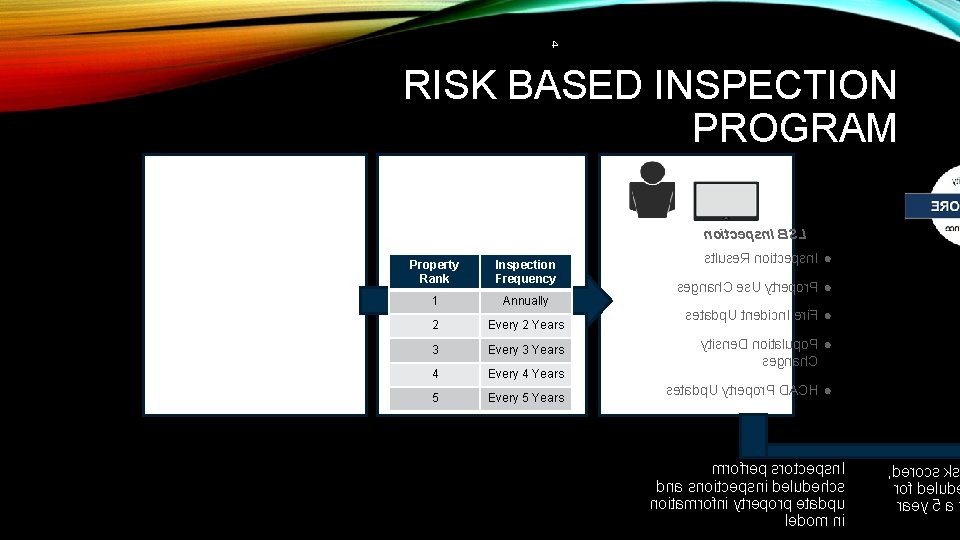
4 RISK BASED INSPECTION PROGRAM noitcepsn. I BSL Property Rank Inspection Frequency 1 Annually 2 Every 2 Years 3 Every 3 Years 4 Every 4 Years 5 Every 5 Years stluse. R noitcepsn. I ● segnah. C es. U ytrepor. P ● setadp. U tnedicn. I eri. F ● ytisne. D noitalupo. P ● segnah. C setadp. U ytrepor. P DACH ● mrofrep srotcepsn. I dna snoitcepsni deludehcs noitamrofni ytreporp etadpu ledom ni , derocs k rof delud raey 5 a
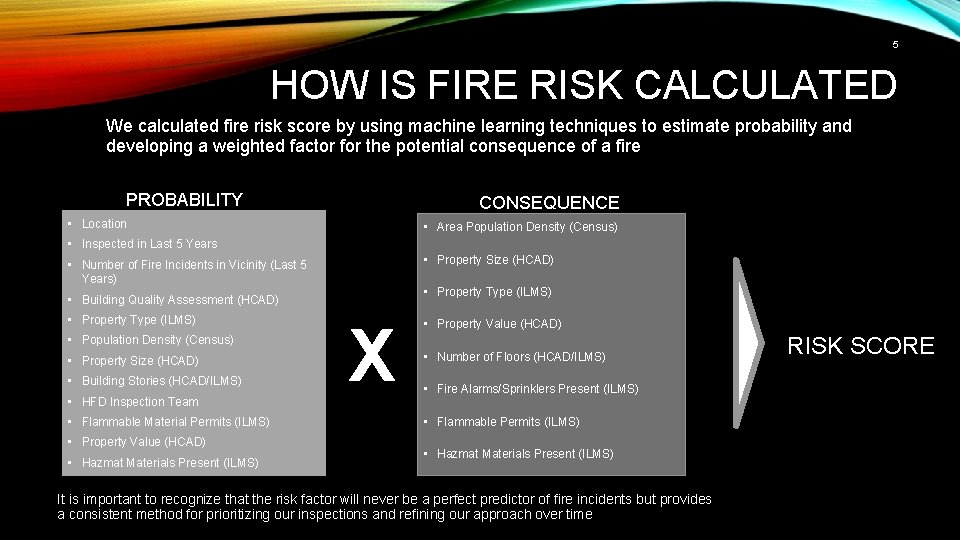
5 HOW IS FIRE RISK CALCULATED We calculated fire risk score by using machine learning techniques to estimate probability and developing a weighted factor for the potential consequence of a fire PROBABILITY CONSEQUENCE • Location • Area Population Density (Census) • Inspected in Last 5 Years • Property Size (HCAD) • Number of Fire Incidents in Vicinity (Last 5 Years) • Property Type (ILMS) • Building Quality Assessment (HCAD) • Property Type (ILMS) • Population Density (Census) • Property Size (HCAD) • Building Stories (HCAD/ILMS) • HFD Inspection Team • Flammable Material Permits (ILMS) • Property Value (HCAD) • Hazmat Materials Present (ILMS) X • Property Value (HCAD) • Number of Floors (HCAD/ILMS) • Fire Alarms/Sprinklers Present (ILMS) • Flammable Permits (ILMS) • Hazmat Materials Present (ILMS) It is important to recognize that the risk factor will never be a perfect predictor of fire incidents but provides a consistent method for prioritizing our inspections and refining our approach over time RISK SCORE
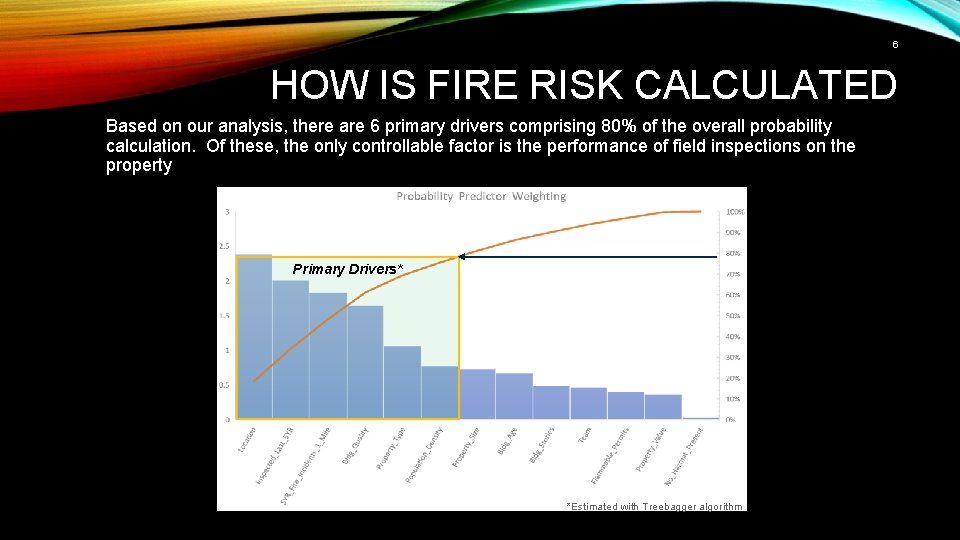
6 HOW IS FIRE RISK CALCULATED Based on our analysis, there are 6 primary drivers comprising 80% of the overall probability calculation. Of these, the only controllable factor is the performance of field inspections on the property Primary Drivers* *Estimated with Treebagger algorithm
7 RISK MODEL ACCURACY AND COMPLETENESS CHALLENGES • Source systems had incomplete information on properties (e. g. missing Fixed Property Use codes) • Some of the identified addresses may no longer exist • Residential properties might have been misclassified as commercial • Some properties may have multiple addresses associated with a single business
8 CURRENT STATUS OF OCCUPANCIES IN CITY OF HOUSTON • 74, 604 Occupancies in consolidated data base requiring periodic inspection • • • Risk Priority 1 – 9, 308 occupancies Risk Priority 2 – 14, 956 occupancies Risk Priority 3 – 14, 941 occupancies Risk Priority 4 – 14, 599 occupancies Risk Priority 5 – 20, 800 occupancies
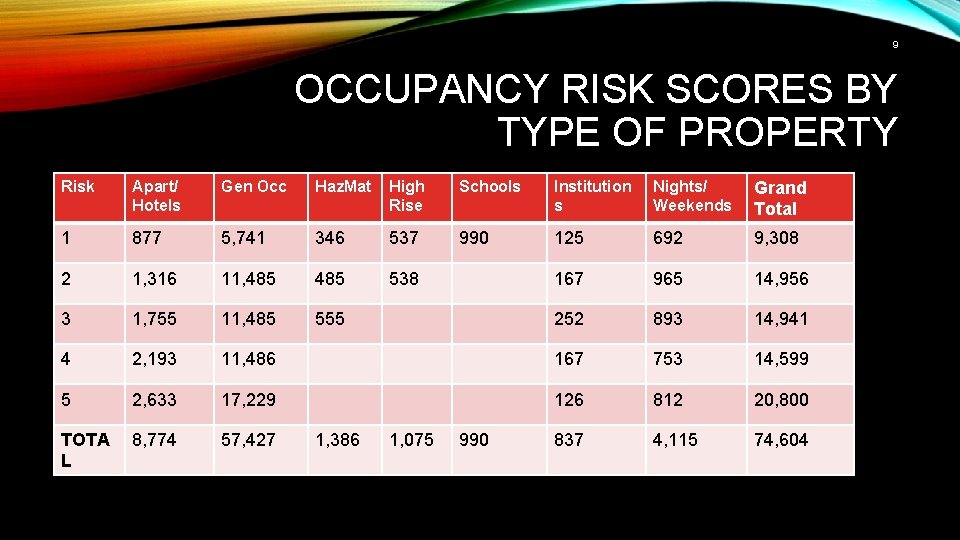
9 OCCUPANCY RISK SCORES BY TYPE OF PROPERTY Risk Apart/ Hotels Gen Occ Haz. Mat High Rise Schools Institution s Nights/ Weekends Grand Total 1 877 5, 741 346 537 990 125 692 9, 308 2 1, 316 11, 485 538 167 965 14, 956 3 1, 755 11, 485 555 252 893 14, 941 4 2, 193 11, 486 167 753 14, 599 5 2, 633 17, 229 126 812 20, 800 TOTA L 8, 774 57, 427 837 4, 115 74, 604 1, 386 1, 075 990
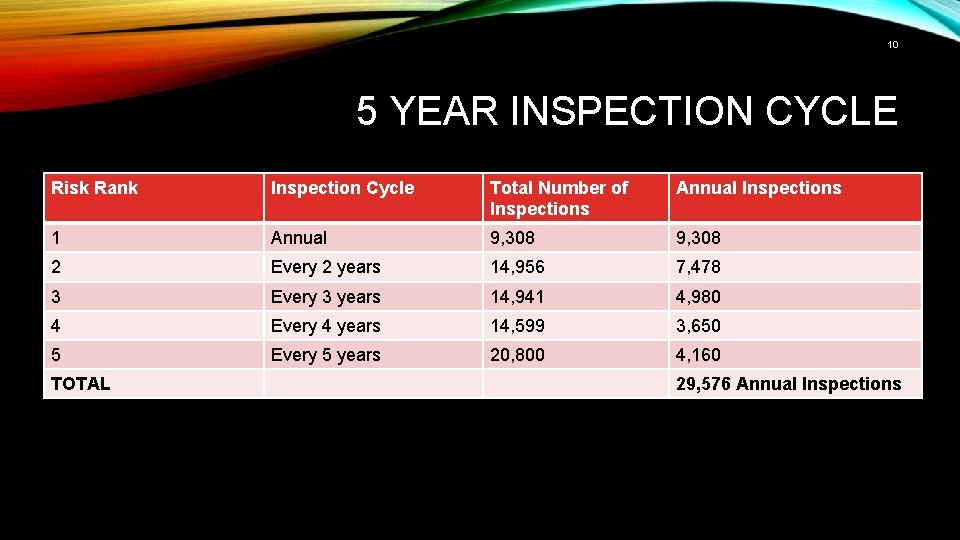
10 5 YEAR INSPECTION CYCLE Risk Rank Inspection Cycle Total Number of Inspections Annual Inspections 1 Annual 9, 308 2 Every 2 years 14, 956 7, 478 3 Every 3 years 14, 941 4, 980 4 Every 4 years 14, 599 3, 650 5 Every 5 years 20, 800 4, 160 TOTAL 29, 576 Annual Inspections
ADVANTAGES • Increases public safety • Increases safety for first responders • Alvarez & Marsal estimate additional $10 M in revenue over 5 -year period by utilizing RBI model • This assumes inspection of all properties • Much of this revenue will be realized by inspecting the low risk General Occupancy properties
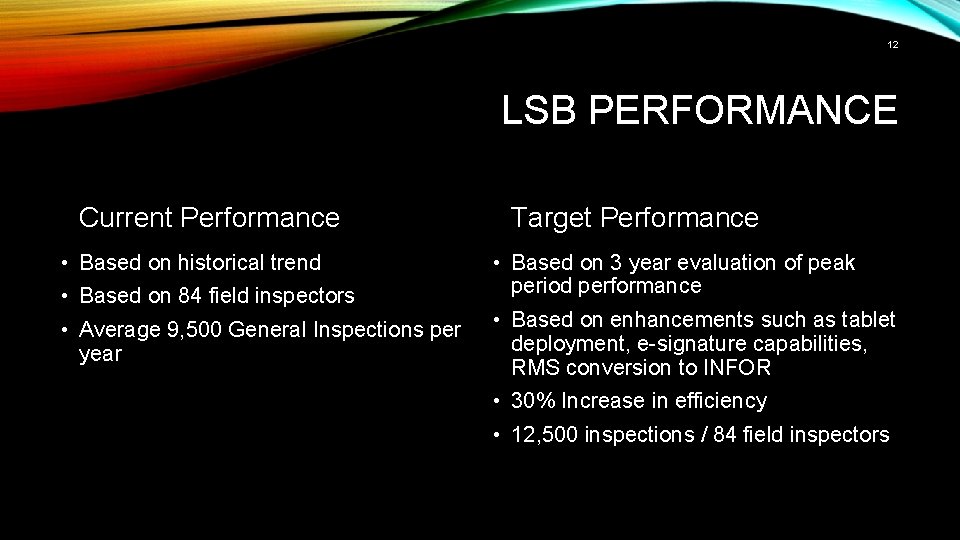
12 LSB PERFORMANCE Current Performance • Based on historical trend • Based on 84 field inspectors • Average 9, 500 General Inspections per year Target Performance • Based on 3 year evaluation of peak period performance • Based on enhancements such as tablet deployment, e-signature capabilities, RMS conversion to INFOR • 30% Increase in efficiency • 12, 500 inspections / 84 field inspectors
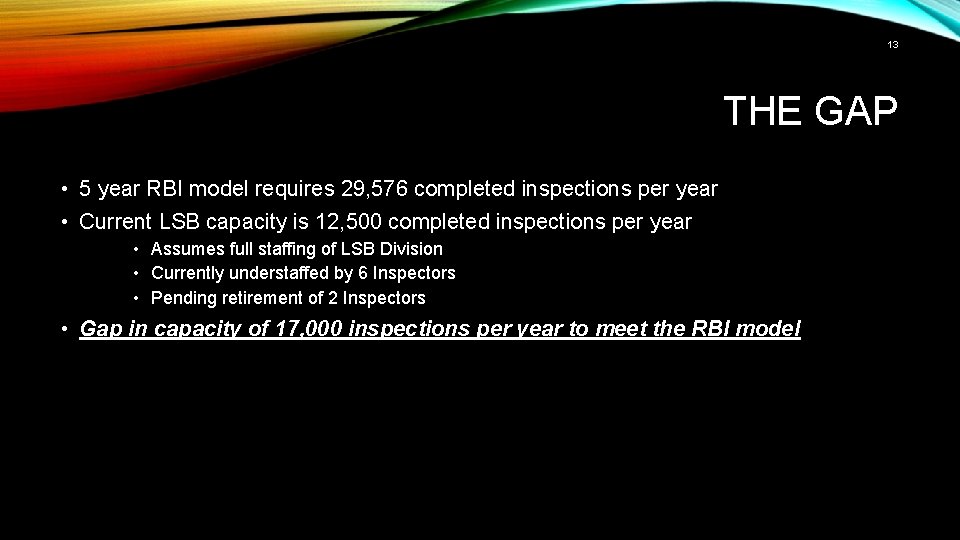
13 THE GAP • 5 year RBI model requires 29, 576 completed inspections per year • Current LSB capacity is 12, 500 completed inspections per year • Assumes full staffing of LSB Division • Currently understaffed by 6 Inspectors • Pending retirement of 2 Inspectors • Gap in capacity of 17, 000 inspections per year to meet the RBI model
14 OPTIONS FOR FILLING THE GAP • Increased efficiency of existing personnel • Technical improvements have been implemented • Transition to Infor within 18 months • Increasing community risk by extending the inspection cycle beyond 5 years • Increasing the number of personnel to perform all inspections • Increasing overtime for existing inspectors to perform inspections
- Slides: 14