
Life Orientation Life Skills NQF 4 Life Orientation
- Slides: 28
Life Orientation: Life Skills NQF 4 Life Orientation NQF Level 4
Apply advanced cognitive skills & strategies in various contexts Module 5 *see terms and conditions
Think about it… • What are the dangers of making decisions based on your feelings only? • Can a person develop thinking skills? • What does it mean to think logically?
Unit 5. 1 Logical reasoning & argument skills Life Orientation NQF Level 4
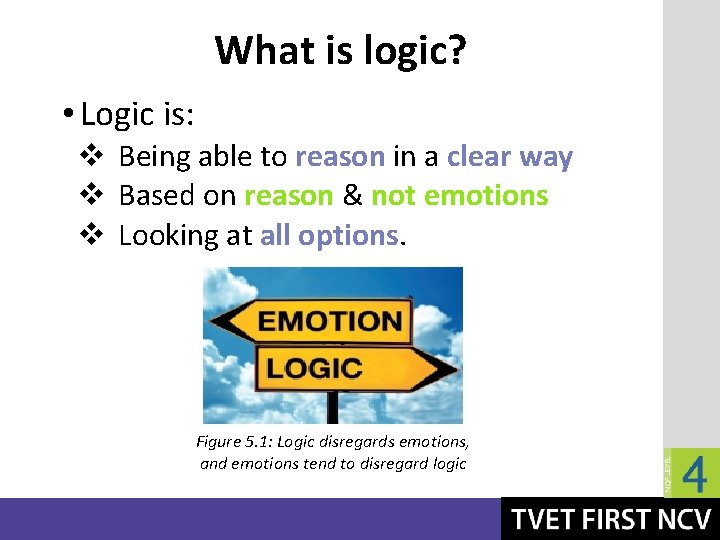
What is logic? • Logic is: v Being able to reason in a clear way v Based on reason & not emotions v Looking at all options. Figure 5. 1: Logic disregards emotions, and emotions tend to disregard logic
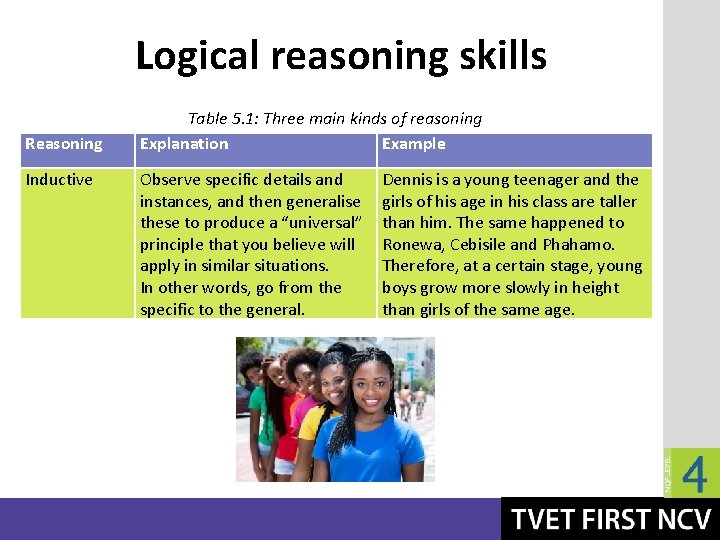
Logical reasoning skills Reasoning Inductive Table 5. 1: Three main kinds of reasoning Explanation Example Observe specific details and instances, and then generalise these to produce a “universal” principle that you believe will apply in similar situations. In other words, go from the specific to the general. Dennis is a young teenager and the girls of his age in his class are taller than him. The same happened to Ronewa, Cebisile and Phahamo. Therefore, at a certain stage, young boys grow more slowly in height than girls of the same age.
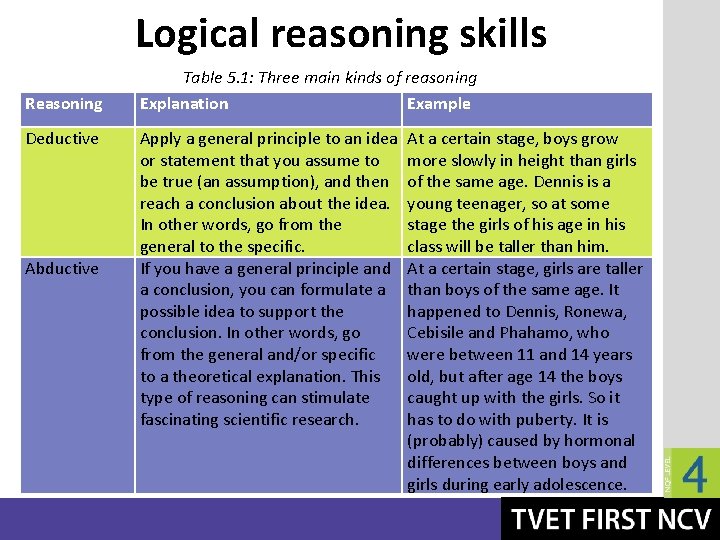
Logical reasoning skills Reasoning Deductive Abductive Table 5. 1: Three main kinds of reasoning Explanation Example Apply a general principle to an idea or statement that you assume to be true (an assumption), and then reach a conclusion about the idea. In other words, go from the general to the specific. If you have a general principle and a conclusion, you can formulate a possible idea to support the conclusion. In other words, go from the general and/or specific to a theoretical explanation. This type of reasoning can stimulate fascinating scientific research. At a certain stage, boys grow more slowly in height than girls of the same age. Dennis is a young teenager, so at some stage the girls of his age in his class will be taller than him. At a certain stage, girls are taller than boys of the same age. It happened to Dennis, Ronewa, Cebisile and Phahamo, who were between 11 and 14 years old, but after age 14 the boys caught up with the girls. So it has to do with puberty. It is (probably) caused by hormonal differences between boys and girls during early adolescence.
Module 5 Learning activity 5. 1 Test your knowledge of this section by completing Learning activity 5. 1 in your Student’s Book. Life Orientation NQF Level 4
Module 5 Learning activity 5. 2 Test your knowledge of this section by completing Learning activity 5. 2 in your Student’s Book. Life Orientation NQF Level 4
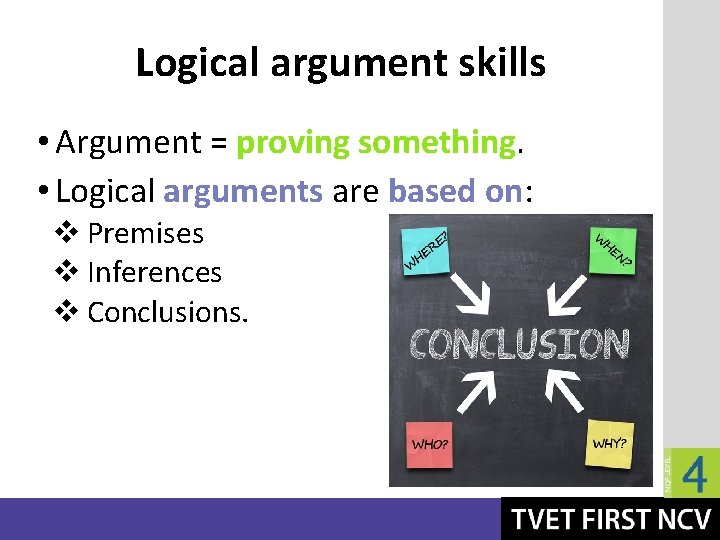
Logical argument skills • Argument = proving something. • Logical arguments are based on: v Premises v Inferences v Conclusions.
Premises • Premise = statement about something. • Arguments need to be based on premises. • If premises are false, the conclusion will be untrue. • Tentative premises need more investigation.
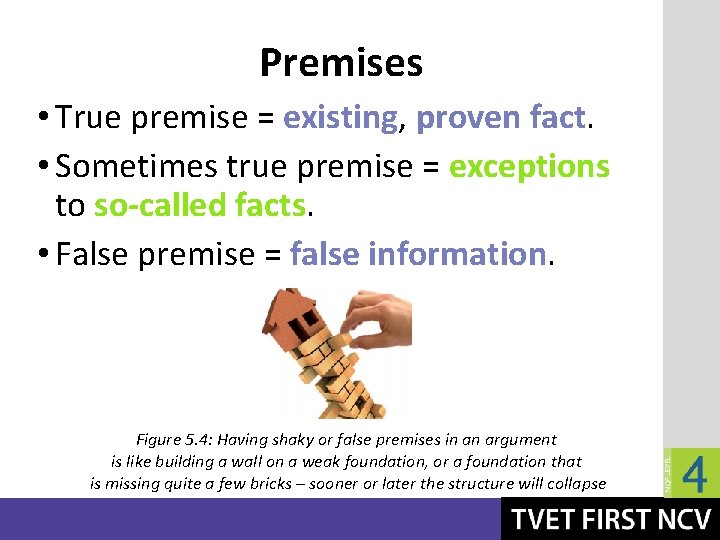
Premises • True premise = existing, proven fact. • Sometimes true premise = exceptions to so-called facts. • False premise = false information. Figure 5. 4: Having shaky or false premises in an argument is like building a wall on a weak foundation, or a foundation that is missing quite a few bricks – sooner or later the structure will collapse
Module 5 Learning activity 5. 3 Test your knowledge of this section by completing Learning activity 5. 3 in your Student’s Book. Life Orientation NQF Level 4
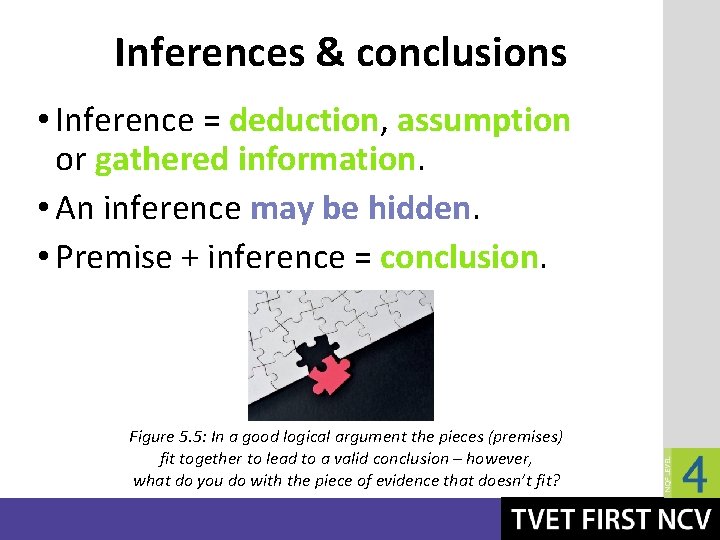
Inferences & conclusions • Inference = deduction, assumption or gathered information. • An inference may be hidden. • Premise + inference = conclusion. Figure 5. 5: In a good logical argument the pieces (premises) fit together to lead to a valid conclusion – however, what do you do with the piece of evidence that doesn’t fit?
Module 5 Learning activity 5. 4 Test your knowledge of this section by completing Learning activity 5. 4 in your Student’s Book. Life Orientation NQF Level 4
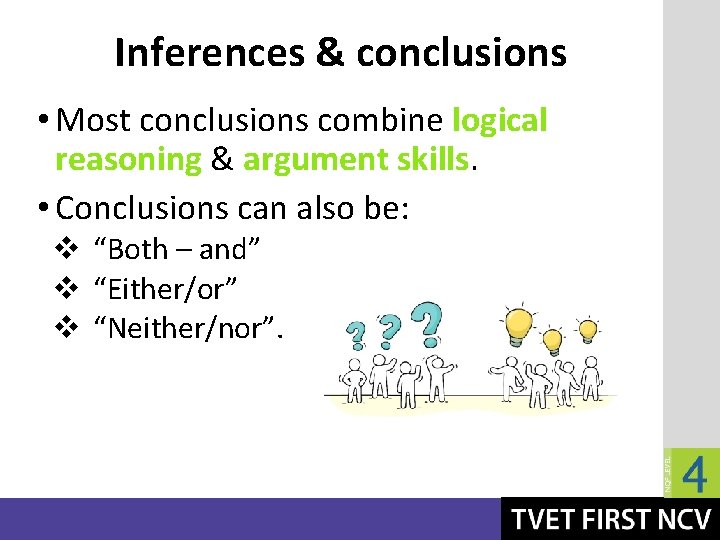
Inferences & conclusions • Most conclusions combine logical reasoning & argument skills. • Conclusions can also be: v “Both – and” v “Either/or” v “Neither/nor”.
Module 5 Learning activity 5. 5 Test your knowledge of this section by completing Learning activity 5. 5 in your Student’s Book. Life Orientation NQF Level 4
Module 5 Learning activity 5. 6 Test your knowledge of this section – and practise your logical reasoning and argument skills – by completing Learning activity 5. 6 in your Student’s Book. Life Orientation NQF Level 4
Unit 5. 2 Reflective thinking – strategies & techniques Life Orientation NQF Level 4
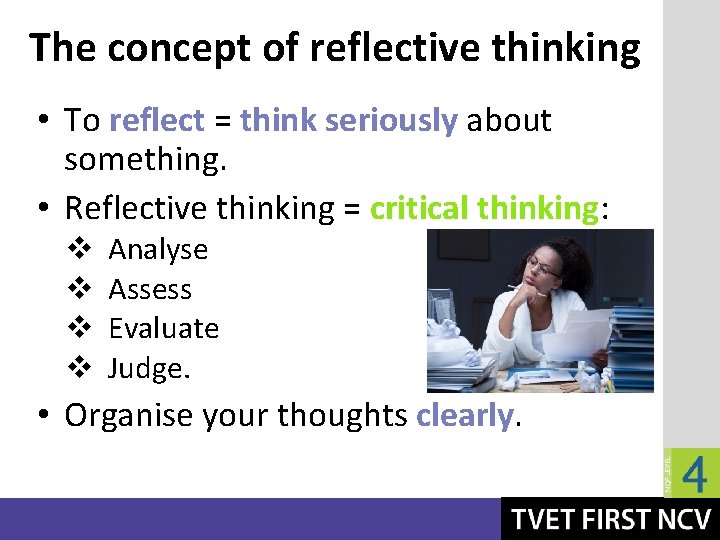
The concept of reflective thinking • To reflect = think seriously about something. • Reflective thinking = critical thinking: v v Analyse Assess Evaluate Judge. • Organise your thoughts clearly.
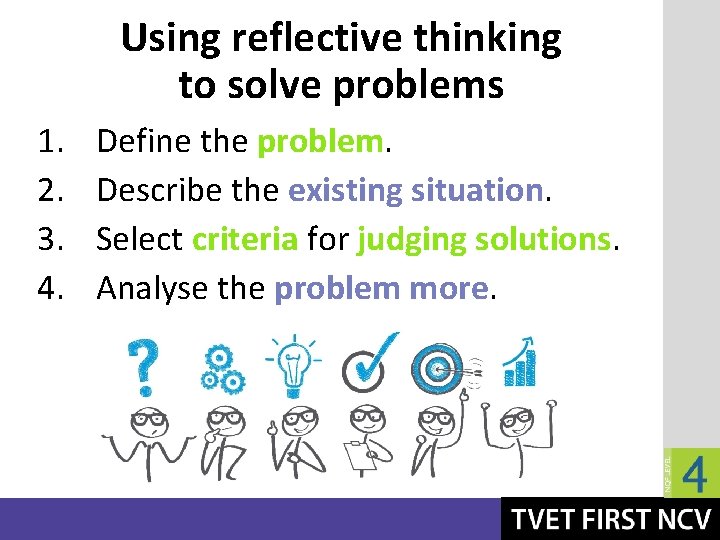
Using reflective thinking to solve problems 1. 2. 3. 4. Define the problem. Describe the existing situation. Select criteria for judging solutions. Analyse the problem more.
Using reflective thinking to solve problems 5. Make the problem as specific as possible. 6. Think of things you haven’t considered. 7. Suggest solutions. 8. Select the best solution. 9. Decide how to apply the solution. 10. Evaluate whether the problem will be solved well.
Module 5 Learning activity 5. 7 Test your knowledge of this section by completing Learning activity 5. 7 in your Student’s Book. Life Orientation NQF Level 4
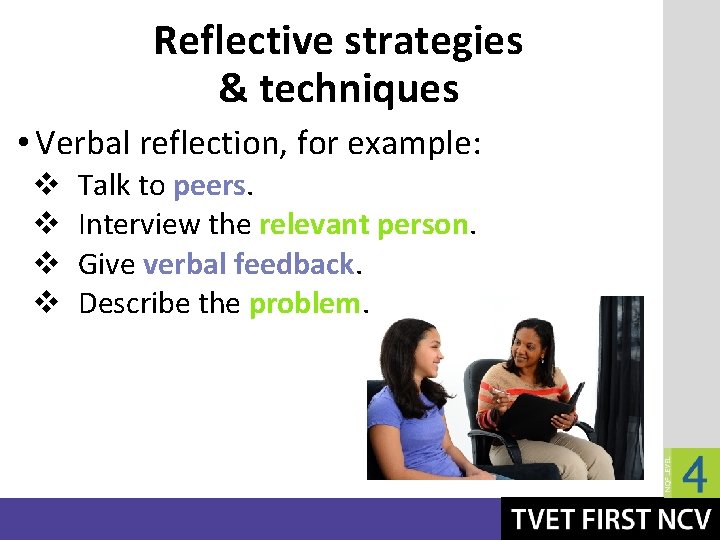
Reflective strategies & techniques • Verbal reflection, for example: v v Talk to peers. Interview the relevant person. Give verbal feedback. Describe the problem.
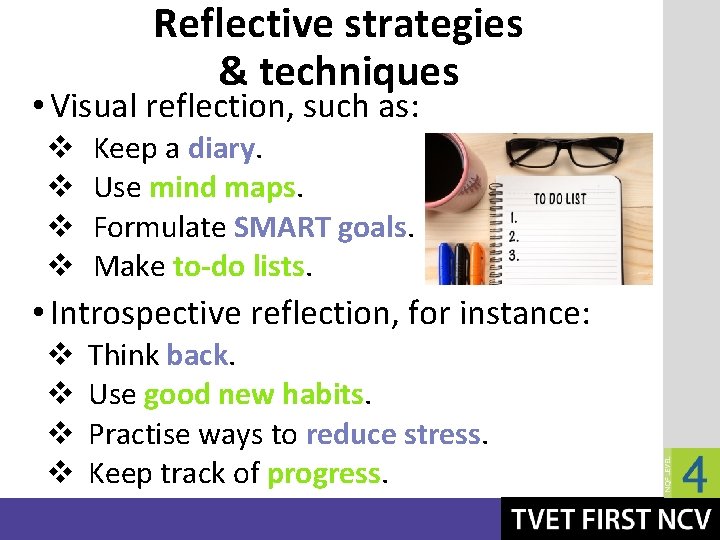
Reflective strategies & techniques • Visual reflection, such as: v v Keep a diary. Use mind maps. Formulate SMART goals. Make to-do lists. • Introspective reflection, for instance: v v Think back. Use good new habits. Practise ways to reduce stress. Keep track of progress.
Module 5 Learning activity 5. 8 Test your knowledge of this section by completing Learning activity 5. 8 in your Student’s Book. Life Orientation NQF Level 4
Summative assessment Module 5 Test your knowledge of this module by completing the Summative assessment of Module 5 in your Student’s Book. Life Orientation NQF Level 4
Mathematics NQF Level 2 Life Orientation (Life Skills) NQF Level 4