
Life of a Star Announcements Think about your
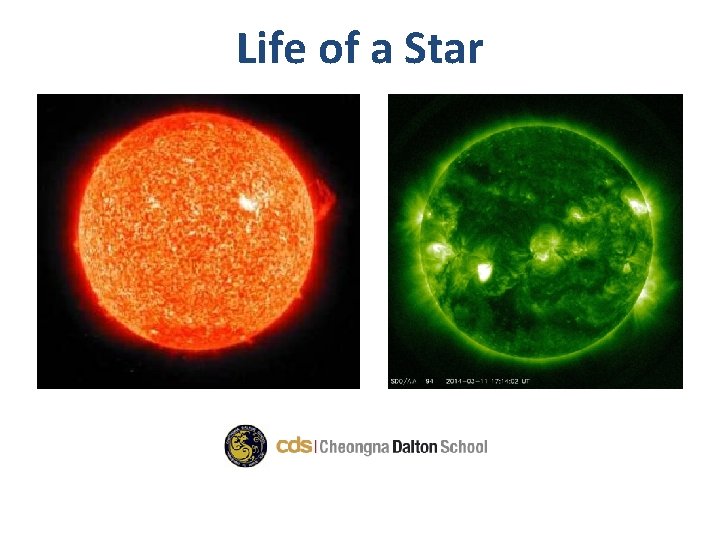
Life of a Star

Announcements • Think about your project ideas and how you would like to proceed.
Goal of the class • To understand the life cycle of stars and their fates • Question of the day: How do the stages of life differ for average stars and massive stars. • Previous answer: Stars are classified by their size, brightness, temperature, color, and composition
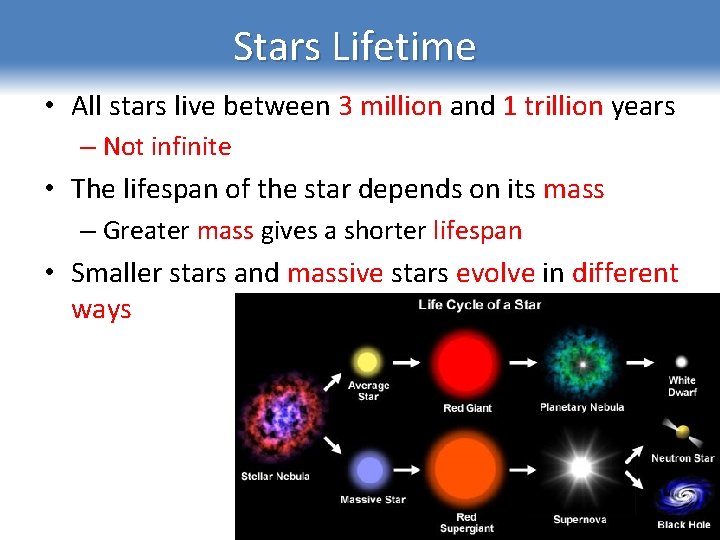
Stars Lifetime • All stars live between 3 million and 1 trillion years – Not infinite • The lifespan of the star depends on its mass – Greater mass gives a shorter lifespan • Smaller stars and massive stars evolve in different ways
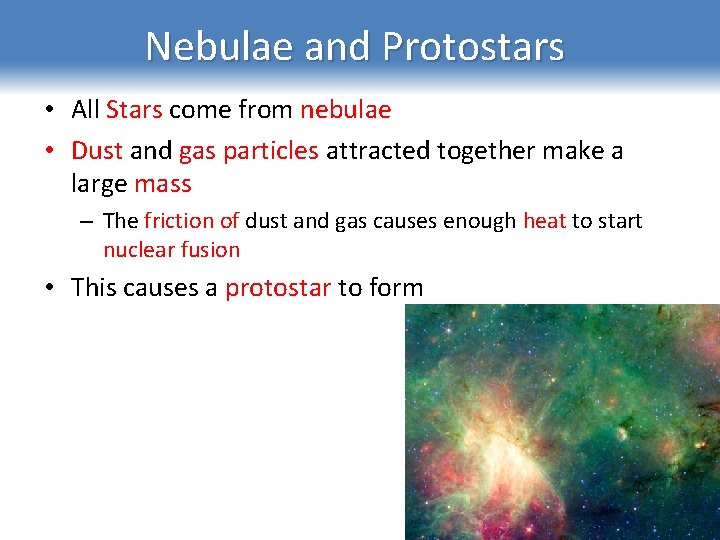
Nebulae and Protostars • All Stars come from nebulae • Dust and gas particles attracted together make a large mass – The friction of dust and gas causes enough heat to start nuclear fusion • This causes a protostar to form
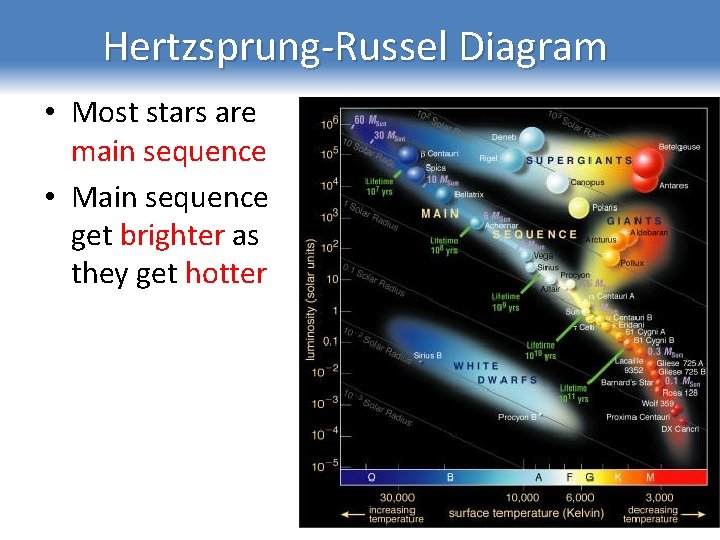
Hertzsprung-Russel Diagram • Most stars are main sequence • Main sequence get brighter as they get hotter
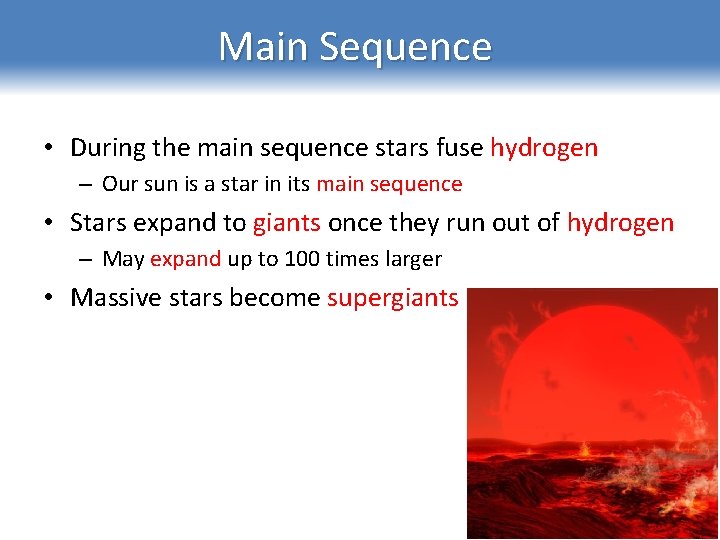
Main Sequence • During the main sequence stars fuse hydrogen – Our sun is a star in its main sequence • Stars expand to giants once they run out of hydrogen – May expand up to 100 times larger • Massive stars become supergiants
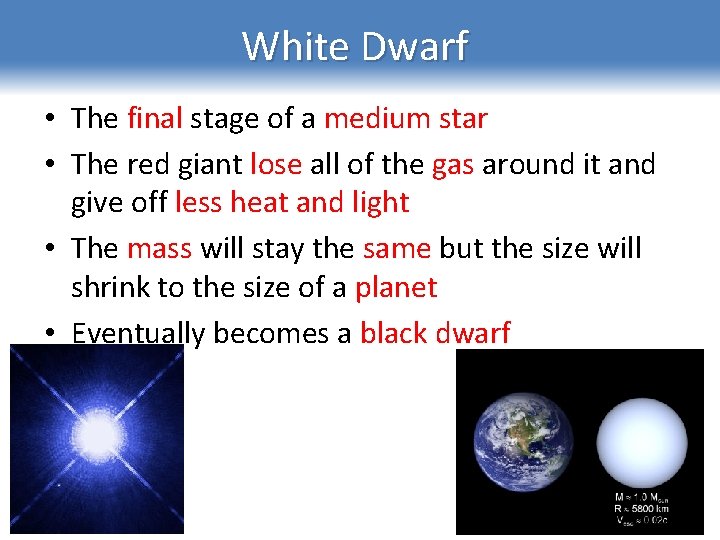
White Dwarf • The final stage of a medium star • The red giant lose all of the gas around it and give off less heat and light • The mass will stay the same but the size will shrink to the size of a planet • Eventually becomes a black dwarf
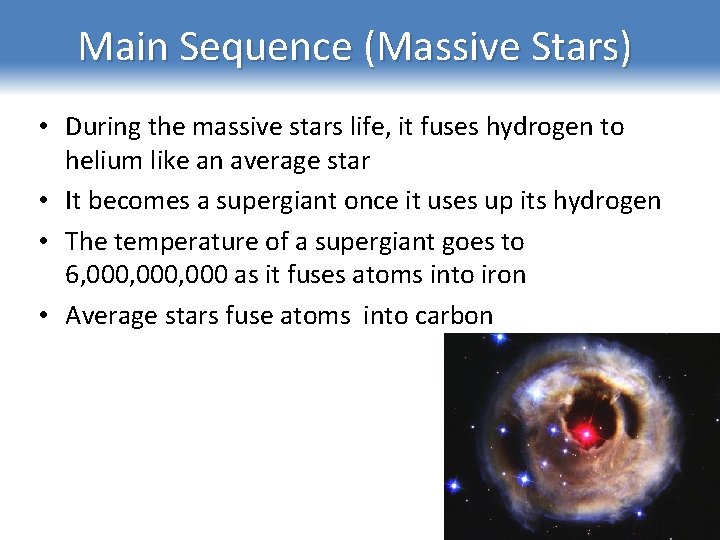
Main Sequence (Massive Stars) • During the massive stars life, it fuses hydrogen to helium like an average star • It becomes a supergiant once it uses up its hydrogen • The temperature of a supergiant goes to 6, 000, 000 as it fuses atoms into iron • Average stars fuse atoms into carbon
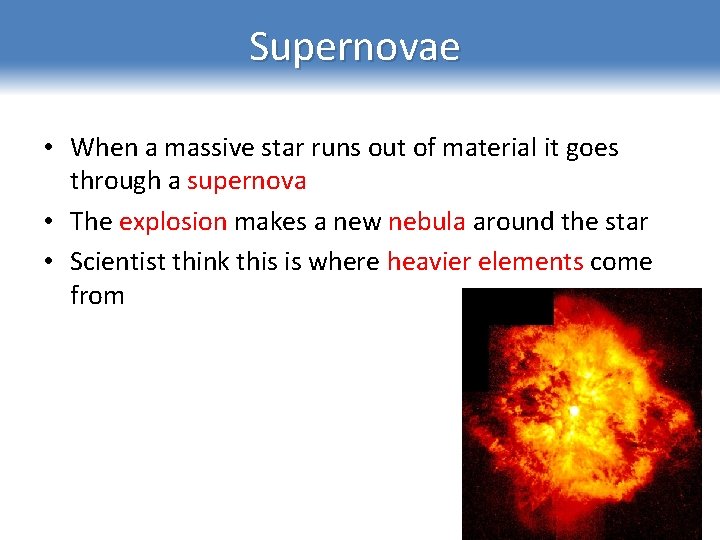
Supernovae • When a massive star runs out of material it goes through a supernova • The explosion makes a new nebula around the star • Scientist think this is where heavier elements come from
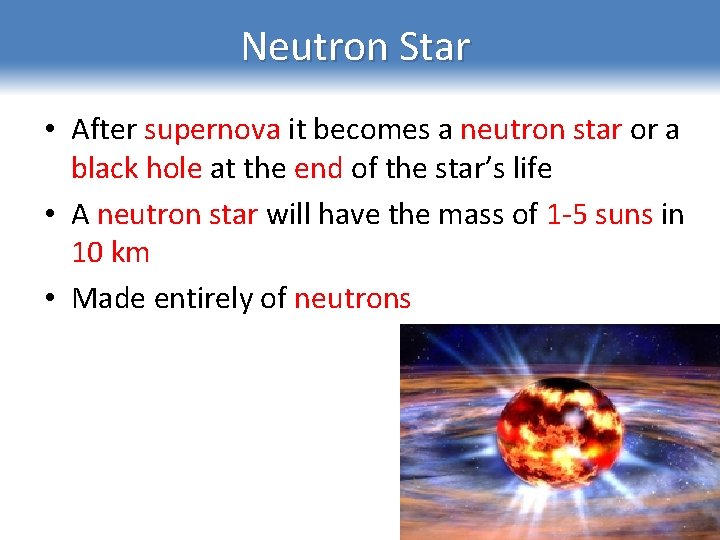
Neutron Star • After supernova it becomes a neutron star or a black hole at the end of the star’s life • A neutron star will have the mass of 1 -5 suns in 10 km • Made entirely of neutrons
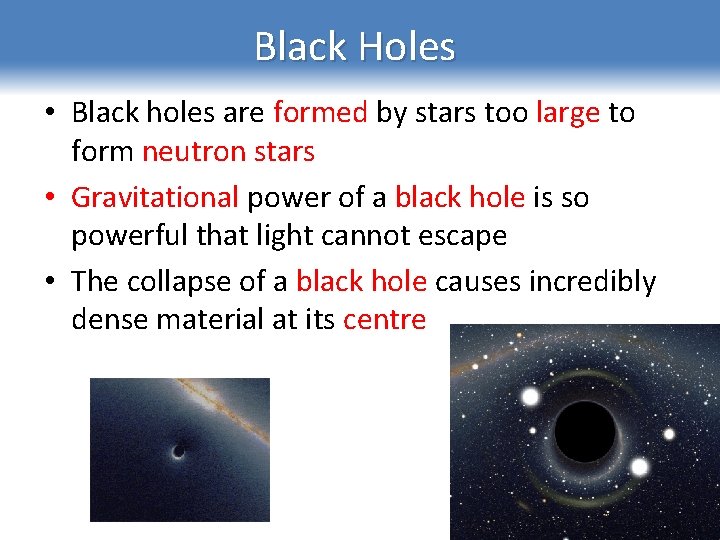
Black Holes • Black holes are formed by stars too large to form neutron stars • Gravitational power of a black hole is so powerful that light cannot escape • The collapse of a black hole causes incredibly dense material at its centre
Vocabulary • Nebula – a cloud of dust and gas in space • Supernova – the explosion of a star caused by gravitational collapse
- Slides: 13