
LIFE OF A SPARTAN AND THE PERSIAN WARS
- Slides: 17
LIFE OF A SPARTAN AND THE PERSIAN WARS
It really started at birth ■ Every infant was examined by members a council of elder Spartans to see whether he was fit and healthy enough to be allowed to live. ■ In the event that the baby did not pass the test, he was placed at the base of a mountain for several days ■ This test ended in death by exposure or survival.
Agoge ■ Was the rigorous education and training program mandated for all male Spartan citizens ■ The training involved learning stealth, cultivating loyalty to the Spartan group, military training, hunting, and social communication. ■ Took place from the age of 7 until 21
Why did they do this? ■ The goal of the system was to produce strong and capable warriors to serve in the Spartan army. ■ It encouraged conformity and the importance of the Spartan state over one's personal interest and generated the future elites of Sparta. ■ The men would become the "walls of Sparta" because Sparta was the only Greek city with no defensive walls ■ Discipline was strict and the males were encouraged to fight amongst themselves to determine the strongest member of the group.
Could anyone just go? ■ The agoge was prestigious throughout the Greek world, and many aristocratic families from other cities asked to send their sons to Sparta to participate in the agoge for varying periods of time. ■ The Spartans were very selective in which young men they would permit to enroll. ■ Such honors were rarely awarded
First Stage ■ The boys lived in groups under an older man. ■ They were encouraged to give their loyalty to their groups rather than to their families. ■ Beginning at the age of 12 boys would be given only one item of clothing per year ■ They also created beds out of reeds pulled by hand, with no knife, from the Eurotas River. ■ Boys were intentionally underfed to encourage them to steal food for themselves; however, they were severely punished for stealing. This was also meant to produce well-built soldiers rather than fat ones. ■ This let the boys become accustomed to hunger, and this prevented hunger from being a problem during battle.
Second Stage ■ At around age 12 the boys would enter into an institutionalized relationship with a young adult male Spartan. ■ The boys were expected to request the relationship, which was seen as a method to pass on knowledge and maintain loyalty on the battlefield. ■ Around the age of 18, the students became reserve members of the Spartan army. Also, some youths were allowed to become part of a type of 'Secret Police', where the members were instructed to spy on the slaves and put down potential rebellions
Third Stage ■ At age 20, the students became fully part of the Spartan army, although they continued to live in barracks ■ At the age of 20, students were voted into one of the public platoons. The voting was done by members of the platoons and must be unanimous. ■ Rejected candidates could try to gain entry to a different platoon for up to ten years. If a man failed to gain entry by age 30, he would not gain full Spartan citizenship. ■ At the age of 30, men were permitted to marry and to become full citizens of Sparta who could vote and hold office.
The Brave Spartan Boy ■ As strange as it sounds, the Spartans trained their boys to steal. They praised them when they succeeded in doing so without being found out, and punished them only when caught in the act. The reason for this strange custom was this: the Spartans were often engaged in war, so they had to depend entirely upon the provisions they could get on their way. If the Spartan soldiers had not been trained to steal, many of them would have starved during campaigns. ■ Once a year all the boys were brought to the Temple of Diana, where their courage was tested by a severe flogging; and those who stood this whipping without a tear or moan were praised. The little Spartan boys were so eager to be thought brave, that it is said that some let themselves be flogged to death rather than complain. The bravery of one of these boys was so amazing that you will find it mentioned in nearly every Greek history you read.
■ This little fellow had stolen a live fox which he planned to eat, and hid it underneath his shirt on his way to school. The imprisoned fox, hoping to escape, began to gnaw a hole in the boy's chest, and to tear his flesh with his sharp claws. If the boy had cried with pain, he would have been seen as weak. And if he had let the fox go, he would have been caught stealing. So, in spite of the pain, he just sat still. It was only when the boy fell lifeless to the floor that the teachers found the fox, and saw how cruelly he had torn the brave little boy to pieces. The boy died, having never said so much as a word. ■ To strengthen their muscles, the boys were also carefully trained in gymnastics. They could handle weapons, throw heavy weights, wrestle, run with great speed, swim, jump, and ride, and were experts in all exercises which tended to make them strong, active, and well. They were also taught to treat old people, many of whom would have survived great and terrible wars, with total respect.
Write a Letter Home ■ Write a letter home to your parents. You are assuming the identity of a 12 year old boy. Tell them what life is like. What are the hardships that you face? What have you improved in? Do you like being in the agoge? Why or why not?
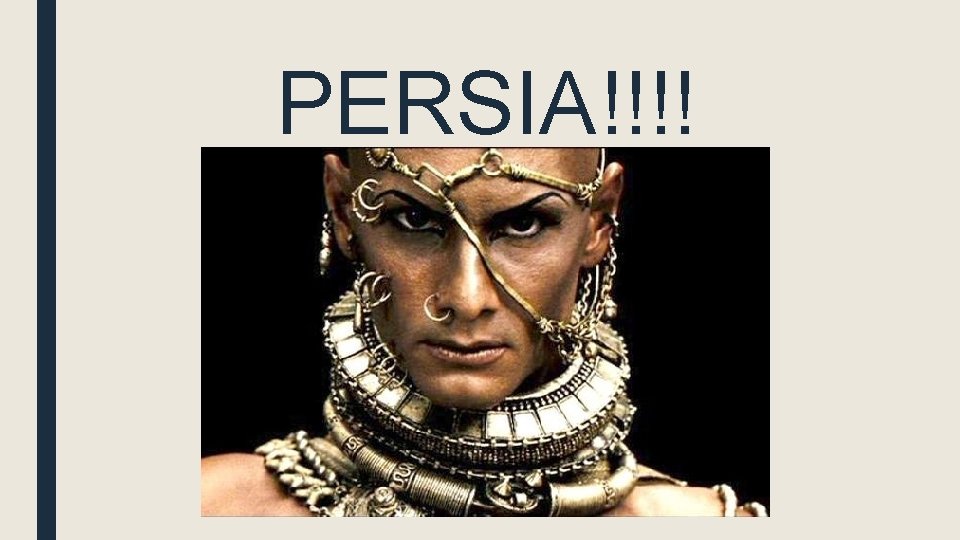
PERSIA!!!!
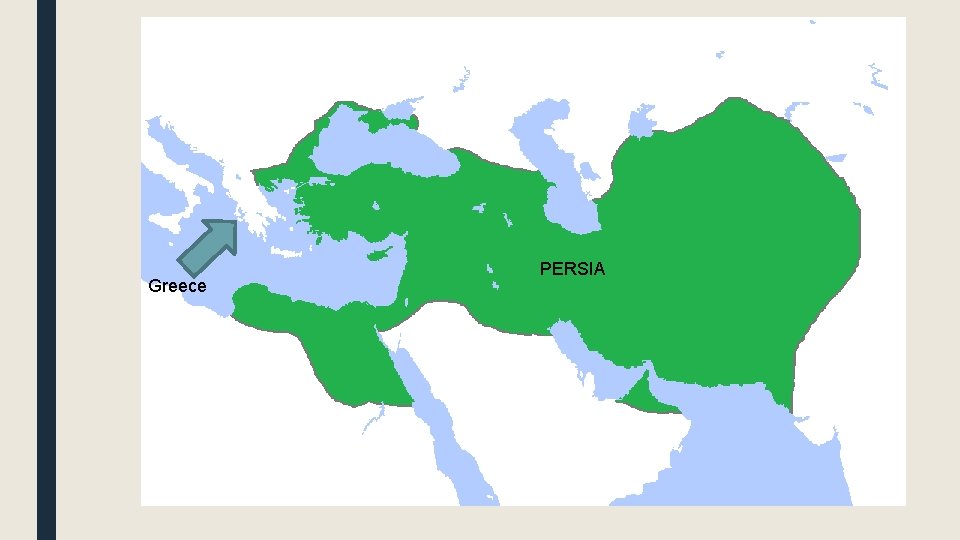
Greece PERSIA
Who are the Persians? ■ Was an empire that covered all that area we just saw ■ Was a monarchy ■ Actually a pretty cool empire. Slavery was illegal, if you submitted you could continue living basically the same, just pay a few taxes, and if the emperor ever needs something then do it ■ Also would improve the buildings and roads that you had in your cities ■ All in all, if you had a choice, not a bad place to live
So why are they fighting? ■ Xerxes’ dad, Darius I, had an issue with some Greeks ■ Greeks didn’t only live in present day Greece, some lived in what was a part of the Persian Empire ■ They didn’t want to live under their rule because they were Greeks ■ So they start a revolt ■ Darius finds out that the Athenians helped their fellow Greeks ■ Darius vows revenge on the Athenians ■ They end up fighting in the Battle of Marathon and the Greeks win ■ Darius dies before he can get his revenge and his son decides to take up the fight
■Reading on the Battle of Thermopylae ■AKA the movie 300!!
Newspaper Article ■ Based off of your reading on the Battle of Thermopylae, write a newspaper article about the events of the battle. Who was involved? What happened? How did it end? How did this effect the Greeks and the Persians? ■ Pretend the person reading it has no idea what has happened. Make it interesting, but make sure to put some details in there. ■ Should be at the very least two paragraphs