
Life Link Prehospital Burn Management Thermal Burns Catastrophic

Life. Link
Prehospital Burn Management
Thermal Burns Catastrophic event Suffering Disability Financial loss 2, 000 people annually suffer burns Majority minor burns Treated in emergency department 70, 000 required hospitalization > 5, 000 people die annually 25% required Life. Link treatment in burn center
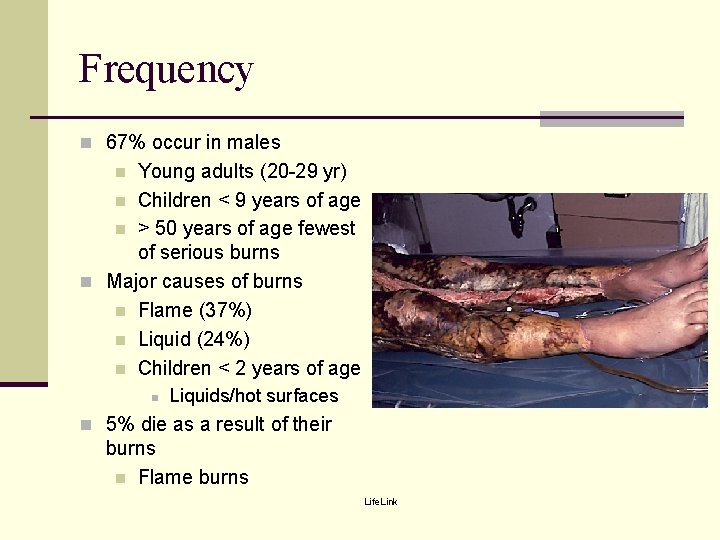
Frequency n 67% occur in males Young adults (20 -29 yr) n Children < 9 years of age n > 50 years of age fewest of serious burns n Major causes of burns n Flame (37%) n Liquid (24%) n Children < 2 years of age n n Liquids/hot surfaces n 5% die as a result of their burns n Flame burns Life. Link
n. Burns are a progressive process! n 3 components to extent of burn injury Temperature n Concentration of heat injury n Length of contact n § ie. , hot air blast versus hot oil contact Life. Link
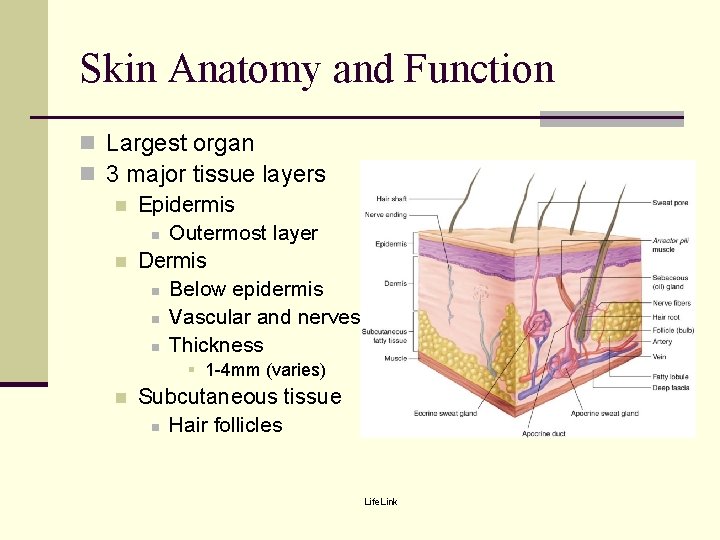
Skin Anatomy and Function n Largest organ n 3 major tissue layers n Epidermis n Outermost layer n Dermis n Below epidermis n Vascular and nerves n Thickness § 1 -4 mm (varies) n Subcutaneous tissue n Hair follicles Life. Link
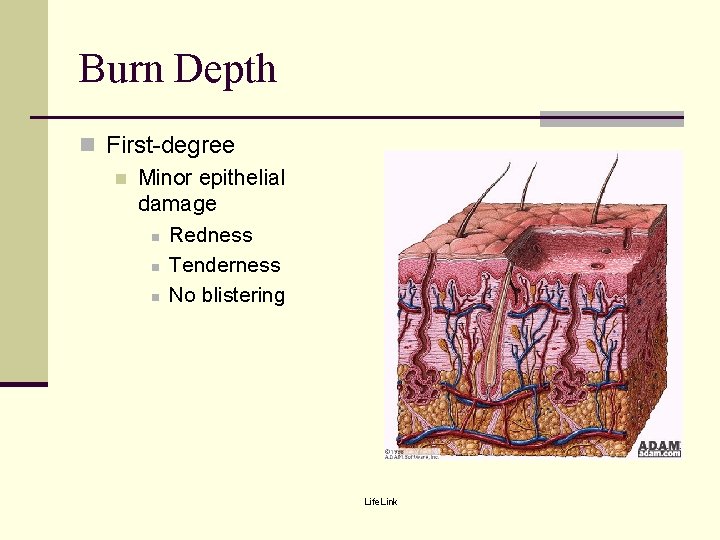
Burn Depth n First-degree n Minor epithelial damage n Redness n Tenderness n No blistering Life. Link
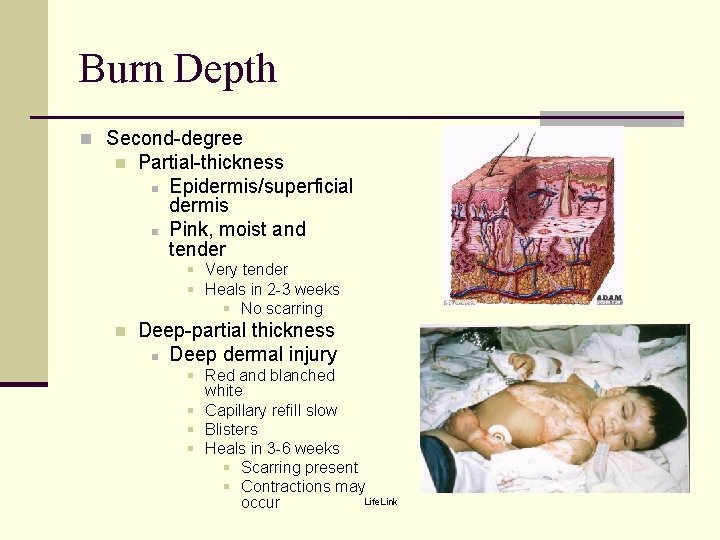
Burn Depth n Second-degree n Partial-thickness n Epidermis/superficial dermis n Pink, moist and tender § Very tender § Heals in 2 -3 weeks § No scarring n Deep-partial thickness n Deep dermal injury § Red and blanched white § Capillary refill slow § Blisters § Heals in 3 -6 weeks § Scarring present § Contractions may Life. Link occur
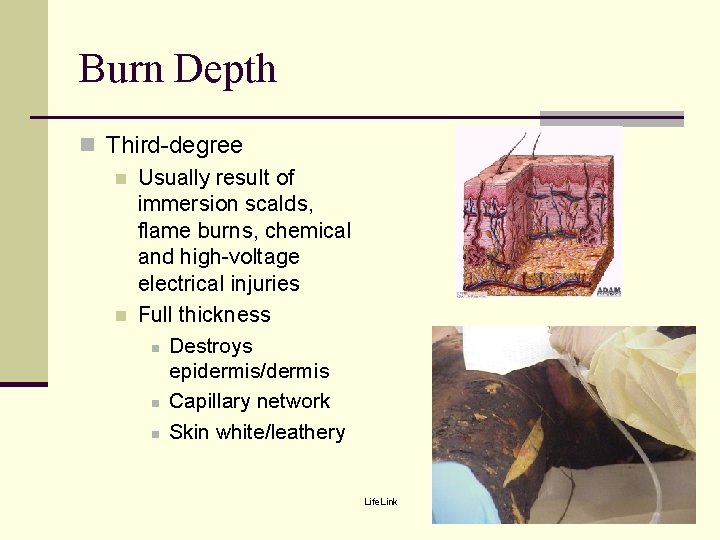
Burn Depth n Third-degree n Usually result of immersion scalds, flame burns, chemical and high-voltage electrical injuries n Full thickness n Destroys epidermis/dermis n Capillary network n Skin white/leathery Life. Link
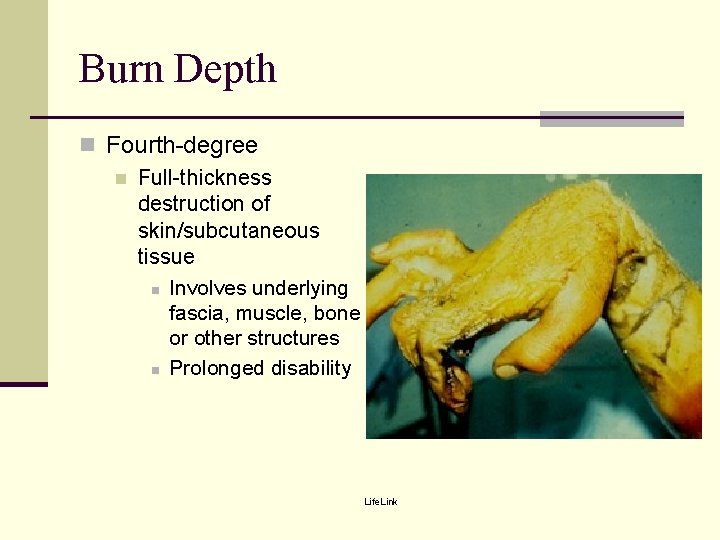
Burn Depth n Fourth-degree n Full-thickness destruction of skin/subcutaneous tissue n Involves underlying fascia, muscle, bone or other structures n Prolonged disability Life. Link
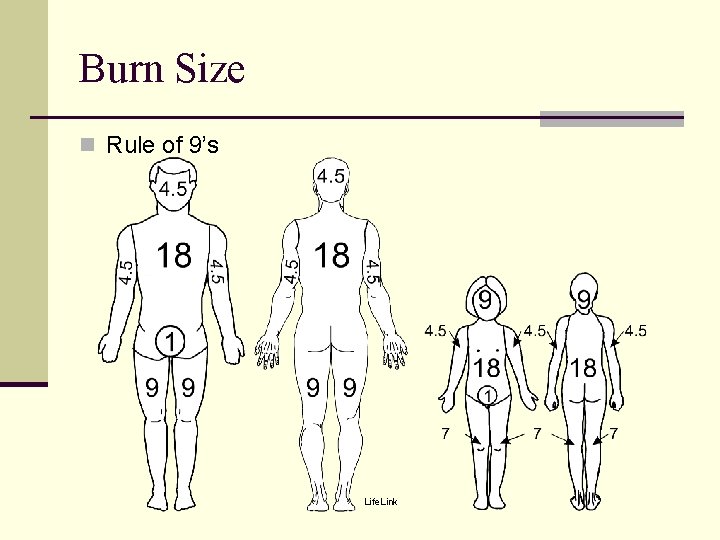
Burn Size n Rule of 9’s Life. Link
Minor Burn Injury n Less than 15% of TBSA in adults n Less than 10% of TBSA in children or older population n Less than 2% full thickness burn n No functional loss to: n n n Eyes Ears Face Hands/feet Perineum Life. Link
Moderate Burn Injury n Partial-thickness of 15 -25% TBSA in adults n 10 -20% TBSA in children or older person n Full thickness of 2 -10% TBSA n No loss of function to: n n Excludes: n n n Eyes, ears, face, hands, feet or perineum High-voltage electrical burns Inhalation injury Requires hospitalization Life. Link
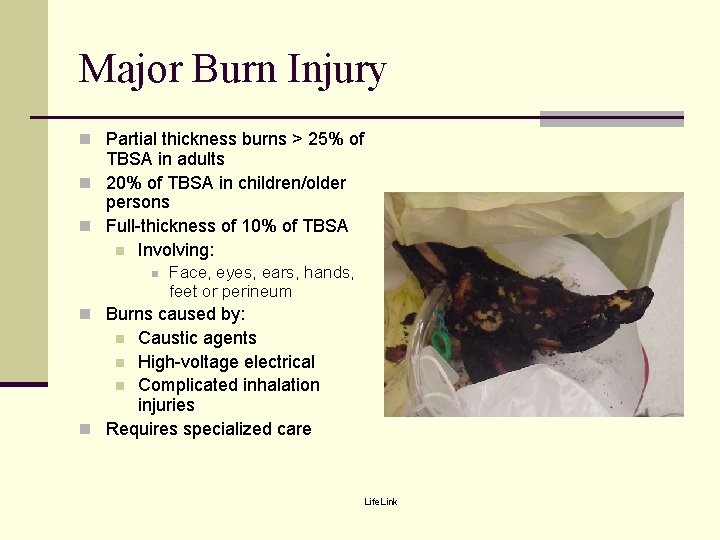
Major Burn Injury n Partial thickness burns > 25% of TBSA in adults n 20% of TBSA in children/older persons n Full-thickness of 10% of TBSA n Involving: n Face, eyes, ears, hands, feet or perineum n Burns caused by: Caustic agents n High-voltage electrical n Complicated inhalation injuries n Requires specialized care n Life. Link
Treatment n Scene safety n Airway/Breathing n 3 components n Upper airway swelling § Edema occurs within 12 -24 hours § Early intubation indicated § Look for stridor, wheezing, grunting n n Acute respiratory failure Carbon monoxide intoxication § 100% O 2 § Decreases CO half life Life. Link
Closed Space Injury n Inhalation Injury n Cyanide poisoning n Early intubation n n 100% Oxygen Sodium Thiosulfate n Symptomatic (unconscious/lethargic) § Adults § 50 cc of 25% solution § Children (under 12 years) § 30 cc of 25% solution Life. Link
Fluid Resuscitation n Influenced by percent of TBSA n Restores plasma volume n Avoids microvascular ischemia n Maintains vital organ function n Amount varies with age, body weight and TBSA n Significant burns n Lactated Ringers or. 9% NS n Adults → 500 cc/hr n Children (5 -15 yrs) → 250 cc/hr n Children (< 5 yrs) not recommended to initiate IV § Per Advanced Burn Life Support Protocol n Parkland Formula Life. Link
Parkland Formula n Initial fluid resuscitation in first 24 hours n Lactated Ringers or 0. 9% NS n 4 cc/kg/TBSA over 24 hours § i. e. , 4/70/50=14, 000 cc in 24 hours § Half within first 8 hours § Begins when burn occurs § May need to play “catch up” § Remainder within next 16 hours n Children § Greater fluid requirements § Include maintenance rate Life. Link
Wound Treatment n Dry chemicals n Brush off chemical n Copiously irrigate skin n Flame/Scalding burns n Cool dressing if < 10% TBSA n n >10% increases risk of hypothermia Dry, sterile dressing n Pain management n Morphine Sulfate n IM versus IV injection Life. Link
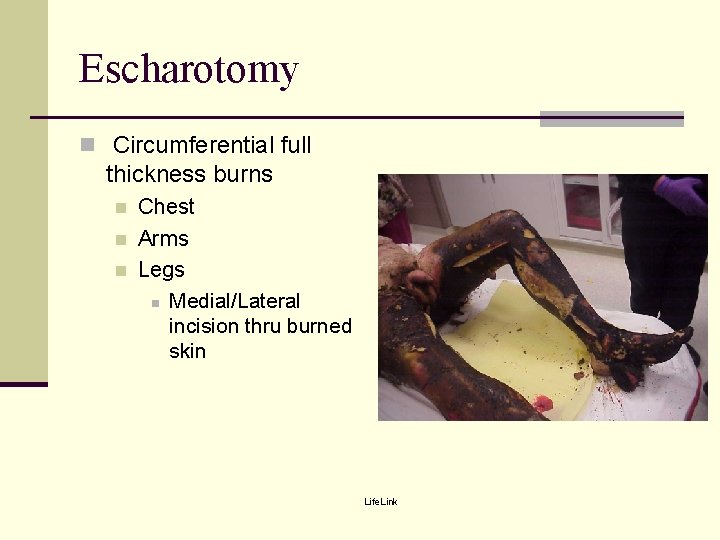
Escharotomy n Circumferential full thickness burns n n n Chest Arms Legs n Medial/Lateral incision thru burned skin Life. Link
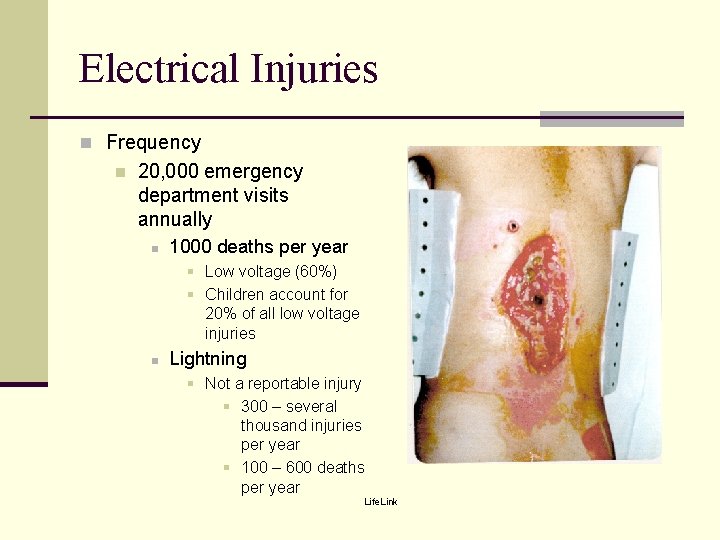
Electrical Injuries n Frequency n 20, 000 emergency department visits annually n 1000 deaths per year § Low voltage (60%) § Children account for 20% of all low voltage injuries n Lightning § Not a reportable injury § 300 – several thousand injuries per year § 100 – 600 deaths per year Life. Link
Electrical Injuries n Mortality/Morbidity n Lightning fatality rate of 25 -30% n 75% have permanent sequelae § Cataracts § Ruptured tympanic membrane § Peripheral nerve damage n Low voltage n Low morbidity/mortality § Increases as voltage increases n Wet skin § Decreases resistance Life. Link
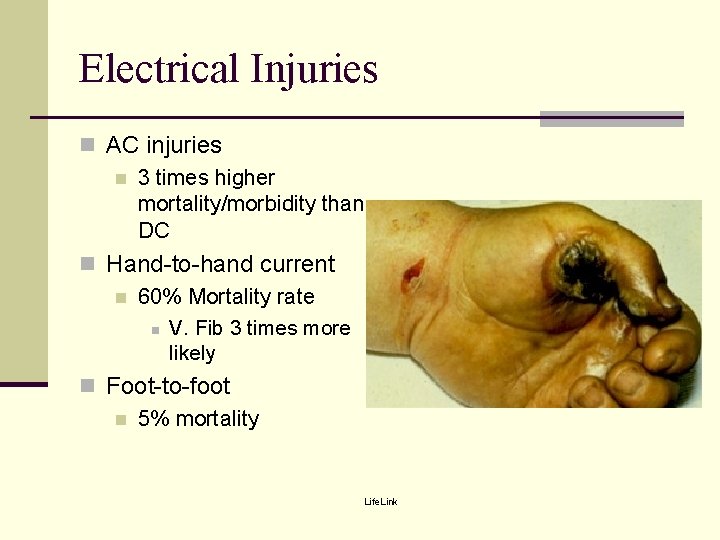
Electrical Injuries n AC injuries n 3 times higher mortality/morbidity than DC n Hand-to-hand current n 60% Mortality rate n V. Fib 3 times more likely n Foot-to-foot n 5% mortality Life. Link
Electrical Injuries n More common in males n Toddlers n n Low voltage Older children/adolescents n High voltage § Unintentional Life. Link
History n Detailed history vital n Current n Low voltage § 120 – 440 V n High voltage § 440 – 1000 V n High-tension § > 1000 V n Type of current n n Alternating current (AC) Direct current (DC) Life. Link
History - continued n Path of current n Hand-to-hand n Hand-to-foot n Foot-to-foot n Length on contact n Tetany n Lock-on phenomenon n Associated events n Fall n Burns n Water contact Life. Link
Pathophysiology n Follows path of least resistance towards ground n Skin a resistor n Skin n n Wet skin n n Resistance of 25, 000 ohms Resistance of 1500 ohms Calloused skin n Resistance of 2, 000 ohms Life. Link
Types of Electrical Burns n Household current n 110 V n Stimulates muscle into tetany n Alternating current (AC) produces n Three times more dangerous than DC at same voltage n Tetany n Locked-on phenomenon § Increases injury n Direct current (DC) produces: n Large muscular contraction § Throws patient § May result in blunt trauma Life. Link
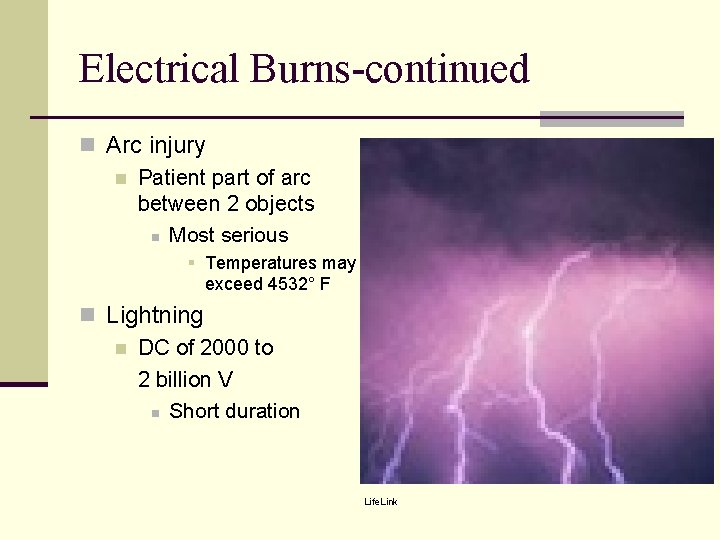
Electrical Burns-continued n Arc injury n Patient part of arc between 2 objects n Most serious § Temperatures may exceed 4532° F n Lightning n DC of 2000 to 2 billion V n Short duration Life. Link
Electrical Injuries n Disrupts body’s electrical activities n Neurological system n n Most commonly affected Maybe temporary § § § Numbness/tingling Loss of consciousness Amnesia Coma Spinal cord involvement § Transverse myelitis (poor prognosis) Life. Link
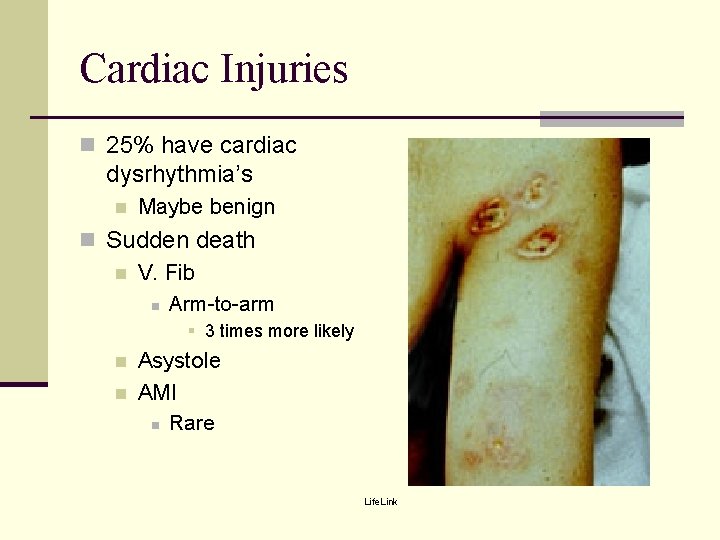
Cardiac Injuries n 25% have cardiac dysrhythmia’s n Maybe benign n Sudden death n V. Fib n Arm-to-arm § 3 times more likely n n Asystole AMI n Rare Life. Link
Lightning Injuries n Cardiac Arrest n Asystole n n n Massive depolarization leads to asystole Heart’s automaticity usually restarts Apnea n n Massive depolarization of brain Stuns respiratory center § Longer duration § Provide ALS § Survivability increases Life. Link
Thermal Injuries n Higher voltage n Higher temperatures n High voltage § Devastating injuries n Lightning § Very little burns § Short duration Life. Link
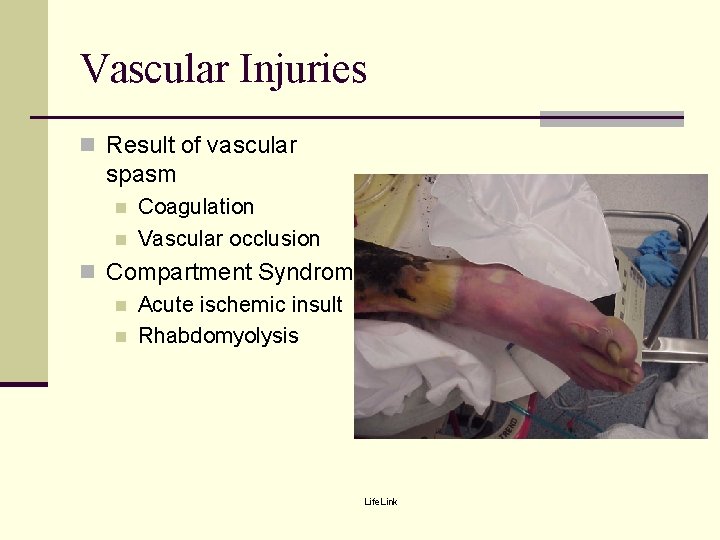
Vascular Injuries n Result of vascular spasm n n Coagulation Vascular occlusion n Compartment Syndrome n Acute ischemic insult n Rhabdomyolysis Life. Link
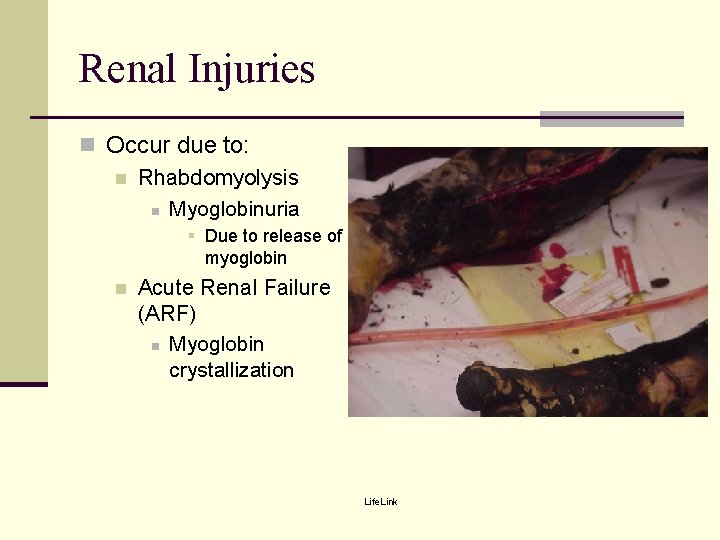
Renal Injuries n Occur due to: n Rhabdomyolysis n Myoglobinuria § Due to release of myoglobin n Acute Renal Failure (ARF) n Myoglobin crystallization Life. Link
Physical Exam n n n Scene safety “Triage the Dead” ABC’s Neuro Exam Environmental factors n n Hypothermia Remove wet/burned clothing n Extremities n Fractures n Injury due to: § Tetany § Falls § Explosion Life. Link
n Skin n Burns n n Can be varying Flash burns n High voltage § External vs. internal injury Life. Link
n Lightning n Intense impulse n Thermal burns n n Uncommon, unless clothing burned Feathering/ferning n Electron shower § Cutaneous markings § Not a true burn n Arc burns n Significant internal energy Life. Link
Treatment n Scene safety n “Triage the Dead” n Airway n Usually unaffected n Unless direct injury n Breathing n Maintain adequate ventilation n Central apnea § Lightning strike Life. Link
Treatment - continued n Circulation n Maintain adequate perfusion n Low voltage § Minimal fluid resuscitation n High voltage § Require large amounts of fluid n Lactated Ringers or 0. 9% NS n n Parkland Formula Based on TBSA involved § Difficult in electrical injuries Life. Link
Treatment - continued n Remove clothing n Leather, watches and any other jewelry n Pain Management n Morphine Sulfate n Wounds n Keep dry and clean n Splint any fractures n Tetany present n Contractures Life. Link
Summary n Burns n Electrical n Low voltage n Good prognosis n Lightning n 25 -30% fatality rate n 75% have permanent sequelae Life. Link
Questions? Life. Link
- Slides: 43