
Life in the Industrial Age Section 3 Daily
- Slides: 14
Life in the Industrial Age Section 3 Daily Life in the Late 1800 s Main Idea During the late 1800 s, cities grew and changed, while education, leisure time activities, and the arts reflected those changing times. Reading Focus • How did cities grow and change in the late 1800 s? • What developments affected education, leisure, and the arts?
Life in the Industrial Age Section 3 Cities Grow and Change Signs of changes during the Industrial Age • New activities like reading by electric light and riding bicycles • Many changes took place in the cities – Throughout 1800 s much of Europe and the U. S. experienced urbanization, growth in the proportion of people living in towns and cities – Not only did cities grow, underwent transformation
Section 3 Life in the Industrial Age Cities Grow and Change Migration to Cities • • • People kept moving to cities in late 1800 s despite unhealthy conditions Wanted jobs, also to escape hunger, political oppression or discrimination Many moved from native countries to cities in different lands Many Europeans sailed to Latin America, Australia, other places United States attracted the most people America Cities of Immigrants • 12 million immigrated to U. S. between 1870 and 1900 • 42 percent of New Yorkers foreignborn in 1890 • Came from Ireland, England, Germany, Italy, Russia, China • Immigrants also poured into Boston, Chicago, San Francisco • Most lived in miserable, crowded conditions when they first arrived • Newcomers gradually created their own unique neighborhoods
Life in the Industrial Age Section 3 Cities Grow and Change The Livable City • Reforms eased squalid conditions, improvements made in infrastructure • Cities modernized their water and wastewater systems • Sanitation and overall health improved as a result Electricity • Made homemaking more convenient • Vacuum cleaners, refrigerators, electric stoves became available Working and Living Space Scarce • Constructing taller buildings became a solution • Architect Jenney designed first multi-story skyscraper, Chicago 1883 • Four years later, high speed elevator perfected and skyscapers could grow
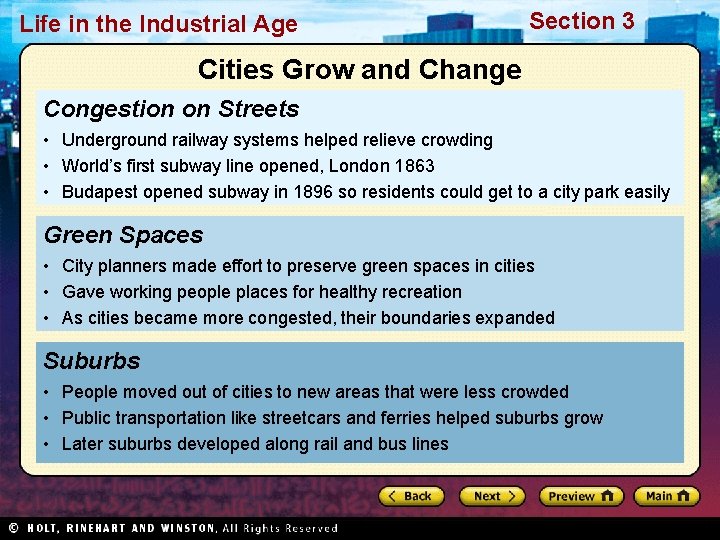
Life in the Industrial Age Section 3 Cities Grow and Change Congestion on Streets • Underground railway systems helped relieve crowding • World’s first subway line opened, London 1863 • Budapest opened subway in 1896 so residents could get to a city park easily Green Spaces • City planners made effort to preserve green spaces in cities • Gave working people places for healthy recreation • As cities became more congested, their boundaries expanded Suburbs • People moved out of cities to new areas that were less crowded • Public transportation like streetcars and ferries helped suburbs grow • Later suburbs developed along rail and bus lines
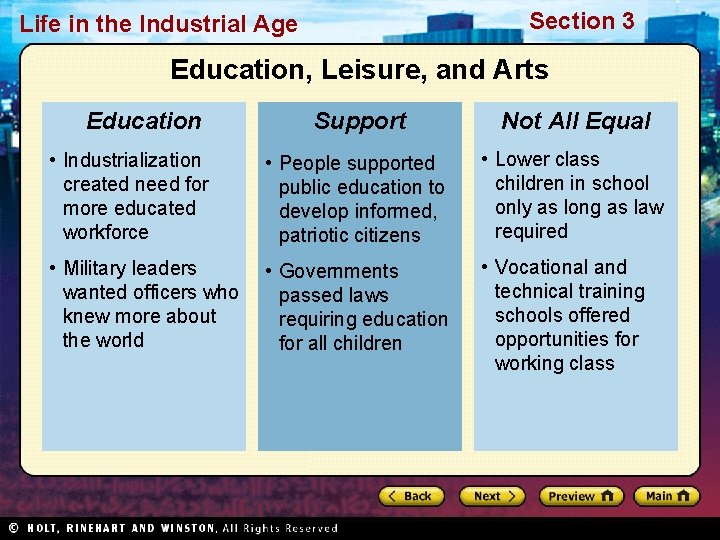
Section 3 Life in the Industrial Age Education, Leisure, and Arts Education Support Not All Equal • Industrialization created need for more educated workforce • People supported public education to develop informed, patriotic citizens • Lower class children in school only as long as law required • Military leaders wanted officers who knew more about the world • Governments passed laws requiring education for all children • Vocational and technical training schools offered opportunities for working class
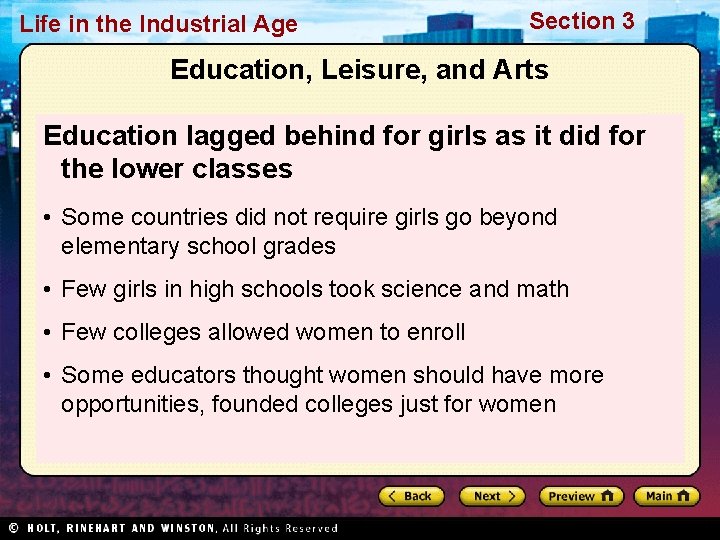
Life in the Industrial Age Section 3 Education, Leisure, and Arts Education lagged behind for girls as it did for the lower classes • Some countries did not require girls go beyond elementary school grades • Few girls in high schools took science and math • Few colleges allowed women to enroll • Some educators thought women should have more opportunities, founded colleges just for women
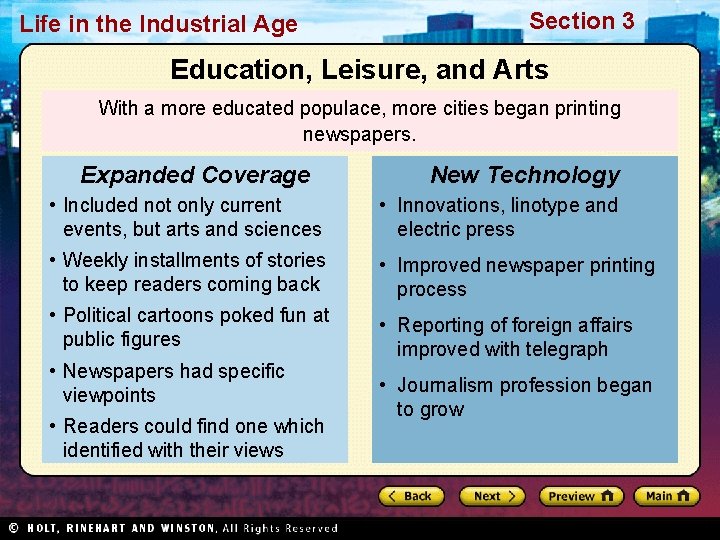
Life in the Industrial Age Section 3 Education, Leisure, and Arts With a more educated populace, more cities began printing newspapers. Expanded Coverage New Technology • Included not only current events, but arts and sciences • Innovations, linotype and electric press • Weekly installments of stories to keep readers coming back • Improved newspaper printing process • Political cartoons poked fun at public figures • Reporting of foreign affairs improved with telegraph • Newspapers had specific viewpoints • Readers could find one which identified with their views • Journalism profession began to grow
Section 3 Life in the Industrial Age Education, Leisure, and Arts Leisure time Cultural activities • More time to play, watch sports • New concert halls and theaters built by governments • British football, American football, rugby developed • Baseball became popular during Civil War • More orchestras, bands, choral groups evolved • Lowered ticket prices Art • Moved from private homes • Museums made great works available to all • Public libraries also opened
Life in the Industrial Age Section 3
Section 3 Life in the Industrial Age Changes in the Arts With all the discoveries, inventions and new ideas of the 1800 s, it is no wonder that the world of arts underwent change as well. Artists, writers, and musicians developed new styles in response to what was going on around them. Literary and Artistic Change • Romanticism, with emphasis on intuition and feeling • Reaction to early abuses of Industrial Revolution • Love of nature, deep emotions, value of individual, affection for past, importance of imagination Romantics of the Time • William Wordsworth, expressed romantic spirit in poetry • Ludwig von Beethoven’s music celebrated human freedom Theodore Gericault, romantic painter with scenes of suffering heroes In the mid-1800 s, a movement known as realism developed in reaction to romanticism.
Life in the Industrial Age Section 3 Changes in the Arts Realism • Revealed the details of everyday life, no matter how unpleasant • Charles Dickens wrote about struggles of London’s poor • Pollution, exploitation, miseries of industrialization were other themes Other Voices • Russian writer Leo Tolstoy showed war as chaotic, horrible in War and Peace- Napoleon’s invasion of Russia • Norwegian Henrik Ibsen revealed unfair treatment of women, A Doll’s House Realism in Art • Painters turned to realism as reaction against romanticism • Painted ordinary working people as they really lived • Many paintings show lower classes possessing quiet dignity
Life in the Industrial Age Section 3
Life in the Industrial Age Section 3 The Impact of Technology Click above to play the video.