
Life Cycle of Stars Star Birth Develops from
Life Cycle of Stars
Star Birth • Develops from nebula – Nebula is a collection of dust and gas • Gravity overcomes pressure • Gravitational contraction facilitates Nuclear Fusion • Star is born!
Stellar Mass • Stellar lives based upon mass of star – Low-mass = less than 2 x’s our Sun – Intermediate-mass = 2 to 8 solar mass – High-mass = greater than 8 x’s solar mass • Mass affects temperature and luminosity • H-R Diagram plots temp and luminosity
H-R Diagram • Horizontal axis represents temperature • Vertical axis represents stellar luminosity • Based upon spectral sequence: – OBAFGKM
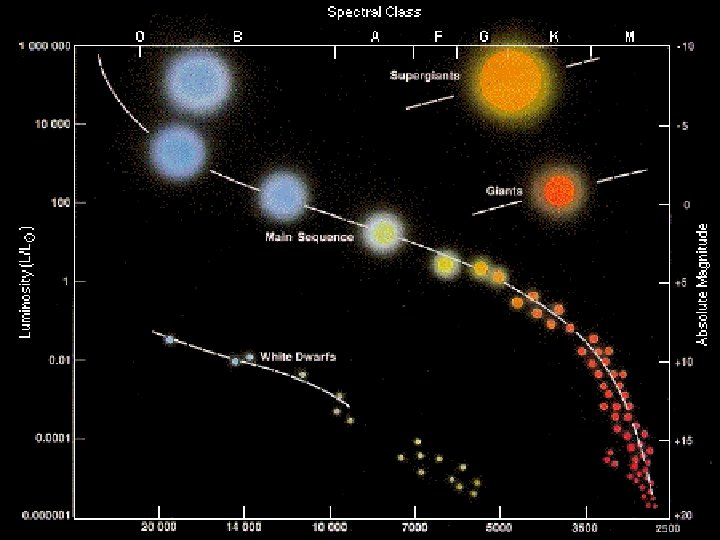
Patterns from H-R Diagram • Most stars fall along the main sequence – Line from upper left to lower right corner • Stars on top are supergiants – Large and bright • Giants located under supergiants • White dwarfs are located in the lower left
Life of a Low Mass Star • Spend life as a main sequence star • Becomes a red giant as hydrogen is depleted • Expands and collapses to facilitate helium burning – Becomes helium burning star • Becomes a red giant
Low mass continued • Outer atmosphere ejected into space forming a planetary nebula • Star fades into a white dwarf • Eventually dies out as a black dwarf • Our sun is a low mass star • Cycle lasts for billions of years

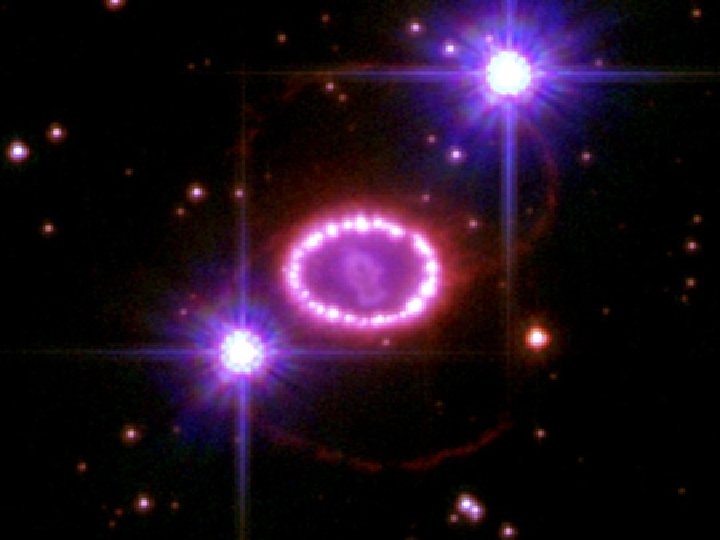
Life as High-Mass Star = 8 x’s sun • Birthed from nebula • Core contains convective zone • Nuclear fusion of heavier elements – Requires high temperatures – More gravitational contraction • When fusion ceases, gravity causes the core to implode known as a supernova • More massive, the shorter the life
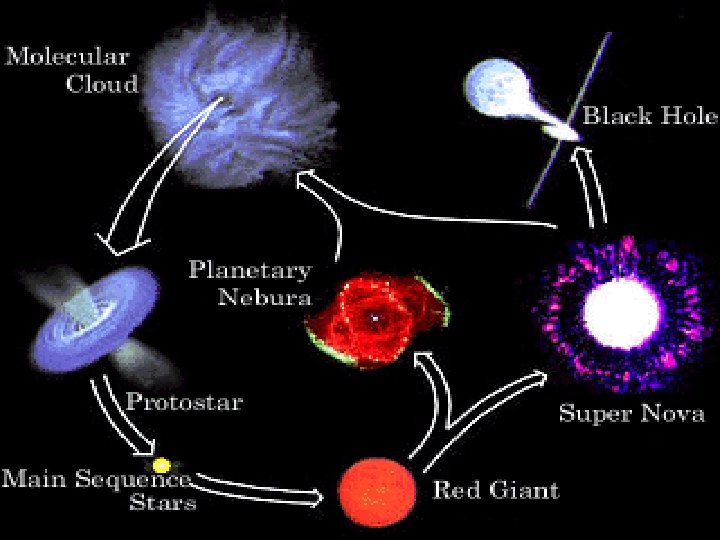
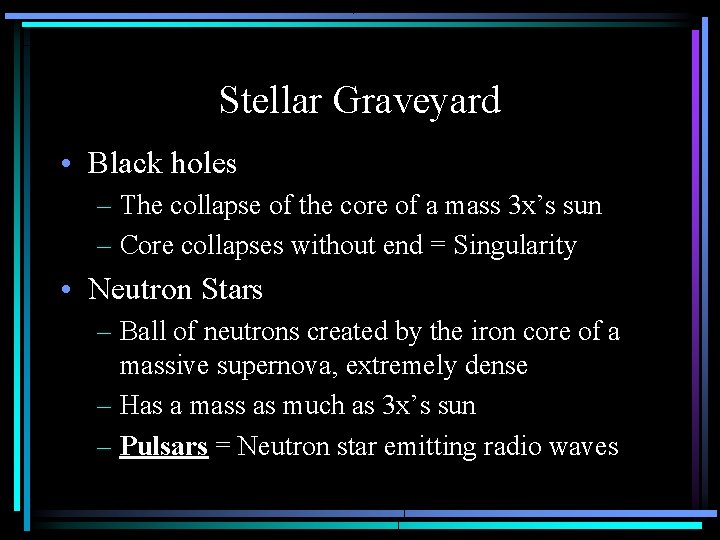
Stellar Graveyard • Black holes – The collapse of the core of a mass 3 x’s sun – Core collapses without end = Singularity • Neutron Stars – Ball of neutrons created by the iron core of a massive supernova, extremely dense – Has a mass as much as 3 x’s sun – Pulsars = Neutron star emitting radio waves
- Slides: 16