
Life Cycle of Stars Objective OVERALL LEARNING TARGET

Life Cycle of Stars
Objective OVERALL LEARNING TARGET: SWBAT communicate scientific ideas about the way stars, over their life cycle, produce elements as demonstrated by completing interactive notes and graphic organizers with 85% or more accuracy. TODAY’S LEARNING TARGET: SWBAT communicate and model the life cycle of medium and high mass stars by filling out interactive Power. Point notes and a graphic organizer, and, by holding class and partner discussions with 85% or more accuracy.
All Stars • A huge burning sphere of gases held together by gravity • Composed mainly of the elements Hydrogen and Helium • Life cycle based on their mass • All stars go through the same first 3 life cycle stages: 1. Nebula – a huge cloud of dust and gas held together by gravity; star nursery 2. Protostar – a young star in the early stages of formation; nuclear fusion begins (light and heat produced)
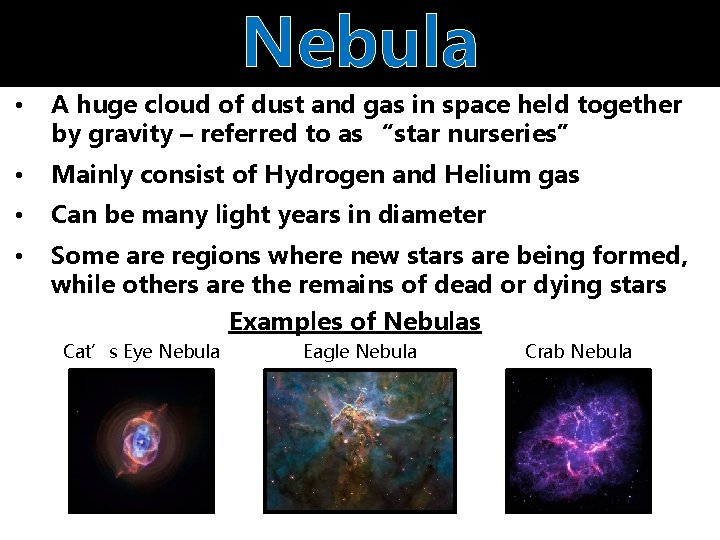
Nebula • A huge cloud of dust and gas in space held together by gravity – referred to as “star nurseries” • Mainly consist of Hydrogen and Helium gas • Can be many light years in diameter • Some are regions where new stars are being formed, while others are the remains of dead or dying stars Examples of Nebulas Cat’s Eye Nebula Eagle Nebula Crab Nebula
Life Cycle – Average Mass After the main sequence stage, stars with an average mass (like the Sun) go through the following stages: • Red Giant – the stage after main sequence for a small to medium mass star; fuel begins to run out • Planetary Nebula – a ring-shaped nebula formed by an expanding shell of gas around an aging star • White Dwarf – a star that has exhausted all of its nuclear fuel; planet sized and very dense • Black Dwarf – a dead star that no longer gives
Life Cycle – High Mass After the main sequence stage, stars with a high mass (1. 5 X to 3 X more massive than the Sun) go through the following stages: • Red Supergiant – a star that is among the most massive and brightest of all stars • Supernova – an extremely bright explosion of a star • Neutron Star – the extremely dense remains of a dead star; very small and very dense
Life Cycle – Extremely High Mass After the main sequence stage, stars with an extremely high mass (more than 3 X as massive as the Sun) go through the following stages: • Red Supergiant • Supernova • Black Hole - a gravitational field so strong that not even light can escape
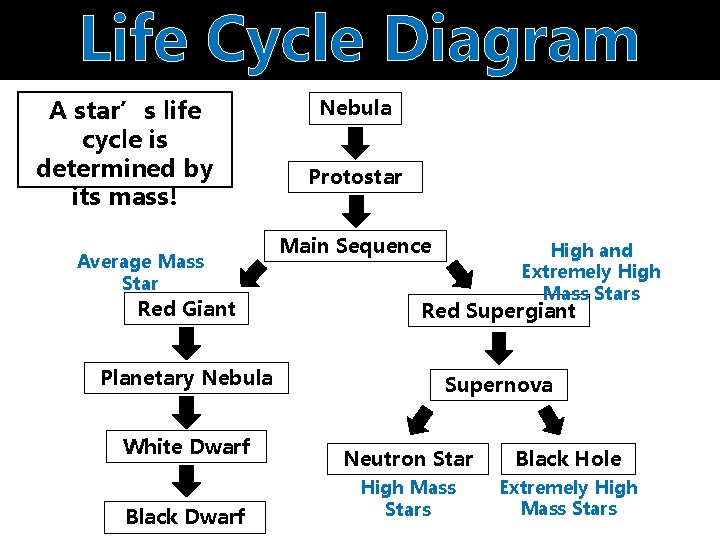
Life Cycle Diagram A star’s life cycle is determined by its mass! Average Mass Star Nebula Protostar Main Sequence High and Extremely High Mass Stars Red Giant Red Supergiant Planetary Nebula Supernova White Dwarf Black Dwarf Neutron Star Black Hole High Mass Stars Extremely High Mass Stars
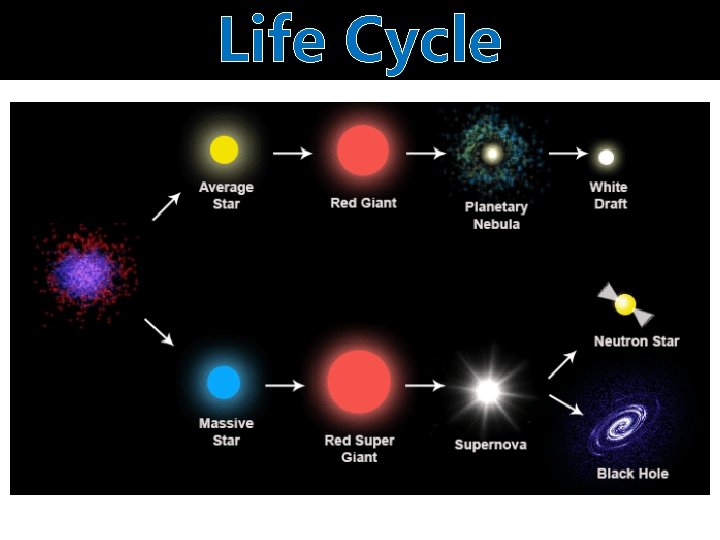
Life Cycle
Life Cycle
Checkpoint • Did we meet today’s objective? : SWBAT communicate and model the life cycle of medium and high mass stars by filling out interactive Power. Point notes and a graphic organizer, and, by holding class and partner discussions with 85% or more accuracy. • Let’s find out!
Question 1 Let’s discuss this together & write What characteristic of a star determines its life cycle? Can you guess why? A characteristic of a star that determines its life cycle is…. Using complete sentences or by drawing a model with labels, write your answer on your paper.
Question 2 Think-Pair-Share-Write What process allows stars to give off light and heat? ____ allows stars to give off light and heat. Using complete sentences or by drawing a model with a label, write your answer on your paper.
Objective OVERALL LEARNING TARGET: SWBAT communicate scientific ideas about the way stars, over their life cycle, produce elements as demonstrated by completing interactive notes and graphic organizers with 85% or more accuracy. TODAY’S LEARNING TARGET: SWBAT communicate and model the life cycle of medium and high mass stars by filling out interactive Power. Point notes and a graphic organizer, and, by holding class and partner discussions with 85% or more accuracy.
Question 3 Class discussion & write Why do you think massive stars have a shorter life cycle than average mass stars? Massive stars have a shorter life cycle than average mass stars because…. Using complete sentences or by drawing a model with labels, write your answer on your paper.
Question 4 Think and then write your answer in your notes. Using complete sentences or by drawing a model with labels, explain why the Sun will not explode at any point in its life cycle. The Sun will not explode at any point in its life cycle because…
Question 5 Discuss with your lab partner & then write/draw Describe the final stages in the life cycle of the Sun. The final stages in the life cycle of the sun are…. Using complete sentences or by drawing a model with labels, write your answer on your paper.
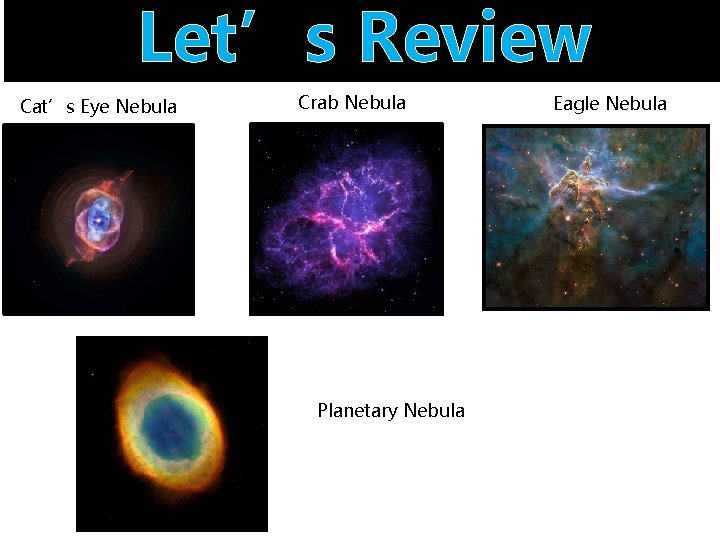
Let’s Review Cat’s Eye Nebula Crab Nebula Planetary Nebula Eagle Nebula
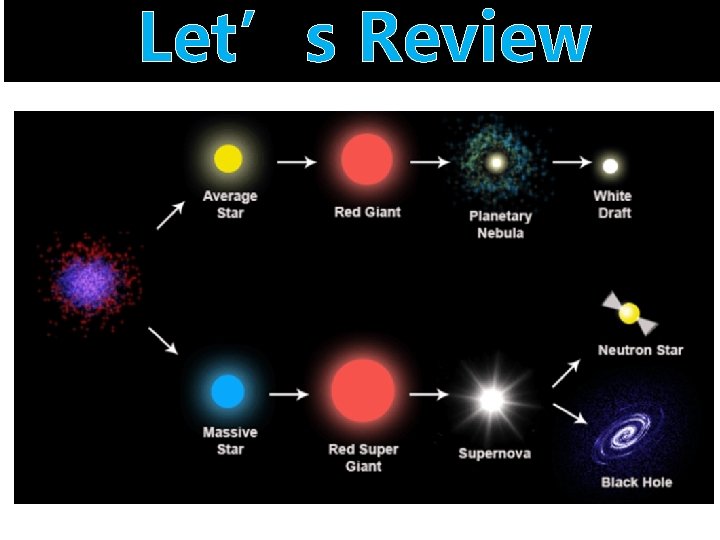
Let’s Review

Lab Group 1 (High-Mass Star Cycle): Rogelio, Samantha, Zach, Zander Group 2 (Medium Mass Star Cycle): Gabriel, Cesar, Isaac, Annett Group 3 (Super High Mass Star Cycle): Joe, Manuel, Cobe
- Slides: 20