
Life Cycle of Stars By Nicholas Frontera Lina
Life Cycle of Stars By: Nicholas Frontera & Lina Rocha
The main sequence • The main sequence is a band of stars. • They are classified into three parts. • The first is the upper left which is hot, blue, bright stars. • The lower left has cool, red, dim stars. • In the middle are yellow main sequence stars like the sun.
Dwarfs, Giants and Super Giants • Small red stars found in the main sequence are called white dwarfs. • In the upper level is filled with large red stars called giants. • The largest giants are called super giants. • The biggest super giant is called Antares it is 300 times bigger than the sun.
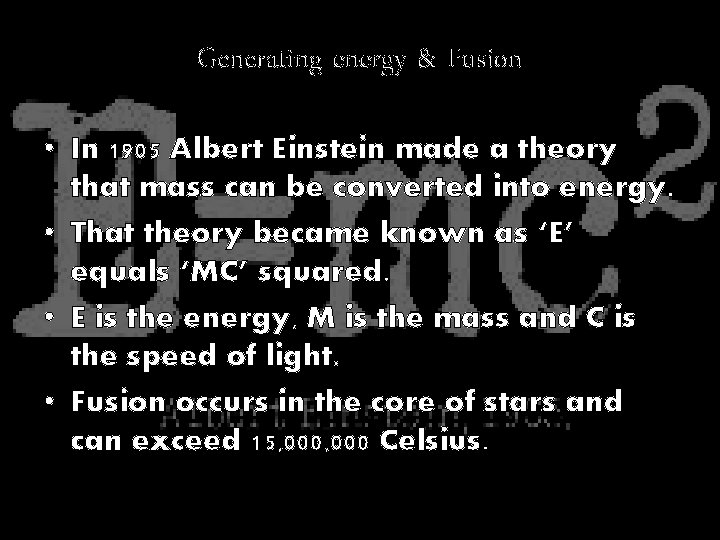
Generating energy & Fusion • In 1905 Albert Einstein made a theory that mass can be converted into energy. • That theory became known as ‘E’ equals ‘MC’ squared. • E is the energy, M is the mass and C is the speed of light. • Fusion occurs in the core of stars and can exceed 15, 000 Celsius.
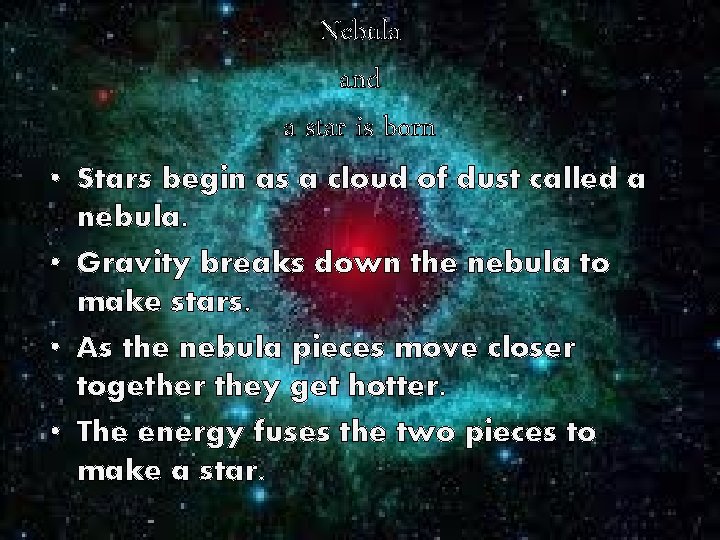
Nebula and a star is born • Stars begin as a cloud of dust called a nebula. • Gravity breaks down the nebula to make stars. • As the nebula pieces move closer together they get hotter. • The energy fuses the two pieces to make a star.
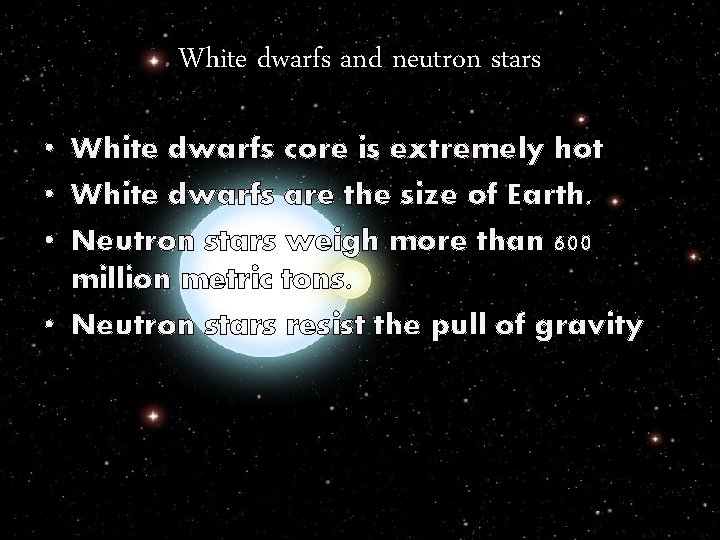
White dwarfs and neutron stars • White dwarfs core is extremely hot • White dwarfs are the size of Earth. • Neutron stars weigh more than 600 million metric tons. • Neutron stars resist the pull of gravity
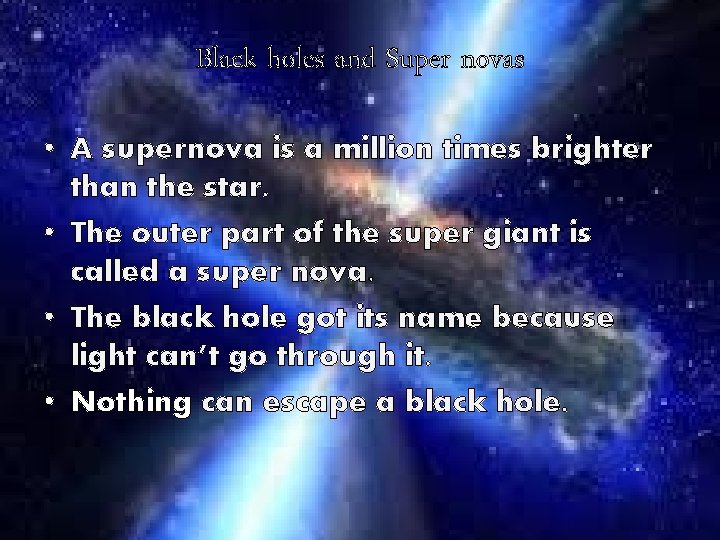
Black holes and Super novas • A supernova is a million times brighter than the star. • The outer part of the super giant is called a super nova. • The black hole got its name because light can’t go through it. • Nothing can escape a black hole.
- Slides: 7