
Life Cycle of a Trend Establishing baselines Detecting
Life Cycle of a Trend Establishing baselines Detecting a Trend What to do following a Trend How to re-baseline Hanford PI Forum
Introduction This presentation provides detailed information on • Establishing baselines • Detecting a Trend • What to do following a Trend • How to rebaseline Hanford PI Forum 2
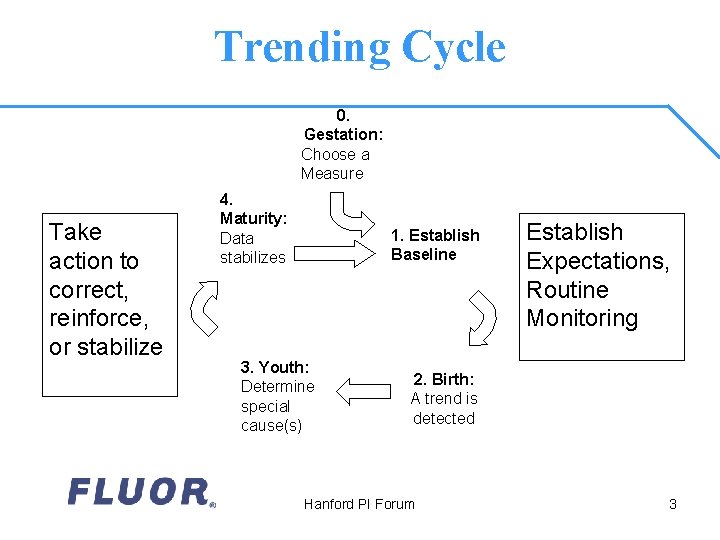
Trending Cycle 0. Gestation: Choose a Measure Take action to correct, reinforce, or stabilize 4. Maturity: Data stabilizes 1. Establish Baseline 3. Youth: Determine special cause(s) Establish Expectations, Routine Monitoring 2. Birth: A trend is detected Hanford PI Forum 3
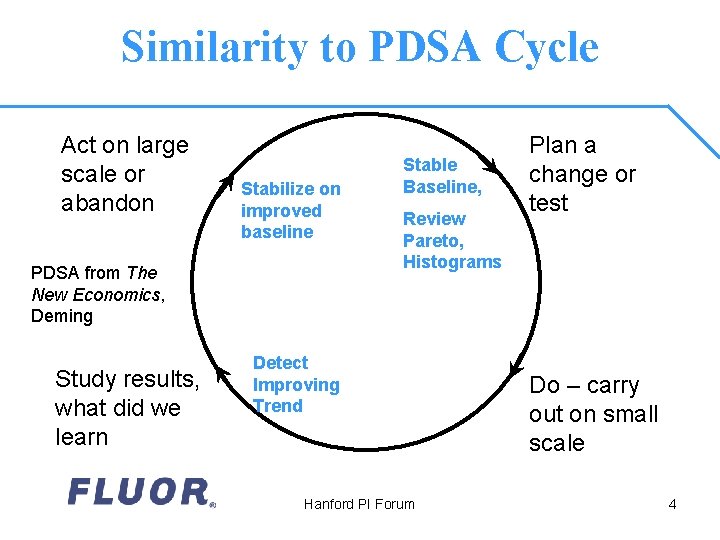
Similarity to PDSA Cycle Act on large scale or abandon Stabilize on improved baseline PDSA from The New Economics, Deming Study results, what did we learn Stable Baseline, Review Pareto, Histograms Detect Improving Trend Hanford PI Forum Plan a change or test Do – carry out on small scale 4
Gestation • Decide what to measure • http: //www. hanford. gov/safety/vpp/busobj 2. htm • • Develop Operational Definition Independent data, and do not cumulate Determine data source(s) Gather initial data, hopefully at least 25 data points of history Hanford PI Forum 5
Gathering Data • Check existing reporting systems. • Many organizations are awash in data, but the data have never been analyzed or put to use. • There is an advantage to using existing data, as it has already been paid for, and historic data for establishing the baseline should be available. Hanford PI Forum 6
Choosing Reporting Intervals • If a trend developed, how long could you go without needing to know it? Longer intervals imply more risk • Need sufficient volume of points (25) • Costs increase as reporting interval decreases • What is current reporting interval? Hanford PI Forum 7
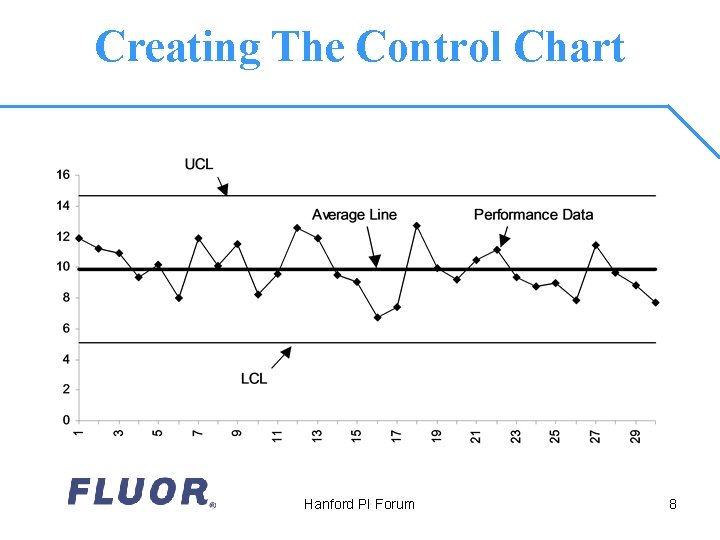
Creating The Control Chart Hanford PI Forum 8
The Baseline • The Baseline on a control chart consists of the average (center) line, a three-standard deviation Upper Control Limit (UCL) and a three-standard deviation Lower Control Limit (LCL). • The Baseline allows us to predict the future, and evaluate for trends. • A procedure for choosing the proper form of control chart, and calculating the baseline and control limits is available at http: //www. hanford. gov/safety/vpp/spc. htm. Hanford PI Forum 9

Establishing a Baseline • The goal is to establish one or more baseline time intervals with no trends within each interval. • The “MW Rule” helps to show if a baseline is likely to be “good”. • A “good” baseline detects future trends with a minimum of false alarms. • If a trend is detected, we don’t want it to be due to too few data points in the baseline, causing the baseline to have been inaccurate. Hanford PI Forum 10
“MW” Rule 3 changes of Direction Hanford PI Forum 11
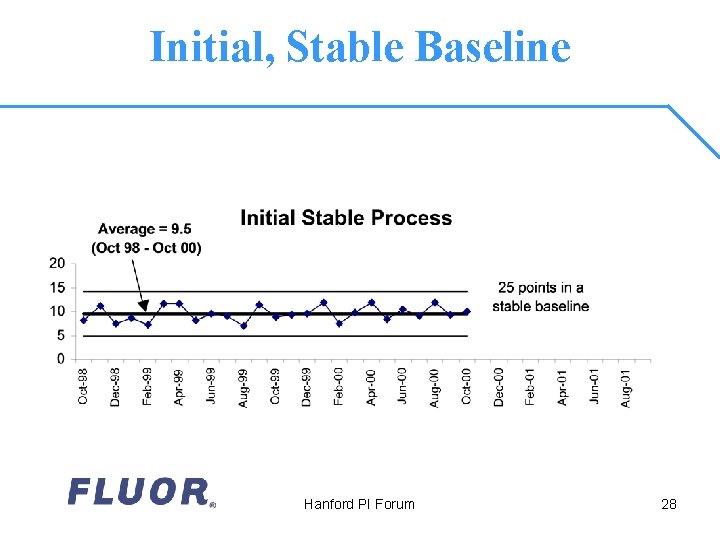
Initial Strategy • Use the first 25 points for a trial baseline • If less than 25, use all points, assuming MW rule is met • Evaluate for trends within this trial baseline • NOTE: Do not change a baseline unless it is “proven guilty” by a Trend Hanford PI Forum 12
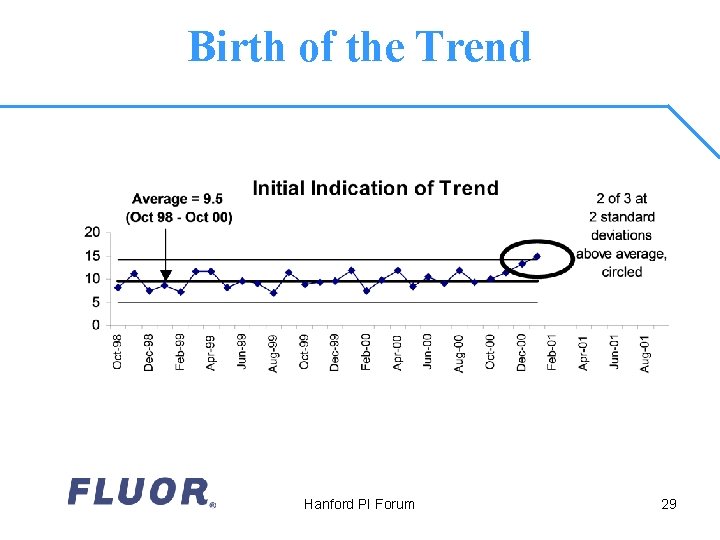
This is a Trend! • One point outside the control limits • Two out of Three points two standard deviations above/below average • Four out of Five points one standard deviation above/below average • Seven points in a row all above/below average • Ten out of Eleven points in a row all above/below average • Seven points in a row all increasing/decreasing. Hanford PI Forum 13
Remove any Trends from the Trial Baseline Do show all data, but change the average and control limit calculations by: • Dropping data off of the beginning • Dropping data off of the end • Dropping individual datum point(s) and circling them • Split into two or more baselines Hanford PI Forum 14
Initial Baseline • In all cases, trends should be investigated to determine the special cause(s) • A circle or a shift in the baseline is a trend • Generally, short term shifts are left circled, long term shifts have a new baseline • Remember – the goal is Prediction of Future Performance Hanford PI Forum 15
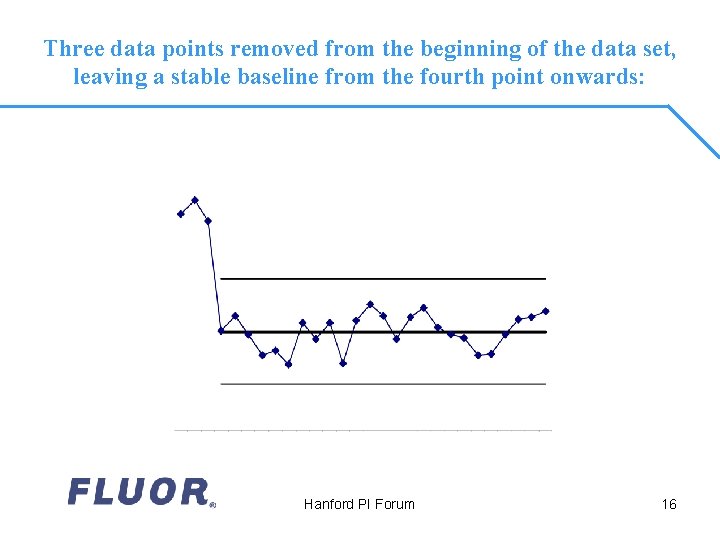
Three data points removed from the beginning of the data set, leaving a stable baseline from the fourth point onwards: Hanford PI Forum 16
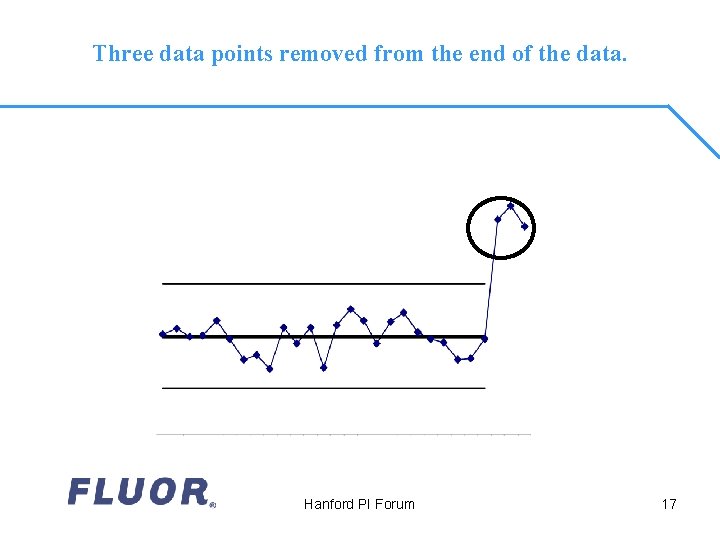
Three data points removed from the end of the data. Hanford PI Forum 17
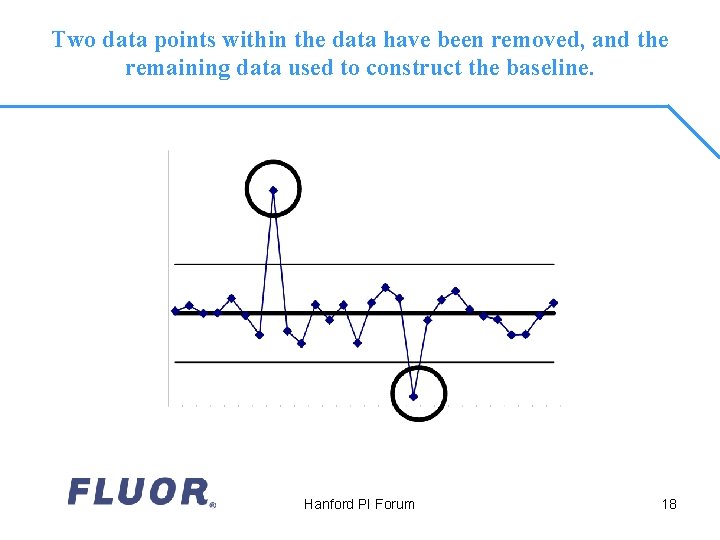
Two data points within the data have been removed, and the remaining data used to construct the baseline. Hanford PI Forum 18
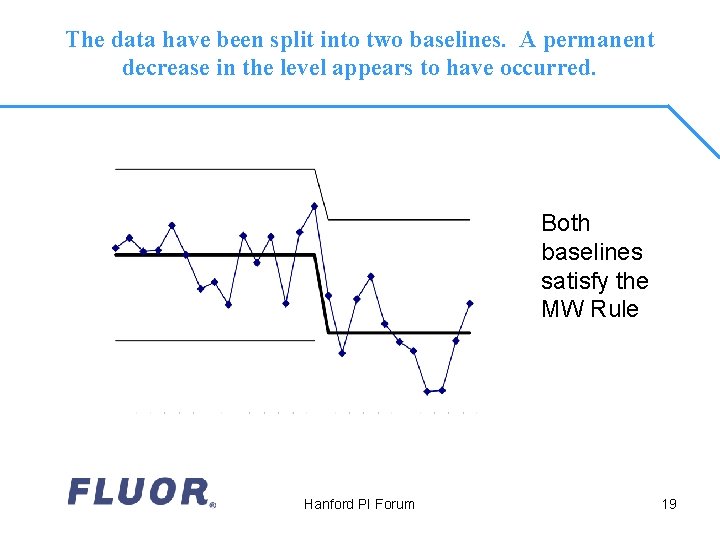
The data have been split into two baselines. A permanent decrease in the level appears to have occurred. Both baselines satisfy the MW Rule Hanford PI Forum 19
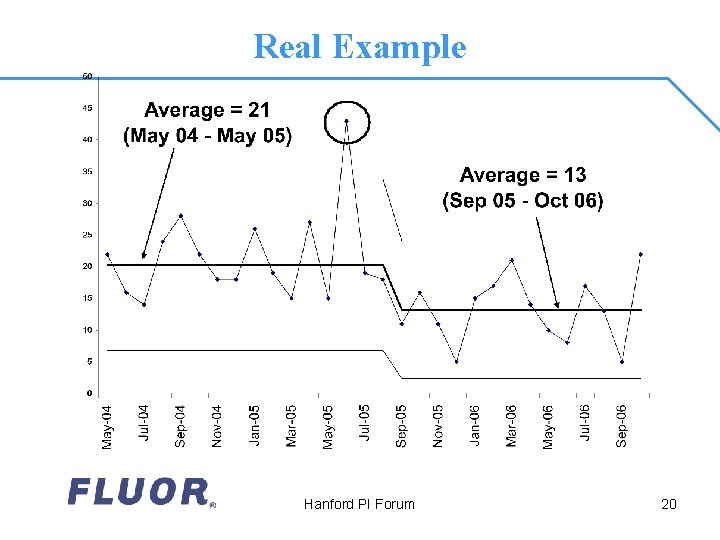
Real Example Hanford PI Forum 20
Standard Deviation • Traditionally, the average range has been used to calculate standard deviation • I have found that the statistical standard deviation works well and is easier to calculate in Excel • Watch out for outliers inflating the standard deviation, however Hanford PI Forum 21
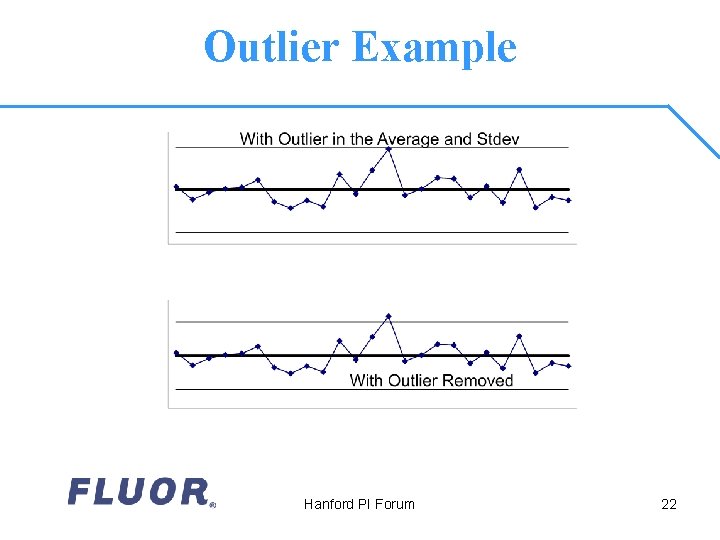
Outlier Example Hanford PI Forum 22
Low Rate Trending If zeroes are causing problems: • Leave runs of 7 or more zeroes out (they will always be below average) • Lengthen the data interval (i. e. from monthly to quarterly) • Try “Low Rate Trending” (http: //www. hanford. gov/safety/vpp/lowrate. htm) Hanford PI Forum 23
Low Rate Trending Description • Order the data by date of occurrence • Determine the number of days between events • Divide the number of days between events into 365 • Plot the resulting rate per year in the date sequence on an x-chart control chart Hanford PI Forum 24
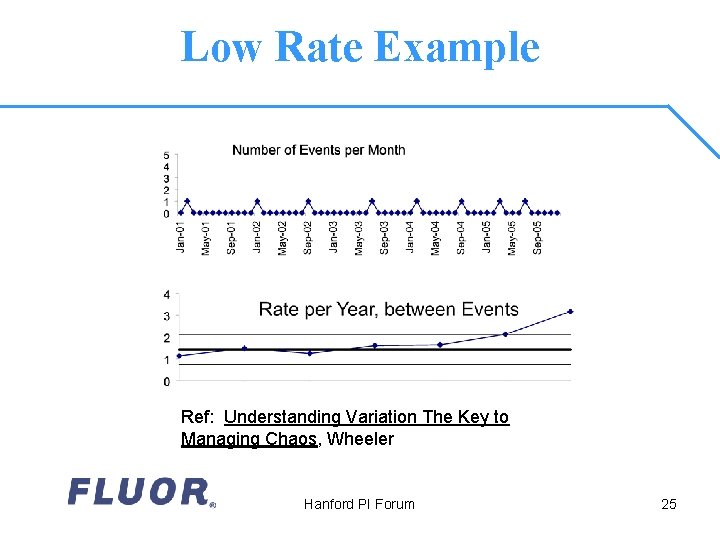
Low Rate Example Ref: Understanding Variation The Key to Managing Chaos, Wheeler Hanford PI Forum 25
Establish Expectations • “Stable” performance is not necessarily good • Management needs to determine if the current stable baseline is “acceptable” or “unacceptable” • May use benchmarks, customer opinion, risk analysis, or management philosophy to make this decision Hanford PI Forum 26
Monitoring • Update charts on the required time interval • Check for trends against the trending rules • Circle any trends, inform owning management and look for special cause(s) • Do not shift a baseline unless there is a trend (baseline proven guilty) • The following slides show an example trend’s life cycle Hanford PI Forum 27
Initial, Stable Baseline Hanford PI Forum 28
Birth of the Trend Hanford PI Forum 29
Initial Actions • Report the trend • Search for Special Causes • Compare Pareto chart of detailed data during the trend to previous stable time interval • Consider Corrective Action Management necessary steps (HNF-PRO-052) Hanford PI Forum 30
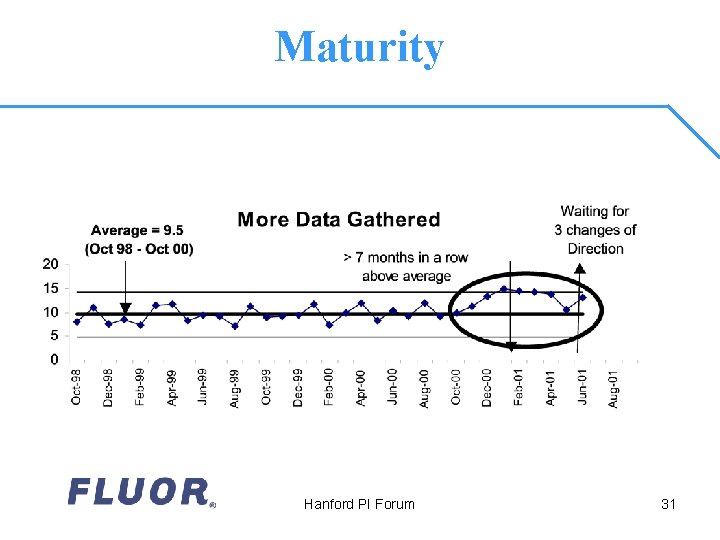
Maturity Hanford PI Forum 31
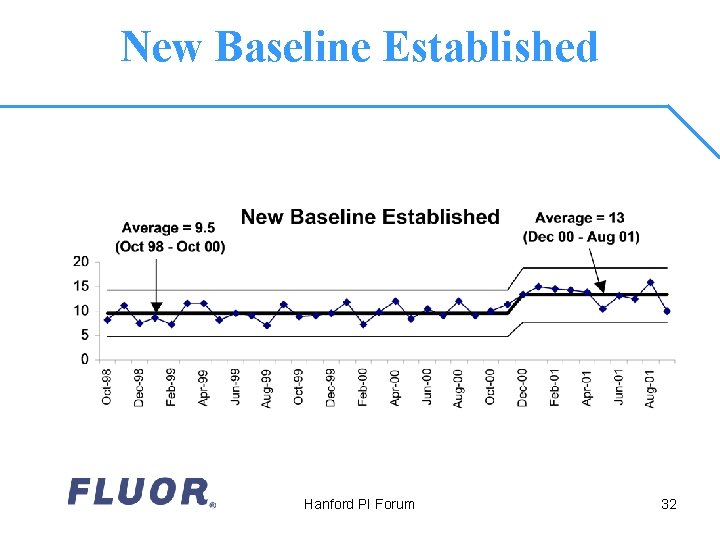
New Baseline Established Hanford PI Forum 32
Conclusion • We can continue to practice with real data and charts in future PI Forums • These strategies fit well with the Control Chart Dashboard process • Proper trending and actions taken will lead to significantly improved performance Hanford PI Forum 33
- Slides: 33