
Life Cycle of a Trade Mark Daniel HardmanSmart


- Slides: 13
Life Cycle of a Trade Mark Daniel Hardman-Smart, Stobbs CITMA Paralegal Course
Life Cycle of a Trade Mark – Typical life cycle of a trade mark – “Cradle to grave” – or involved only on a few touchpoints – The steps do not apply to every trade mark, or necessarily in the order we will go through, but are commonplace CITMA Paralegal Course
Contents – – – – – Selection Searching Filing Prosecution Registration Renewal Recording changes to the Register Commercialisation Watching » » » Enforcement Disposal – Setting the scene for the rest of the course CITMA Paralegal Course
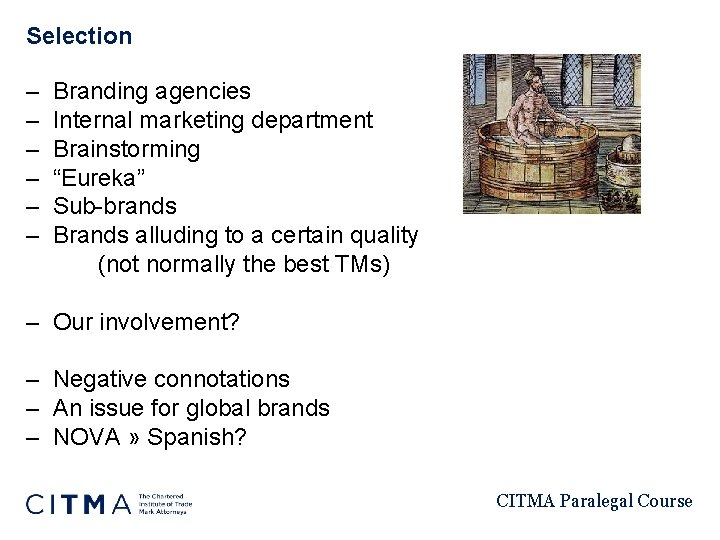
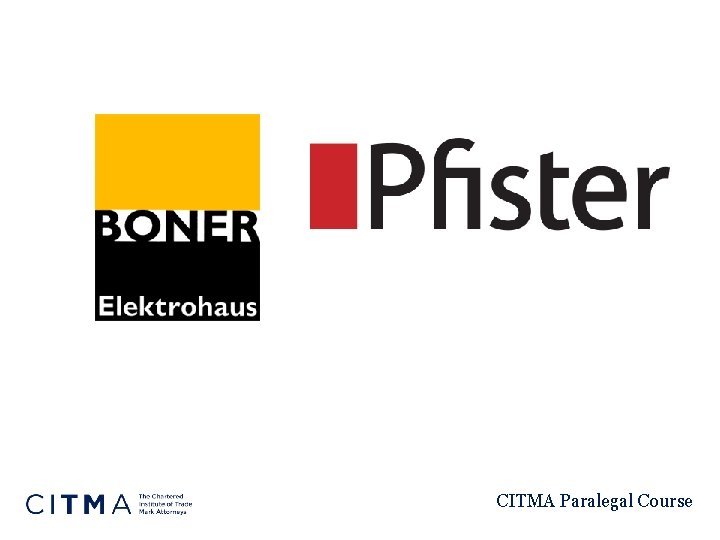
Selection – – – Branding agencies Internal marketing department Brainstorming “Eureka” Sub-brands Brands alluding to a certain quality (not normally the best TMs) – Our involvement? – Negative connotations – An issue for global brands – NOVA » Spanish? CITMA Paralegal Course
CITMA Paralegal Course
Searching – Trade marks are searched to check that identical or similar trade marks do not already exist – Two-tiered approach common: 1. Screening – identical searches for straight knock-outs 2. Full Clearance searching – Searching is a step that is sometimes skipped – not recommended! CITMA Paralegal Course
Domain names – First-come, first-served – If available, often secured at this stage inexpensive – Global brand may want e. g. . com and key cc. TLDs CITMA Paralegal Course
Filing & Prosecution & Registration – Probably the area you’re most involved in – and I will cover it in one slide �� – Filing: an application is then filed with the relevant Trade Marks Registry – Prosecution: this involves dealing with any objections raised by the Trade Marks Registry and/or third parties – Hopefully, there are none or all objections are overcome and the mark proceeds to registration – Registration: where a Certificate of Registration is issued and you now have registered trade mark rights CITMA Paralegal Course
Renewal – In most countries, trade marks are registered for 10 years and at the end of that 10 years they must be renewed – This involves some fees and formalities CITMA Paralegal Course
Changes to the Register – Also known as Recordals – Sometimes it is necessary to record Changes to the Register of Trade Marks, for example: • The trade mark owner changes their or address • A new owner takes over ownership by buying a trade mark registration • A trade mark is used as security against a loan name CITMA Paralegal Course
Commercialisation – Once your trade mark is known, you will want to capitalise on this – Naturally, the owner can use the TM themselves but it's also possible to license a trade mark (allow another party to use it) – A licensing program can involve a third party being allowed to use a TM on merchandise items like clothes, bags, toys, mugs, key rings and so on CITMA Paralegal Course
Watching – It is important to keep an eye out for later filed trade marks that might conflict with yours – Usually done through employing a watching service – Then it is possible to contact third parties or file oppositions against similar and identical marks – Enforcement can be part of the trade mark lifecycle CITMA Paralegal Course
Disposal – When a TM is no longer required – You can dispose of it: • Voluntarily surrenderring/cancelling it • Sell it to a third party • Allow it to lapse (expire) at its next renewal date • Appropriately, this is THE END CITMA Paralegal Course