
LIFE CYCLE OF A STAR PROTOSTAR First stage
- Slides: 15
LIFE CYCLE OF A STAR
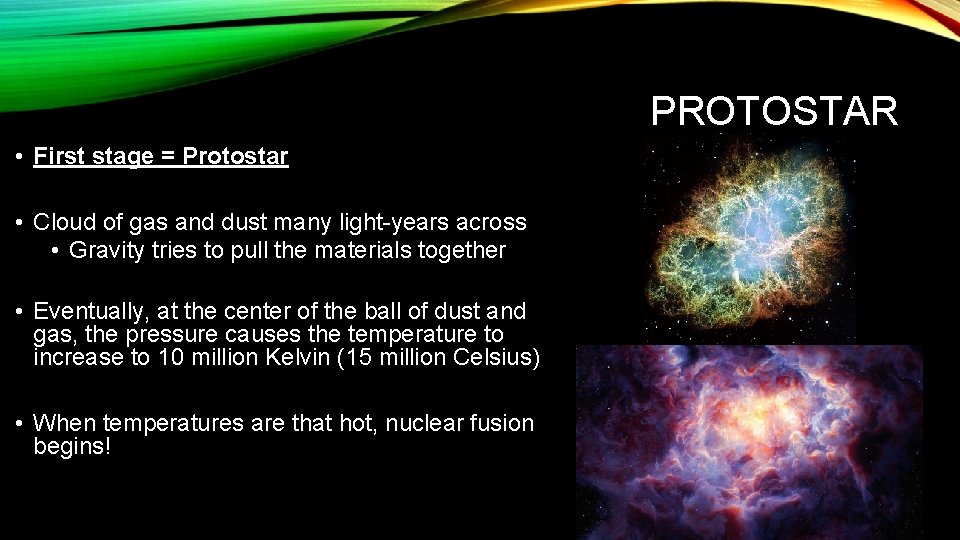
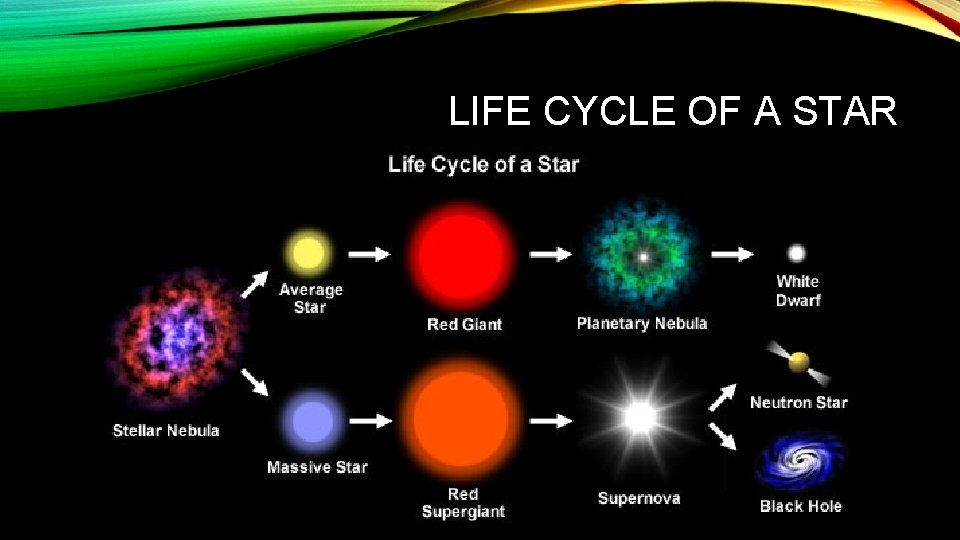
PROTOSTAR • First stage = Protostar • Cloud of gas and dust many light-years across • Gravity tries to pull the materials together • Eventually, at the center of the ball of dust and gas, the pressure causes the temperature to increase to 10 million Kelvin (15 million Celsius) • When temperatures are that hot, nuclear fusion begins!
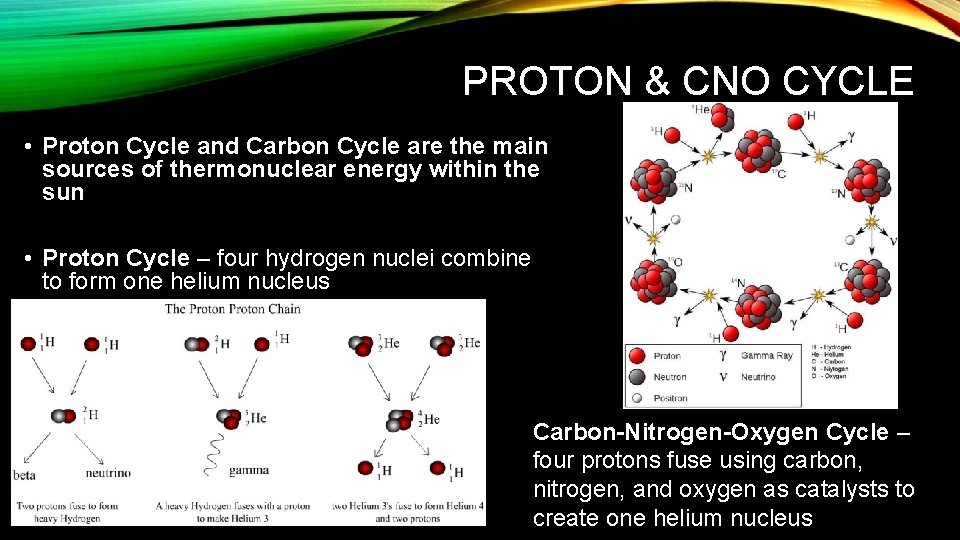
PROTON & CNO CYCLE • Proton Cycle and Carbon Cycle are the main sources of thermonuclear energy within the sun • Proton Cycle – four hydrogen nuclei combine to form one helium nucleus Carbon-Nitrogen-Oxygen Cycle – four protons fuse using carbon, nitrogen, and oxygen as catalysts to create one helium nucleus
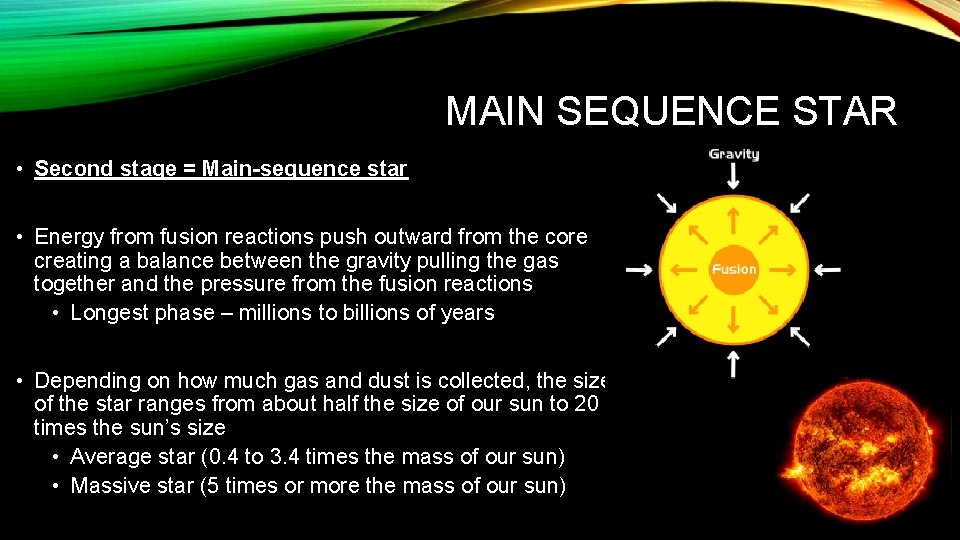
MAIN SEQUENCE STAR • Second stage = Main-sequence star • Energy from fusion reactions push outward from the core creating a balance between the gravity pulling the gas together and the pressure from the fusion reactions • Longest phase – millions to billions of years • Depending on how much gas and dust is collected, the size of the star ranges from about half the size of our sun to 20 times the sun’s size • Average star (0. 4 to 3. 4 times the mass of our sun) • Massive star (5 times or more the mass of our sun)
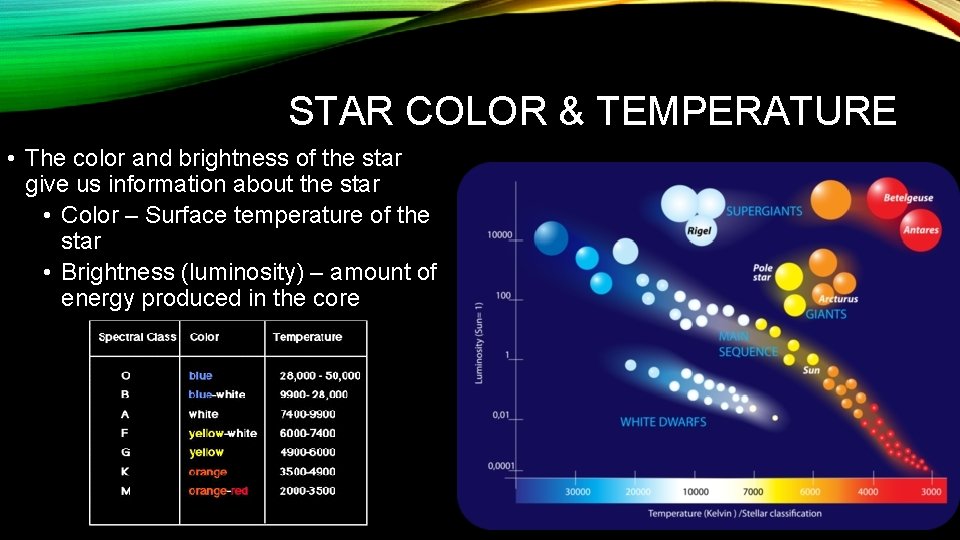
STAR COLOR & TEMPERATURE • The color and brightness of the star give us information about the star • Color – Surface temperature of the star • Brightness (luminosity) – amount of energy produced in the core
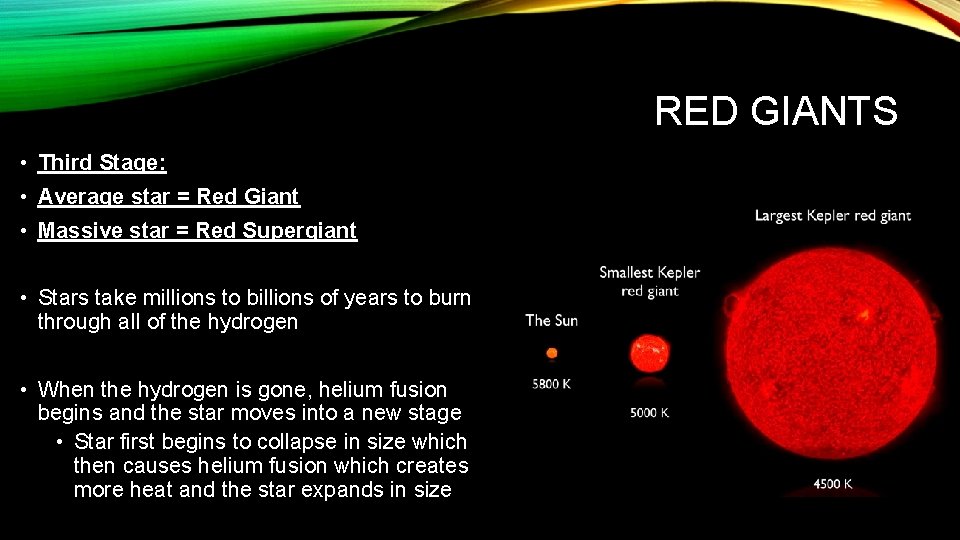
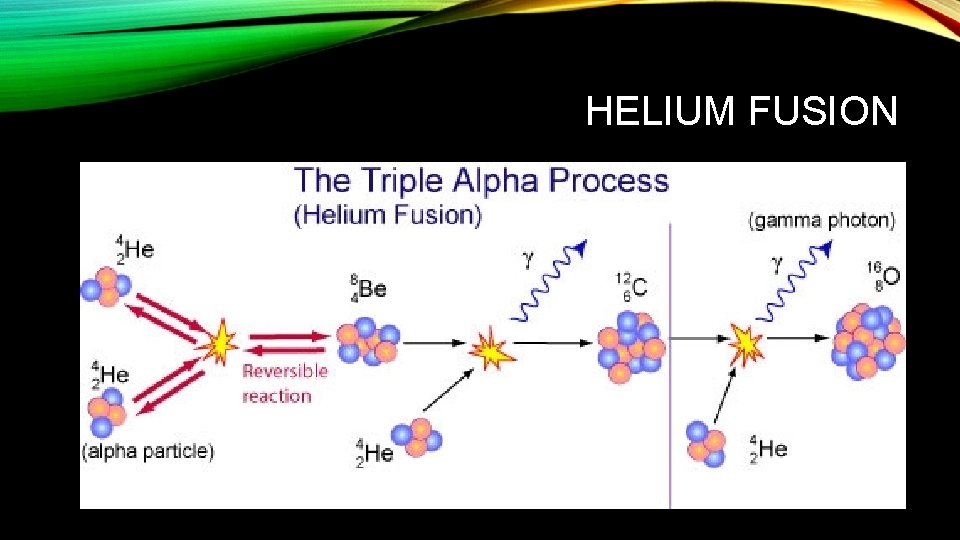
RED GIANTS • Third Stage: • Average star = Red Giant • Massive star = Red Supergiant • Stars take millions to billions of years to burn through all of the hydrogen • When the hydrogen is gone, helium fusion begins and the star moves into a new stage • Star first begins to collapse in size which then causes helium fusion which creates more heat and the star expands in size
HELIUM FUSION
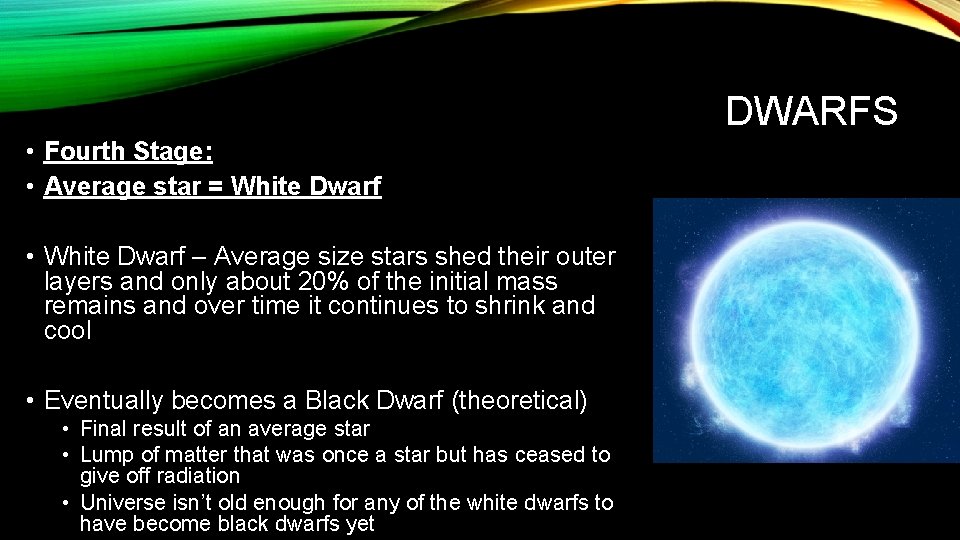
DWARFS • Fourth Stage: • Average star = White Dwarf • White Dwarf – Average size stars shed their outer layers and only about 20% of the initial mass remains and over time it continues to shrink and cool • Eventually becomes a Black Dwarf (theoretical) • Final result of an average star • Lump of matter that was once a star but has ceased to give off radiation • Universe isn’t old enough for any of the white dwarfs to have become black dwarfs yet
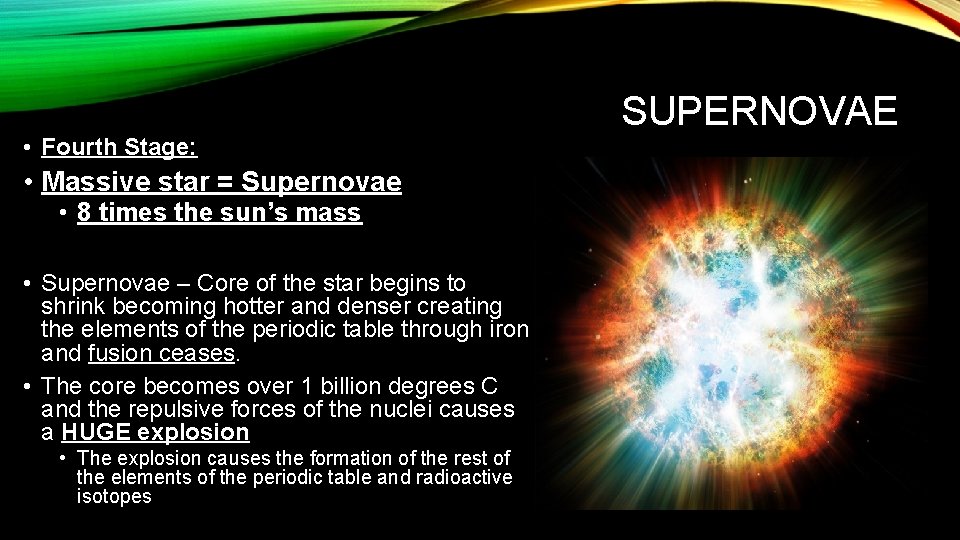
• Fourth Stage: • Massive star = Supernovae • 8 times the sun’s mass • Supernovae – Core of the star begins to shrink becoming hotter and denser creating the elements of the periodic table through iron and fusion ceases. • The core becomes over 1 billion degrees C and the repulsive forces of the nuclei causes a HUGE explosion • The explosion causes the formation of the rest of the elements of the periodic table and radioactive isotopes SUPERNOVAE
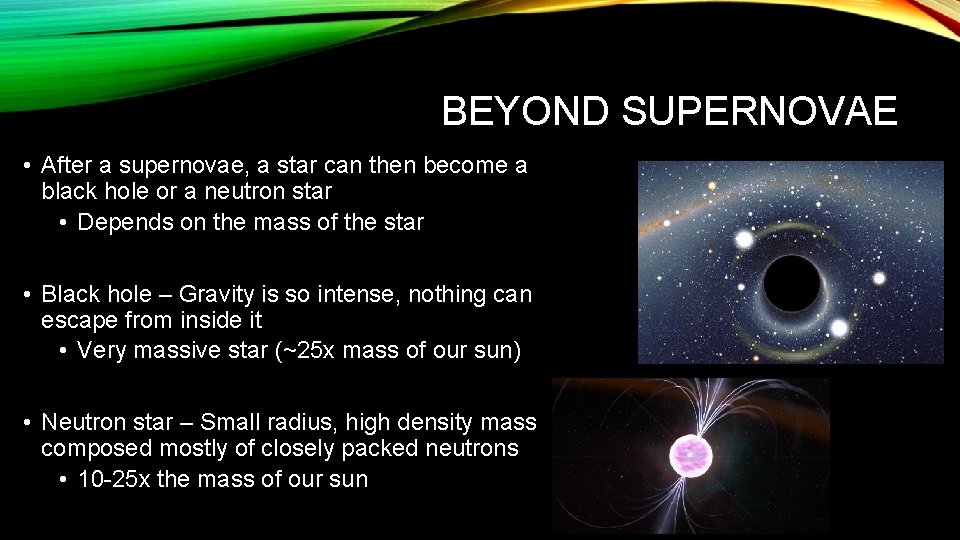
BEYOND SUPERNOVAE • After a supernovae, a star can then become a black hole or a neutron star • Depends on the mass of the star • Black hole – Gravity is so intense, nothing can escape from inside it • Very massive star (~25 x mass of our sun) • Neutron star – Small radius, high density mass composed mostly of closely packed neutrons • 10 -25 x the mass of our sun
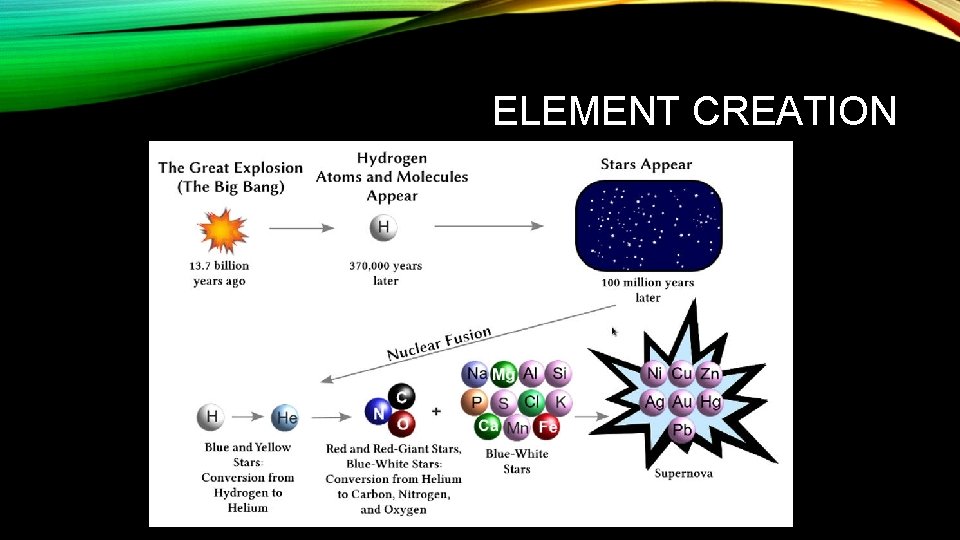
ELEMENT CREATION
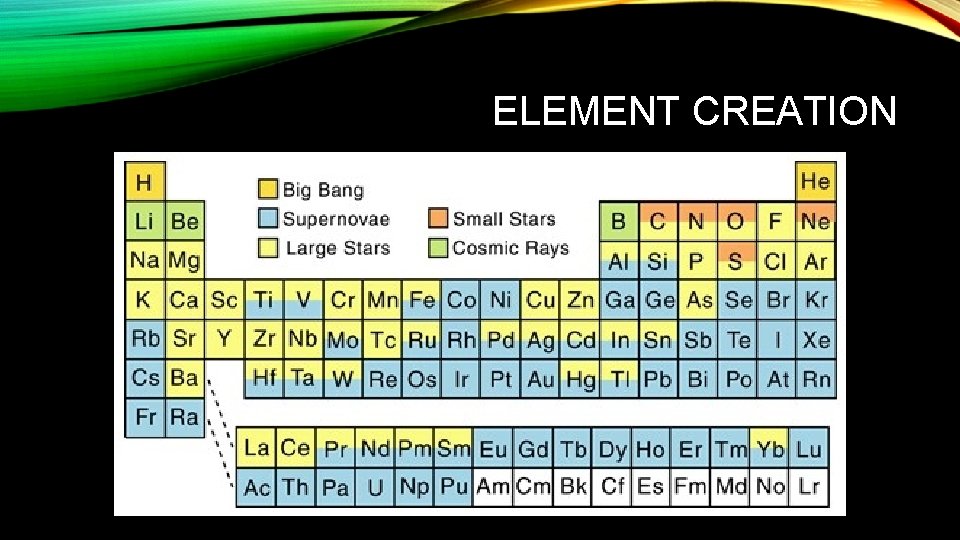
ELEMENT CREATION
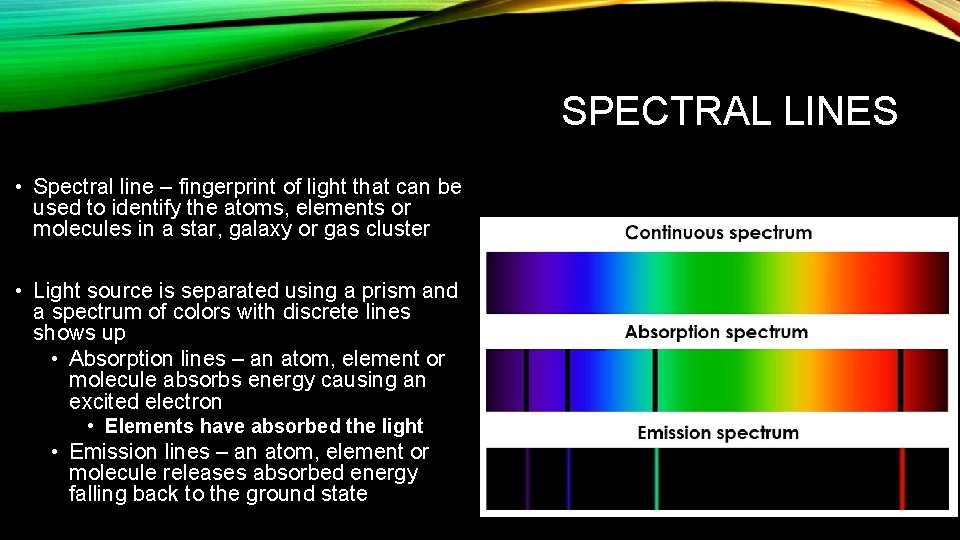
SPECTRAL LINES • Spectral line – fingerprint of light that can be used to identify the atoms, elements or molecules in a star, galaxy or gas cluster • Light source is separated using a prism and a spectrum of colors with discrete lines shows up • Absorption lines – an atom, element or molecule absorbs energy causing an excited electron • Elements have absorbed the light • Emission lines – an atom, element or molecule releases absorbed energy falling back to the ground state
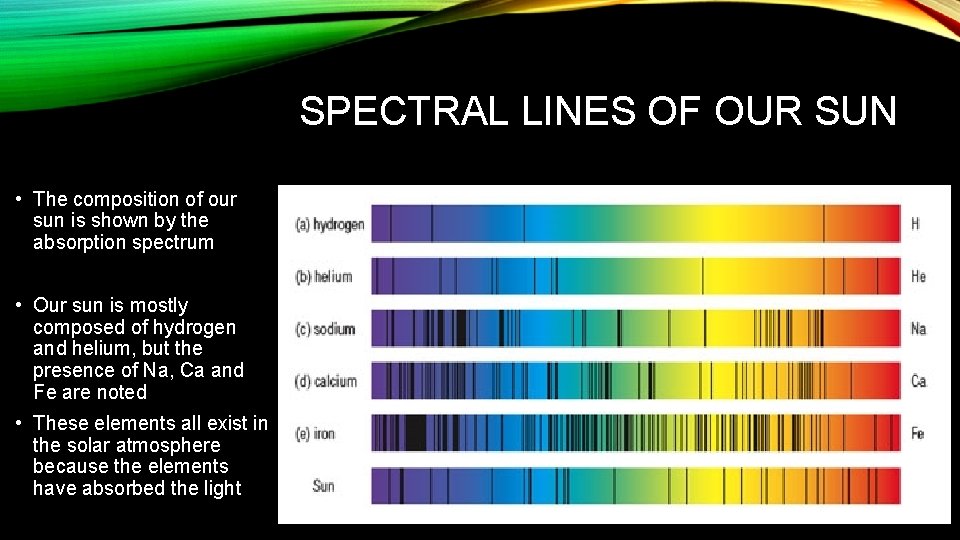
SPECTRAL LINES OF OUR SUN • The composition of our sun is shown by the absorption spectrum • Our sun is mostly composed of hydrogen and helium, but the presence of Na, Ca and Fe are noted • These elements all exist in the solar atmosphere because the elements have absorbed the light
LIFE CYCLE OF A STAR