
LIFE CYCLE OF A SHIP TOPIC 5 LIFECYCLE




- Slides: 16
LIFE CYCLE OF A SHIP TOPIC 5
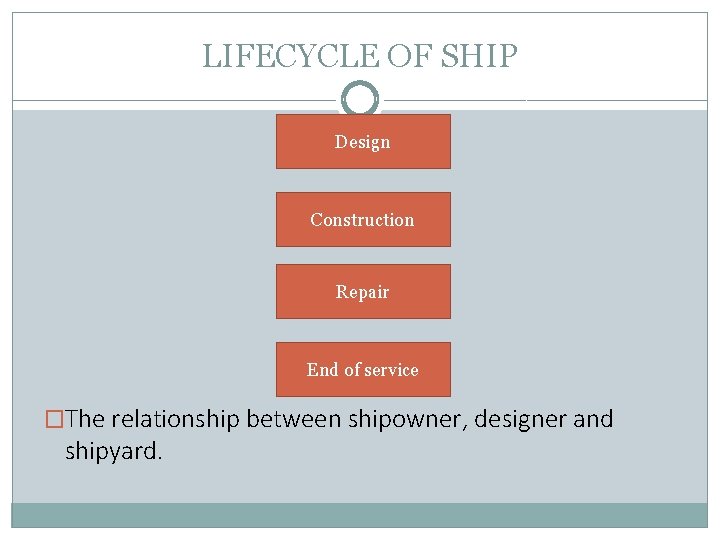
LIFECYCLE OF SHIP Design Construction Repair End of service �The relationship between shipowner, designer and shipyard.
Design �The design phase carried out by a naval architect. �A vessel's design starts with a specification. �The architect create an initial hull design, a general profile and an initial overview of the ship's propulsion.
GREEN SHIP �The objective of green shipbuilding – to minimize the harmful emission during design, manufacturing, service in order and end of her services to reduce the pollution to air, water and soil, save resources and improve economical. �Green ship mainly depends on green design. �Ships should be designed to enable them to give minimal effect on the environment during manufacturing and service.
Keys to Green Ship : �Reduce the consumption of materials and energy and the pollution to the environment. �Recycle the parts and accessories in ship maintenance. �Reuse the majority of materials after ship laying up.
The Ultimate Green Ship 1. No Ballast System 2. Sulphur Scrubber System 3. Advanced Rudder and Propeller System 4. LNG Fuel for Propulsion 5. LNG Fuel for Auxiliary engine 6. Speed Nozzle 7. Hull Paint 8. Waste Heat Recovery System 9. Sail and Kite Propulsion System
Construction �Ship construction takes place in a shipyard. �Hull materials and vessel size play a large part in determining the method of construction. �Construction starts with the hull by the laying of the keel. This is done in a drydock or on land. �Once the hull is assembled and painted, it is launched.
�The last stages, raising the superstructure and adding equipment and accommodation. �Once completed, the vessel is delivered to the customer. �Ship launching is often a ceremony of some significance, and is usually when the vessel is formally named.
Repair �Ships undergo constant maintenance during their career. �Tasks often done at drydock include removing biological growths on the hull, sandblasting and repainting the hull, and replacing sacrificial anodes used to protect submerged equipment from corrosion. �Major repairs to the propulsion and steering systems as well as major electrical systems are also often performed at dry dock.
End of Service �Most ocean-going cargo ships have a life expectancy of between 20 and 30 years. �At the end of ship lifetime, the ship is transported to the yard for demolition. It can be scrapped by shipbreakers. �Ship scrapping causes pollution of air and water as well as solid wastes. �Demand for recycling of ship components is high due to the rising raw materials cost.
�The waste is sent to different place where could be incinerated, landfills, or recycling. �Ships can also be used as museum ships, restaurants, hotels, or expended to construct breakwaters or artificial reefs.
IMO Sub Committee �Under the direct instructions of the Maritime Safety Committee and as may be requested by the Marine Environment Protection Committee, �Sub-Committee on Ship Design and Equipment (DE) will consider matters related to the following subjects: 1. 2. development of any necessary amendments to relevant conventions and other mandatory and non-mandatory instruments preparation of new mandatory and nonmandatory instruments, guidelines and recommendations,
v Sub-Committee on Ship Design and Equipment (DE) 1. design, construction, structure, equipment, machinery installations and electrical installations of all types of ships, vessels and craft covered by IMO instruments; 2. life-saving equipment, appliances and arrangements; and 3. survey and certification.
Mandatory Instruments 1. 1974 SOLAS Convention (chapters I, II-1, 2. 3. 4. 5. 6. III, X, XI-1 and XII) and the 1988 Protocol MARPOL 73/78 (Annexes I and IV) International Life-Saving Appliance (LSA) Code; International Code of Safety for High-Speed Craft (HSC Code), 1994 and 2000 Guidelines on the enhanced programme of inspections during surveys of bulk carriers and oil tankers (resolution A. 744(18)) Condition Assessment Scheme (CAS).
Non-mandatory Instruments 1. Code of Safety for Dynamically Supported 2. 3. 4. 5. Craft (DSC Code) Code for the Construction and Equipment of Mobile Offshore Drilling Units (MODU Code) Code of Safe Practice for the Carriage of Cargoes and Persons by Offshore Supply Vessels (OSV Code) Code of Safety for Diving Systems Code of Safety for Special Purpose Ships (SPS Code)
6. Code on Alarms and Indicators 7. Code on Noise Level on Board Ships 8. Interim Guidelines for Wing-In-Ground (WIG) Craft 9. Standards for Ship Manoeuvrability 10. Guidelines for the Design, Construction and Operation of Passenger Submersible Craft 11. Guidelines for Ships Operating in Arctic Ice -Covered Waters.