
Life Cycle Models for High Technology Projects Applying

- Slides: 45
Life Cycle Models for High. Technology Projects Applying Systems Thinking to Managing Projects Russ Archibald, PMP, FPMI Russ Archibald PMI-Central Iowa Chapter PDD Oct. 17 2003
Purpose of My Presentation n To enhance your ability to: n n n Develop the best life cycle model for your projects Document your Project Life Cycle Management System/PLCMS Improve your PLCMS through systems thinking Russ Archibald PMI-Central Iowa Chapter PDD Oct. 17 2003 2
Presentation Outline 1. 2. 3. 4. 5. Categorizing Projects Project Life Cycle Models & PLCMS Hi-Tech Project Categories & Their Life Cycles Improving the PLCMS Conclusions Russ Archibald PMI-Central Iowa Chapter PDD Oct. 17 2003 3
1. Categorizing Projects n Projects: n n Are the common denominator for all aspects of project management Exist in many sizes & types Produce many different products & results Can be classified in many different ways Russ Archibald PMI-Central Iowa Chapter PDD Oct. 17 2003 4
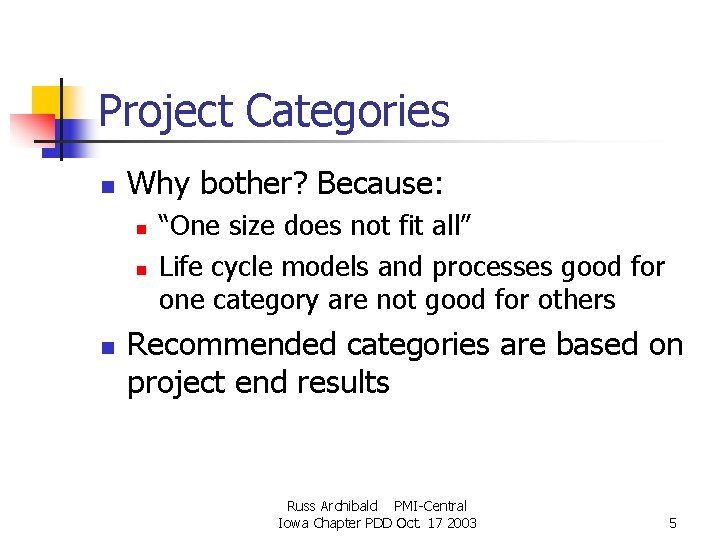
Project Categories n Why bother? Because: n n n “One size does not fit all” Life cycle models and processes good for one category are not good for others Recommended categories are based on project end results Russ Archibald PMI-Central Iowa Chapter PDD Oct. 17 2003 5
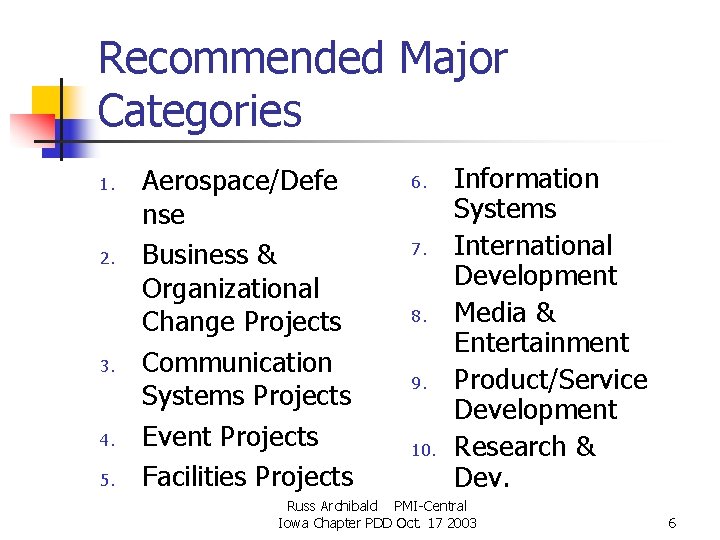
Recommended Major Categories 1. 2. 3. 4. 5. Aerospace/Defe nse Business & Organizational Change Projects Communication Systems Projects Event Projects Facilities Projects 6. 7. 8. 9. 10. Information Systems International Development Media & Entertainment Product/Service Development Research & Dev. Russ Archibald PMI-Central Iowa Chapter PDD Oct. 17 2003 6
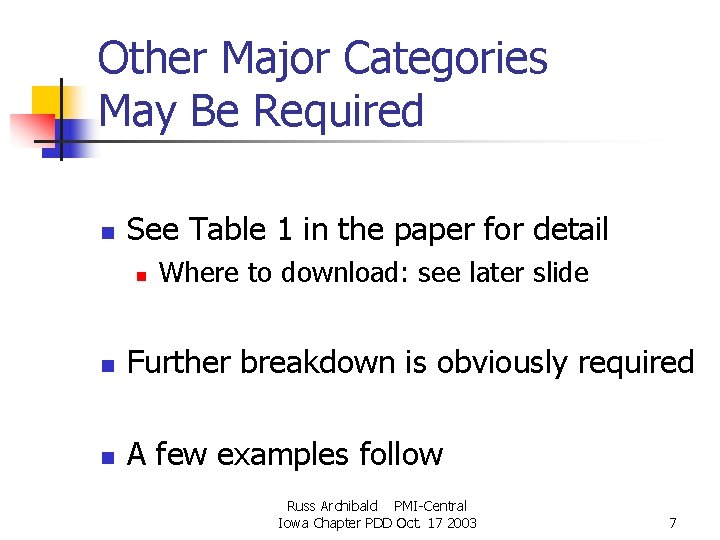
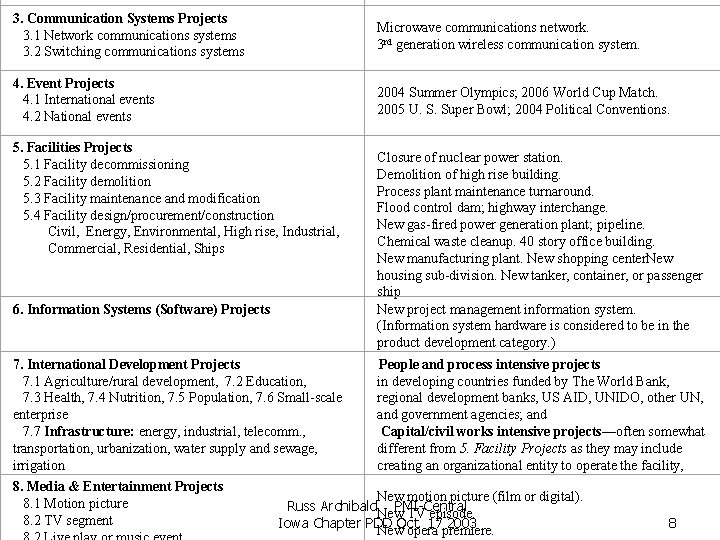
Other Major Categories May Be Required n See Table 1 in the paper for detail n Where to download: see later slide n Further breakdown is obviously required n A few examples follow Russ Archibald PMI-Central Iowa Chapter PDD Oct. 17 2003 7
3. Communication Systems Projects 3. 1 Network communications systems 3. 2 Switching communications systems Microwave communications network. 3 rd generation wireless communication system. 4. Event Projects 4. 1 International events 4. 2 National events 2004 Summer Olympics; 2006 World Cup Match. 2005 U. S. Super Bowl; 2004 Political Conventions. 5. Facilities Projects 5. 1 Facility decommissioning 5. 2 Facility demolition 5. 3 Facility maintenance and modification 5. 4 Facility design/procurement/construction Civil, Energy, Environmental, High rise, Industrial, Commercial, Residential, Ships 6. Information Systems (Software) Projects 7. International Development Projects 7. 1 Agriculture/rural development, 7. 2 Education, 7. 3 Health, 7. 4 Nutrition, 7. 5 Population, 7. 6 Small-scale enterprise 7. 7 Infrastructure: energy, industrial, telecomm. , transportation, urbanization, water supply and sewage, irrigation 8. Media & Entertainment Projects 8. 1 Motion picture 8. 2 TV segment Closure of nuclear power station. Demolition of high rise building. Process plant maintenance turnaround. Flood control dam; highway interchange. New gas-fired power generation plant; pipeline. Chemical waste cleanup. 40 story office building. New manufacturing plant. New shopping center. New housing sub-division. New tanker, container, or passenger ship New project management information system. (Information system hardware is considered to be in the product development category. ) People and process intensive projects in developing countries funded by The World Bank, regional development banks, US AID, UNIDO, other UN, and government agencies; and Capital/civil works intensive projects—often somewhat different from 5. Facility Projects as they may include creating an organizational entity to operate the facility, New motion picture (film or digital). Russ Archibald PMI-Central New TV episode. Iowa Chapter PDD Oct. 17 2003 New opera premiere. 8
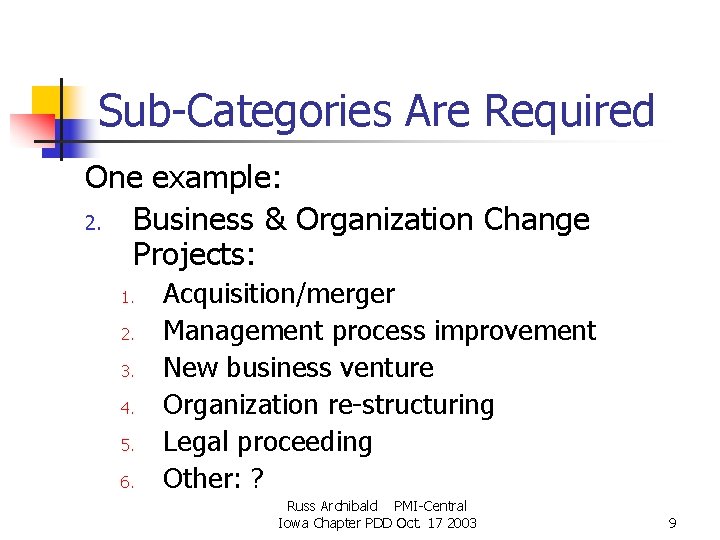
Sub-Categories Are Required One example: 2. Business & Organization Change Projects: 1. 2. 3. 4. 5. 6. Acquisition/merger Management process improvement New business venture Organization re-structuring Legal proceeding Other: ? Russ Archibald PMI-Central Iowa Chapter PDD Oct. 17 2003 9
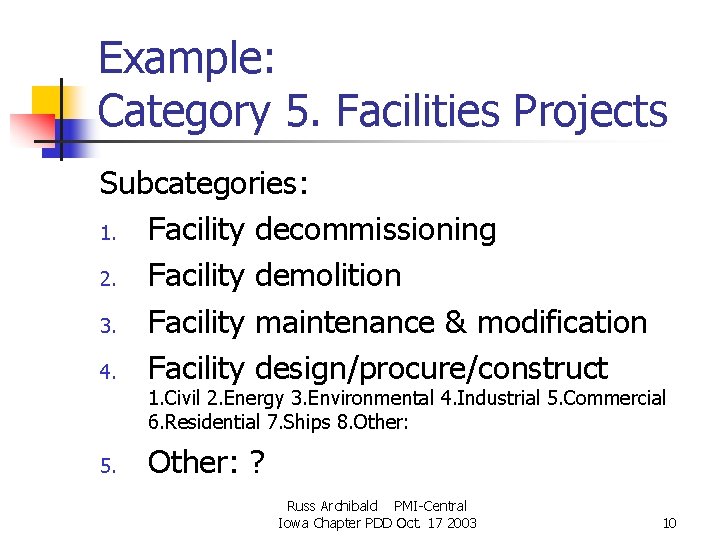
Example: Category 5. Facilities Projects Subcategories: 1. Facility decommissioning 2. Facility demolition 3. Facility maintenance & modification 4. Facility design/procure/construct 1. Civil 2. Energy 3. Environmental 4. Industrial 5. Commercial 6. Residential 7. Ships 8. Other: 5. Other: ? Russ Archibald PMI-Central Iowa Chapter PDD Oct. 17 2003 10
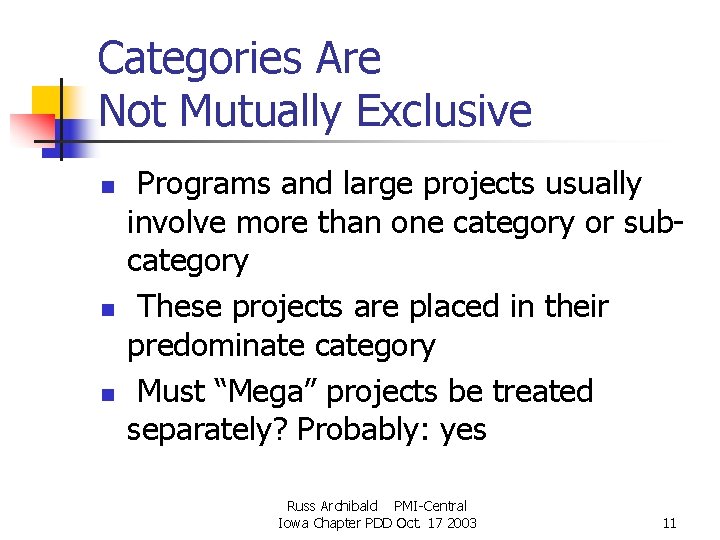
Categories Are Not Mutually Exclusive n n n Programs and large projects usually involve more than one category or subcategory These projects are placed in their predominate category Must “Mega” projects be treated separately? Probably: yes Russ Archibald PMI-Central Iowa Chapter PDD Oct. 17 2003 11
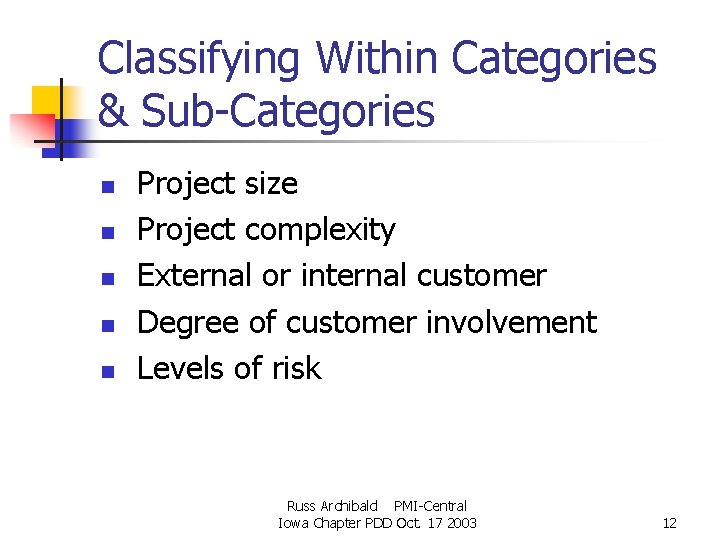
Classifying Within Categories & Sub-Categories n n n Project size Project complexity External or internal customer Degree of customer involvement Levels of risk Russ Archibald PMI-Central Iowa Chapter PDD Oct. 17 2003 12
Classifying Within Categories n n n (Cont’d) Major & minor projects Mega projects: not categorizable? Stand-alone versus create supporting infrastructure Standard versus transitional Other: ? Russ Archibald PMI-Central Iowa Chapter PDD Oct. 17 2003 13
Current Global Survey Will Test This Approach n n Global survey of project categories & life cycles in progress Please go to: http: //ipmaglobalsurvey. com Download 11 page paper and complete the online survey prior to Nov. 15 Results will be reported to respondents Russ Archibald PMI-Central Iowa Chapter PDD Oct. 17 2003 14
2. Project Life Cycle Models & PLC Management Systems n n n Many life cycle models are in use They portray a project as an overall process or system Their purposes include: n n n To enable all to understand overall process To capture best experience, enable improvement To relate roles, responsibilities, systems and tools to all elements of the project Russ Archibald PMI-Central Iowa Chapter PDD Oct. 17 2003 15
Generic Life Cycle: 4 Phases n Concept n n Definition n n Feasibility, development, demonstration, design prototype, quantification Execution n n Initiation, identification, selection Implementation, realization, production & deployment, design/construct/commission, installation and test Closeout Russ Archibald PMI-Central Iowa Chapter PDD Oct. 17 2003 16
Generic Life Cycles n n n Apply to any project Too broad to be very useful, practical Need to be tailored to the project category… … And key environmental factors Russ Archibald PMI-Central Iowa Chapter PDD Oct. 17 2003 17
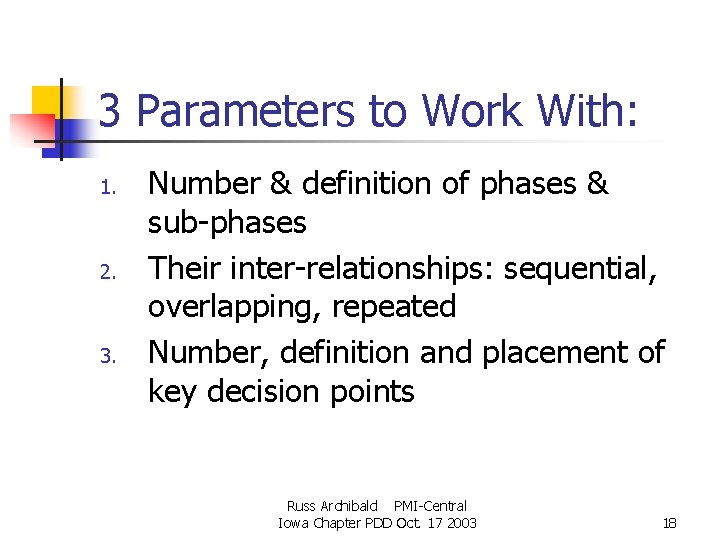
3 Parameters to Work With: 1. 2. 3. Number & definition of phases & sub-phases Their inter-relationships: sequential, overlapping, repeated Number, definition and placement of key decision points Russ Archibald PMI-Central Iowa Chapter PDD Oct. 17 2003 18
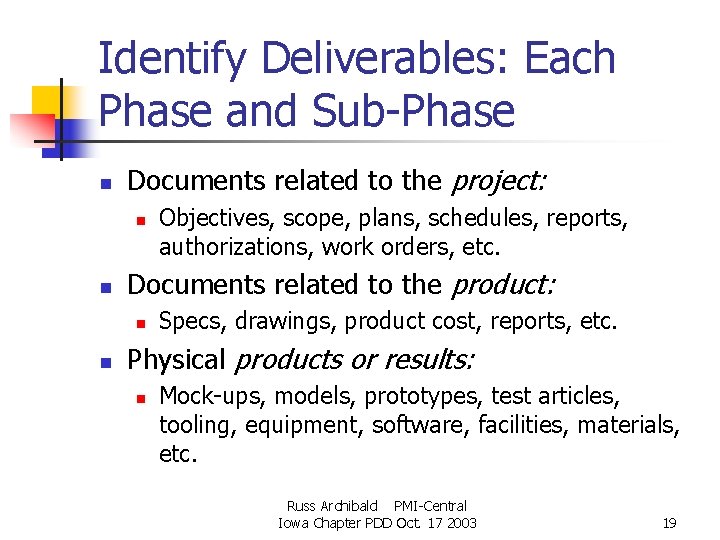
Identify Deliverables: Each Phase and Sub-Phase n Documents related to the project: n n Documents related to the product: n n Objectives, scope, plans, schedules, reports, authorizations, work orders, etc. Specs, drawings, product cost, reports, etc. Physical products or results: n Mock-ups, models, prototypes, test articles, tooling, equipment, software, facilities, materials, etc. Russ Archibald PMI-Central Iowa Chapter PDD Oct. 17 2003 19
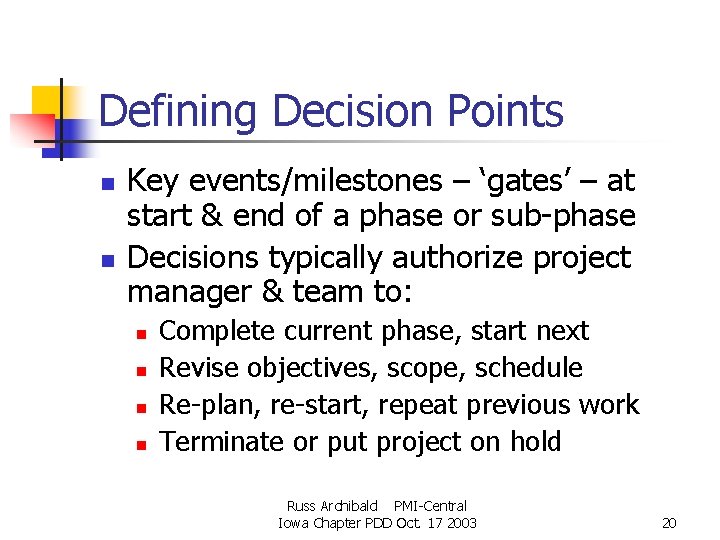
Defining Decision Points n n Key events/milestones – ‘gates’ – at start & end of a phase or sub-phase Decisions typically authorize project manager & team to: n n Complete current phase, start next Revise objectives, scope, schedule Re-plan, re-start, repeat previous work Terminate or put project on hold Russ Archibald PMI-Central Iowa Chapter PDD Oct. 17 2003 20
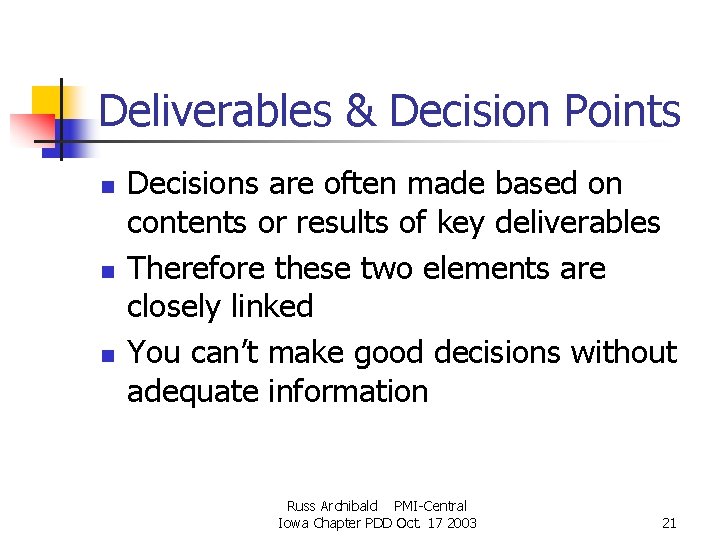
Deliverables & Decision Points n n n Decisions are often made based on contents or results of key deliverables Therefore these two elements are closely linked You can’t make good decisions without adequate information Russ Archibald PMI-Central Iowa Chapter PDD Oct. 17 2003 21
Documenting a Project Life Cycle Management Process n Define the life cycle: n n n Select the life cycle model to be used Name phases, sub-phases decision points Establish inter-relationships among them Portray the result: flow chart, narrative Specify authorizing documents: n n Purpose & levels of approval authority For initiation & major changes Russ Archibald PMI-Central Iowa Chapter PDD Oct. 17 2003 22
Documenting PLCMS (Cont’d) n n Identify key roles & define responsibilities Identify major deliverables by phase Specify issue escalation procedures Specify differences for: n n Major vs minor projects, or Other project classes within a sub-category Russ Archibald PMI-Central Iowa Chapter PDD Oct. 17 2003 23
3. Hi-Tech Project Categories & Their Life Cycles n 4 (of 10) basic hi-tech categories: n n Communication Systems Information Systems Product & Service Development Research & Development Russ Archibald PMI-Central Iowa Chapter PDD Oct. 17 2003 24
Hi-Tech in Other Categories n Defense/Aerospace: n n Facilities: n n Very advanced, specialized life cycles prescribed by DOD & NASA Very mature, specialized life cycle models Hi-tech projects within programs in these and other categories can be placed in one of the preceding 4 hi-tech categories Russ Archibald PMI-Central Iowa Chapter PDD Oct. 17 2003 25
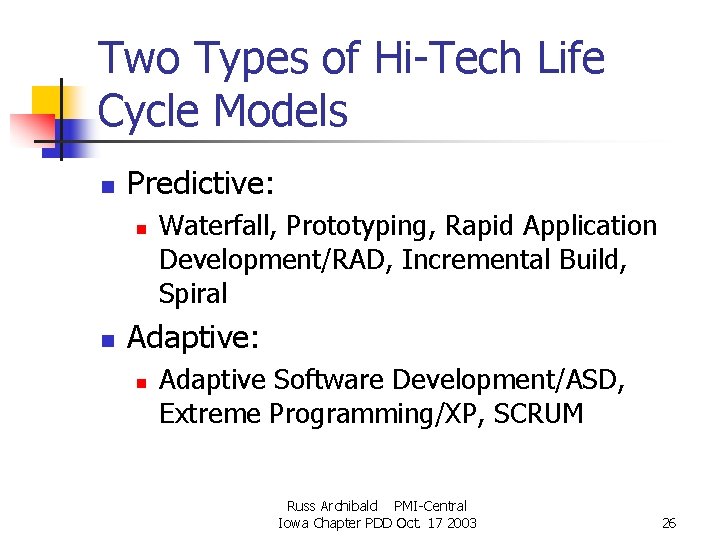
Two Types of Hi-Tech Life Cycle Models n Predictive: n n Waterfall, Prototyping, Rapid Application Development/RAD, Incremental Build, Spiral Adaptive: n Adaptive Software Development/ASD, Extreme Programming/XP, SCRUM Russ Archibald PMI-Central Iowa Chapter PDD Oct. 17 2003 26
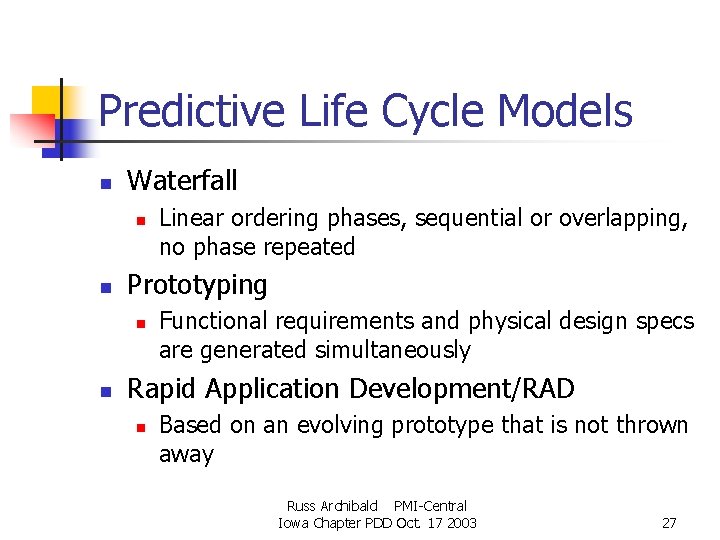
Predictive Life Cycle Models n Waterfall n n Prototyping n n Linear ordering phases, sequential or overlapping, no phase repeated Functional requirements and physical design specs are generated simultaneously Rapid Application Development/RAD n Based on an evolving prototype that is not thrown away Russ Archibald PMI-Central Iowa Chapter PDD Oct. 17 2003 27
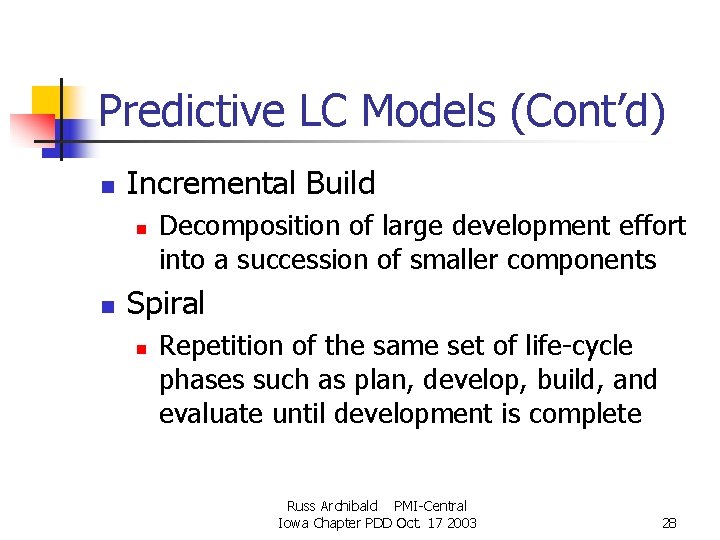
Predictive LC Models (Cont’d) n Incremental Build n n Decomposition of large development effort into a succession of smaller components Spiral n Repetition of the same set of life-cycle phases such as plan, develop, build, and evaluate until development is complete Russ Archibald PMI-Central Iowa Chapter PDD Oct. 17 2003 28
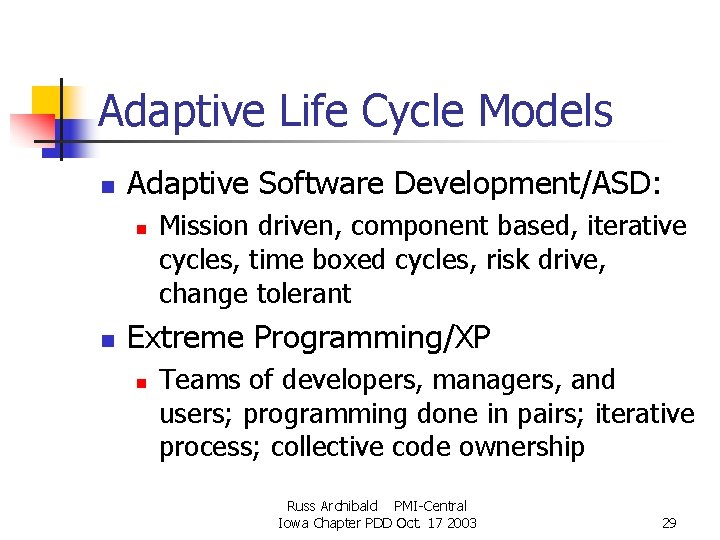
Adaptive Life Cycle Models n Adaptive Software Development/ASD: n n Mission driven, component based, iterative cycles, time boxed cycles, risk drive, change tolerant Extreme Programming/XP n Teams of developers, managers, and users; programming done in pairs; iterative process; collective code ownership Russ Archibald PMI-Central Iowa Chapter PDD Oct. 17 2003 29
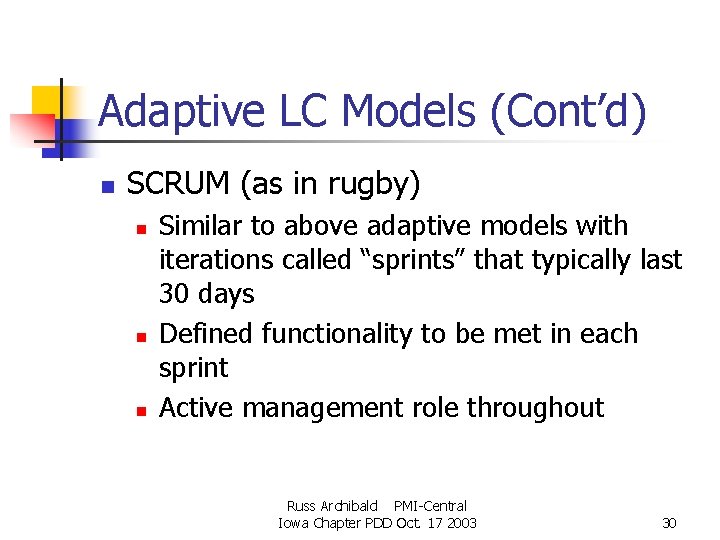
Adaptive LC Models (Cont’d) n SCRUM (as in rugby) n n n Similar to above adaptive models with iterations called “sprints” that typically last 30 days Defined functionality to be met in each sprint Active management role throughout Russ Archibald PMI-Central Iowa Chapter PDD Oct. 17 2003 30
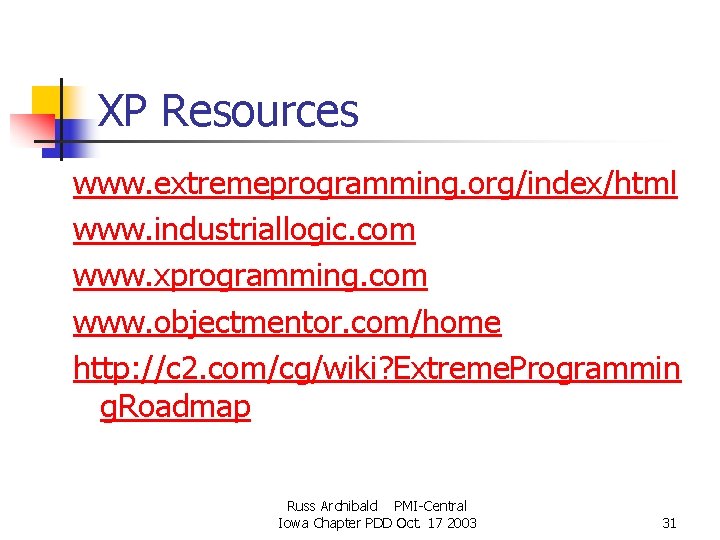
XP Resources www. extremeprogramming. org/index/html www. industriallogic. com www. xprogramming. com www. objectmentor. com/home http: //c 2. com/cg/wiki? Extreme. Programmin g. Roadmap Russ Archibald PMI-Central Iowa Chapter PDD Oct. 17 2003 31
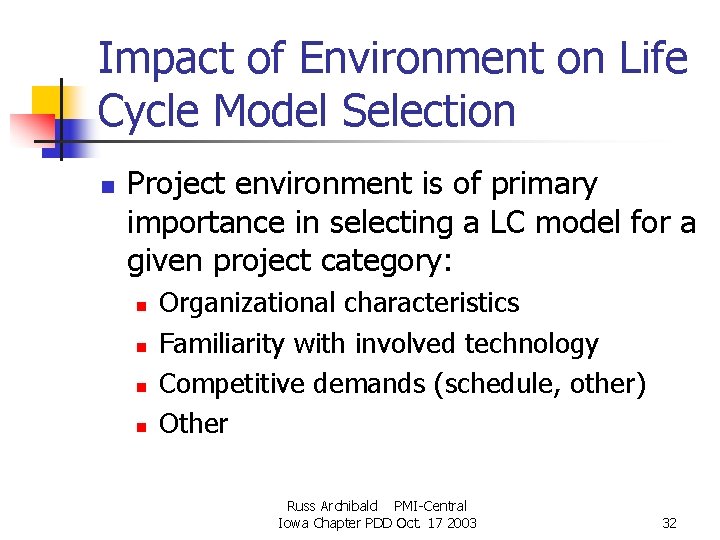
Impact of Environment on Life Cycle Model Selection n Project environment is of primary importance in selecting a LC model for a given project category: n n Organizational characteristics Familiarity with involved technology Competitive demands (schedule, other) Other Russ Archibald PMI-Central Iowa Chapter PDD Oct. 17 2003 32
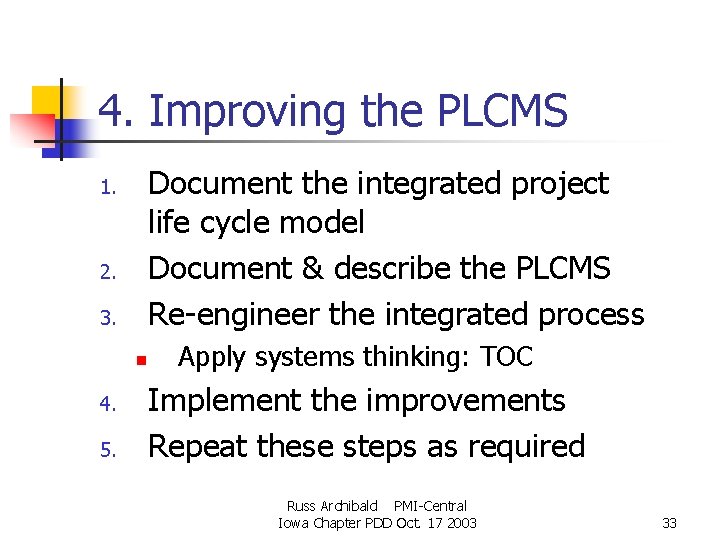
4. Improving the PLCMS Document the integrated project life cycle model Document & describe the PLCMS Re-engineer the integrated process 1. 2. 3. n 4. 5. Apply systems thinking: TOC Implement the improvements Repeat these steps as required Russ Archibald PMI-Central Iowa Chapter PDD Oct. 17 2003 33
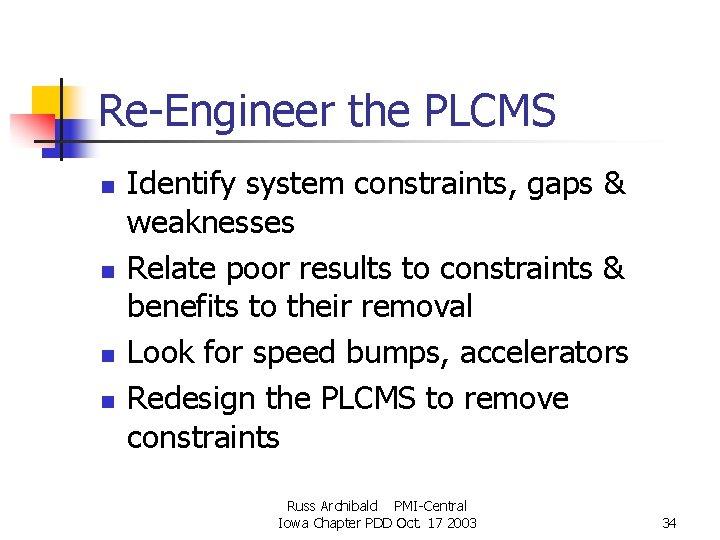
Re-Engineer the PLCMS n n Identify system constraints, gaps & weaknesses Relate poor results to constraints & benefits to their removal Look for speed bumps, accelerators Redesign the PLCMS to remove constraints Russ Archibald PMI-Central Iowa Chapter PDD Oct. 17 2003 34
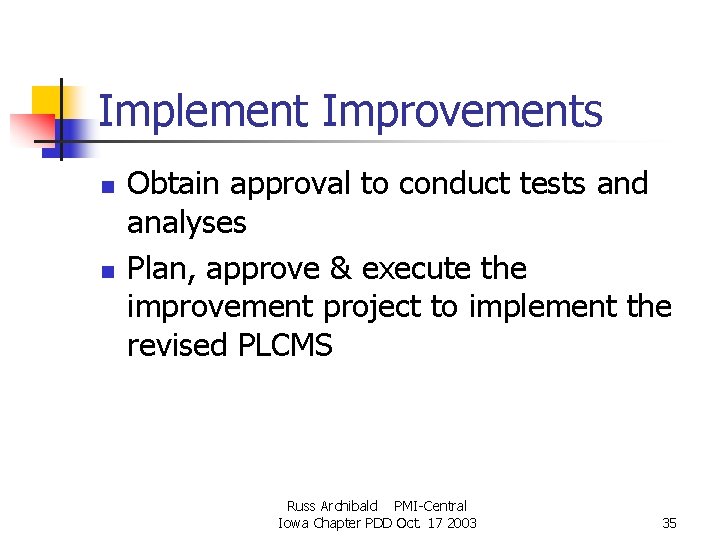
Implement Improvements n n Obtain approval to conduct tests and analyses Plan, approve & execute the improvement project to implement the revised PLCMS Russ Archibald PMI-Central Iowa Chapter PDD Oct. 17 2003 35
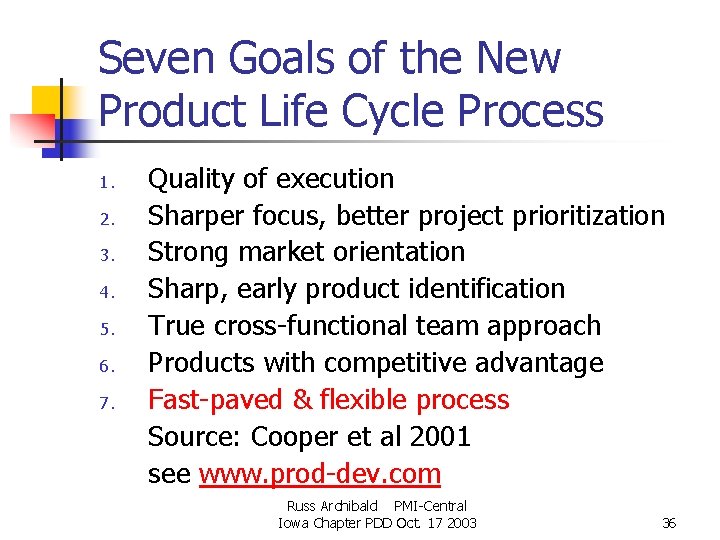
Seven Goals of the New Product Life Cycle Process 1. 2. 3. 4. 5. 6. 7. Quality of execution Sharper focus, better project prioritization Strong market orientation Sharp, early product identification True cross-functional team approach Products with competitive advantage Fast-paved & flexible process Source: Cooper et al 2001 see www. prod-dev. com Russ Archibald PMI-Central Iowa Chapter PDD Oct. 17 2003 36
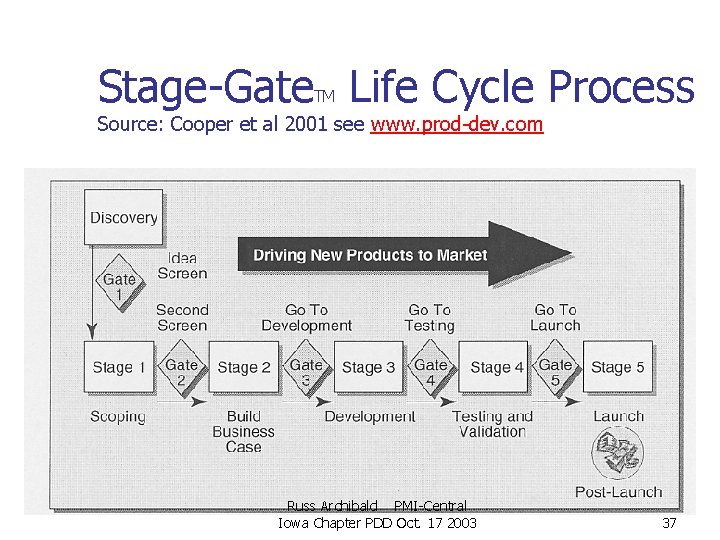
Stage-Gate Life Cycle Process TM Source: Cooper et al 2001 see www. prod-dev. com Russ Archibald PMI-Central Iowa Chapter PDD Oct. 17 2003 37
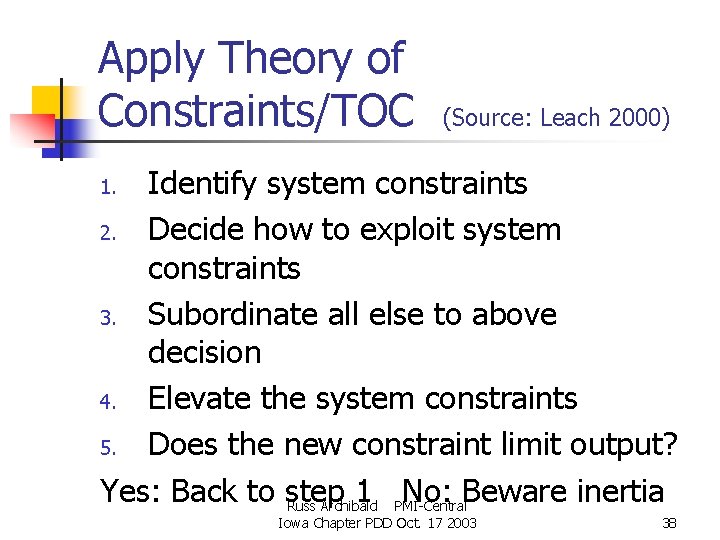
Apply Theory of Constraints/TOC (Source: Leach 2000) Identify system constraints 2. Decide how to exploit system constraints 3. Subordinate all else to above decision 4. Elevate the system constraints 5. Does the new constraint limit output? Yes: Back to step 1 No: Beware inertia Russ Archibald PMI-Central 1. Iowa Chapter PDD Oct. 17 2003 38
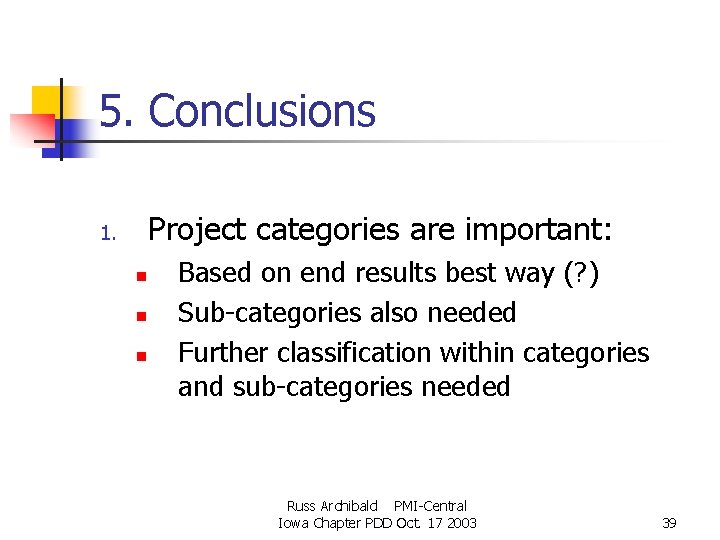
5. Conclusions Project categories are important: 1. n n n Based on end results best way (? ) Sub-categories also needed Further classification within categories and sub-categories needed Russ Archibald PMI-Central Iowa Chapter PDD Oct. 17 2003 39
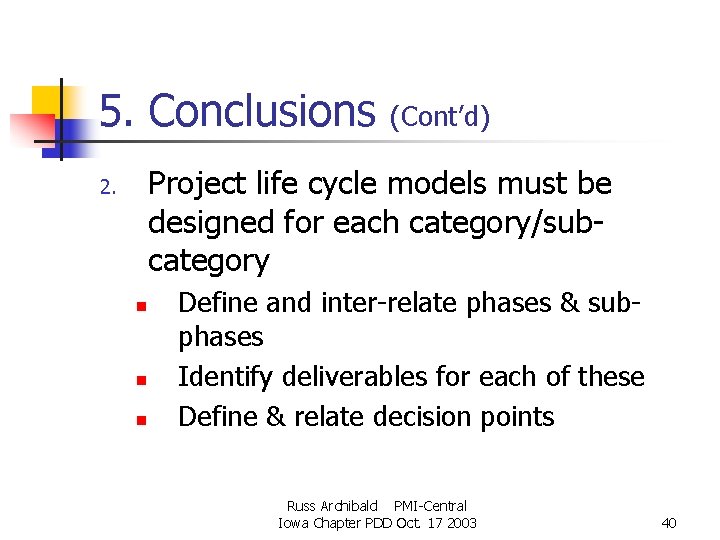
5. Conclusions (Cont’d) Project life cycle models must be designed for each category/subcategory 2. n n n Define and inter-relate phases & subphases Identify deliverables for each of these Define & relate decision points Russ Archibald PMI-Central Iowa Chapter PDD Oct. 17 2003 40
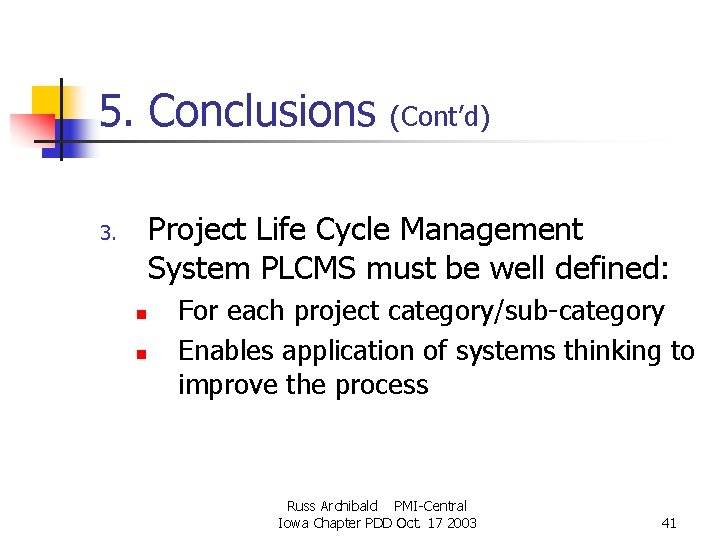
5. Conclusions (Cont’d) Project Life Cycle Management System PLCMS must be well defined: 3. n n For each project category/sub-category Enables application of systems thinking to improve the process Russ Archibald PMI-Central Iowa Chapter PDD Oct. 17 2003 41
5. Conclusions (Cont’d) Two types of life cycle models are used for high-technology projects: 4. Predictive n Adaptive With several variations within each of these n Selection depends on the key environmental factors affecting the project Russ Archibald PMI-Central Iowa Chapter PDD Oct. 17 2003 42
5. Conclusions Systematic improvement of PLCMS is achieved through: 5. n n 6. (Cont’d) Re-engineering the total system Application of TOC to total PLCMS or to a given phase Such improvement must be a major project management goal in every organization Russ Archibald PMI-Central Iowa Chapter PDD Oct. 17 2003 43
Further Reading n Archibald: Managing High-Technology Programs and Projects, 3 rd ed 2003 n n n Chapters 2 and 3 Download this paper 18 additional references given in the paper Russ Archibald PMI-Central Iowa Chapter PDD Oct. 17 2003 44
Thanks for Listening!! n n Questions? Rebuttals? Download this paper and/or slides at www. russarchibald. com go to ‘Author: Recent Papers’ & select title of paper Contact me: archie@unisono. net. mx Russ Archibald PMI-Central Iowa Chapter PDD Oct. 17 2003 45