
LIFE CYCLE MODELING THE BACKGROUND NEIL BEAGRIE British
LIFE CYCLE MODELING, THE BACKGROUND NEIL BEAGRIE British Library/JISC LIFE conference April 2006
OVERVIEW • • History of Lifecycle approaches Approaches at AHDS and JISC Impact and take-up (selectively) utilises LIFE Research Review by James Watson Nov 2005 (with some additions)
EARLY HISTORY • Terotechnology Handbook 1978 – The report advocates the life cycle costing approach and provides case studies on a selection of physical assets, including: a GLC Office Block, the National Bus Company and Rank Xerox. • The life cycle stages of physical assets are defined by the report as: – Acquisition (of physical assets) – The operational life (of physical assets)
EARLY HISTORY • LIFE Review was cast wider with research into the broader context of the concept of “life cycles” including: – Construction (Building and Maintenance) Life Cycle – Cost Analysis – Cost Design – Cost Impact – Family Life Cycle – Information (Resources) Life Cycle – Information System Life Cycle – Information Technology Life Cycle – Organisational Life Cycle – Plant Life Cycle – Records Life Cycle – Software Development Life Cycle – Waste Management Life Cycle
LIBRARY LIFE CYCLE COLLECTION MODELS • Andy Stephens 1988 – The application of life cycle costing techniques to library collections began with Andy Stephens of the British Library. – He introduces the formula for working out the total cost of keeping an item in a library throughout its life from acquisition. – The system is discussed and advocated, but, in this early study, no figures are applied. • Andy Stephens 1994 – uses practical case studies to input data into his model

LIBRARY LIFE CYCLE COLLECTION MODELS • Hernon (1994) – early discussion of the “information life cycle” in the context of managing US governmental information. • provides specific, generic stages, namely: – Information Creation and Gathering – Production, Processing and Publication – Transmittal (Access, Dissemination and Distribution) – Retrieval and use – Retention (Storage and Archiving) and Disposition • Models item rather than organisational life-cycle
ARTS AND HUMANITIES DATA SERVICE • Established late 1996 -distributed service to promote creation, archiving and re-use of digital research • I joined AHDS January 2007 to develop common collection development /rights/funders • integrating support for creation, archiving, and use fundamental to ethos and policy of service • Basic digital item life cycle approach in first collection policy
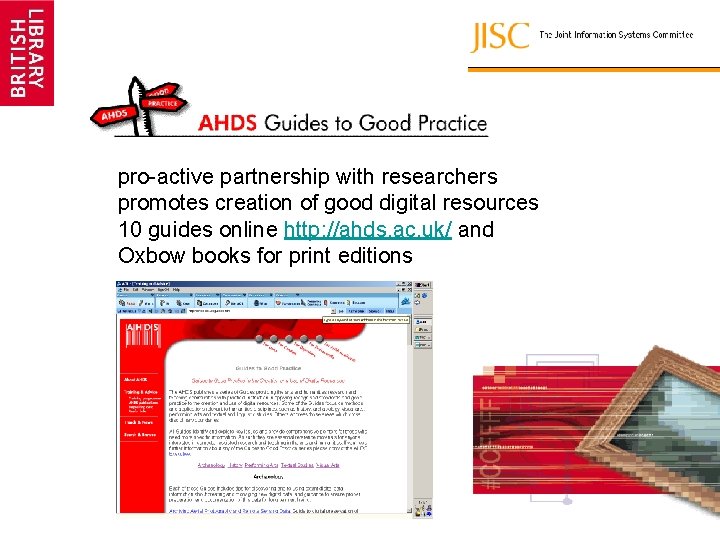
pro-active partnership with researchers promotes creation of good digital resources 10 guides online http: //ahds. ac. uk/ and Oxbow books for print editions
ARTS AND HUMANITIES RESEARCH BOARD ICT POLICY • AHRB/AHDS strategic partnership - AHDS role: – advise the AHRB on matters involving ICT in the arts and humanities – advise the AHRB in the technical assessment of grant applications – advise the AHRB, its applicants and award-holders on standards and best practices – act as a repository for selected data resources created in whole or in part with AHRB funding – educational re-use of those data resources and disseminate them for that purpose;
A STRATEGIC FRAMEWORK FOR CREATING AND PRESERVING DIGITAL RESOURCES • Develops basic AHDS Collection Policy and tests for wider application • policy framework life-cycle(“continuum”) of a digital resource and preservation • Desk-top survey and 15 interviews with archives, libraries and museums • 5 Case studies, best practice guidelines, resources and other studies • Research starts 1997 – report Beagrie and Greenstein 1998
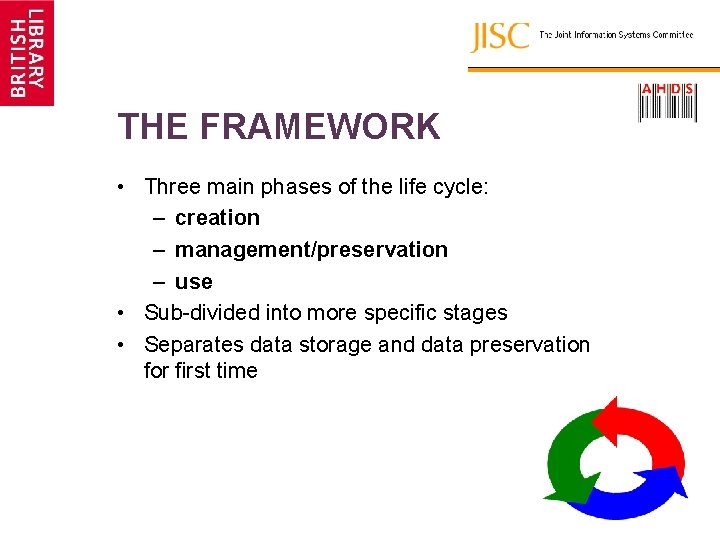
THE FRAMEWORK • Three main phases of the life cycle: – creation – management/preservation – use • Sub-divided into more specific stages • Separates data storage and data preservation for first time
IMPACT AND TAKE-UP • Hendley 1998 establishes the first life cycle based cost model for digital preservation. – adopts the strategic framework as basis of cost model • Moving Theory into Practice: Digital Imaging for Libraries and Archives Anne Kenney/Oya Rieger 2000 – Develop Formal policies to Encompass the Lifecycle of Digital Resources – Digitisation Workshop and Online tutorial • Hodge 1999 Digital Electronic Archiving: The State of the Art, The State of the Practice for ICSTI • Jones and Beagrie 2001 Preservation Management of Digital Materials: A Handbook
FURTHER INFORMATION LIFE Research Review by James Watson Nov 2005 http: //www. ucl. ac. uk/ls/lifeproject/documentation/review. doc
- Slides: 13