
LIFE CYCLE MANAGEMENT A Bridge to More Sustainable
LIFE CYCLE MANAGEMENT - A Bridge to More Sustainable Products LCM Slide Show April 2005
Contents • Introduction to sustainability and life cycle thinking • Getting started • Integrated management systems and tools • Life cycle based design and product development • Communication of life cycle information • Stakeholder relationships • Economic aspects in life cycle management • Process life cycle management
INTRODUCTION TO SUSTAINABILITY AND LIFE CYCLE THINKING Allan Astrup Jensen Arne Remmen LCM Slide Show April 2005
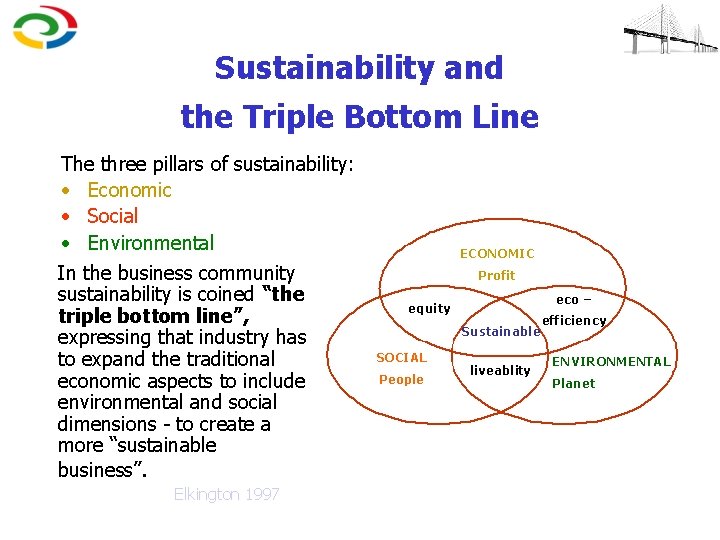
Sustainability and the Triple Bottom Line The three pillars of sustainability: • Economic • Social • Environmental In the business community sustainability is coined “the triple bottom line”, expressing that industry has to expand the traditional economic aspects to include environmental and social dimensions - to create a more “sustainable business”. Elkington 1997
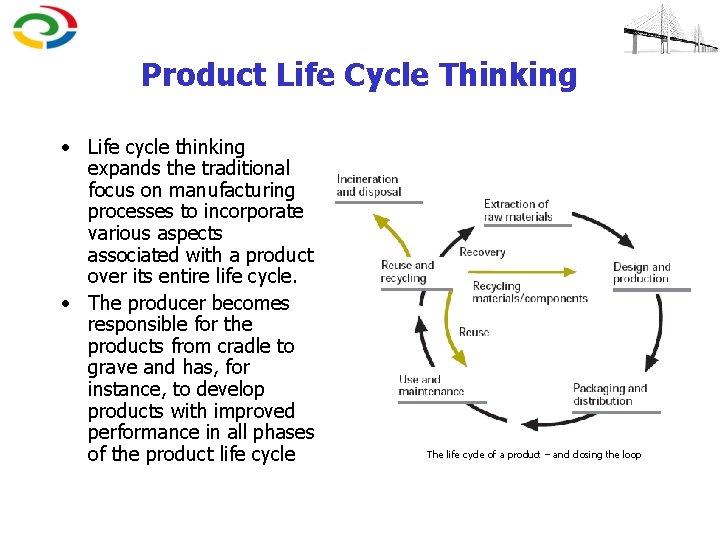
Product Life Cycle Thinking • Life cycle thinking expands the traditional focus on manufacturing processes to incorporate various aspects associated with a product over its entire life cycle. • The producer becomes responsible for the products from cradle to grave and has, for instance, to develop products with improved performance in all phases of the product life cycle The life cycle of a product – and closing the loop
Goal of Life Cycle Thinking The main goal of life cycle thinking is to reduce resource use and emissions from/to the environment as well as to improve the social performance in various stages of a product’s life. In this way, companies can achieve cleaner products and processes, a competitive advantage in the marketplace, and an improved platform to meet the needs of a changing business climate.
Life Cycle Thinking and Pollution Prevention Life cycle thinking expands pollution prevention to include the complete product life cycle and sustainability. Source reduction in a product life cycle perspective is then equivalent to eco-design principles and what had been called the “ 6 RE philosophy”: • Re-think the product and its functions. The product may be used more efficiently, thereby reducing use of energy and other natural resources. • Re-duce energy and material consumption throughout a product’s life cycle. • Re-place harmful substances with more environmentally friendly alternatives. • Re-cycle. Select materials that can be recycled, and build the product such that it is disassembled easier for recycling. • Re-use. Design the product so parts can be reused. • Re-pair. Make the product easy to repair so that the product does not yet need to be replaced.
What is Life Cycle Management (LCM)? • LCM is the application of life cycle thinking to modern business practice with the aim to manage the total life cycle of an organization’s products and services towards more sustainable consumption and production • LCM is systematic integration of sustainability, e. g. in company strategy and planning, product design and development, purchasing decisions and communication programs • LCM is not a single tool or methodology but a flexible integrated management framework of concepts, techniques and procedures incorporating environmental, economic, and social aspects of products, processes and organizations • LCM is voluntary and can be gradually adapted to the specific needs and characteristics of individual organizations LCM is a dynamic process; organizations may begin with small goals and objectives with the resources they have and get more ambitious over time. [Hunkeler et al. 2004]
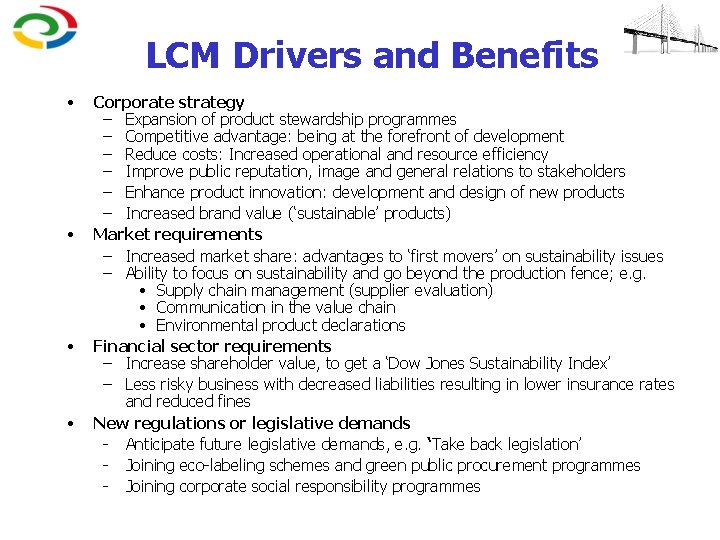
LCM Drivers and Benefits • • Corporate strategy – Expansion of product stewardship programmes – Competitive advantage: being at the forefront of development – Reduce costs: Increased operational and resource efficiency – Improve public reputation, image and general relations to stakeholders – Enhance product innovation: development and design of new products – Increased brand value (‘sustainable’ products) Market requirements – Increased market share: advantages to ‘first movers’ on sustainability issues – Ability to focus on sustainability and go beyond the production fence; e. g. • Supply chain management (supplier evaluation) • Communication in the value chain • Environmental product declarations Financial sector requirements – Increase shareholder value, to get a ‘Dow Jones Sustainability Index’ – Less risky business with decreased liabilities resulting in lower insurance rates and reduced fines New regulations or legislative demands - Anticipate future legislative demands, e. g. ‘Take back legislation’ - Joining eco-labeling schemes and green public procurement programmes - Joining corporate social responsibility programmes
Entry Gates in the Organization • Introduction of LCM has to be a top management decision and be according to the company’s policies and strategy. Continued support from top management during implementation of LCM is also needed. • The entry gates of LCM in a company typically correspond to the drivers and a function within an organization, such as manufacturing, procurement, marketing, research and development (R&D), or environment, health, and safety (EHS). • It is often a company’s department of environment or sustainability who initially suggests and coordinated the implementation of an LCM system.
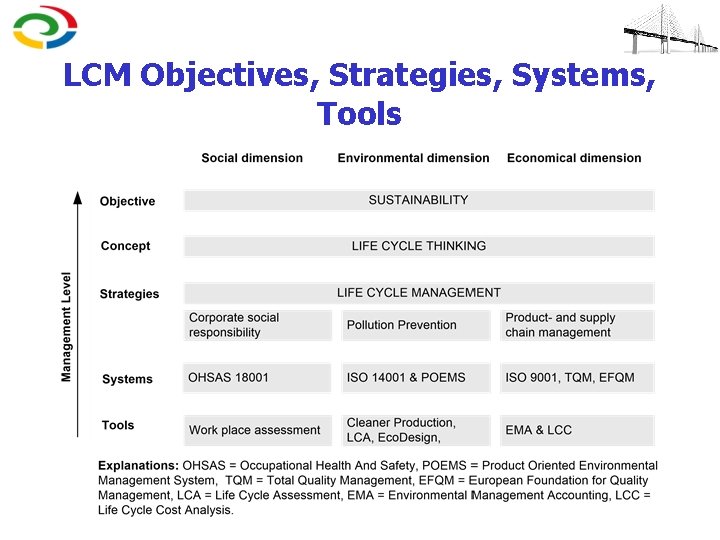
LCM Objectives, Strategies, Systems, Tools

Overview of LCM issues Companies can integrate sustainability and life cycle thinking into everyday management and decision-making processes using various environmental and economic approaches, concepts, and tools operating at a management system level, a program level, or a technical level.
GETTING STARTED Allan Astrup Jensen Arne Remmen Anne Landfield LCM Slide Show April 2005

Any Organization can implement an LCM Program • • Product life cycle initiatives have often focused on the method, for example a detailed life cycle assessment (LCA), followed by determination of the most significant environmental impacts in a product’s life cycle. These efforts are resource-intensive for a small organization, and do often end up focusing on data collection, rather than concrete strategies concerning how to improve the environmental and social profile of a product. An organization needs not “jump into” tools like LCA, but instead take a step-by-step approach and begin with focusing on the life cycle perspective and on concrete possibilities to improve the environmental characteristics of a product. Various levels can lead to good LCM practices.
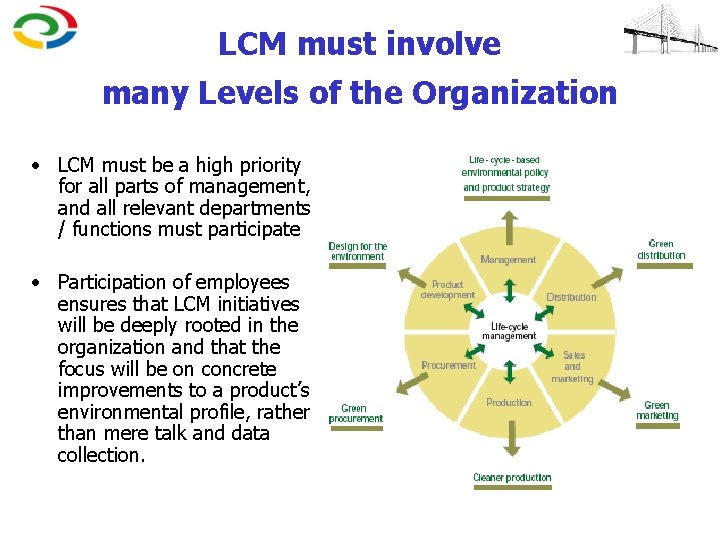
LCM must involve many Levels of the Organization • LCM must be a high priority for all parts of management, and all relevant departments / functions must participate • Participation of employees ensures that LCM initiatives will be deeply rooted in the organization and that the focus will be on concrete improvements to a product’s environmental profile, rather than mere talk and data collection.
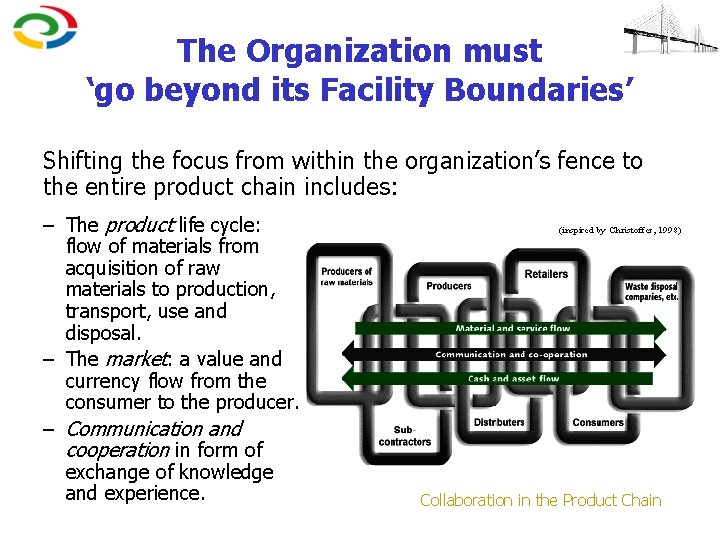
The Organization must ‘go beyond its Facility Boundaries’ Shifting the focus from within the organization’s fence to the entire product chain includes: – The product life cycle: flow of materials from acquisition of raw materials to production, transport, use and disposal. – The market: a value and currency flow from the consumer to the producer. – Communication and cooperation in form of exchange of knowledge and experience. Collaboration in the Product Chain
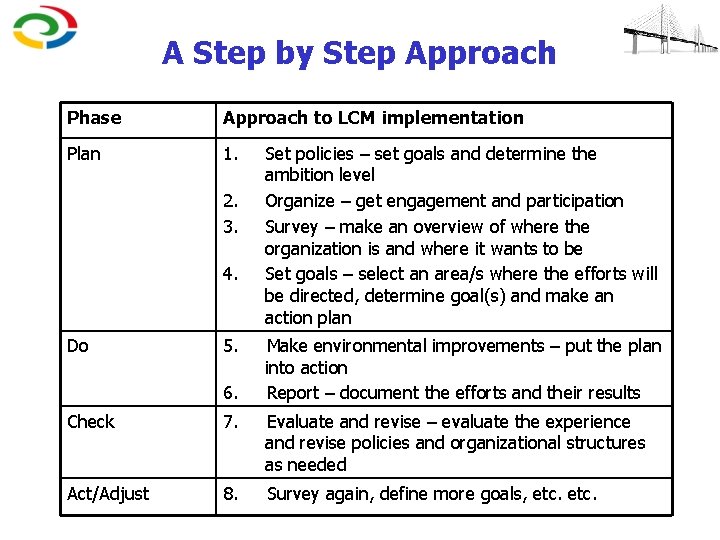
A Step by Step Approach Phase Approach to LCM implementation Plan 1. 2. 3. 4. Do 5. 6. Set policies – set goals and determine the ambition level Organize – get engagement and participation Survey – make an overview of where the organization is and where it wants to be Set goals – select an area/s where the efforts will be directed, determine goal(s) and make an action plan Make environmental improvements – put the plan into action Report – document the efforts and their results Check 7. Evaluate and revise – evaluate the experience and revise policies and organizational structures as needed Act/Adjust 8. Survey again, define more goals, etc.
1. Set Policies LCM has to be part of an organization’s policies so its importance rings through all management levels. LCM policies should be visionary and long-term while also being realistic and concrete, parallel to its level of ambition. Setting goals according to the level of ambition ensures conformity between policy and actions. There at least three different levels of ambition: 1. 2. 3. Internal readiness/commitment to continuous improvement This level signifies awareness that environmental and social improvements can be made using management frameworks such as ISO 9001 and/or ISO 14001, and that a commitment to improvements is the first step to a more integrated system Life cycle improvement of products An organization understands the value of addressing its products beyond the manufacturing level, for instances in materials acquisition, use of the product, distribution and end-of-life Environmental profiles of products A step further by reporting and marketing activities and thereby creating general organizational successes, e. g. eco-labelling
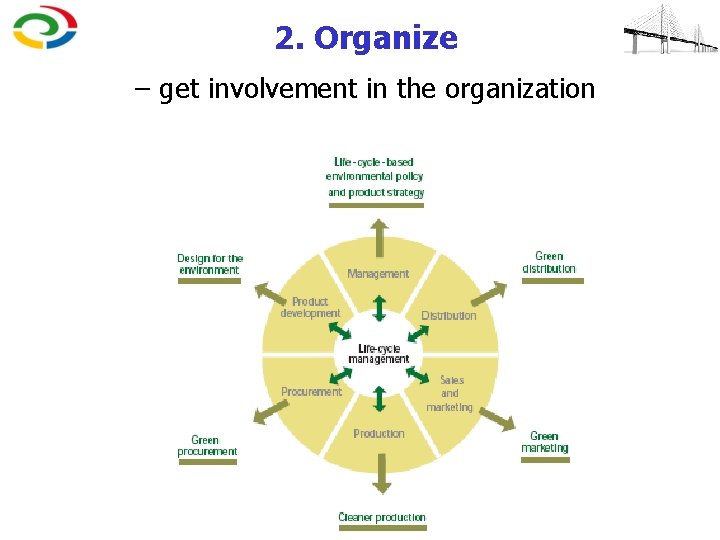
2. Organize – get involvement in the organization
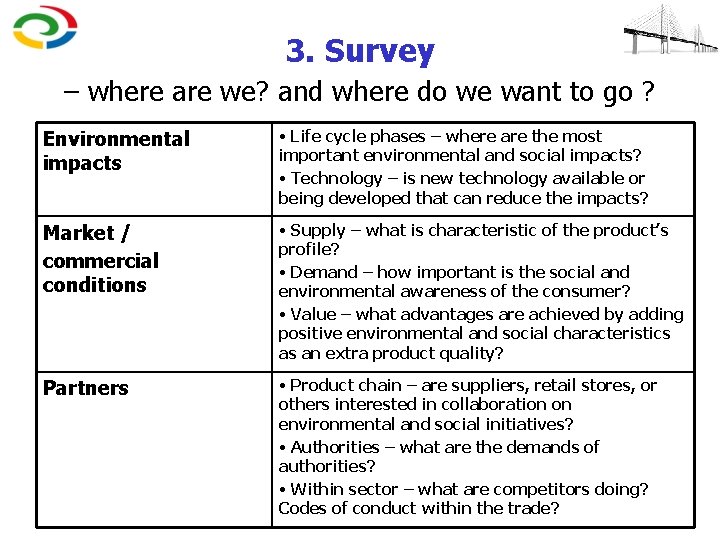
3. Survey – where are we? and where do we want to go ? Environmental impacts • Life cycle phases – where are the most important environmental and social impacts? • Technology – is new technology available or being developed that can reduce the impacts? Market / commercial conditions • Supply – what is characteristic of the product’s profile? • Demand – how important is the social and environmental awareness of the consumer? • Value – what advantages are achieved by adding positive environmental and social characteristics as an extra product quality? Partners • Product chain – are suppliers, retail stores, or others interested in collaboration on environmental and social initiatives? • Authorities – what are the demands of authorities? • Within sector – what are competitors doing? Codes of conduct within the trade?
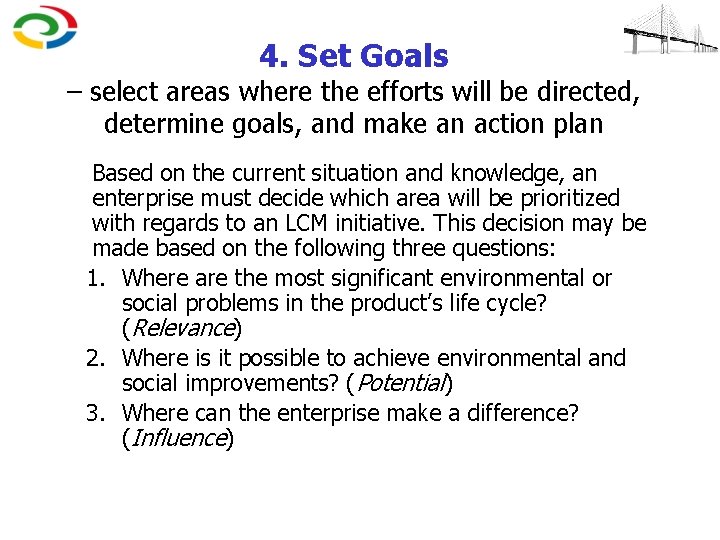
4. Set Goals – select areas where the efforts will be directed, determine goals, and make an action plan Based on the current situation and knowledge, an enterprise must decide which area will be prioritized with regards to an LCM initiative. This decision may be made based on the following three questions: 1. Where are the most significant environmental or social problems in the product’s life cycle? (Relevance) 2. Where is it possible to achieve environmental and social improvements? (Potential) 3. Where can the enterprise make a difference? (Influence)
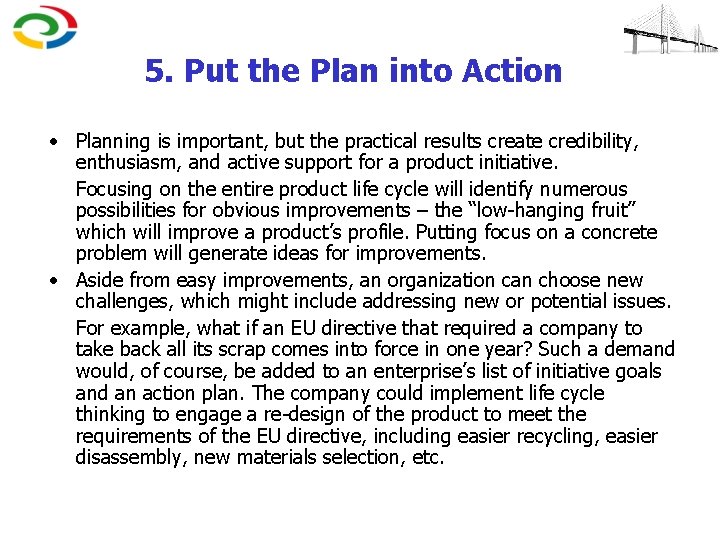
5. Put the Plan into Action • Planning is important, but the practical results create credibility, enthusiasm, and active support for a product initiative. Focusing on the entire product life cycle will identify numerous possibilities for obvious improvements – the “low-hanging fruit” which will improve a product’s profile. Putting focus on a concrete problem will generate ideas for improvements. • Aside from easy improvements, an organization can choose new challenges, which might include addressing new or potential issues. For example, what if an EU directive that required a company to take back all its scrap comes into force in one year? Such a demand would, of course, be added to an enterprise’s list of initiative goals and an action plan. The company could implement life cycle thinking to engage a re-design of the product to meet the requirements of the EU directive, including easier recycling, easier disassembly, new materials selection, etc.
6. Report – document efforts and results • • • With commitment of management and employees, it is crucial that the results of the efforts are documented, and that the results are made public. Such documentation gives credibility when answering inquiries from customers, suppliers, etc. The form of documentation is dependent upon the ambition level. It is advantageous for enterprises to have insight into which environmental and social impacts the enterprise’s stakeholders prioritize, so communication can be targeted at this group. Corporate accounts and environmental reports, which already contain details of social and environmental initiatives, may be redirected to be more product-oriented, thus providing a forum to document results and make them visible to the public. Product-oriented environmental reporting may address (examples): – To what degree has the energy consumption of the product in the use phase been reduced? – How much of the product can be recycled? – To what degree and how has transport been optimized?
7. Evaluate and revise – evaluate the experience and revise policies, etc. After the first round of product improvements, “take a deep breath” and evaluate the experience: – What worked and what did not? – How can the effort be improved? – Should more of the employees be involved in the initiative? – Should the efforts be focused in a different direction? – Were the appropriate means and methods used? – Should more partners be involved? – Should the level of ambition be raised? – Etc.
8. Survey again, define more Goals, etc. • Through the experience from the first round of product improvements from a life cycle perspective, an enterprise has likely identified areas where further investigation may be advantageous. • If demands are made requiring an enterprise to supply further documentation regarding the environmental impact of a product, then a simple environmental assessment is appropriate. • If it becomes evident that there are significant environmental impacts in the use phase of a product, then investigation of consumer desires and demands would be an obvious method to obtain ideas for design changes or to develop better instructions for product use. • If an enterprise uses chemicals or materials, which are on the list of undesirable substances, it would be sensible to begin phasing out.
9. Define new Initiative Areas and Goal(s) • On the basis of experience, the initiative area(s) and goal(s) are redefined and a new round of efforts begins with plans, improvements, etc. Focus remains on achieving concrete environmental and social improvements to the product profile, while realizing results during the improvement process. • During this and subsequent stages, the organization can begin (or continue) to broaden its relationship in the product chain – it is much easier to develop a base of knowledge if there is good cooperation and an atmosphere of trust among producers, suppliers, retail store owners, disposal facilities and other stakeholders in the product chain.
INTEGRATED MANAGEMENT SYSTEMS AND TOOLS Kim Christiansen LCM Slide Show April 2005
What is it? At the level of the single actor in the product chain, an integrated management system can help the organization • to address strategic planning, • overall management, • product and process development, • procurement, • production, • distribution, • marketing, • communication and other functions in a more systematic and comprehensive approach.
What is it - Examples • ISO 9001: 2000 – quality • ISO 14001: 2004 – environment • ISO 18001: 2004 – occupational health and safety • SA 8000: 1999 – social accountability • AA 1000: 1999 accountability • AFNOR FD X 50189: 2003 Management systems – Guidelines for their integration • AFNOR AC X 50200: 2003 Integrated management systems – Good practices and experience feedback • DS 8001 Guidance for integrated management systems
Systems oriented and product oriented standards within the ISO 14000 family System standards • ISO 14001: 1996/2004 and 14004: 1997/2004 Environmental Management Systems • ISO 14010: 1998, 14011: 1998, 14012: 1998 and 14015: 2001 Environmental auditing[1] • ISO/TR 14061: 1998 Informative Reference Material to assist forestry organizations in the use of ISO 14001 and ISO 14004 • ISO 14031: 1999, TR 14032: 1999 Environmental performance evaluation • ISO 9000: 2000 Quality management systems • ISO 19011: 2002 Guidelines for quality and/or environmental management systems auditing Product related standards • ISO 14020: 1998, 14021: 1999, 14024: 1999, and TR 14025: 2000/2005 Environmental labelling • ISO 14040: 1997/2005, 14041: 1999, 14042: 2000, 14043: 2000, 14044: 2005, TR 14049: 2000, TR 14048, TR 14047 Life cycle assessment • ISO Guide 64: 1997 Guide for inclusion of environmental aspects in product standards • ISO TR 14062: 2002 Integrating environmental aspects into product design and development • ISO DIS 14063 Environmental communication • ISO DIS 14064 Greenhouse gases
Drivers • Improvement of the transparency in the organization and between the companies in the supply chain • Better options to set-up a material and energy flow based cost accounting • Improvement of the efficiency of material and energy flows • Lower costs through product development and avoidance of material loss • Lower costs through integrated development of information systems, organization and material and energy flows • Less stress on the environment through waste avoidance and lower materials consumption • Innovation through development of new procedures and relations in the supply chain • Reduction of interfaces through flow and process orientation • Better communication and coordination at the interfaces • Access to up-front expertise on life cycle management that will be actively transferred to the companies during the project.
Opportunities (1/2) • Address all market information likely to have an impact on the organization • Facilitate the identification and assessment of opportunities for improving performance in all management areas based on a prioritization of risks and opportunities – and a clear acceptance of the identified risks • Enable optimizing and rendering reliable of operations by applying common provisions, thereby reducing the risks of contradiction and/or inconsistencies • Ensure a better knowledge of the requirements, needs and expectations of all interested parties • Continually integrate new requirements, needs or expectations • Improve the external image of the organization • Facilitate communication, explanation and justification of the top management's objectives and decisions throughout the entire organization
Opportunities (2/2) • Render compatible, simplify and reduce the number and the management costs of the operational instructions, tools, manuals etc. • Aid the harmonization of the internal organizational structure (network of key processes; optimum management methods; fair allocation and optimization of resources and responsibilities; regrouping of activities having similar purposes e. g. audits, management reviews, document management, and certification • Allow a better knowledge and a better control of the legal, regulatory requirements and of the other applicable requirements
Life Cycle and Sustainability Awareness in a Department of an Organization
Why is this Important to (my) Organization? • Better management • Comprehensive and systematic approach to target setting and implementation of improvements • Clear picture of responsibilities and roles of all actors in (and outside) of the organization • User friendly – only one system and not a handful
Success Factors (Pre-requisites) • Know your organization, your processes, your products and your customers and other interested parties • Decide where you want to go and how (vision and mission) • Specify by setting objectives and targets • Clarify roles and responsibilities for action using procedures, instructions and action plans • Measure progress (very) regularly and make revisions when needed • Communicate internally and externally
LIFE CYCLE BASED DESIGN AND PRODUCT DEVELOPMENT Kun Mo Lee Tom Swarr LCM Slide Show April 2005
Introduction • Design determines – 70~80% of the total project life cycle costs – most of the total life cycle environmental impacts • Early assessment of the cradle- to- grave environmental aspects of the product system can lead to effective integration of environmental considerations into the design process
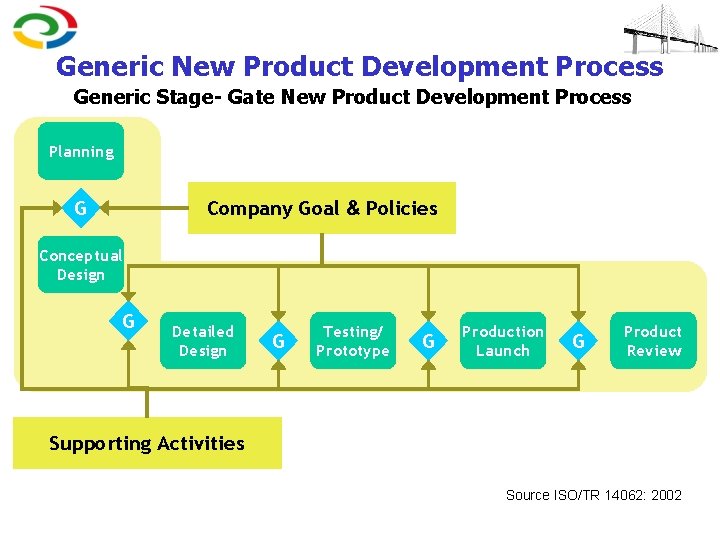
Generic New Product Development Process Generic Stage- Gate New Product Development Process Planning Company Goal & Policies G Conceptual Design G Detailed Design G Testing/ Prototype G Production Launch G Product Review Supporting Activities Source ISO/TR 14062: 2002
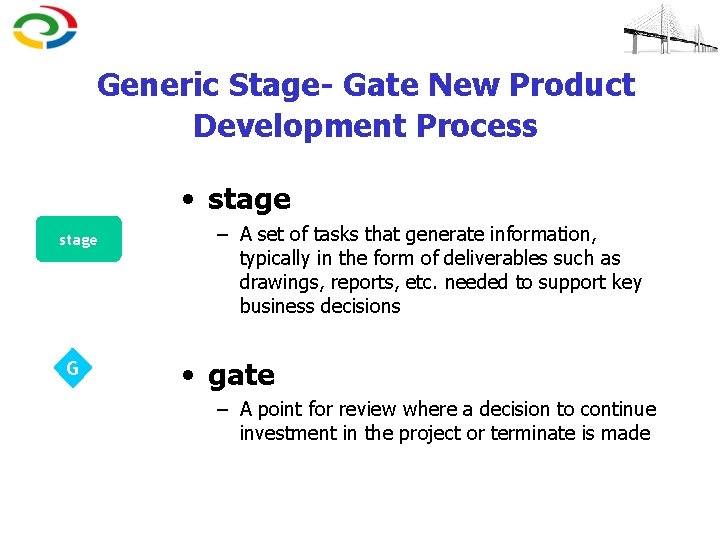
Generic Stage- Gate New Product Development Process • stage G – A set of tasks that generate information, typically in the form of deliverables such as drawings, reports, etc. needed to support key business decisions • gate – A point for review where a decision to continue investment in the project or terminate is made
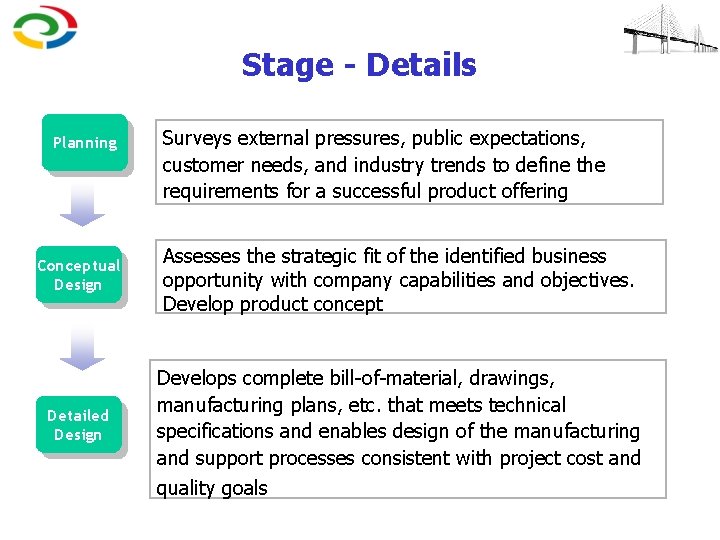
Stage - Details Planning Surveys external pressures, public expectations, customer needs, and industry trends to define the requirements for a successful product offering Conceptual Design Assesses the strategic fit of the identified business opportunity with company capabilities and objectives. Develop product concept Detailed Design Develops complete bill-of-material, drawings, manufacturing plans, etc. that meets technical specifications and enables design of the manufacturing and support processes consistent with project cost and quality goals
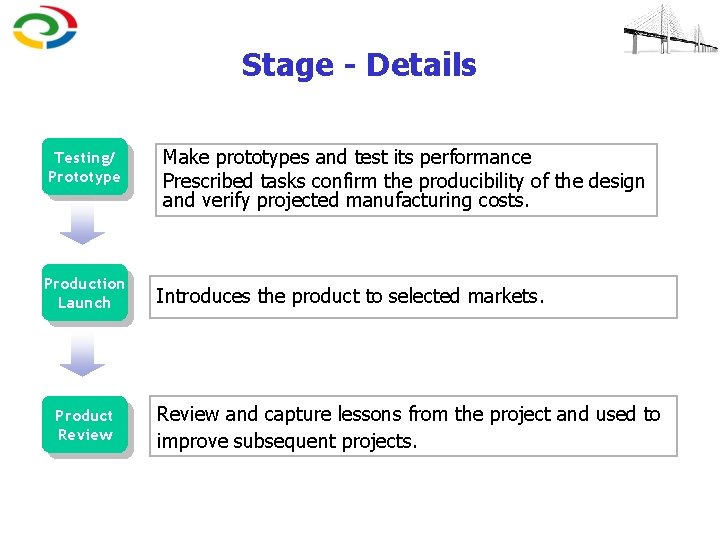
Stage - Details Testing/ Prototype Production Launch Product Review Make prototypes and test its performance Prescribed tasks confirm the producibility of the design and verify projected manufacturing costs. Introduces the product to selected markets. Review and capture lessons from the project and used to improve subsequent projects.
Eco-design Concept • Eco-design Based on the life cycle profile of the specific product, the business strategy, and the culture and capabilities of the organization
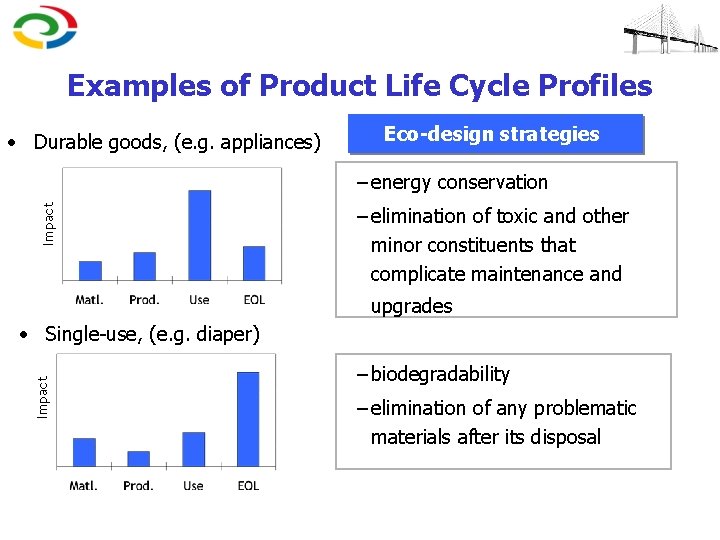
Examples of Product Life Cycle Profiles • Durable goods, (e. g. appliances) Eco-design strategies Impact – energy conservation – elimination of toxic and other minor constituents that complicate maintenance and upgrades Impact • Single-use, (e. g. diaper) – biodegradability – elimination of any problematic materials after its disposal
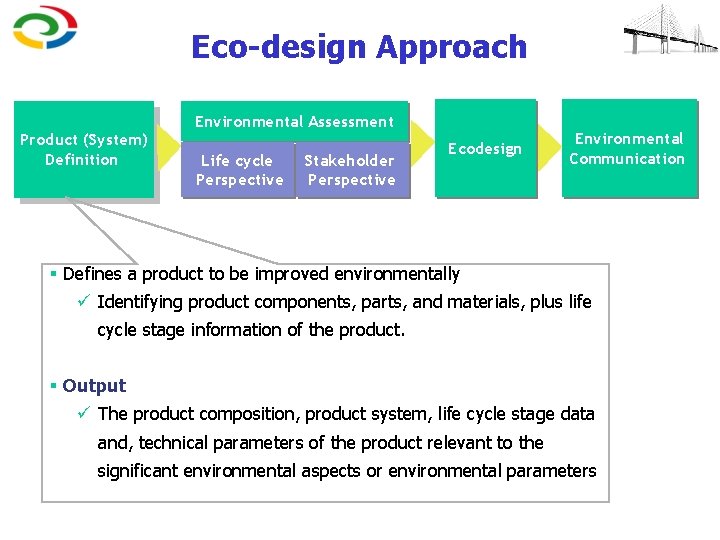
Eco-design Approach Environmental Assessment Product (System) Definition Life cycle Perspective Stakeholder Perspective Ecodesign Environmental Communication § Defines a product to be improved environmentally ü Identifying product components, parts, and materials, plus life cycle stage information of the product. § Output ü The product composition, product system, life cycle stage data and, technical parameters of the product relevant to the significant environmental aspects or environmental parameters
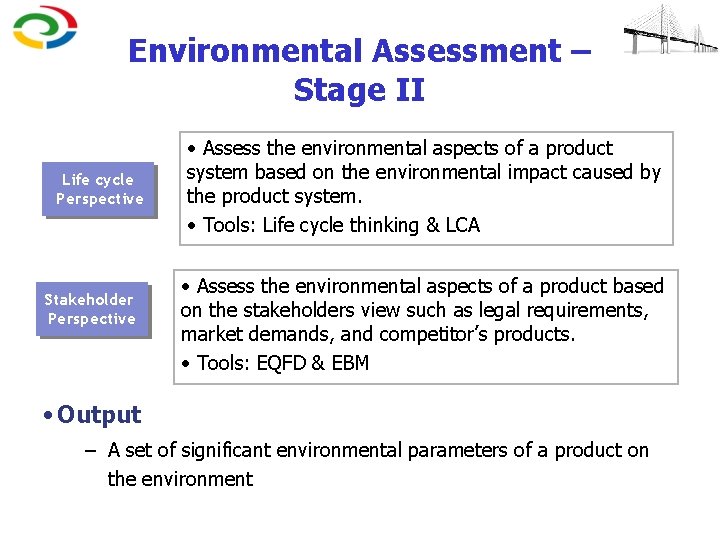
Environmental Assessment – Stage II Life cycle Perspective Stakeholder Perspective • Assess the environmental aspects of a product system based on the environmental impact caused by the product system. • Tools: Life cycle thinking & LCA • Assess the environmental aspects of a product based on the stakeholders view such as legal requirements, market demands, and competitor’s products. • Tools: EQFD & EBM • Output – A set of significant environmental parameters of a product on the environment
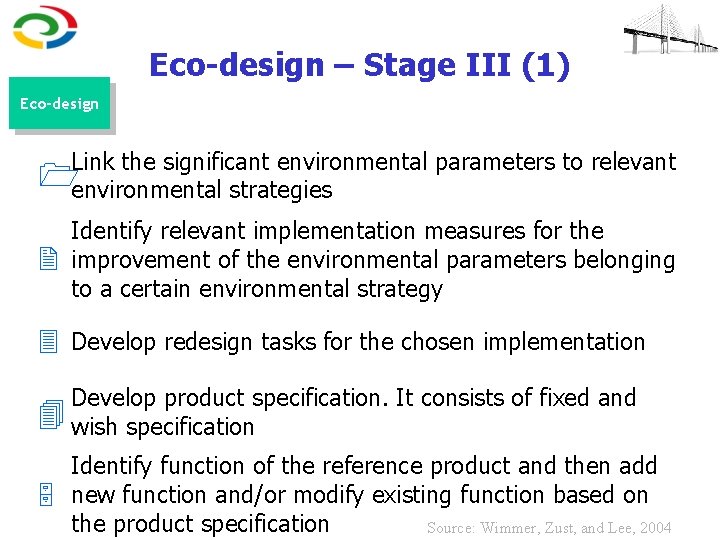
Eco-design – Stage III (1) Eco-design Link the significant environmental parameters to relevant 1 environmental strategies 2 Identify relevant implementation measures for the improvement of the environmental parameters belonging to a certain environmental strategy 3 Develop redesign tasks for the chosen implementation Develop product specification. It consists of fixed and 4 wish specification 5 Identify function of the reference product and then add new function and/or modify existing function based on the product specification Source: Wimmer, Zust, and Lee, 2004
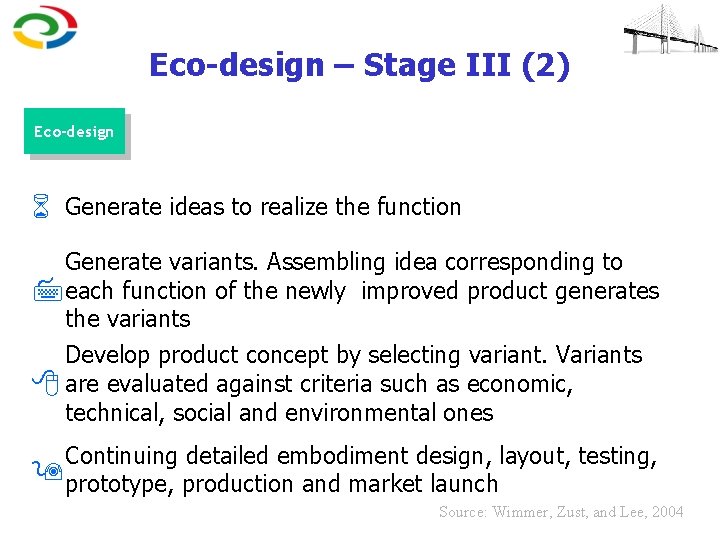
Eco-design – Stage III (2) Eco-design 6 Generate ideas to realize the function Generate variants. Assembling idea corresponding to 7 each function of the newly improved product generates the variants Develop product concept by selecting variant. Variants 8 are evaluated against criteria such as economic, technical, social and environmental ones Continuing detailed embodiment design, layout, testing, 9 prototype, production and market launch Source: Wimmer, Zust, and Lee, 2004
Environmental Communication – Stage IV Environmental Communication Communicate the environmental aspects of the environmentally improved product or ecoproduct to the market with the hope of increasing market share or at the least to enhance the image of the product and the company
COMMUNICATION OF LIFE CYCLE INFORMATION Paolo Frankl LCM Slide Show April 2005
Drivers • Product related environmental issues are becoming increasingly of strategic concern for business sector • Business and organizations require more and better information about environmental aspects of products in order to be able to make better-informed decisions • Implications on the way these assessments are communicated to internal and external stakeholders
Opportunities / Target Audiences • Competitive advantage in emerging or new green markets – Final consumers – Business clients – Public administrations • Better image – – Consumers and clients Financial stakeholders NGOs Legislators • Influence regulations and pre-normative processes
What is it? • Which communication tools are used in practice by industry and business? • Distinguish communication tools vs. target stakeholders • • • Final consumers Business clients Financial stakeholders Public administrators and policy makers Other society stakeholders
What is it / Observed Trends • ISO-type I labels still most widely used communication tool to final consumers • However, important limitations of eco-labels other communication tools increase awareness and foster better use of products • Simplification of complex life-cycle information into ISO-type II claims • ISO-type III declarations for B 2 B • Combination of tools
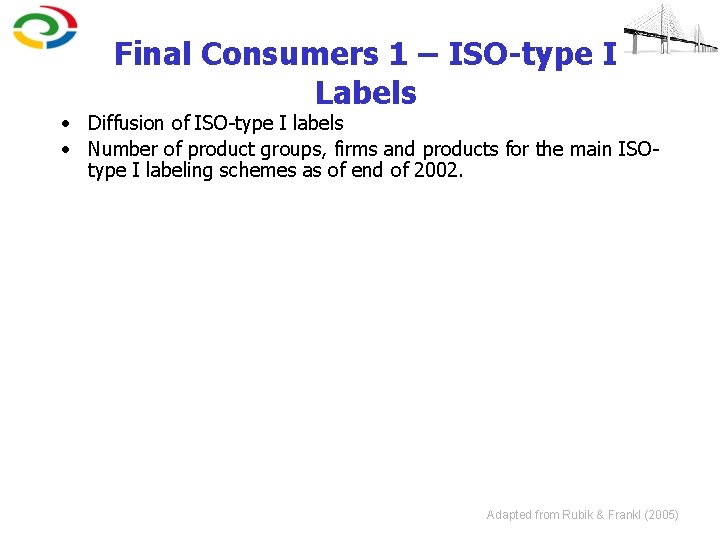
Final Consumers 1 – ISO-type I Labels • Diffusion of ISO-type I labels • Number of product groups, firms and products for the main ISOtype I labeling schemes as of end of 2002. Adapted from Rubik & Frankl (2005)
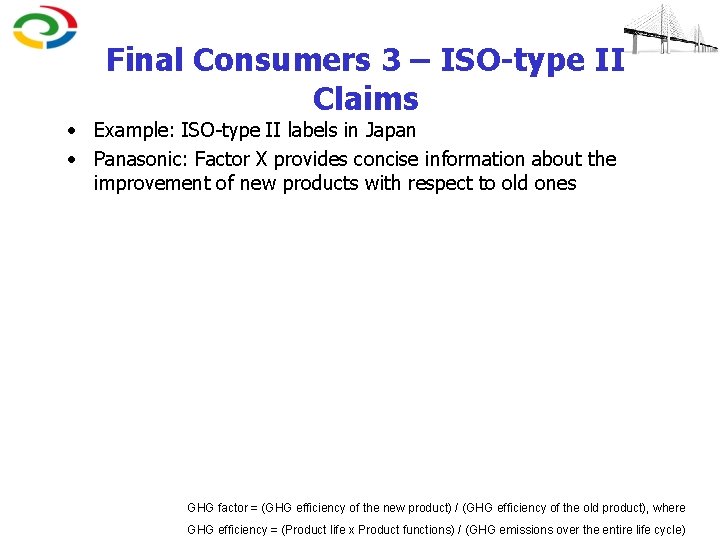
Final Consumers 3 – ISO-type II Claims • Example: ISO-type II labels in Japan • Panasonic: Factor X provides concise information about the improvement of new products with respect to old ones GHG factor = (GHG efficiency of the new product) / (GHG efficiency of the old product), where GHG efficiency = (Product life x Product functions) / (GHG emissions over the entire life cycle)
Business Clients 1 – ISO-type III Declaration • ISO-type III programmes in EU-15
Business Clients 2 – ISO-type III Declaration • Development of Swedish EPD system • Total: 99 EPDs and 55 companies Number of certified EPDs under the Swedish EPD® system in the period 1999 – July 2004 (own elaboration on data from www. environdec. com as retrieved in August 2004)
Business Clients 3 – ISO-type III Declaration • ISO-type III programmes outside Europe – – Canada Japan South Korea US • Japanese Eco-Leaf as of July 2004: 161 declarations, 27 companies • Harmonization issues!
Business Clients 4 – Information Brochures • Example: Product life cycle information in a brochure of Unilever
Stakeholders – Marketing and Sustainability Reports • Example of marketing of Eco-leaf at the example of CO 2 emissions at Fujitsu
Final Consumers 5 – Advertising • Example: Fujitsu develops ISO-type III declarations and advertises it in newspapers
Publ. Admin. – Combination of Tools Combination of tools used by Japanese companies to provide life cycle information to public stakeholders for green public procurement
STAKEHOLDER RELATIONSHIPS Michael Kundt Burcu Tuncer LCM Slide Show April 2005
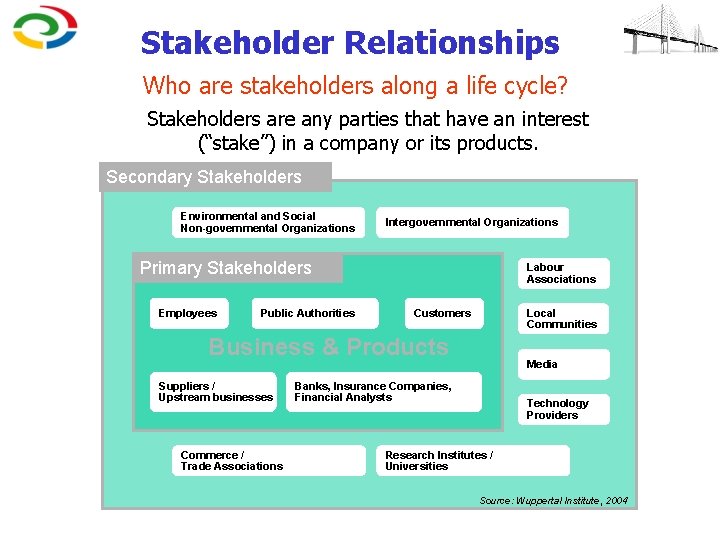
Stakeholder Relationships Who are stakeholders along a life cycle? Stakeholders are any parties that have an interest (“stake”) in a company or its products. Secondary Stakeholders Environmental and Social Non-governmental Organizations Intergovernmental Organizations Primary Stakeholders Employees Public Authorities Labour Associations Local Communities Customers Business & Products Suppliers / Upstream businesses Commerce / Trade Associations Media Banks, Insurance Companies, Financial Analysts Technology Providers Research Institutes / Universities Source: Wuppertal Institute, 2004
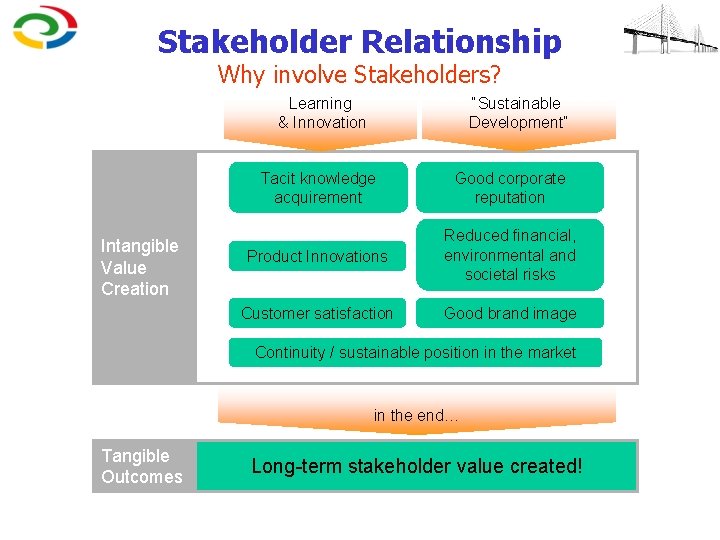
Stakeholder Relationship Why involve Stakeholders? Learning & Innovation Intangible Value Creation “Sustainable Development” Tacit knowledge acquirement Good corporate reputation Product Innovations Reduced financial, environmental and societal risks Customer satisfaction Good brand image Continuity / sustainable position in the market in the end… Tangible Outcomes Long-term stakeholder value created!
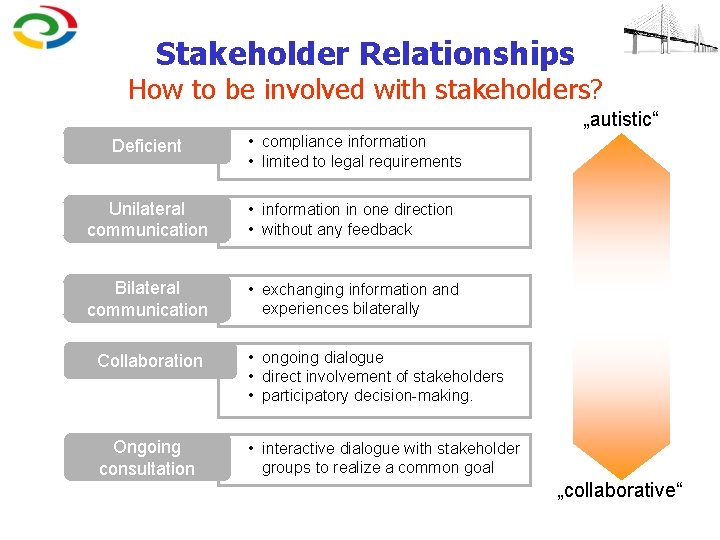
Stakeholder Relationships How to be involved with stakeholders? „autistic“ Deficient • compliance information • limited to legal requirements Unilateral communication • information in one direction • without any feedback Bilateral communication • exchanging information and experiences bilaterally Collaboration • ongoing dialogue • direct involvement of stakeholders • participatory decision-making. Ongoing consultation • interactive dialogue with stakeholder groups to realize a common goal „collaborative“
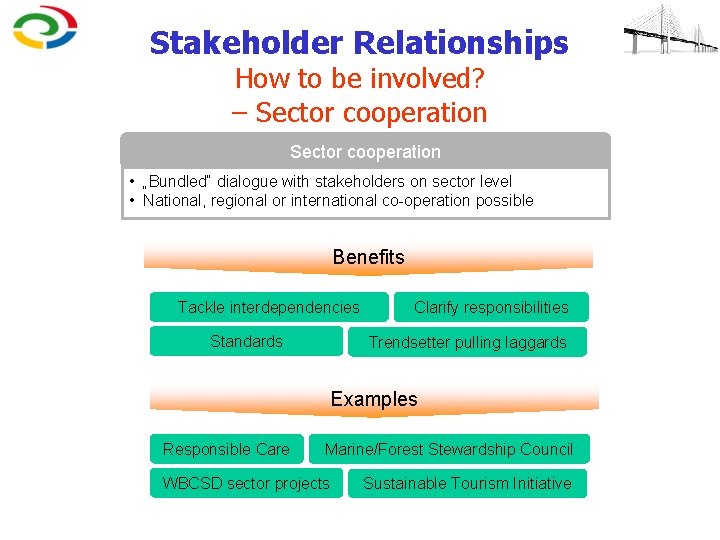
Stakeholder Relationships How to be involved? – Sector cooperation • „Bundled“ dialogue with stakeholders on sector level • National, regional or international co-operation possible Benefits Tackle interdependencies Standards Clarify responsibilities Trendsetter pulling laggards Examples Responsible Care Marine/Forest Stewardship Council WBCSD sector projects Sustainable Tourism Initiative
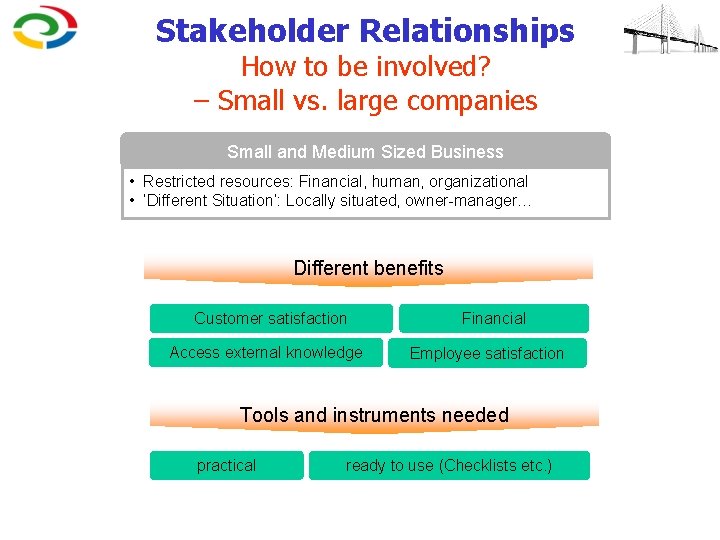
Stakeholder Relationships How to be involved? – Small vs. large companies Small and Medium Sized Business • Restricted resources: Financial, human, organizational • ‘Different Situation’: Locally situated, owner-manager… Different benefits Customer satisfaction Access external knowledge Financial Employee satisfaction Tools and instruments needed practical ready to use (Checklists etc. )
ECONOMIC ASPECTS IN LIFE CYCLE MANAGEMENT Gerald Rebitzer LCM Slide Show April 2005
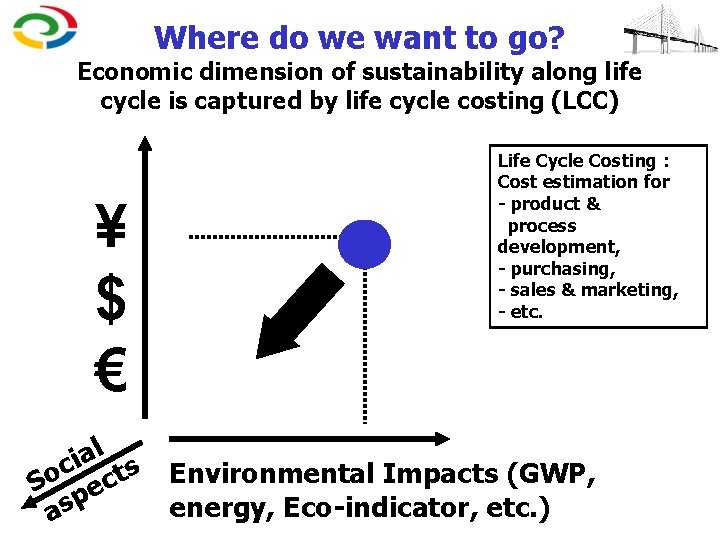
Where do we want to go? Economic dimension of sustainability along life cycle is captured by life cycle costing (LCC) ¥ $ € Life Cycle Costing : Cost estimation for - product & process development, - purchasing, - sales & marketing, - etc. l a i c s Environmental Impacts (GWP, t o c S e p energy, Eco-indicator, etc. ) as
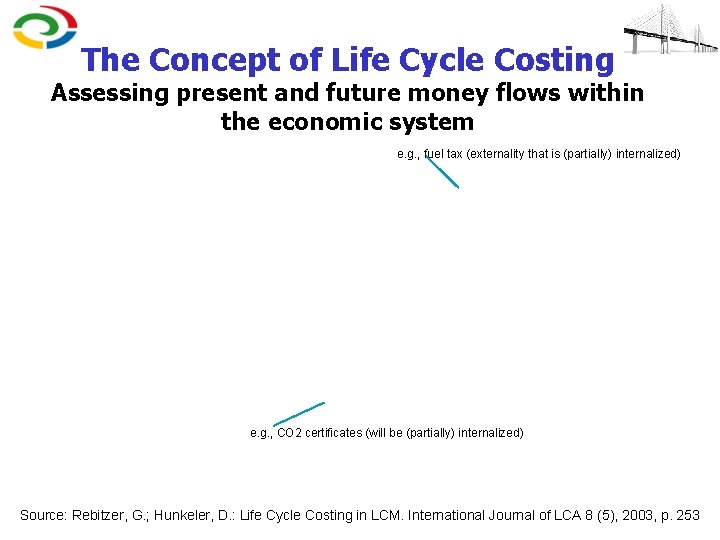
The Concept of Life Cycle Costing Assessing present and future money flows within the economic system e. g. , fuel tax (externality that is (partially) internalized) e. g. , CO 2 certificates (will be (partially) internalized) Source: Rebitzer, G. ; Hunkeler, D. : Life Cycle Costing in LCM. International Journal of LCA 8 (5), 2003, p. 253
Definition of LCC A tool for comparative cost estimations Life Cycle Costing (LCC) is as an assessment of all costs associated with the life cycle of a product that are directly covered by any one or more of the actors in the product life cycle (supplier, producer, user/consumer, EOL-actor), with complimentary inclusion of externalities that are anticipated to be internalized in the decisionrelevant future. Source: Rebitzer, G. ; Hunkeler, D. : Life Cycle Costing in LCM. International Journal of LCA 8 (5), 2003, p. 253
Drivers and Opportunities What can you do with comparative cost estimations along the life cycle? • Optimize product and process planning & development (R&D), purchasing decisions, etc overall costs can be anticipated • Exploitation for sales and marketing (integrate use and end-of-life performance of products and services) demonstrate life cycle performance in economic terms customer focus • To identify trade-offs and economic-environmental win-win situations • To support internal decision-making in corporate context information on costs can be easily communicated to management mid- and long term implications of decisions positioning on the market • Facilitating communication between internal decision-makers and external stakeholders
Success Factors Integration of life cycle thinking at all relevant levels within a firm • Life cycle costing should be based on LCA (simplified or detailed) consistency ensured Life cycle inventory data model of LCA can be efficiently reused elements for sustainability assessments are created • Results have to be usable for different functions (R&D, sales & marketing, management, etc. ) integration into existing systems (e. g. R&D stage gate process) adapt specific terminology (talk the language of the receiver) establish specific tools where required • Effective communication of approaches awareness trainings for general audience (why we do this) specific trainings for users of tools • Establish a data structure compatible with existing data management systems data have to be easily retrievable from existing systems
PROCESS LIFE CYCLE MANAGEMENT Robert Ackermann LCM Slide Show April 2005
What is it? • Tool to make the business procedure level accessible for life cycle thinking • Integration of Life cycle thinking in the continuous improvement of production processes • Establishing a starting point for integrated optimization towards sustainability
Drivers • • Consumer demands Legal demands Reduction of (costs for) waste and emissions Increasing of benefits through ecological assessment • Iterative improvement of life cycles without major changes • Indirect improvement through change in life cycle • Identification of risks inherent in the life cycle
Opportunities • Iterative optimization of process chain according to priority ranking • Continuous improvement of the enterprise • Flexible reaction to demands of customers • Ecological optimization in the life cycle without consideration of external costs • Combined ecological and economic optimization of small production units
Why is this important to (my) Organization? • Identification of upcoming environmental problems in/caused by the enterprise • Priority ranking od the activities • Decreasing costs through outsourcing in the life cycle • Support for the realization of EMAS or ISO 14001 procedures
Success Factors (Pre-requisites) • In-depth analysis of processes and correlations within the system • Generation of consistent parametric process models • Compatibility with business perception to facilitate the implementation
- Slides: 81