
Life Cycle Assessment of flax fibre for the
Life Cycle Assessment of flax fibre for the reinforcement of composites Nilmini Dissanayake, John Summerscales, Stephen Grove and Miggy Singh
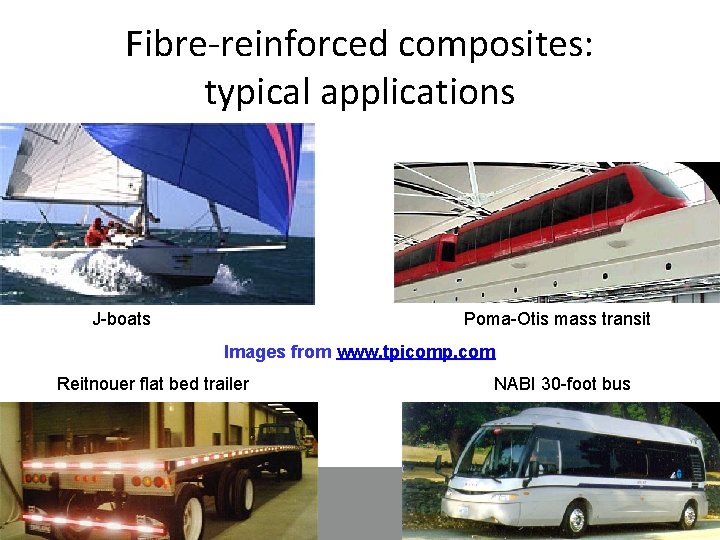
Fibre-reinforced composites: typical applications J-boats Poma-Otis mass transit Images from www. tpicomp. com Reitnouer flat bed trailer NABI 30 -foot bus

Content § Flax § Life Cycle Assessment (LCA) § goal and scope § system boundaries § Life Cycle Inventory analysis (LCI) § 3 scenarios § energy § Environmental Impact Classification Factors (EICF) § Life Cycle Impact Assessment (LCIA) - results § Conclusions
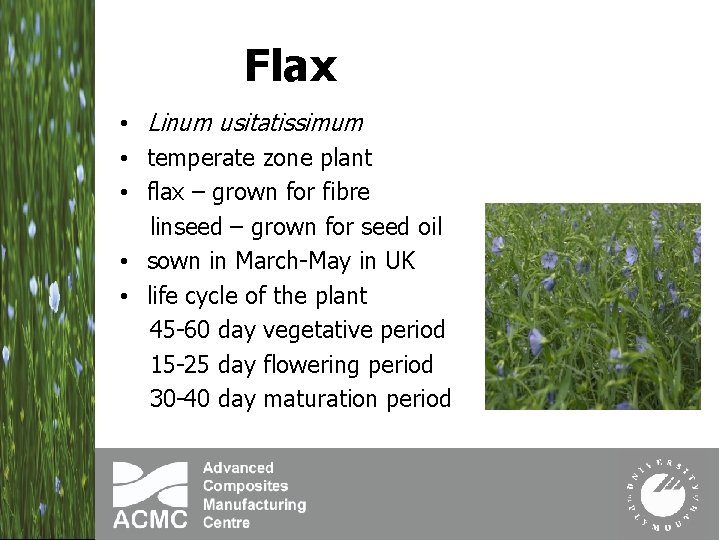
Flax • Linum usitatissimum • temperate zone plant • flax – grown for fibre linseed – grown for seed oil • sown in March-May in UK • life cycle of the plant 45 -60 day vegetative period 15 -25 day flowering period 30 -40 day maturation period
Why Flax ? • flax is the most agro-chemical intensive bast fibre used as reinforcement • other bast fibres may be “greener” provided yield/hectare and performance/durability are satisfactory
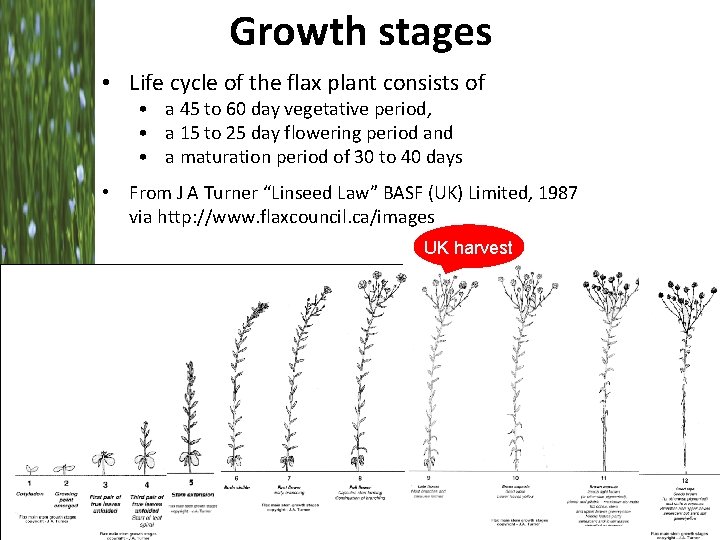
Growth stages • Life cycle of the flax plant consists of • a 45 to 60 day vegetative period, • a 15 to 25 day flowering period and • a maturation period of 30 to 40 days • From J A Turner “Linseed Law” BASF (UK) Limited, 1987 via http: //www. flaxcouncil. ca/images UK harvest
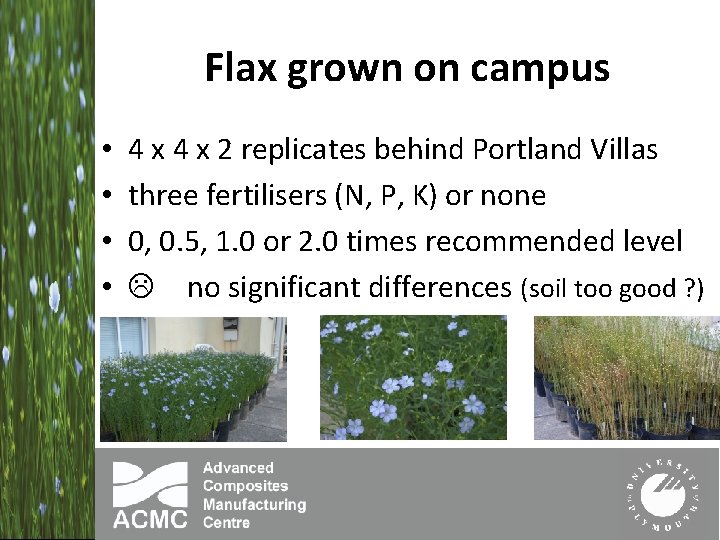
Flax grown on campus • • 4 x 2 replicates behind Portland Villas three fertilisers (N, P, K) or none 0, 0. 5, 1. 0 or 2. 0 times recommended level no significant differences (soil too good ? )
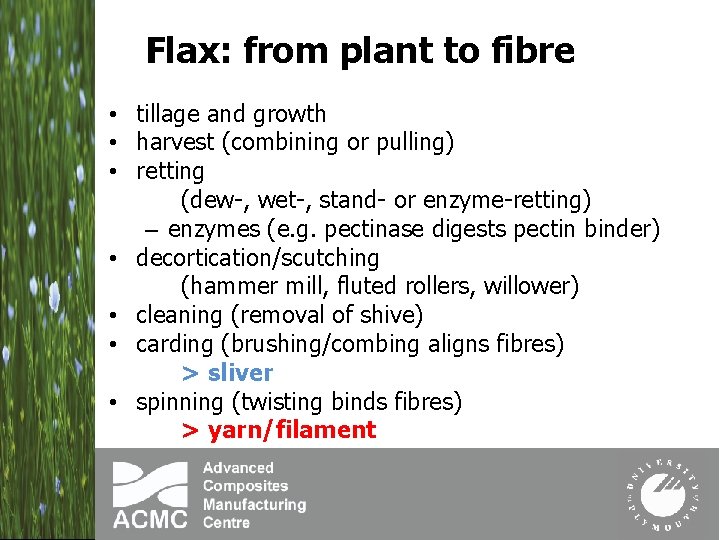
Flax: from plant to fibre • tillage and growth • harvest (combining or pulling) • retting (dew-, wet-, stand- or enzyme-retting) – enzymes (e. g. pectinase digests pectin binder) • decortication/scutching (hammer mill, fluted rollers, willower) • cleaning (removal of shive) • carding (brushing/combing aligns fibres) > sliver • spinning (twisting binds fibres) > yarn/filament
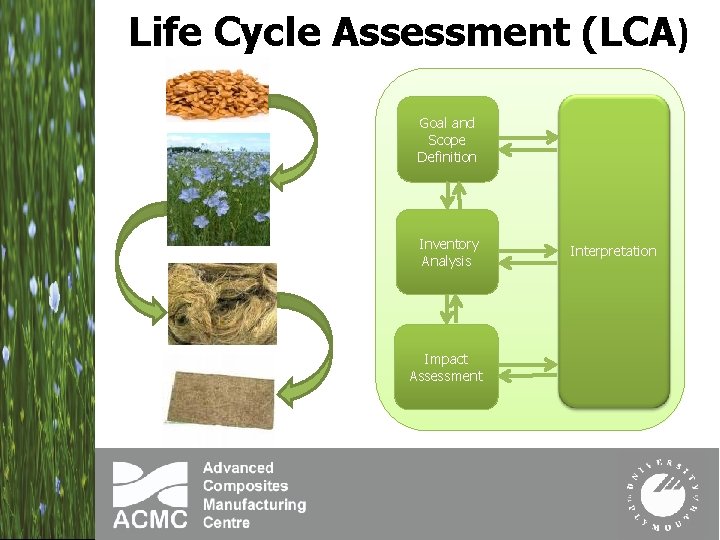
Life Cycle Assessment (LCA) Goal and Scope Definition Inventory Analysis Impact Assessment Interpretation
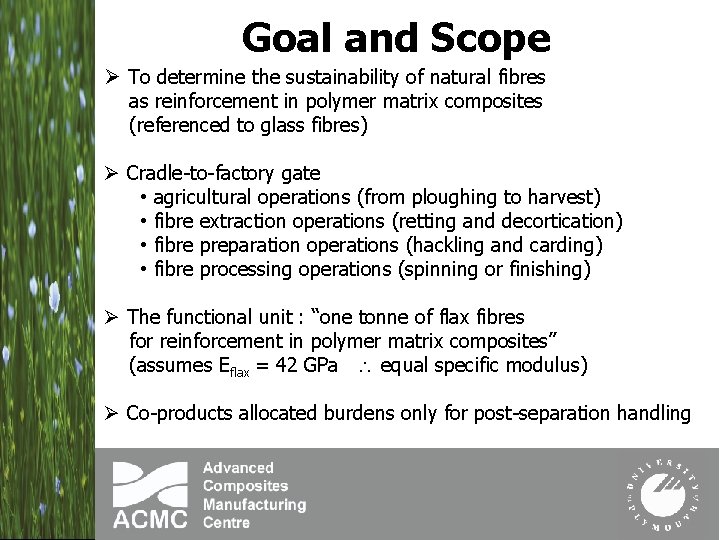
Goal and Scope Ø To determine the sustainability of natural fibres as reinforcement in polymer matrix composites (referenced to glass fibres) Ø Cradle-to-factory gate • agricultural operations (from ploughing to harvest) • fibre extraction operations (retting and decortication) • fibre preparation operations (hackling and carding) • fibre processing operations (spinning or finishing) Ø The functional unit : “one tonne of flax fibres for reinforcement in polymer matrix composites” (assumes Eflax = 42 GPa equal specific modulus) Ø Co-products allocated burdens only for post-separation handling
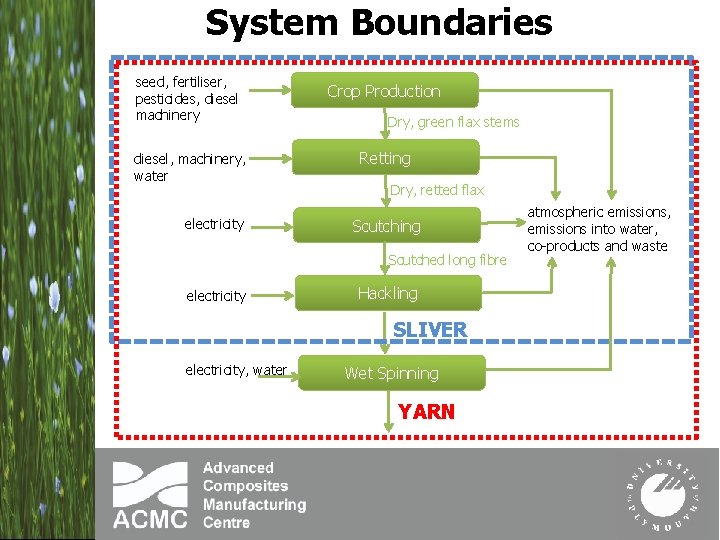
System Boundaries seed, fertiliser, pesticides, diesel machinery diesel, machinery, water electricity Crop Production Dry, green flax stems Retting Dry, retted flax Scutching Scutched long fibre electricity Hackling SLIVER electricity, water Wet Spinning YARN atmospheric emissions, emissions into water, co-products and waste
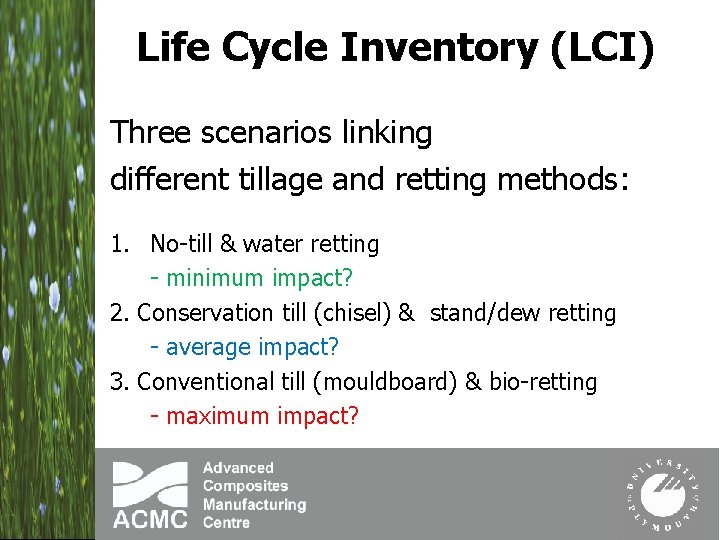
Life Cycle Inventory (LCI) Three scenarios linking different tillage and retting methods: 1. No-till & water retting - minimum impact? 2. Conservation till (chisel) & stand/dew retting - average impact? 3. Conventional till (mouldboard) & bio-retting - maximum impact?
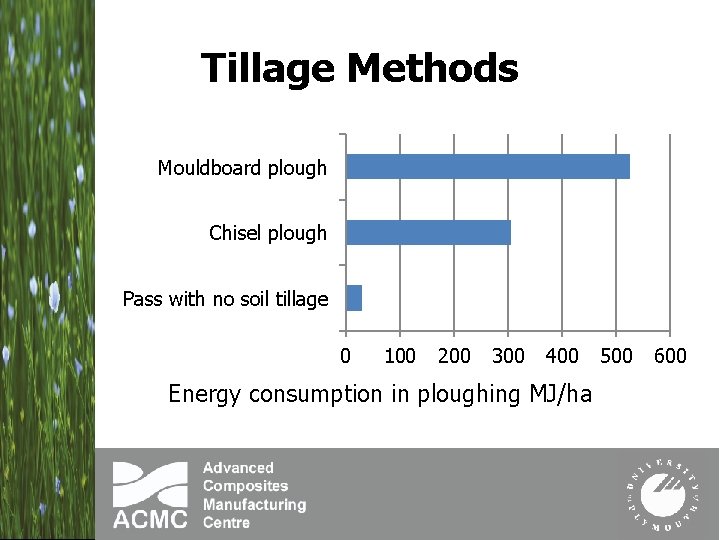
Tillage Methods Mouldboard plough Chisel plough Pass with no soil tillage 0 100 200 300 400 Energy consumption in ploughing MJ/ha 500 600
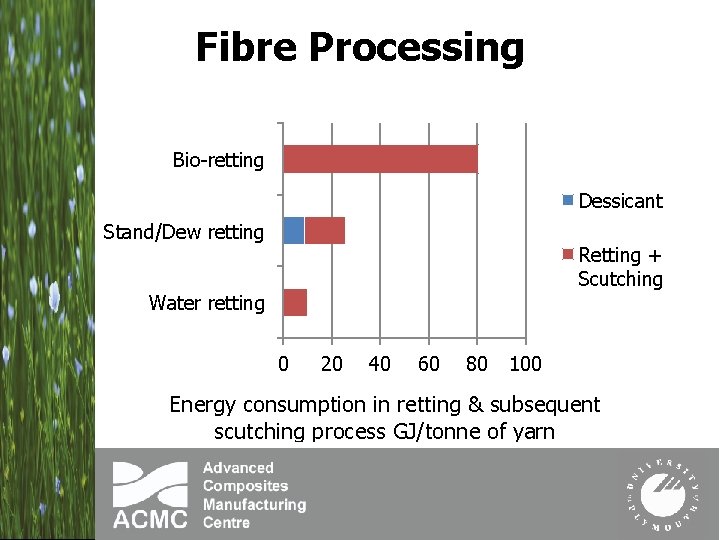
Fibre Processing Bio-retting Dessicant Stand/Dew retting Retting + Scutching Water retting 0 20 40 60 80 100 Energy consumption in retting & subsequent scutching process GJ/tonne of yarn
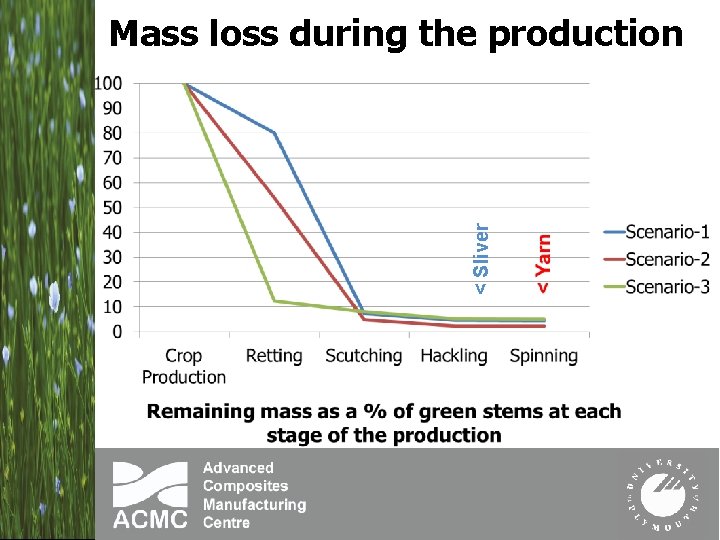
< Sliver Mass loss during the production
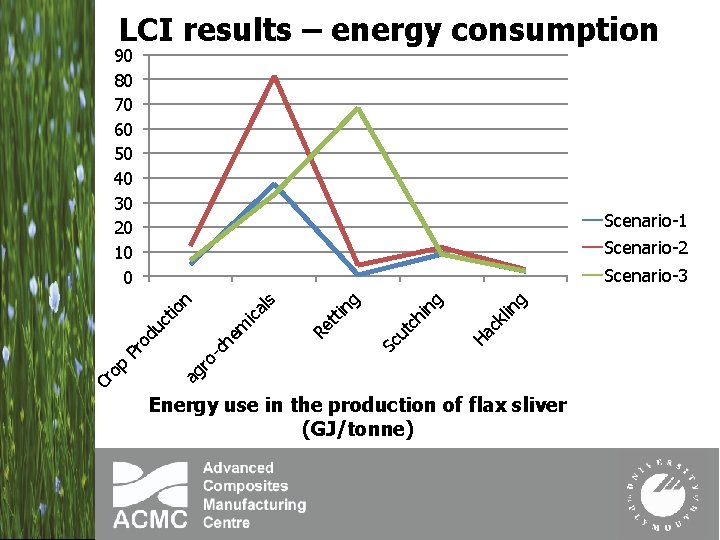
LCI results – energy consumption 90 80 70 60 50 40 30 20 10 0 Scenario-1 Scenario-2 lin g Ha ck hi ng tc Sc u ng tti Re m he -c ro ag Cr op P r od uc ica tio n ls Scenario-3 Energy use in the production of flax sliver (GJ/tonne)
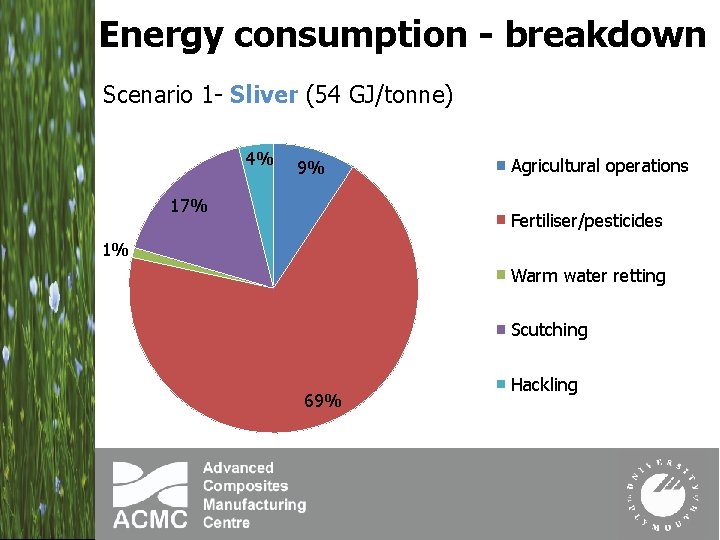
Energy consumption - breakdown Scenario 1 - Sliver (54 GJ/tonne) 4% 9% 17% Agricultural operations Fertiliser/pesticides 1% Warm water retting Scutching 69% Hackling
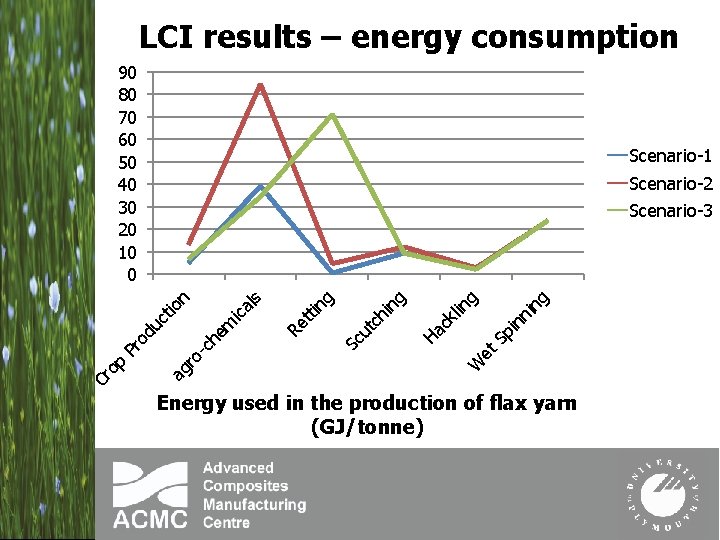
LCI results – energy consumption 90 80 70 60 50 40 30 20 10 0 Scenario-1 Scenario-2 g g ni n in in kl W et S p Ha c hi ng tc Sc u ng tti Re m he -c ro ag Cr op P r od uc ica tio n ls Scenario-3 Energy used in the production of flax yarn (GJ/tonne)
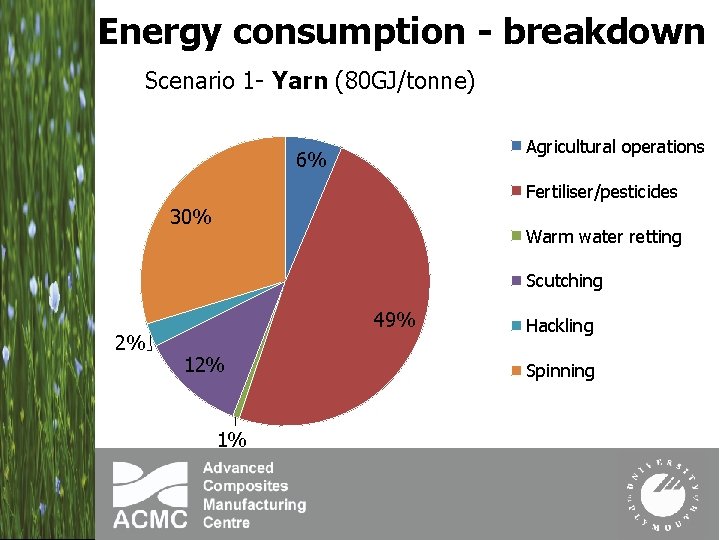
Energy consumption - breakdown Scenario 1 - Yarn (80 GJ/tonne) Agricultural operations 6% Fertiliser/pesticides 30% Warm water retting Scutching 2% 49% 12% 1% Hackling Spinning
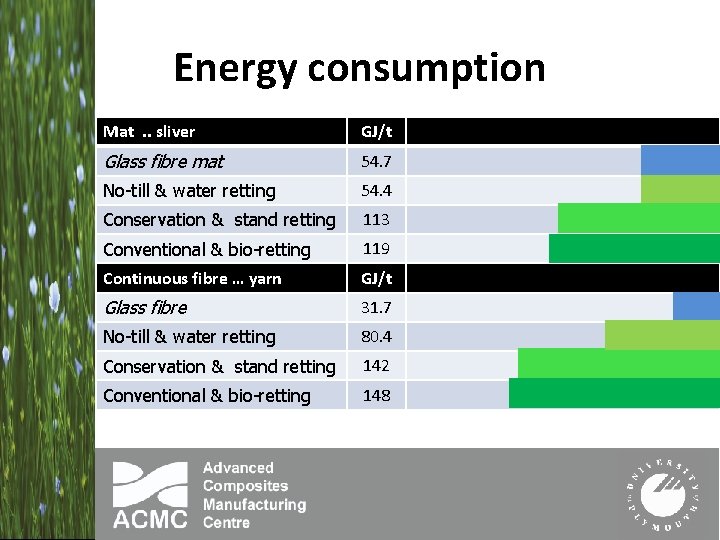
Energy consumption Mat. . sliver GJ/t Glass fibre mat 54. 7 No-till & water retting 54. 4 Conservation & stand retting 113 Conventional & bio-retting 119 Continuous fibre … yarn GJ/t Glass fibre 31. 7 No-till & water retting 80. 4 Conservation & stand retting 142 Conventional & bio-retting 148
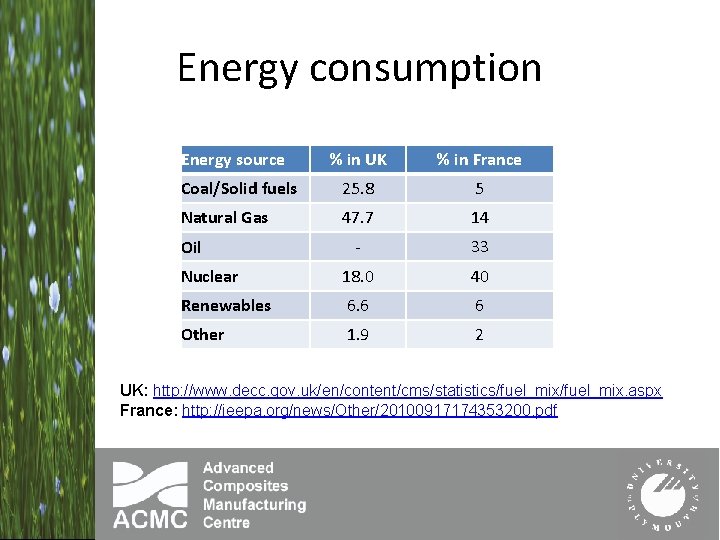
Energy consumption % in UK % in France Coal/Solid fuels 25. 8 5 Natural Gas 47. 7 14 - 33 Nuclear 18. 0 40 Renewables 6. 6 6 Other 1. 9 2 Energy source Oil UK: http: //www. decc. gov. uk/en/content/cms/statistics/fuel_mix. aspx France: http: //ieepa. org/news/Other/20100917174353200. pdf
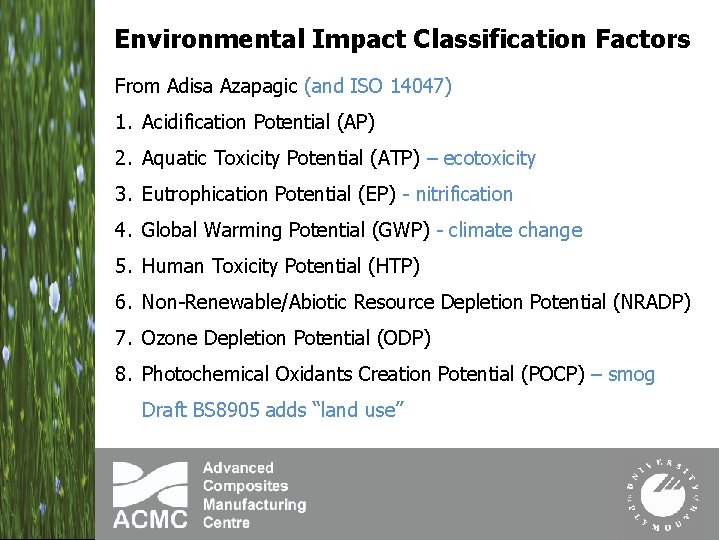
Environmental Impact Classification Factors From Adisa Azapagic (and ISO 14047) 1. Acidification Potential (AP) 2. Aquatic Toxicity Potential (ATP) – ecotoxicity 3. Eutrophication Potential (EP) - nitrification 4. Global Warming Potential (GWP) - climate change 5. Human Toxicity Potential (HTP) 6. Non-Renewable/Abiotic Resource Depletion Potential (NRADP) 7. Ozone Depletion Potential (ODP) 8. Photochemical Oxidants Creation Potential (POCP) – smog Draft BS 8905 adds “land use”
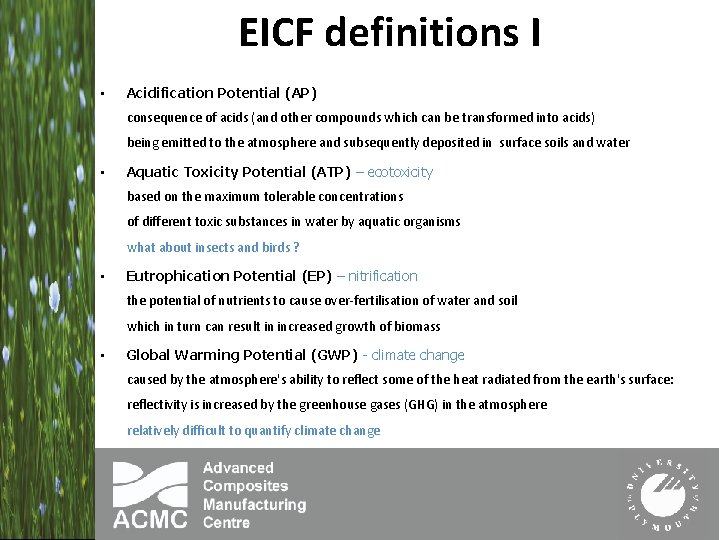
EICF definitions I • Acidification Potential (AP) consequence of acids (and other compounds which can be transformed into acids) being emitted to the atmosphere and subsequently deposited in surface soils and water • Aquatic Toxicity Potential (ATP) – ecotoxicity based on the maximum tolerable concentrations of different toxic substances in water by aquatic organisms what about insects and birds ? • Eutrophication Potential (EP) – nitrification the potential of nutrients to cause over-fertilisation of water and soil which in turn can result in increased growth of biomass • Global Warming Potential (GWP) - climate change caused by the atmosphere's ability to reflect some of the heat radiated from the earth's surface: reflectivity is increased by the greenhouse gases (GHG) in the atmosphere relatively difficult to quantify climate change
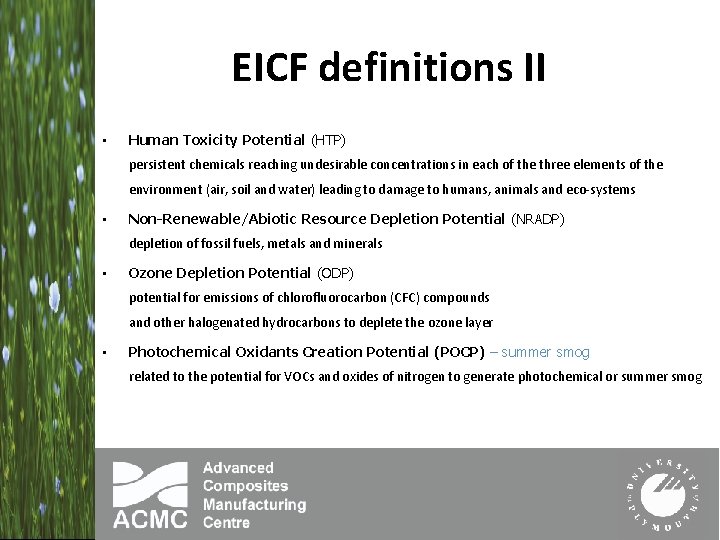
EICF definitions II • Human Toxicity Potential (HTP) persistent chemicals reaching undesirable concentrations in each of the three elements of the environment (air, soil and water) leading to damage to humans, animals and eco-systems • Non-Renewable/Abiotic Resource Depletion Potential (NRADP) depletion of fossil fuels, metals and minerals • Ozone Depletion Potential (ODP) potential for emissions of chlorofluorocarbon (CFC) compounds and other halogenated hydrocarbons to deplete the ozone layer • Photochemical Oxidants Creation Potential (POCP) – summer smog related to the potential for VOCs and oxides of nitrogen to generate photochemical or summer smog
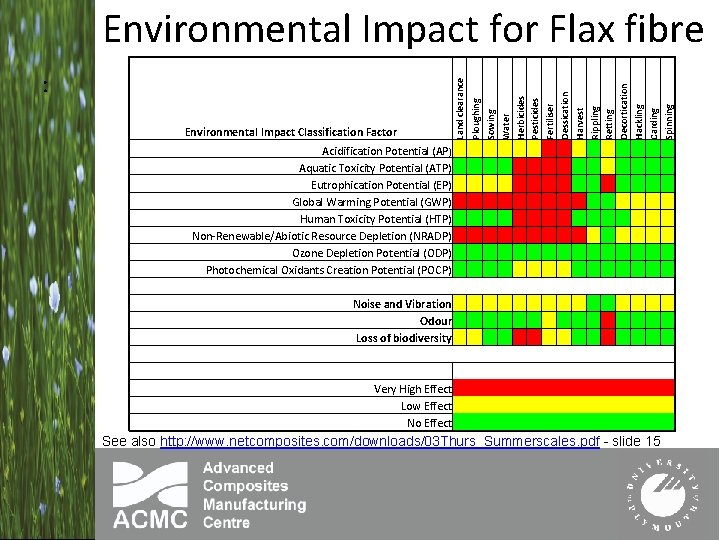
Environmental Impact Classification Factor Acidification Potential (AP ) Aquatic Toxicity Potential (ATP) Eutrophication Potential (EP) Global Warming Potential (GWP) Human Toxicity Potential (HTP) Non-Renewable/Abiotic Resource Depletion (NRADP) Ozone Depletion Potential (ODP) Photochemical Oxidants Creation Potential (POCP) Ploughing Sowing Water Herbicides Pesticides Fertiliser Dessication Harvest Rippling Retting Decortication Hackling Carding Spinning : Land clearance Environmental Impact for Flax fibre Noise and Vibration Odour Loss of biodiversity Very High Effect Low Effect No Effect See also http: //www. netcomposites. com/downloads/03 Thurs_Summerscales. pdf - slide 15
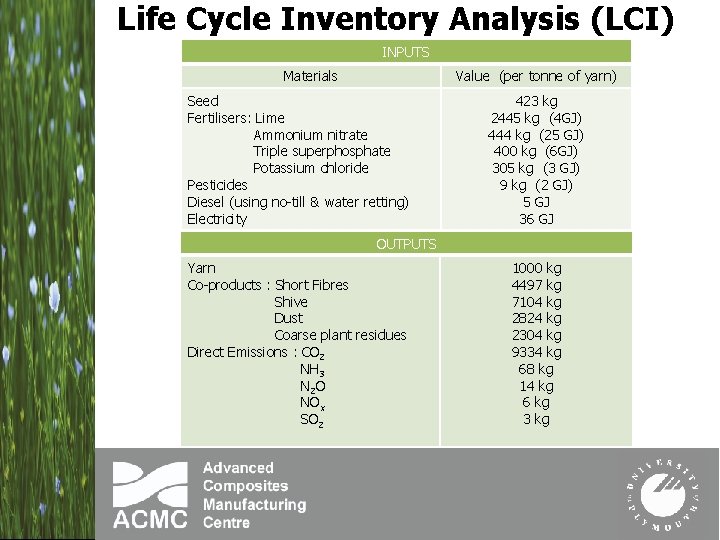
Life Cycle Inventory Analysis (LCI) INPUTS Materials Value (per tonne of yarn) Seed Fertilisers: Lime Ammonium nitrate Triple superphosphate Potassium chloride Pesticides Diesel (using no-till & water retting) Electricity 423 kg 2445 kg (4 GJ) 444 kg (25 GJ) 400 kg (6 GJ) 305 kg (3 GJ) 9 kg (2 GJ) 5 GJ 36 GJ OUTPUTS Yarn Co-products : Short Fibres Shive Dust Coarse plant residues Direct Emissions : CO 2 NH 3 N 2 O NOx SO 2 1000 kg 4497 kg 7104 kg 2824 kg 2304 kg 9334 kg 68 kg 14 kg 6 kg 3 kg
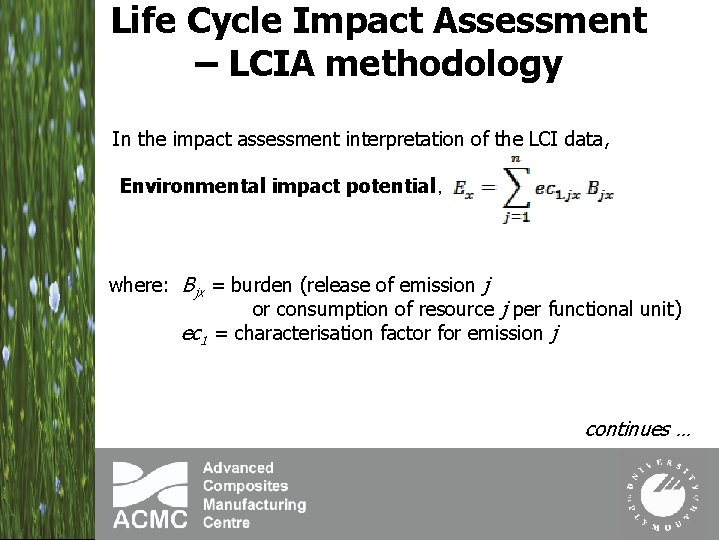
Life Cycle Impact Assessment – LCIA methodology In the impact assessment interpretation of the LCI data, Environmental impact potential, where: Bjx = burden (release of emission j or consumption of resource j per functional unit) ec 1 = characterisation factor for emission j continues …
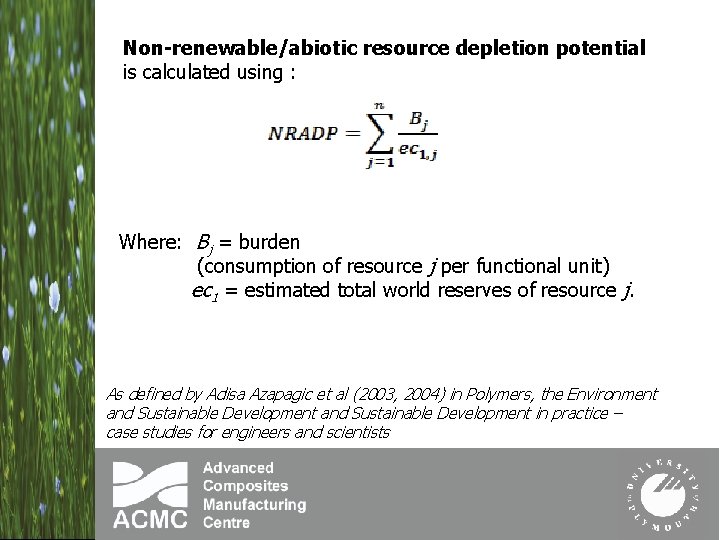
Non-renewable/abiotic resource depletion potential is calculated using : Where: Bj = burden (consumption of resource j per functional unit) ec 1 = estimated total world reserves of resource j. As defined by Adisa Azapagic et al (2003, 2004) in Polymers, the Environment and Sustainable Development in practice – case studies for engineers and scientists
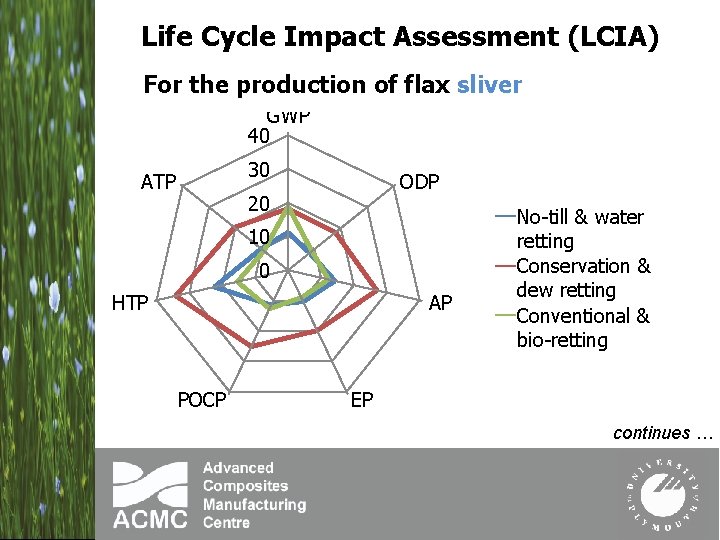
Life Cycle Impact Assessment (LCIA) For the production of flax sliver GWP 40 30 ATP ODP 20 10 0 HTP AP POCP No-till & water retting Conservation & dew retting Conventional & bio-retting EP continues …
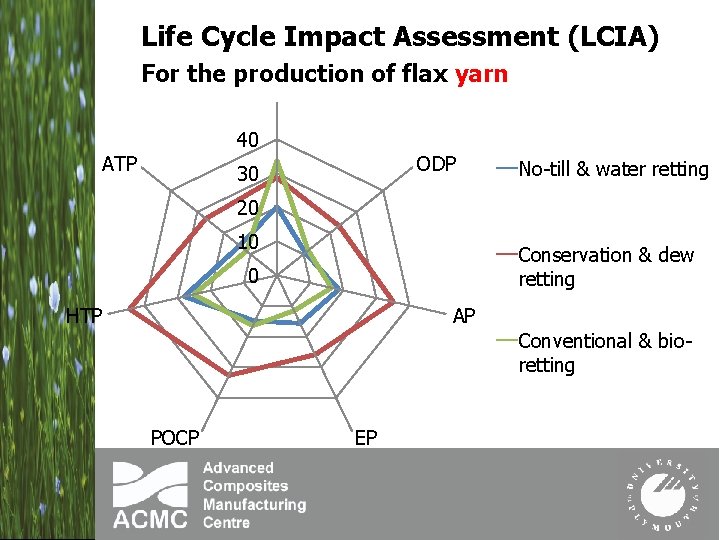
Life Cycle Impact Assessment (LCIA) For the production of flax yarn GWP 40 ATP ODP 30 No-till & water retting 20 10 Conservation & dew retting 0 HTP AP Conventional & bioretting POCP EP

No-till/water-ret flax vs glass fibres… GF data from Sustainability at Owens Corning – 2008 Summary Progress Report
This study did not address: • sequestration of CO 2 • use phase – assumed comparable to glass • disposal – flax could be composted but degradation leads to “biogas [which] is typically 60 -65% methane, 35% carbon dioxide and a small amount of other impurities” [Jana et al, 2001] S Jana, NR Chakrabarty and SC Sarkar, Removal of Carbon Dioxide from Biogas for Methane Generation, Journal of Energy in Southern Africa, August 2001, 12(3).
A Le Duigou et al, JBMBE, 2011. • environmental impact analysis on French flax fibers using different underlying assumptions to Dissanayake et al for UK fibers concluded that “without the allocation procedure the results from the two studies would be similar. ”
Le Duigou vs Dissanayake key differences • UK plants desiccated at mid-point flowering but French plants allowed to set seed • UK yield only 6000 kg/ha but French yield 7500 kg/ha at harvest • UK study excluded photosynthesis and CO 2 sequestration • Higher level of nuclear power in the French energy mix • UK study allocated all burdens to fiber French study allocated on mass of product and co-products
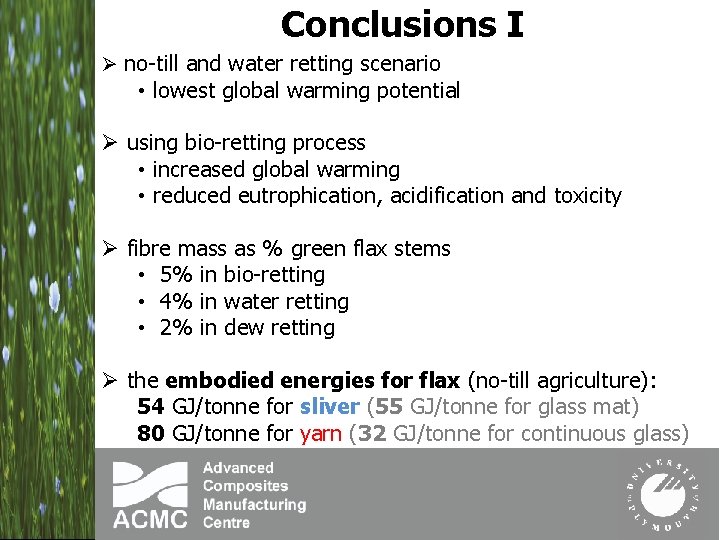
Conclusions I Ø no-till and water retting scenario • lowest global warming potential Ø using bio-retting process • increased global warming • reduced eutrophication, acidification and toxicity Ø fibre mass as % green flax stems • 5% in bio-retting • 4% in water retting • 2% in dew retting Ø the embodied energies for flax (no-till agriculture): 54 GJ/tonne for sliver (55 GJ/tonne for glass mat) 80 GJ/tonne for yarn (32 GJ/tonne for continuous glass)
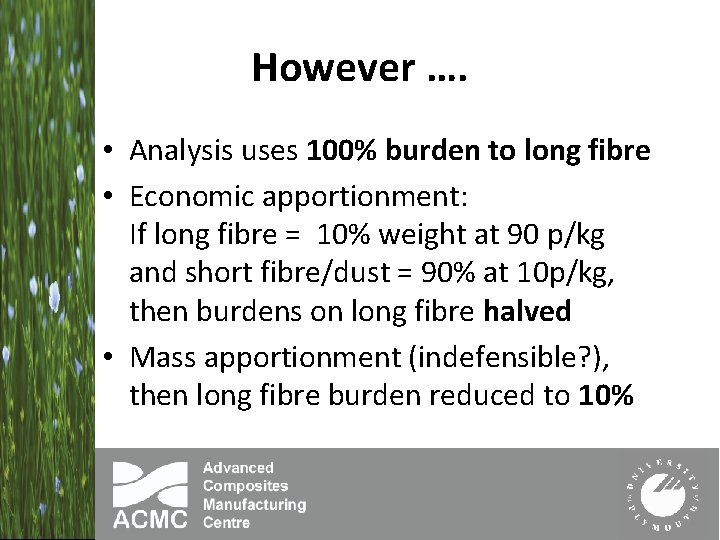
However …. • Analysis uses 100% burden to long fibre • Economic apportionment: If long fibre = 10% weight at 90 p/kg and short fibre/dust = 90% at 10 p/kg, then burdens on long fibre halved • Mass apportionment (indefensible? ), then long fibre burden reduced to 10%
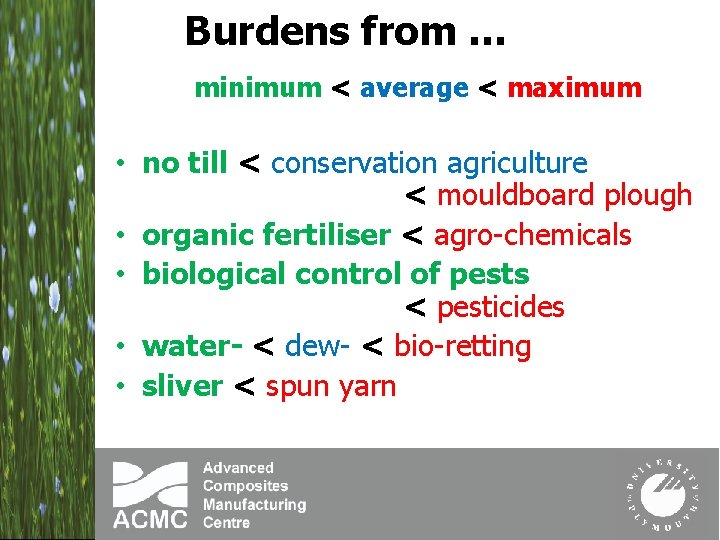
Burdens from … minimum < average < maximum • no till < conservation agriculture < mouldboard plough • organic fertiliser < agro-chemicals • biological control of pests < pesticides • water- < dew- < bio-retting • sliver < spun yarn
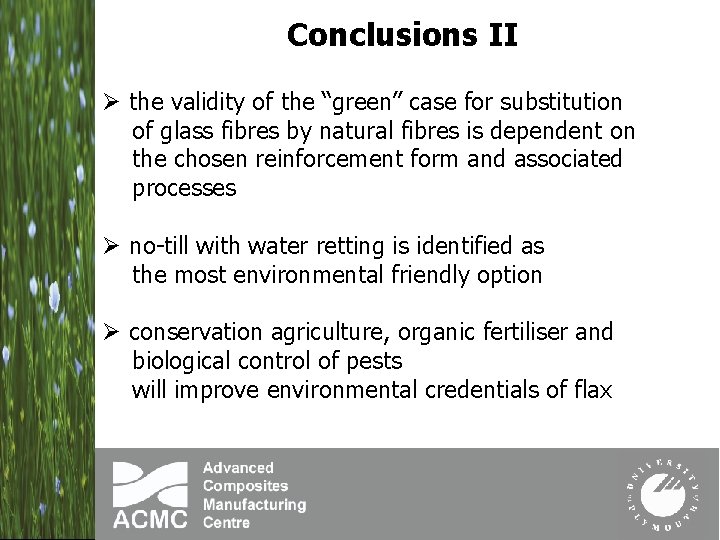
Conclusions II Ø the validity of the “green” case for substitution of glass fibres by natural fibres is dependent on the chosen reinforcement form and associated processes Ø no-till with water retting is identified as the most environmental friendly option Ø conservation agriculture, organic fertiliser and biological control of pests will improve environmental credentials of flax
Ph. D thesis as free download: http: //pearl. plymouth. ac. uk/ handle/10026. 1/483

Thank you for your attention. Any questions? http: //www. tech. plym. ac. uk/sme/acmc/lca. htm
- Slides: 40