
Life cycle and ecology of the loggerhead turtle
- Slides: 19
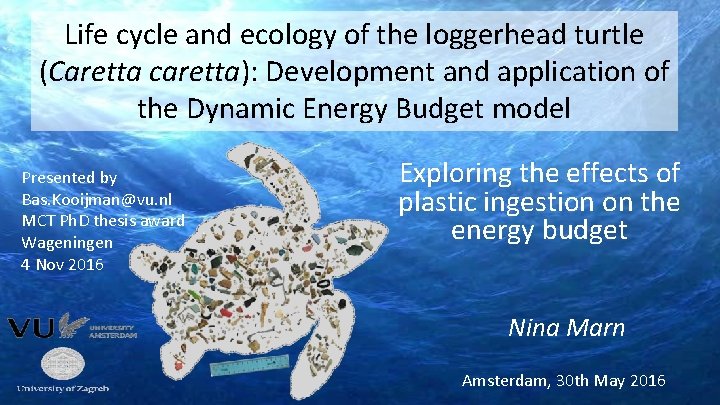
Life cycle and ecology of the loggerhead turtle (Caretta caretta): Development and application of the Dynamic Energy Budget model Presented by Bas. Kooijman@vu. nl MCT Ph. D thesis award Wageningen 4 Nov 2016 Exploring the effects of plastic ingestion on the energy budget Nina Marn Amsterdam, 30 th May 2016
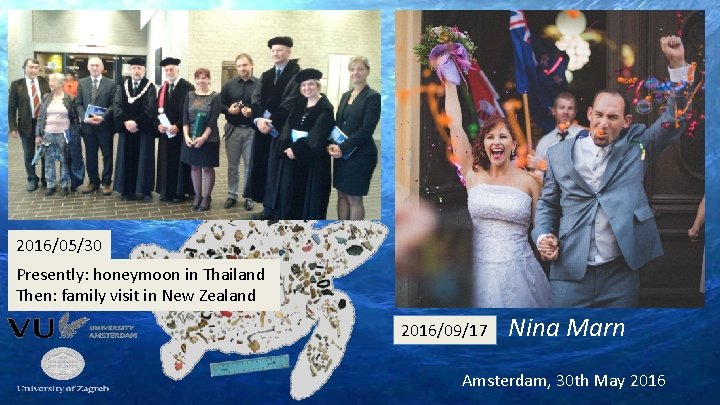
2016/05/30 Exploring the effects of plastic ingestion on the energy budget Presently: honeymoon in Thailand Then: family visit in New Zealand 2016/09/17 Nina Marn Amsterdam, 30 th May 2016
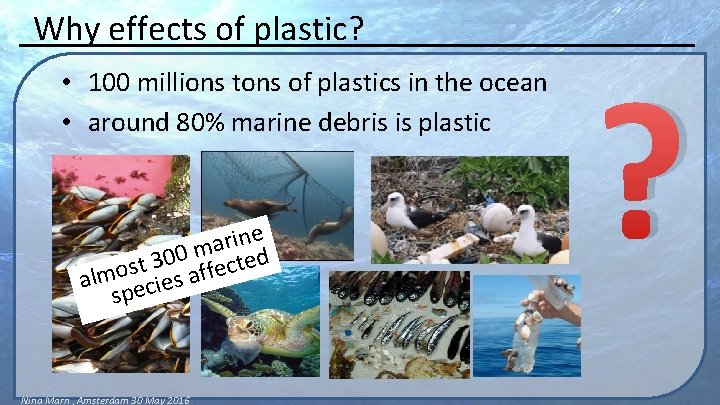
Why effects of plastic? • 100 millions tons of plastics in the ocean • around 80% marine debris is plastic e n i r a m ed 0 0 3 t t c s e o f f m a al ecies sp Nina Marn , Amsterdam 30 May 2016 ?
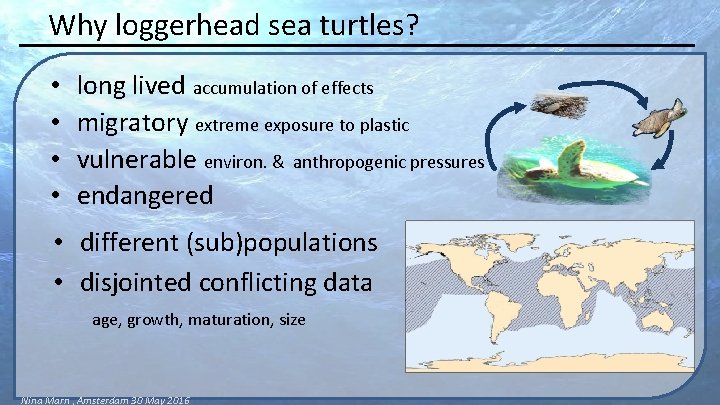
Why loggerhead sea turtles? • • long lived accumulation of effects migratory extreme exposure to plastic vulnerable environ. & anthropogenic pressures endangered • different (sub)populations • disjointed conflicting data age, growth, maturation, size Nina Marn , Amsterdam 30 May 2016
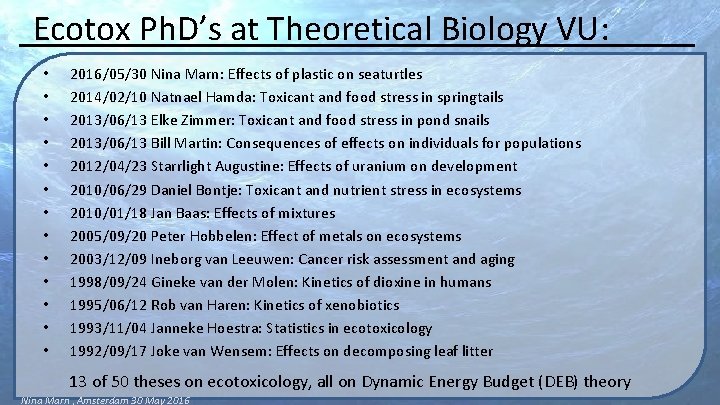
Ecotox Ph. D’s at Theoretical Biology VU: • • • • 2016/05/30 Nina Marn: Effects of plastic on seaturtles 2014/02/10 Natnael Hamda: Toxicant and food stress in springtails 2013/06/13 Elke Zimmer: Toxicant and food stress in pond snails 2013/06/13 Bill Martin: Consequences of effects on individuals for populations 2012/04/23 Starrlight Augustine: Effects of uranium on development 2010/06/29 Daniel Bontje: Toxicant and nutrient stress in ecosystems 2010/01/18 Jan Baas: Effects of mixtures 2005/09/20 Peter Hobbelen: Effect of metals on ecosystems 2003/12/09 Ineborg van Leeuwen: Cancer risk assessment and aging 1998/09/24 Gineke van der Molen: Kinetics of dioxine in humans 1995/06/12 Rob van Haren: Kinetics of xenobiotics 1993/11/04 Janneke Hoestra: Statistics in ecotoxicology 1992/09/17 Joke van Wensem: Effects on decomposing leaf litter 13 of 50 theses on ecotoxicology, all on Dynamic Energy Budget (DEB) theory Nina Marn , Amsterdam 30 May 2016
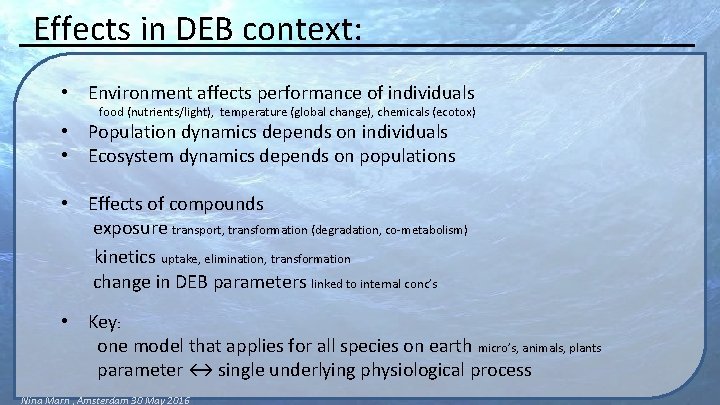
Effects in DEB context: • Environment affects performance of individuals food (nutrients/light), temperature (global change), chemicals (ecotox) • Population dynamics depends on individuals • Ecosystem dynamics depends on populations • Effects of compounds exposure transport, transformation (degradation, co-metabolism) kinetics uptake, elimination, transformation change in DEB parameters linked to internal conc’s • Key: one model that applies for all species on earth micro’s, animals, plants parameter ↔ single underlying physiological process Nina Marn , Amsterdam 30 May 2016
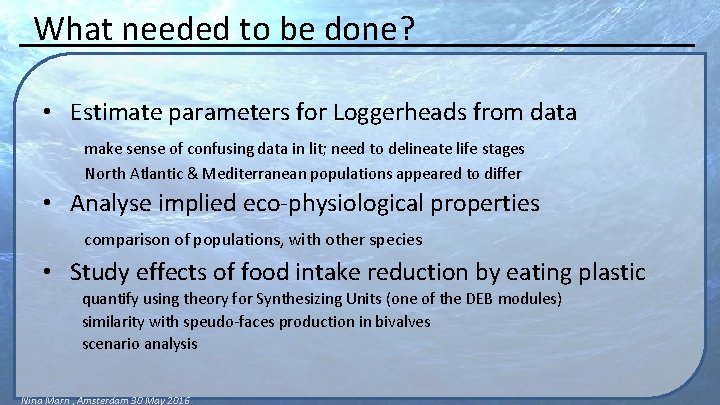
What needed to be done? • Estimate parameters for Loggerheads from data make sense of confusing data in lit; need to delineate life stages North Atlantic & Mediterranean populations appeared to differ • Analyse implied eco-physiological properties comparison of populations, with other species • Study effects of food intake reduction by eating plastic quantify using theory for Synthesizing Units (one of the DEB modules) similarity with speudo-faces production in bivalves scenario analysis Nina Marn , Amsterdam 30 May 2016
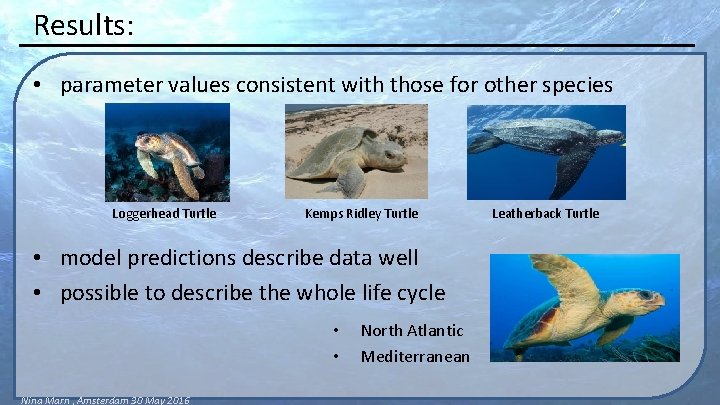
Results: • parameter values consistent with those for other species Loggerhead Turtle Kemps Ridley Turtle • model predictions describe data well • possible to describe the whole life cycle • • Nina Marn , Amsterdam 30 May 2016 North Atlantic Mediterranean Leatherback Turtle
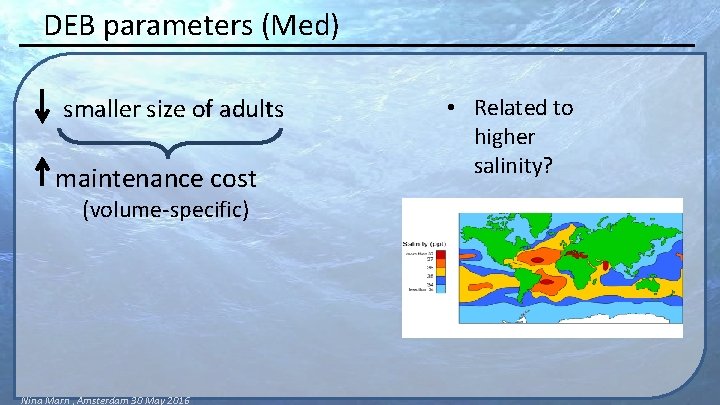
DEB parameters (Med) smaller size of adults maintenance cost (volume-specific) Nina Marn , Amsterdam 30 May 2016 • Related to higher salinity?
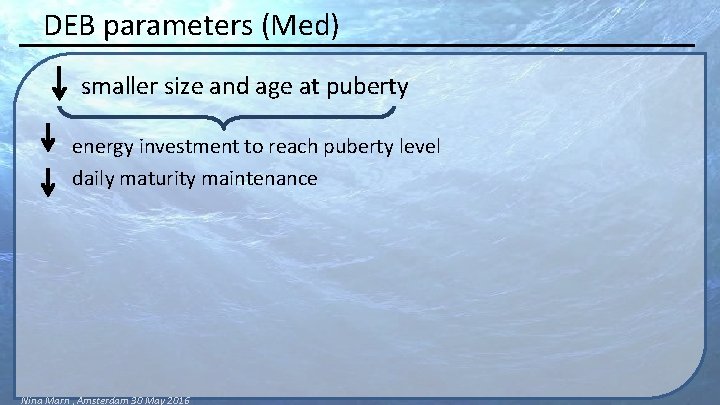
DEB parameters (Med) smaller size and age at puberty energy investment to reach puberty level daily maturity maintenance Nina Marn , Amsterdam 30 May 2016
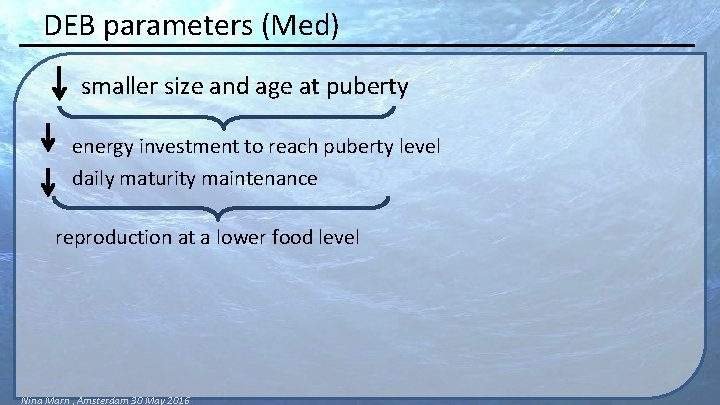
DEB parameters (Med) smaller size and age at puberty energy investment to reach puberty level daily maturity maintenance reproduction at a lower food level Nina Marn , Amsterdam 30 May 2016
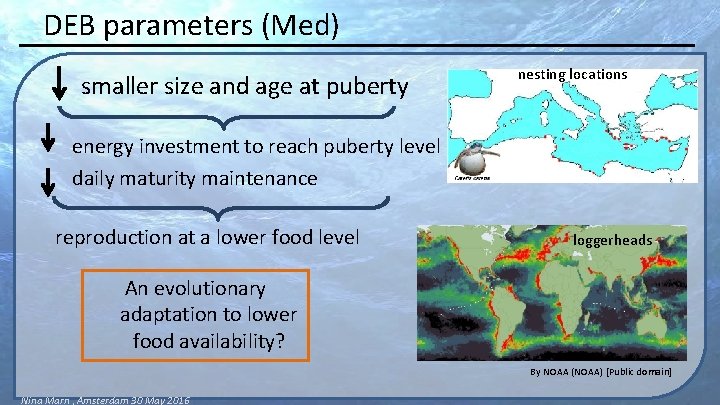
DEB parameters (Med) smaller size and age at puberty nesting locations energy investment to reach puberty level daily maturity maintenance reproduction at a lower food level loggerheads An evolutionary adaptation to lower food availability? By NOAA (NOAA) [Public domain] Nina Marn , Amsterdam 30 May 2016
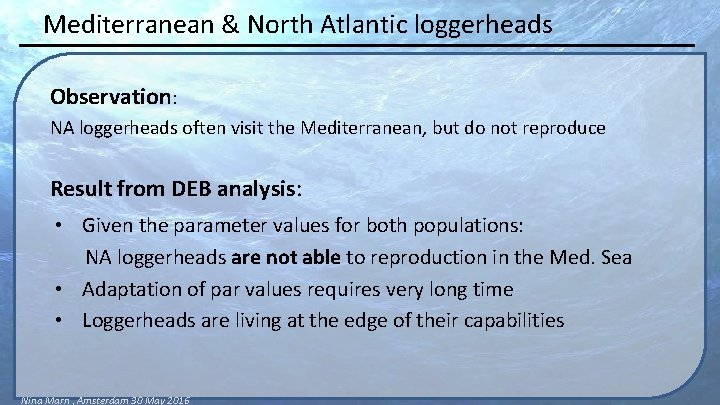
Mediterranean & North Atlantic loggerheads Observation: NA loggerheads often visit the Mediterranean, but do not reproduce Result from DEB analysis: • Given the parameter values for both populations: NA loggerheads are not able to reproduction in the Med. Sea • Adaptation of par values requires very long time • Loggerheads are living at the edge of their capabilities Nina Marn , Amsterdam 30 May 2016
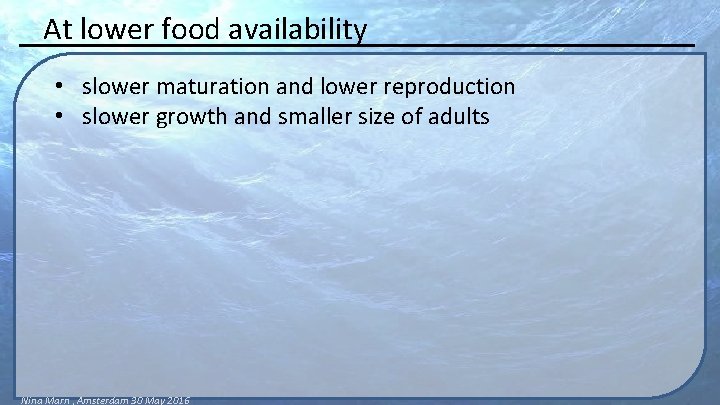
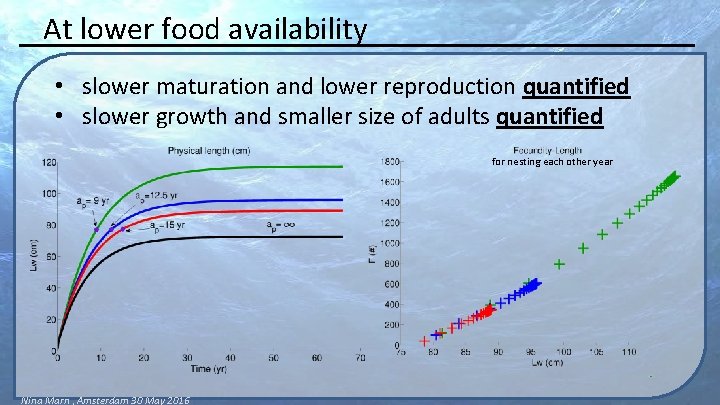
At lower food availability • slower maturation and lower reproduction • slower growth and smaller size of adults Nina Marn , Amsterdam 30 May 2016
At lower food availability • slower maturation and lower reproduction quantified • slower growth and smaller size of adults quantified for nesting each other year Nina Marn , Amsterdam 30 May 2016
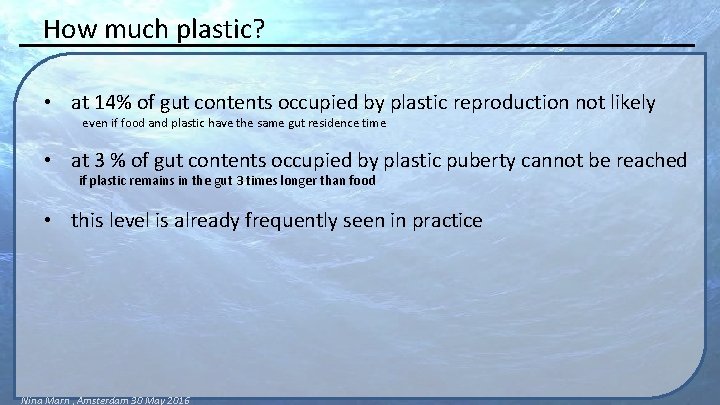
How much plastic? • at 14% of gut contents occupied by plastic reproduction not likely even if food and plastic have the same gut residence time • at 3 % of gut contents occupied by plastic puberty cannot be reached if plastic remains in the gut 3 times longer than food • this level is already frequently seen in practice Nina Marn , Amsterdam 30 May 2016
Conclusions • mechanistic models • • • combining different types of data simulations for various food and temperature scenarios physiological properties of organisms daily energy allocation to processes defining the life-cycle defining stress as deviations from unstressed performance Nina Marn , Amsterdam 30 May 2016
Conclusions • mechanistic models • plastic waste • lower food availability leads to population decline • both residence time and amount of plastics in the gut need to be taken into account • education and better waste management necessary Nina Marn , Amsterdam 30 May 2016
DEB tele course 2017 http: //www. bio. vu. nl/thb/deb/ Program for 2017 Starrlight. Augustine@akvaplan. niva. no general theory (5 w, tele mode): 2017/03/02 -04/06 free of financial costs; 108 or 216 h effort investment school & symp in Tromsø (N): 2017/05/21 -30 Target audience: Ph. D students We encourage participation in groups who organize local meetings weekly Software package DEBtool Matlab freely downloadable Slides of this presentation: http: //www. bio. vu. nl/thb/users/bas/lectures/ Nina Marn , Amsterdam 30 May 2016 Audience: thank you for your attention