
Life cycle and breeding of squids Introduction Phylummolluscs
Life cycle and breeding of squids
Introduction Phylum-molluscs Ø Most advanced group. Ø 800 sp have been recorded. Ø Most interesting group because of their behaviour patterns. Ø Exclusively marine.
Morphology of squid Ø Ø Ø Ø Bilaterally symmetrical. Oval shaped body. Body –divided into head and trunk. Internal shell (gladius) is present. 8 sessile arms and 2 tentacular arms. Fin lobes fused posteriorly. Locomotin – jet of water produced by ventral siphon.
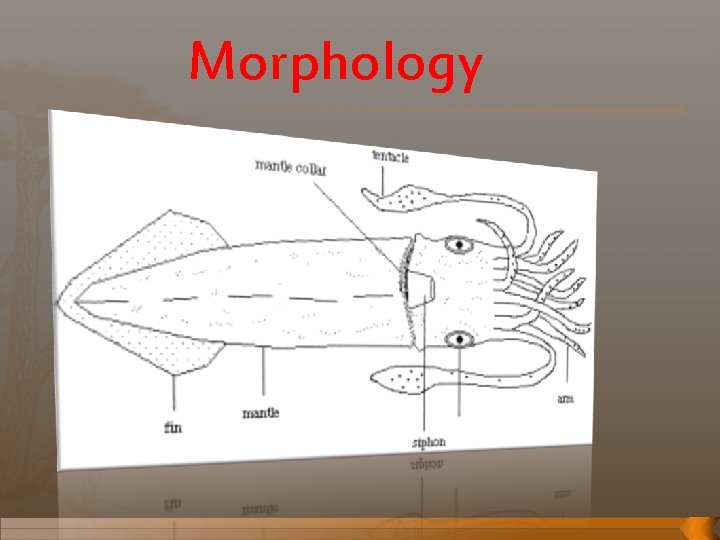
Morphology

Distribution & Habitat World wide distribution in warm waters � Abundant in the Indian seas. � But they are in great shoals in Gulf of Kutch, Gulf of Mannar and Palk Bay. � It is found mostly in the deep waters. �

Breeds mainly in the spring and in the early summer. � It can move fast both back and front by funnel � It uses a black ink to escape from the predators. � Has a great power of rapid colour change. �
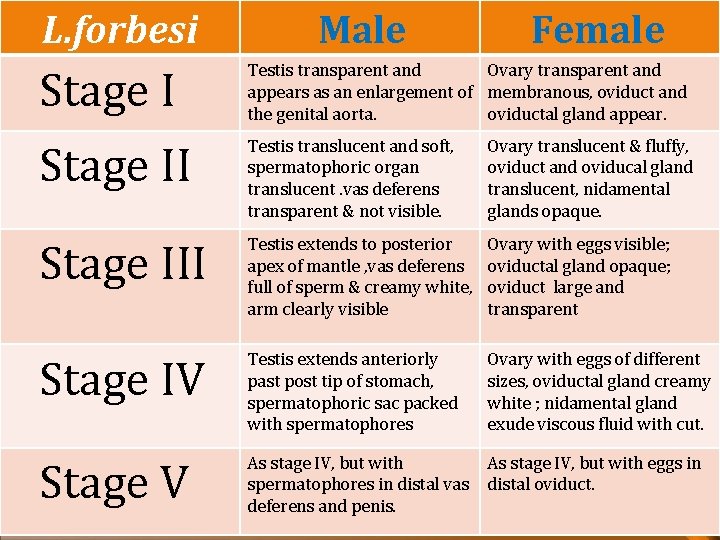
L. forbesi Male Female Stage I Testis transparent and Ovary transparent and appears as an enlargement of membranous, oviduct and the genital aorta. oviductal gland appear. Stage II Testis translucent and soft, spermatophoric organ translucent. vas deferens transparent & not visible. Ovary translucent & fluffy, oviduct and oviducal gland translucent, nidamental glands opaque. Stage III Testis extends to posterior apex of mantle , vas deferens full of sperm & creamy white, arm clearly visible Ovary with eggs visible; oviductal gland opaque; oviduct large and transparent Stage IV Testis extends anteriorly past post tip of stomach, spermatophoric sac packed with spermatophores Ovary with eggs of different sizes, oviductal gland creamy white ; nidamental gland exude viscous fluid with cut. Stage V As stage IV, but with spermatophores in distal vas deferens and penis. As stage IV, but with eggs in distal oviduct.

Reproductive system Sexes are separate. � Single testis. � A single gland of the visceral mass opens directly into the coelom by slit. � Gonoduct runs on the left from the coelom to the mantle cavity & opens near funnel. � Hectocotylized arm – copulatory organ � It is used for the transfer of sperm. �
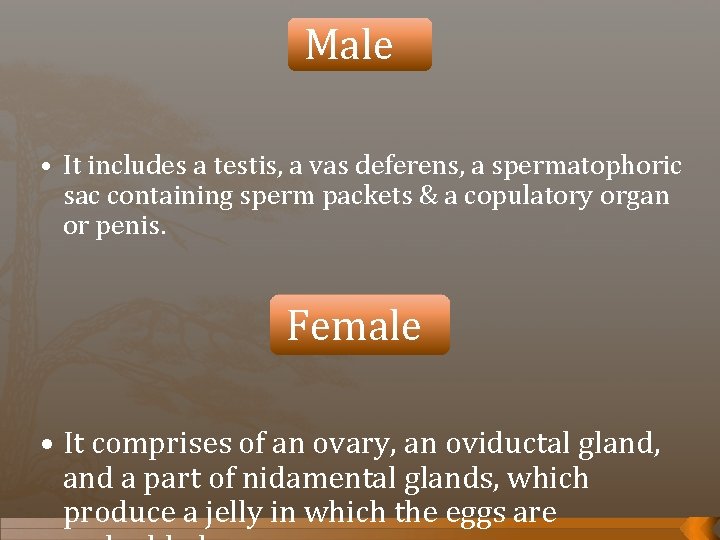
Male • It includes a testis, a vas deferens, a spermatophoric sac containing sperm packets & a copulatory organ or penis. Female • It comprises of an ovary, an oviductal gland, and a part of nidamental glands, which produce a jelly in which the eggs are
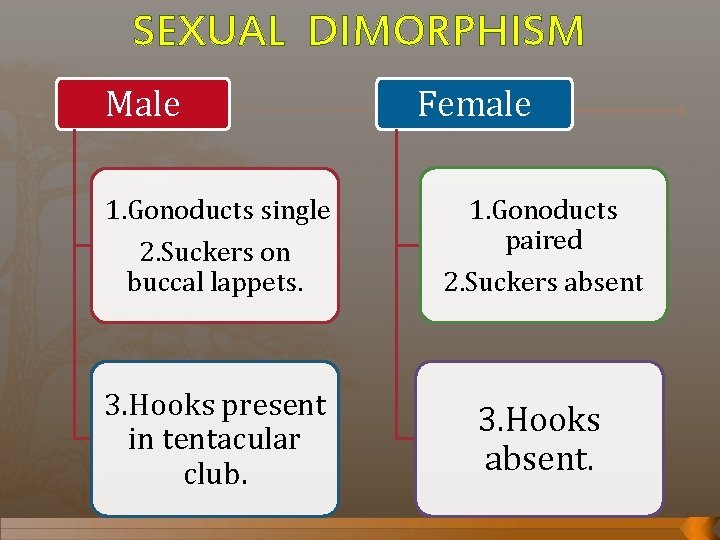
SEXUAL DIMORPHISM Male Female 1. Gonoducts paired 1. Gonoducts single 2. Suckers on buccal lappets. 2. Suckers absent 3. Hooks present in tentacular club. 3. Hooks absent.
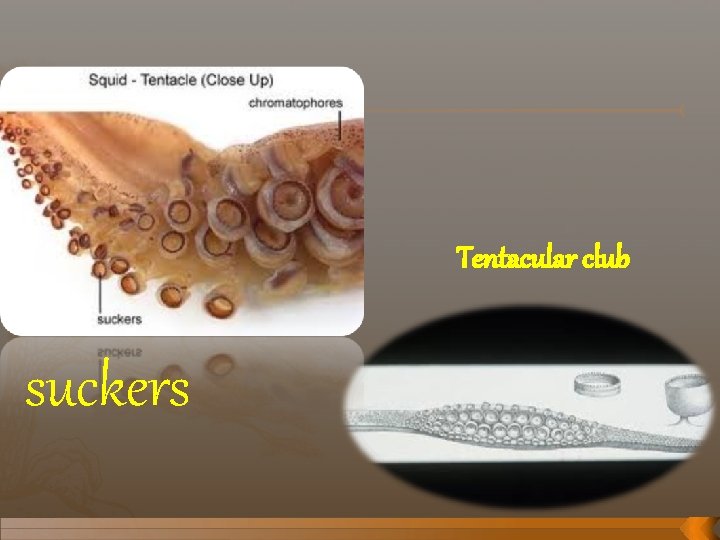
Tentacular club suckers

during mating. . � � � attracting females begins in the morning Around dawn swims rapidly in very large circles After some time the squids they start swimming in pairs. These r mating couples. Males start changing colours to attract female. Once the female shows interest mating takes place.
� � � The females have an ink sac under a set of glands in gills. During mating , sperms are stored inside sac where they will fertilize her eggs. Male uses the shorter arm to place the sperm. Female uses the nidamental secretion to stick the eggs in the solid object in the event. 7 -8 weeks to hatch out.
Life cycle…. � Within 1 -2 years. Universal pattern-that coleoidea are single breeding & short life span. � Life cycle characteristics is based on relatively small no of species; that occur in the shelf and coastally based scientific study. � Similar for squid, octopus, cuttlefish. �
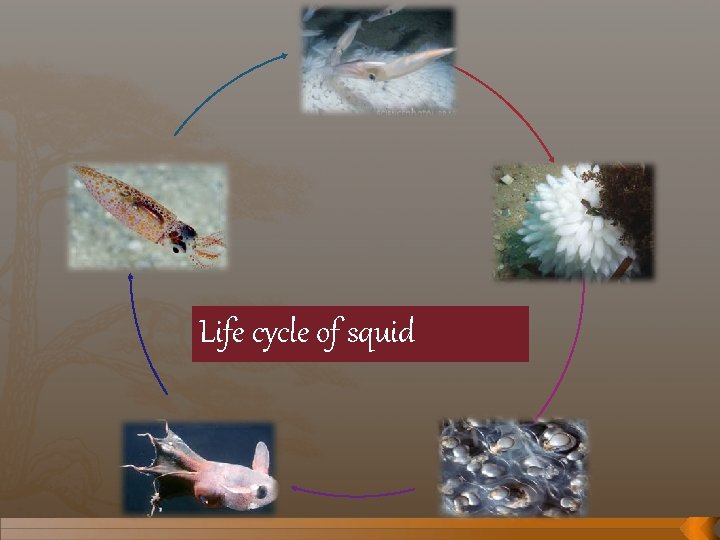
Life cycle of squid
Single breeding � All cephalopods undergo only one breeding cycle(monocycly), except nautiluses. Semelparous � � All the modern cephalopods are single-season breeders
The term semelparity was first proposed by L. C. Cole to describe the condition of multiplying only once in a life time. � Cephalopods have a clearly defined breeding event, followed by death. �
- Slides: 17