
Life cycle analysis of vertical building extensions environmental
Life cycle analysis of vertical building extensions – environmental impacts of different material selection Annette HAFNER, Michael STORCK Resource Efficient Building, Ruhr-University Bochum, Germany

Vertical Building Extensions Extending a building by one or more storeys Decreasing the demand of living space Useful way of creating living space while keeping most of the existing structures Source: ARCHPLAN Gmb. H Life cycle assessment (LCA) describe the environmental impacts of buildings and building parts Covered by EN 15978 and EN 15804, describe different life-cycle stages and environmental impact categories A LCA-method for vertical building extensions does not exist yet Download full paper at www. cesb. cz/19/8888 1150
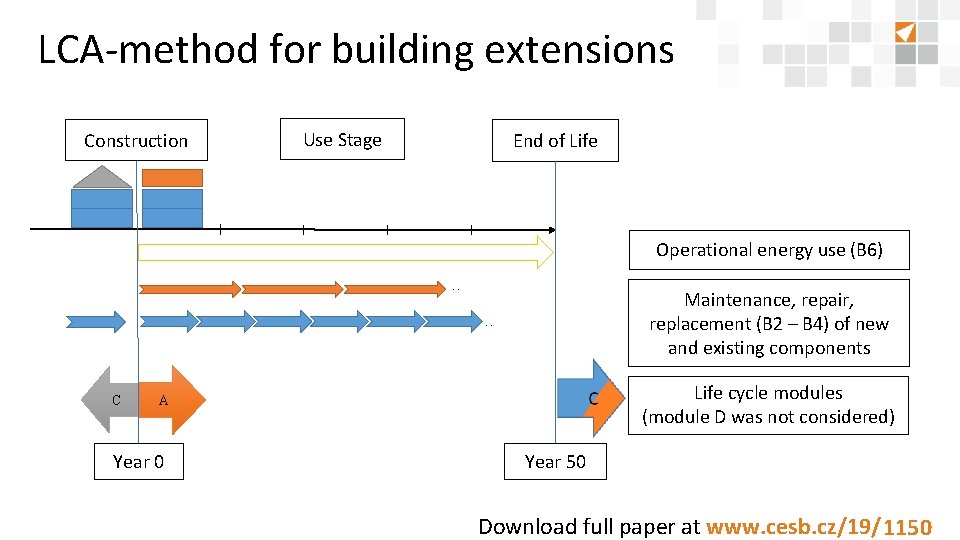
LCA-method for building extensions Construction Use Stage End of Life Operational energy use (B 6) … Maintenance, repair, replacement (B 2 – B 4) of new and existing components … C Life cycle modules (module D was not considered) A Year 0 Year 50 Download full paper at www. cesb. cz/19/8888 1150
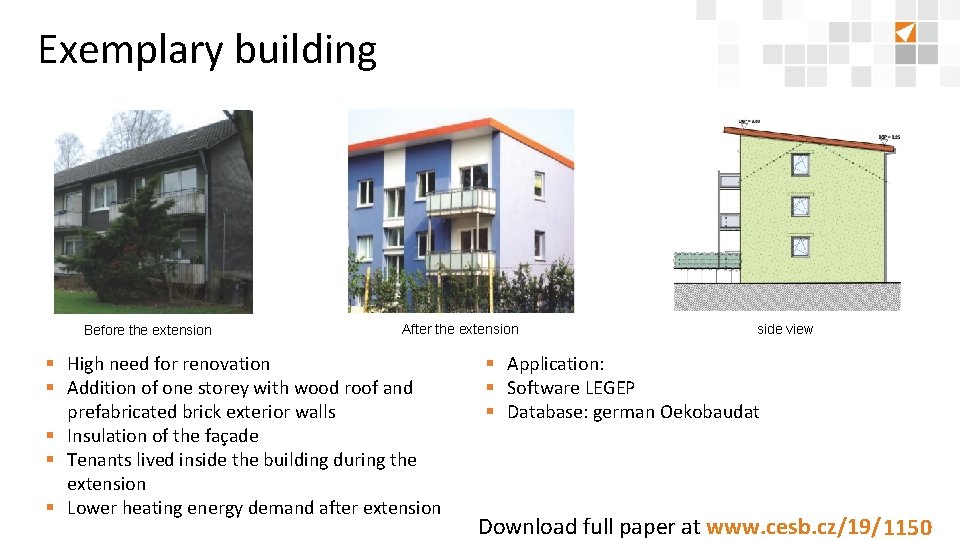
Exemplary building Before the extension After the extension High need for renovation Addition of one storey with wood roof and prefabricated brick exterior walls Insulation of the façade Tenants lived inside the building during the extension Lower heating energy demand after extension side view Application: Software LEGEP Database: german Oekobaudat Download full paper at www. cesb. cz/19/8888 1150
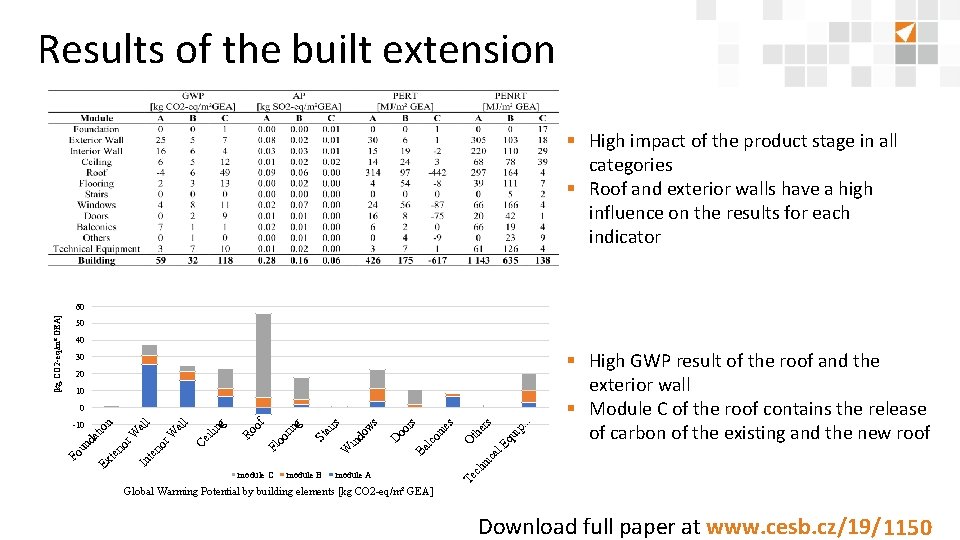
Results of the built extension High impact of the product stage in all categories Roof and exterior walls have a high influence on the results for each indicator 50 40 30 20 10 . . High GWP result of the roof and the exterior wall Module C of the roof contains the release of carbon of the existing and the new roof module C module B module A Te ch ni ca l. E qu ip. rs th e O lc o ni es rs Ba D oo s W in do w ai rs St Fl oo rin g of Ro g Ce ili n l al r. W In te io te r rio al l r. W tio Ex un da -10 n 0 Fo [kg CO 2 -eq/m² GEA] 60 Global Warming Potential by building elements [kg CO 2 -eq/m² GEA] Download full paper at www. cesb. cz/19/8888 1150
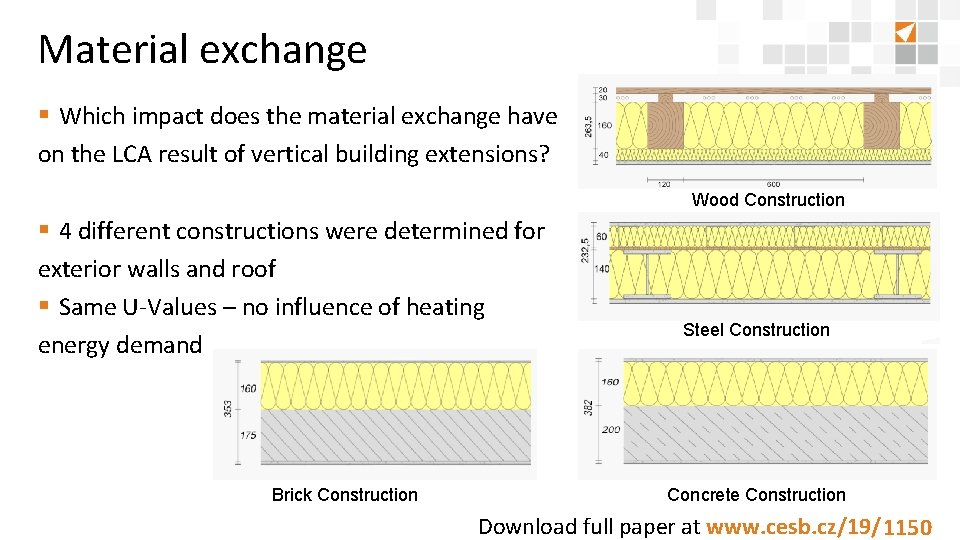
Material exchange Which impact does the material exchange have on the LCA result of vertical building extensions? Wood Construction 4 different constructions were determined for exterior walls and roof Same U-Values – no influence of heating energy demand Brick Construction Steel Construction Concrete Construction Download full paper at www. cesb. cz/19/8888 1150
![GWP result comparison for the exchanged materials GWP total [kg CO 2 eq/m² GEA]](http://slidetodoc.com/presentation_image_h2/8fa13eb8d641fed899f9572e56144d09/image-7.jpg "GWP result comparison for the exchanged materials GWP total [kg CO 2 eq/m² GEA]")
GWP result comparison for the exchanged materials GWP total [kg CO 2 eq/m² GEA] 250, 00 [kg CO 2 eq/m² GEA] Results for the entire building 200, 00 Range from 182 to 227 kg CO 2 eq/m² GEA 150, 00 Woodframe construction has the lowest GWP emissions 100, 00 The highest emissions are caused by the steel construction 50, 00 - Brick Reinforced Concrete Woodframe Steel Brick/Wood Download full paper at www. cesb. cz/19/8888 1150
Conclusion Vertical building extensions create living space while using existing building parts and cause no land to be sealed There is no existing LCA methodology of vertical building extensions Choice of material has an important influence on LCA results In this case a woodframe construction had the lowest GWP emissions Future research should investigate more vertical building extensions Difference between demolition and vertical extension It is possible to divide the module C into two different scenarios depending on the year in which they appear Download full paper at www. cesb. cz/19/8888 1150

Thank you for your attention! Michael Storck Michael. Storck@rub. de Scan QR or download full paper at www. cesb. cz/19/ 1150
- Slides: 9