
Life Beyond Earth Solar System consists of the
Life Beyond Earth? Solar System: consists of the Sun, planets, moons, asteroids, meteors, comets, dust, gases and primarily empty space. Atmosphere: layer of air, made up of many layers and gases that surround the Earth’s surface keeping humans safe from the sun’s radiation. Earth: (78% Nitrogen, 21% Oxygen, . 9% Argon, . 03% Carbon Dioxide) Comet: chunk of ice and rock originating from the outer solar system
Life Beyond Earth? Asteroid: rock in orbit, generally between Mars and Jupiter Meteoroid: space rock that is bigger than dust grain but smaller than asteroid. If it strikes Earth, it is a meteorite. Meteor: streak of light seen when a space rock enters the atmosphere and starts burning up; a falling star.
Life Beyond Earth? Extraterrestrial Life: life that exists other than on earth Satellite: is an object that revolves around another object in space. natural satellite: any celestial body in space that orbits around a larger body. example: Moons artificial satellite: made by people and launched into orbit using rockets
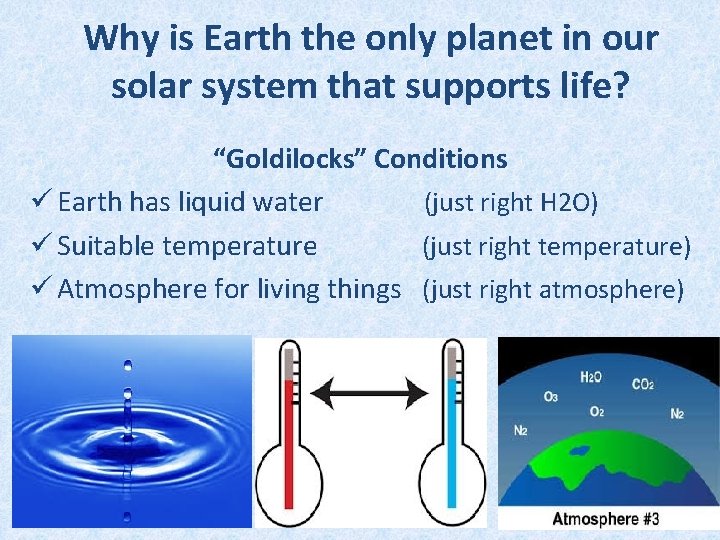
Why is Earth the only planet in our solar system that supports life? “Goldilocks” Conditions ü Earth has liquid water (just right H 2 O) ü Suitable temperature (just right temperature) ü Atmosphere for living things (just right atmosphere)
Why are other planets in our solar system unable to support life as we know it based on their characteristics? https: //www. youtube. com/watch? v=6 OJUn 9 jm. Ii 4
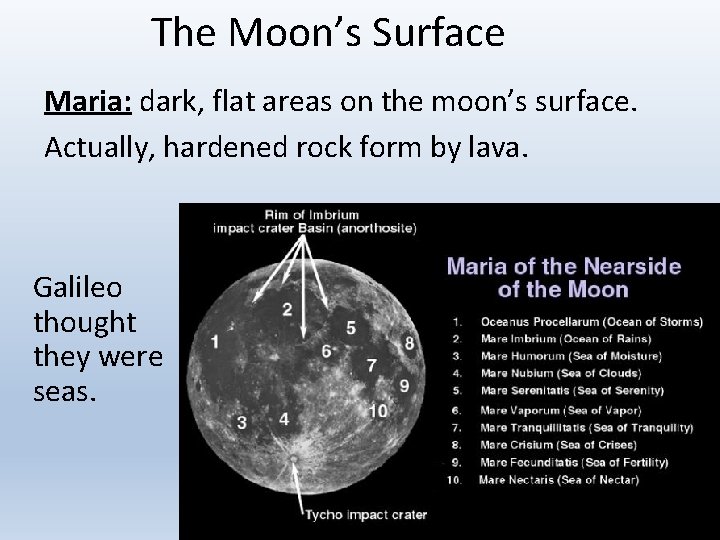
The Moon’s Surface Maria: dark, flat areas on the moon’s surface. Actually, hardened rock form by lava. Galileo thought they were seas.
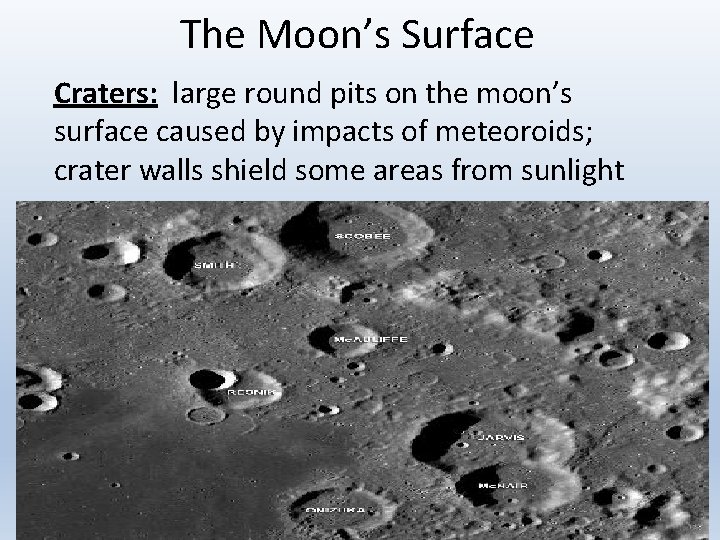
The Moon’s Surface Craters: large round pits on the moon’s surface caused by impacts of meteoroids; crater walls shield some areas from sunlight
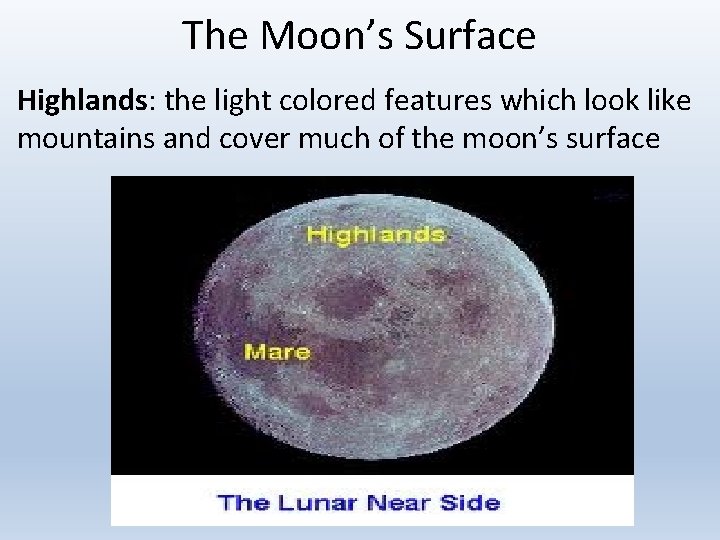
The Moon’s Surface Highlands: the light colored features which look like mountains and cover much of the moon’s surface
Characteristics of the Moon Atmosphere: dry and airless Size: 3, 476 km in diameter; about ¼ of the Earth’s diameter; compared to the Earth, moon is small. Temperature: range from a torrid 130 degree C in direct sunlight to a frigid -180 degree C at night. Water: no liquid water; large patches of ice near the poles are evident
The Origin of the Moon https: //app. discoveryeducation. com/le arn/videos/b 326760 a-a 079 -48 c 9 -bc 1 bafe 9 e 101402 d? has. Local. Host=true https: //goo. gl/AZMy 9 q
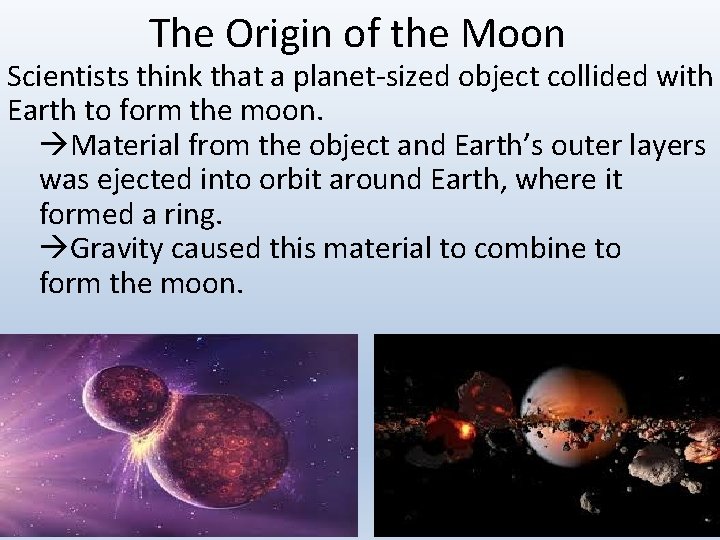
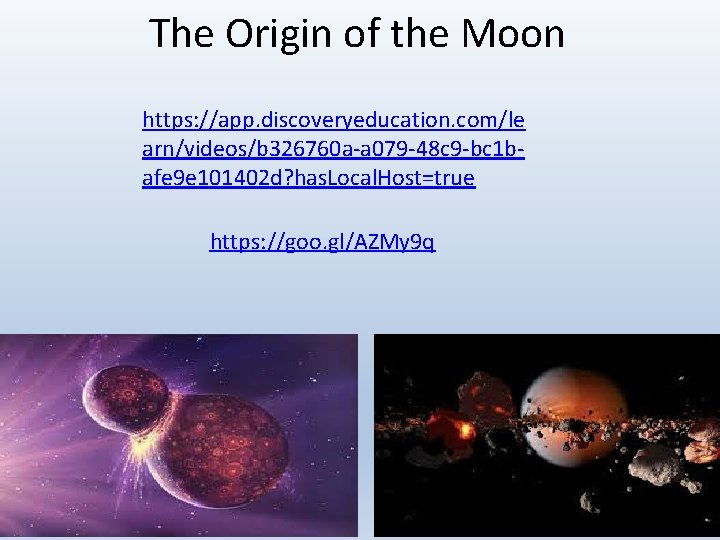
The Origin of the Moon Scientists think that a planet-sized object collided with Earth to form the moon. Material from the object and Earth’s outer layers was ejected into orbit around Earth, where it formed a ring. Gravity caused this material to combine to form the moon.
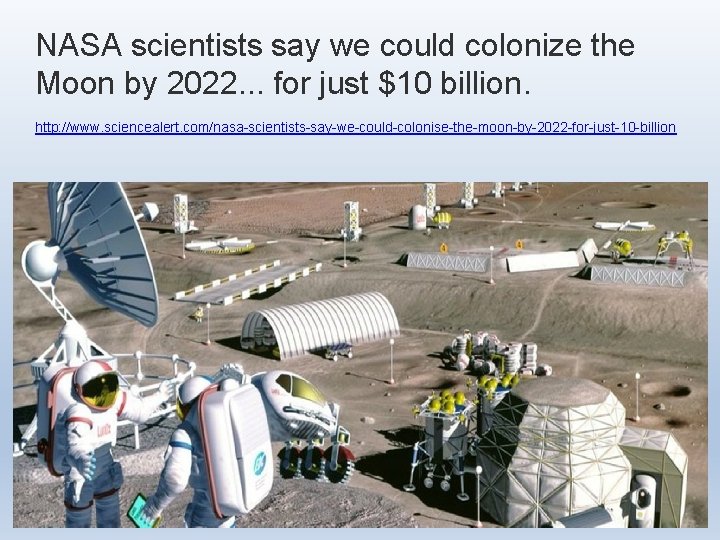
NASA scientists say we could colonize the Moon by 2022. . . for just $10 billion. http: //www. sciencealert. com/nasa-scientists-say-we-could-colonise-the-moon-by-2022 -for-just-10 -billion
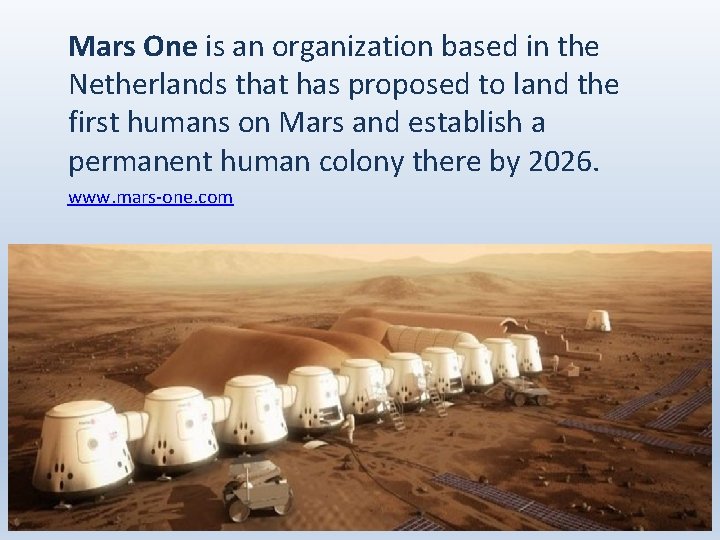
Mars One is an organization based in the Netherlands that has proposed to land the first humans on Mars and establish a permanent human colony there by 2026. www. mars-one. com
- Slides: 13