
Lidar Profiling of the Atmosphere Geraint Vaughan University
- Slides: 23
Lidar Profiling of the Atmosphere Geraint Vaughan University of Manchester, UK geraint. vaughan@manchester. ac. uk
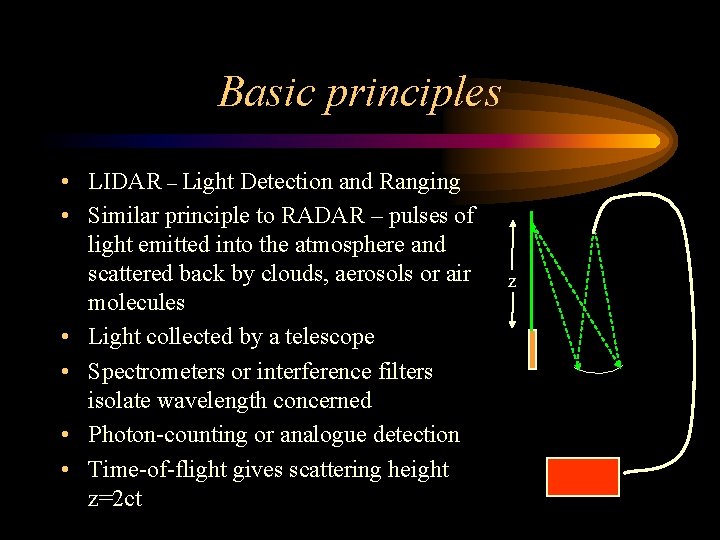
Basic principles • LIDAR – Light Detection and Ranging • Similar principle to RADAR – pulses of light emitted into the atmosphere and scattered back by clouds, aerosols or air molecules • Light collected by a telescope • Spectrometers or interference filters isolate wavelength concerned • Photon-counting or analogue detection • Time-of-flight gives scattering height z=2 ct z
What can we measure with lidar? • • • Clouds Aerosol Water vapour Minor constituents e. g. ozone, hydrocarbons Temperature Wind (by Doppler-shifting) Lidars can be used from the ground, aircraft or from space
Properties of lidar as a remote sensing tool Advantages Disadvantages • Good height and time resolution • Backscattered signals readily interpreted • May be mounted on trailers or aircraft for mobile operation • Affected by cloud (light can’t get through) • Background light is a problem in daytime • Systems to observe the stratosphere tend to be large (and expensive) • Precise alignment must be maintained
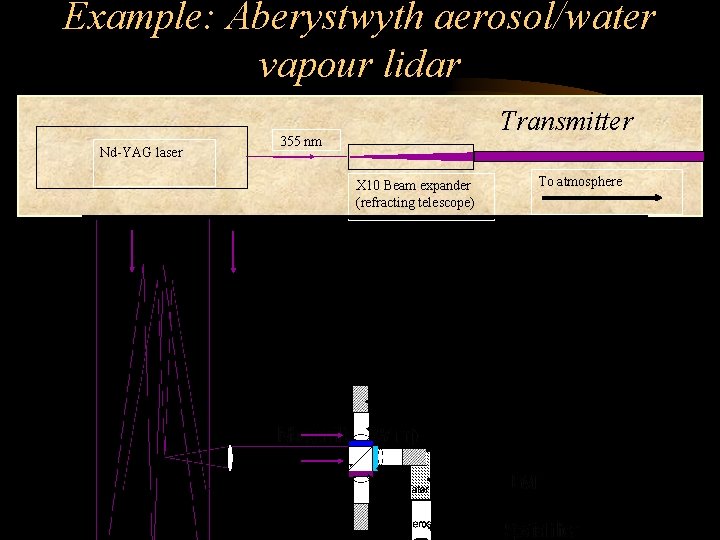
Example: Aberystwyth aerosol/water vapour lidar Nd-YAG laser Transmitter 355 nm X 10 Beam expander (refracting telescope) From atmosphere Receiver To atmosphere
Transmitter characteristics • High power pulsed laser (UV/Vis/IR) • Typical pulse energy 10 – 400 m. J • Typical rep rate 10 – 50 s-1 (much higher for excimer or copper vapour laser) • Typical pulse length 3 ns (1 m) • Linearly polarised • Usually fixed wavelength – dye lasers and some solid state lasers tuneable. Neodymium-YAG lasers a popular choice (1. 06µm, 532, 355, 266 nm)
Receiver characteristics • Basically, focusing mirror to collect backscattered light. Size depends on application (e. g. 10 cm for low-level work, 1 m for stratosphere/mesosphere) • Photomultipliers with photon-counting electronics best for linearity and sensitivity but dynamic range limited: analogue electronics can deliver this for large signals. • Typical range resolution 30 m (min ~ 1 m) • Time resolution can range from single pulse to several hours • All equipment can be bought off-the-shelf these days.
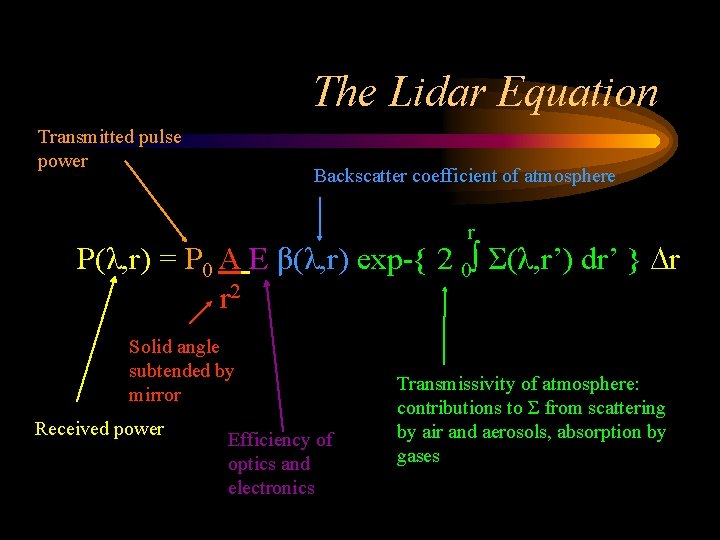
The Lidar Equation Transmitted pulse power Backscatter coefficient of atmosphere r P(λ, r) = P 0 A E β(λ, r) exp-{ 2 0∫ Σ(λ, r’) dr’ } r r 2 Solid angle subtended by mirror Received power Efficiency of optics and electronics Transmissivity of atmosphere: contributions to Σ from scattering by air and aerosols, absorption by gases
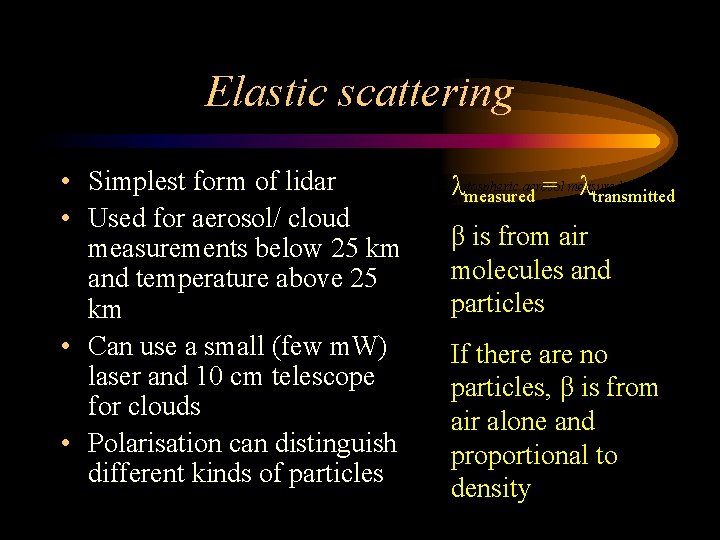
Elastic scattering • Simplest form of lidar • Used for aerosol/ cloud measurements below 25 km and temperature above 25 km • Can use a small (few m. W) laser and 10 cm telescope for clouds • Polarisation can distinguish different kinds of particles λ = λ Stratospheric aerosol measured with measured transmitted polarisation lidar, 9 Dec 2001 β is from air molecules and particles If there are no particles, β is from air alone and proportional to density
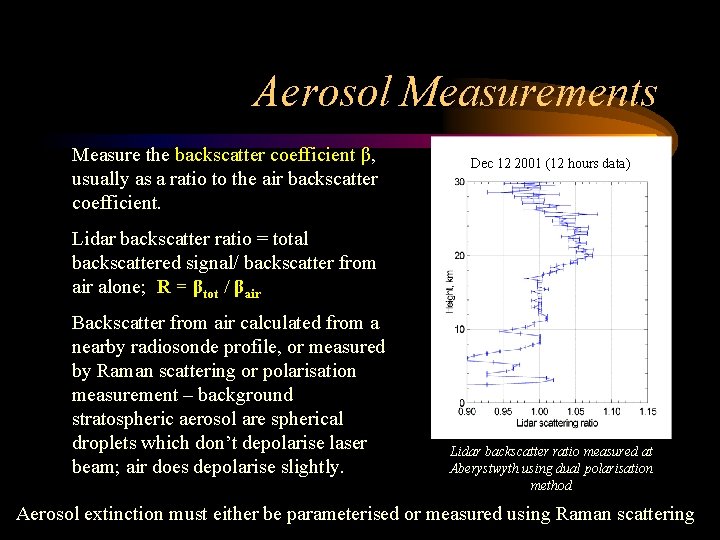
Aerosol Measurements Measure the backscatter coefficient β, usually as a ratio to the air backscatter coefficient. Dec 12 2001 (12 hours data) Lidar backscatter ratio = total backscattered signal/ backscatter from air alone; R = βtot / βair Backscatter from air calculated from a nearby radiosonde profile, or measured by Raman scattering or polarisation measurement – background stratospheric aerosol are spherical droplets which don’t depolarise laser beam; air does depolarise slightly. Lidar backscatter ratio measured at Aberystwyth using dual polarisation method Aerosol extinction must either be parameterised or measured using Raman scattering
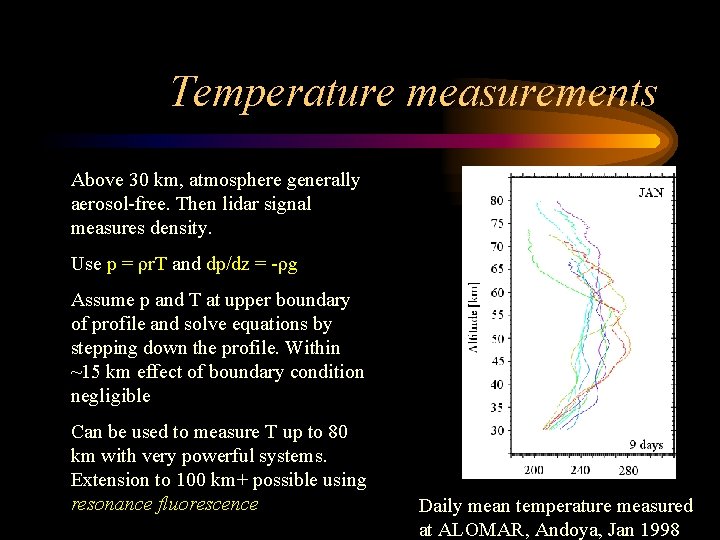
Temperature measurements Above 30 km, atmosphere generally aerosol-free. Then lidar signal measures density. Use p = ρr. T and dp/dz = -ρg Assume p and T at upper boundary of profile and solve equations by stepping down the profile. Within ~15 km effect of boundary condition negligible Can be used to measure T up to 80 km with very powerful systems. Extension to 100 km+ possible using resonance fluorescence Daily mean temperature measured at ALOMAR, Andoya, Jan 1998
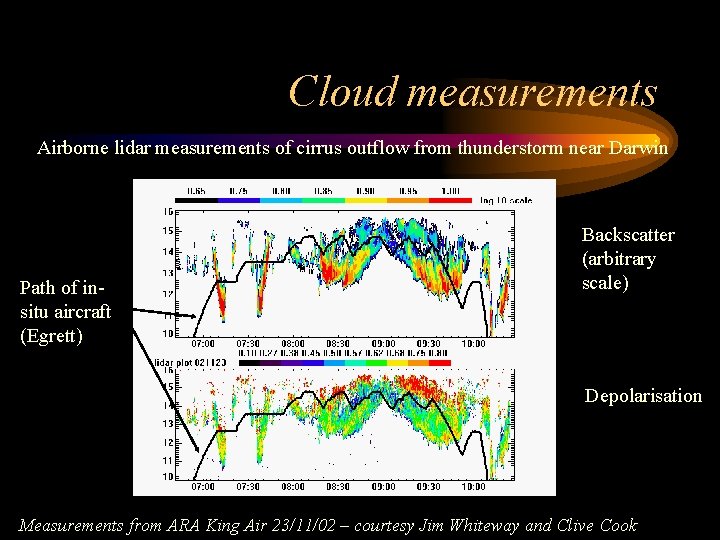
Cloud measurements Airborne lidar measurements of cirrus outflow from thunderstorm near Darwin Path of insitu aircraft (Egrett) Backscatter (arbitrary scale) Depolarisation Measurements from ARA King Air 23/11/02 – courtesy Jim Whiteway and Clive Cook
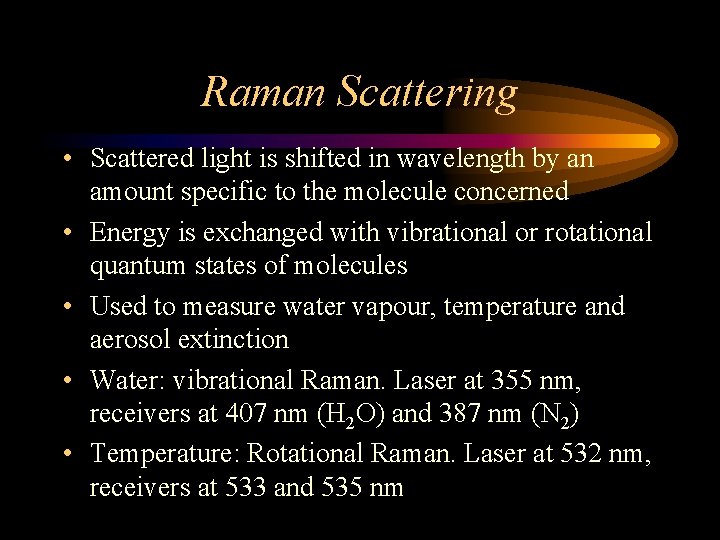
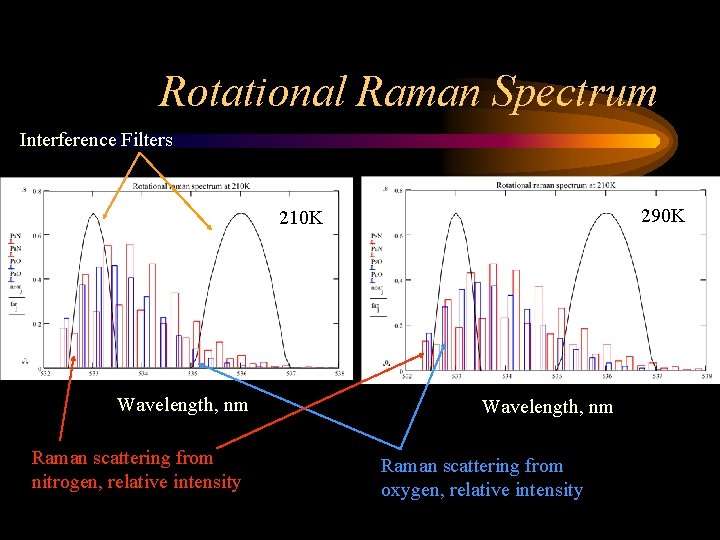
Raman Scattering • Scattered light is shifted in wavelength by an amount specific to the molecule concerned • Energy is exchanged with vibrational or rotational quantum states of molecules • Used to measure water vapour, temperature and aerosol extinction • Water: vibrational Raman. Laser at 355 nm, receivers at 407 nm (H 2 O) and 387 nm (N 2) • Temperature: Rotational Raman. Laser at 532 nm, receivers at 533 and 535 nm
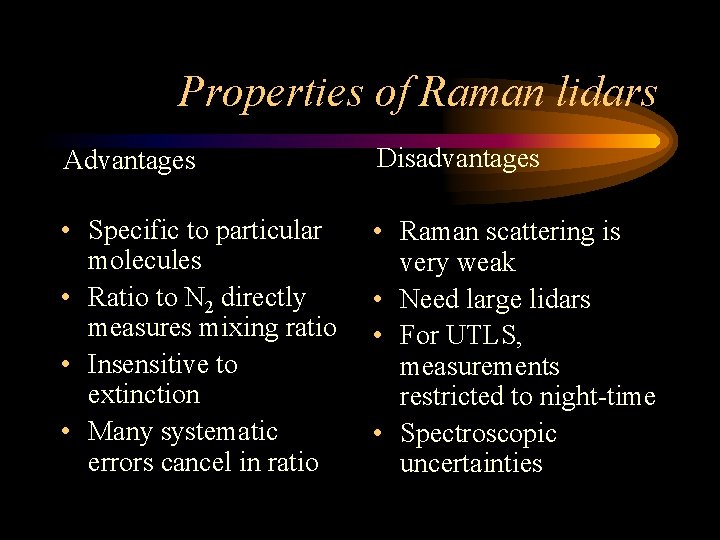
Properties of Raman lidars Advantages Disadvantages • Specific to particular molecules • Ratio to N 2 directly measures mixing ratio • Insensitive to extinction • Many systematic errors cancel in ratio • Raman scattering is very weak • Need large lidars • For UTLS, measurements restricted to night-time • Spectroscopic uncertainties
Rotational Raman Spectrum Interference Filters 290 K 210 K Wavelength, nm Raman scattering from nitrogen, relative intensity Wavelength, nm Raman scattering from oxygen, relative intensity
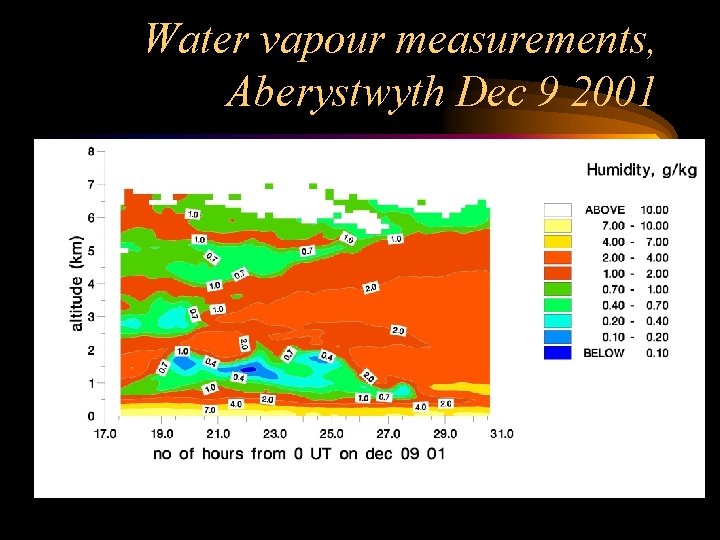
Water vapour measurements, Aberystwyth Dec 9 2001
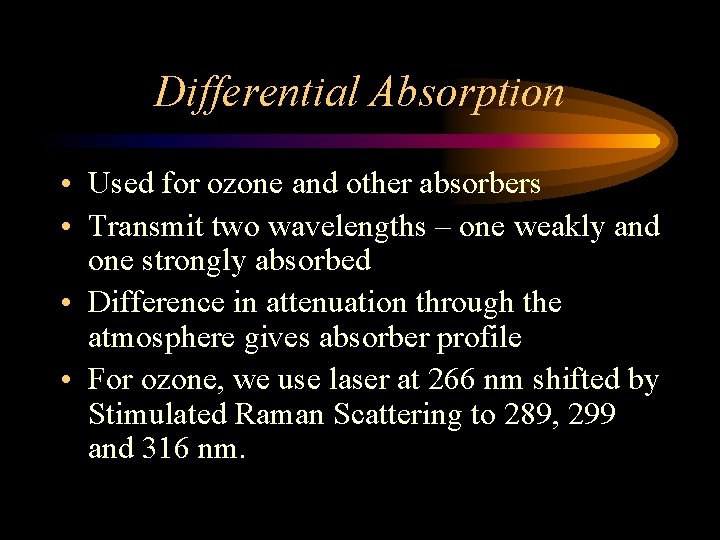
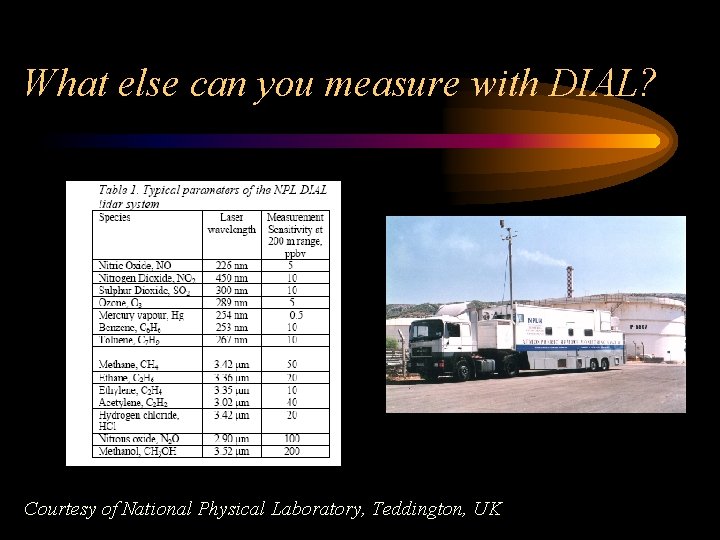
Differential Absorption • Used for ozone and other absorbers • Transmit two wavelengths – one weakly and one strongly absorbed • Difference in attenuation through the atmosphere gives absorber profile • For ozone, we use laser at 266 nm shifted by Stimulated Raman Scattering to 289, 299 and 316 nm.
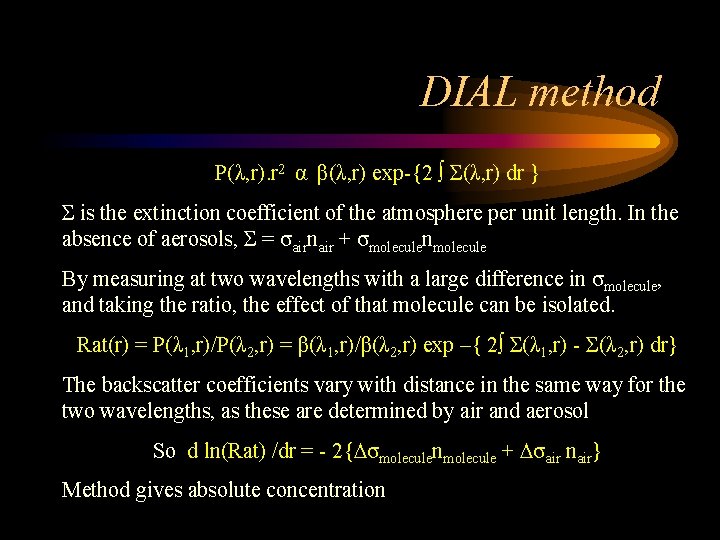
DIAL method P(λ, r). r 2 α β(λ, r) exp-{2 ∫ Σ(λ, r) dr } Σ is the extinction coefficient of the atmosphere per unit length. In the absence of aerosols, Σ = σairnair + σmoleculenmolecule By measuring at two wavelengths with a large difference in σmolecule, and taking the ratio, the effect of that molecule can be isolated. Rat(r) = P(λ 1, r)/P(λ 2, r) = β(λ 1, r)/β(λ 2, r) exp –{ 2∫ Σ(λ 1, r) - Σ(λ 2, r) dr} The backscatter coefficients vary with distance in the same way for the two wavelengths, as these are determined by air and aerosol So d ln(Rat) /dr = - 2{ σmoleculenmolecule + σair nair} Method gives absolute concentration
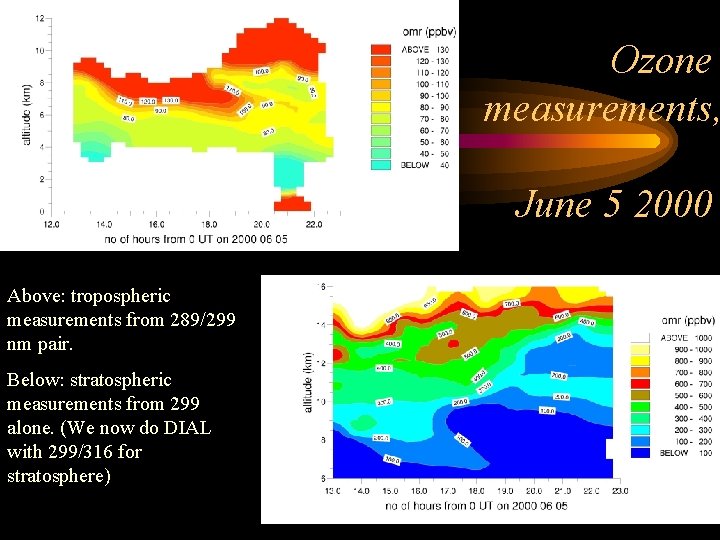
Ozone measurements, June 5 2000 Above: tropospheric measurements from 289/299 nm pair. Below: stratospheric measurements from 299 alone. (We now do DIAL with 299/316 for stratosphere)
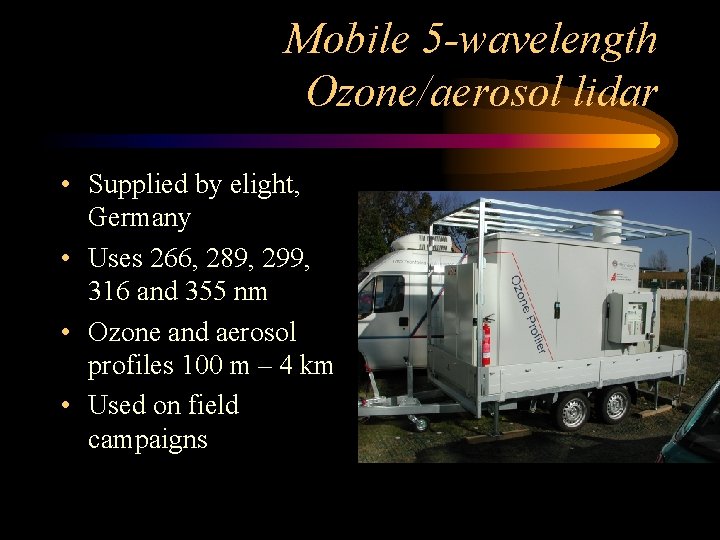
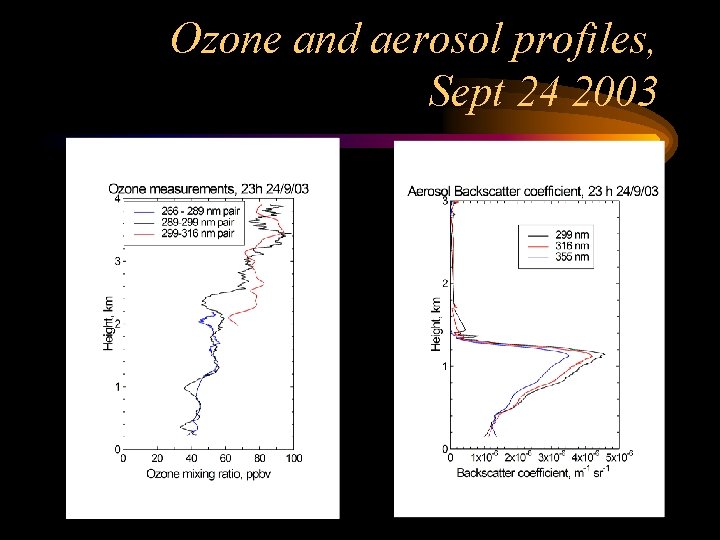
Mobile 5 -wavelength Ozone/aerosol lidar • Supplied by elight, Germany • Uses 266, 289, 299, 316 and 355 nm • Ozone and aerosol profiles 100 m – 4 km • Used on field campaigns
Ozone and aerosol profiles, Sept 24 2003
What else can you measure with DIAL? Courtesy of National Physical Laboratory, Teddington, UK
Summary • Lidar technique allows continuous monitoring of profiles with good height resolution • Different scattering mechanisms permit different kinds of measurement • New technology offers more compact sources and development of transportable and mobile systems