
Liceo Scientifico Leonardo da Vinci Casalecchio di Reno

















- Slides: 48
Liceo Scientifico Leonardo da Vinci Casalecchio di Reno (BO) May 2 nd, 2016 Analysis of P. Fussell’s The Great War and Modern Memory Ch IV: Myth, Ritual and Romance Class V A Michele Gardini (Project Supervisor) Fiorenza Bedostri (Lab Supervisor)
A NEW WORLD OF MYTH
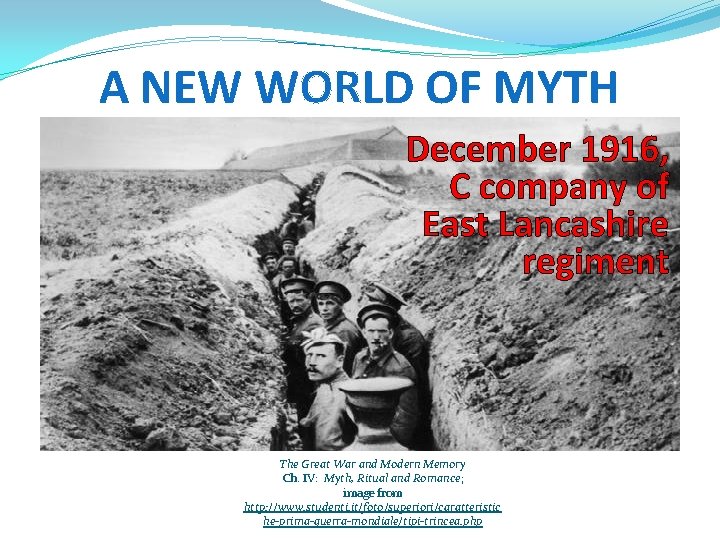
A NEW WORLD OF MYTH December 1916, C company of East Lancashire regiment The Great War and Modern Memory Ch. IV: Myth, Ritual and Romance; image from http: //www. studenti. it/foto/superiori/caratteristic he-prima-guerra-mondiale/tipi-trincea. php
«The experience of war involves a personal, inescapable transformation» . The commander of the troop sloughs off the fear of soldiers (no man’s land episode). �Rebirth (Foster, Plowman) �Initiation (Carrington, Parker) The Great War and Modern Memory - Ch. IV: Myth, Ritual and Romance
REBIRTH «Because I was no longer fearful, elation filled me. But I could not understand what had caused the transformation. It was as though I had become another person altogether, or rather as though had entered another life» (Foster). «It is marvellous to be out of the trenches: it is like being born again» (Plowman). INITIATION «We are still an initiate generation possessing a secret that can never be communicated» (Carrington). «What effect this experience would have on our lives we could not imagine, but at least it was unlikely that we should survive without some sort of inner change. Towards this transmutation of our personalities we now marched» (Parker). The Great War and Modern Memory - Ch. IV: Myth, Ritual and Romance
CONVERSION AND METAPHORS «The First World War represents a triumph of modern industrialism but the result of inexpressible terror long and inesplicably endured is a plethora of very un-modern superstition, talismans, wonders, miracles, relics, legends and rumours» . The Great War and Modern Memory - Ch. IV: Myth, Ritual and Romance
RUMOR, FICTION, BELIEF
www. minerva. unito. it RUMOR March Bloch 1886 - 1944 �According to Marc Bloch theory (inverse skepticism) «the prevailing opinion in the trenches was that anything might be true, except what was printed» . �From this skepticism about anything official there arose «a prodigious renewal of ORAL TRADITON, the ancient mother of myths and legends» . The Great War and Modern Memory – Ch. IV: Myth, Ritual and Romance
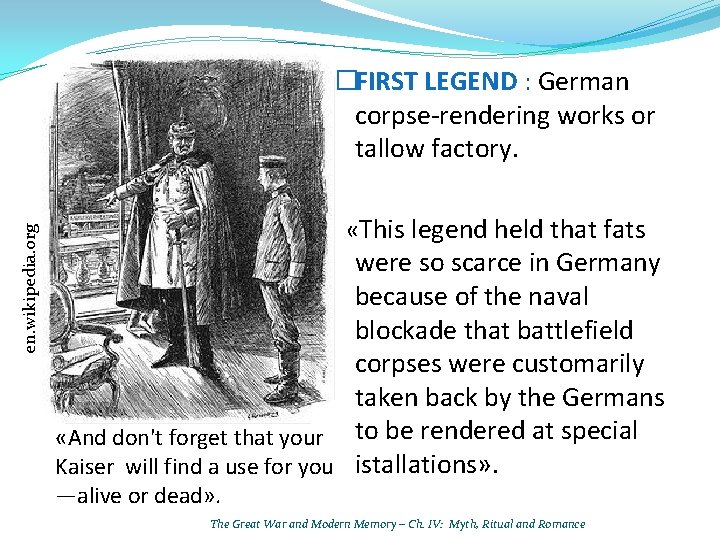
en. wikipedia. org �FIRST LEGEND : German corpse-rendering works or tallow factory. «This legend held that fats were so scarce in Germany because of the naval blockade that battlefield corpses were customarily taken back by the Germans «And don't forget that your to be rendered at special Kaiser will find a use for you istallations» . —alive or dead» . The Great War and Modern Memory – Ch. IV: Myth, Ritual and Romance
�SECOND LEGEND : German bayonets. «Germans used bayonets with a saw-like edge, the better to rip open the British belly. Actually there were such bayonets […] but they were not supposed to be sadistic instruments: they were issued to German pioneer units for sawing tree-branches, and they were carried in addition to the regular ‘antipersonnel’ bayonet» . The Great War and Modern Memory – Ch. IV: Myth, Ritual and Romance
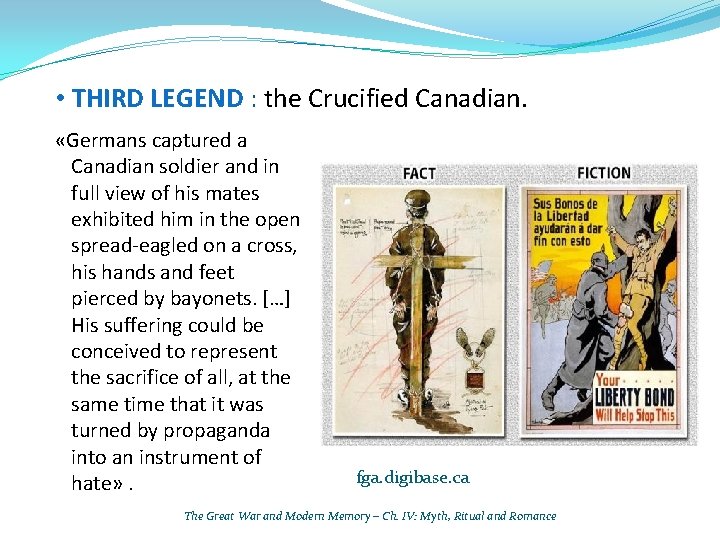
• THIRD LEGEND : the Crucified Canadian. «Germans captured a Canadian soldier and in full view of his mates exhibited him in the open spread-eagled on a cross, his hands and feet pierced by bayonets. […] His suffering could be conceived to represent the sacrifice of all, at the same time that it was turned by propaganda into an instrument of hate» . fga. digibase. ca The Great War and Modern Memory – Ch. IV: Myth, Ritual and Romance
THE SACRIFICIAL THEME «Each soldier becomes a type of the crucified Christ» . «The image of crucifixion was always accessible at the front because of the numerous real physical calvaries visible at French and Belgian crossroads, many of them named Crucifix Corner» . The Great War and Modern Memory – Ch. IV: Myth, Ritual and Romance
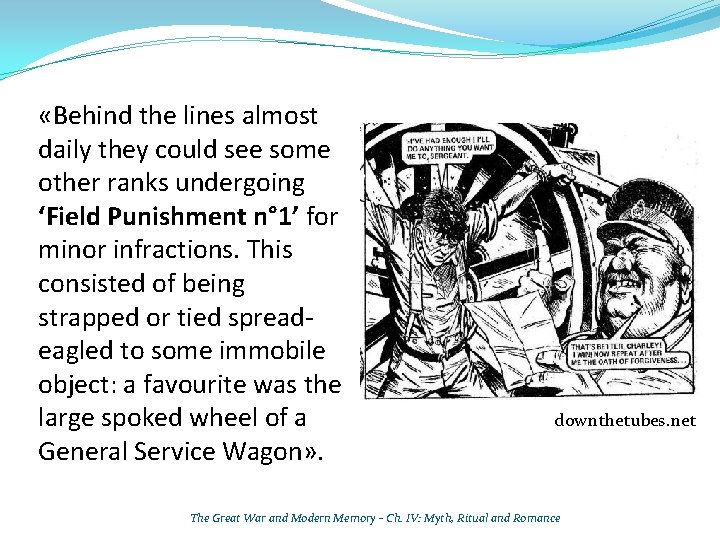
«Behind the lines almost daily they could see some other ranks undergoing ‘Field Punishment n° 1’ for minor infractions. This consisted of being strapped or tied spreadeagled to some immobile object: a favourite was the large spoked wheel of a General Service Wagon» . downthetubes. net The Great War and Modern Memory - Ch. IV: Myth, Ritual and Romance
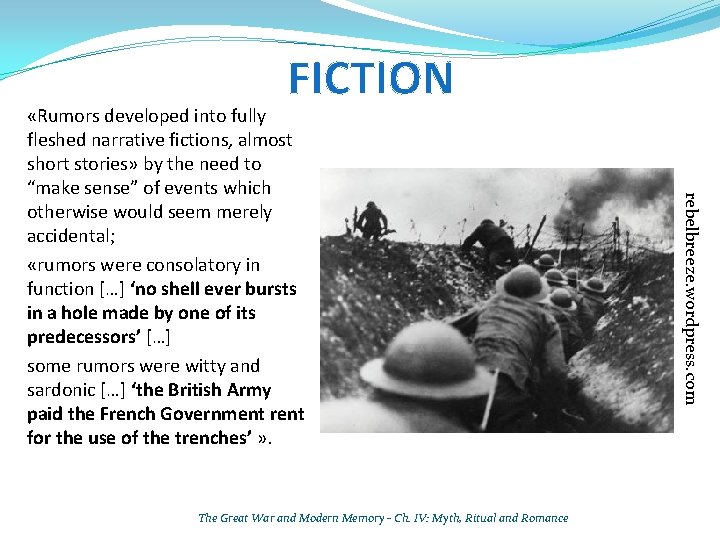
FICTION The Great War and Modern Memory - Ch. IV: Myth, Ritual and Romance rebelbreeze. wordpress. com «Rumors developed into fully fleshed narrative fictions, almost short stories» by the need to “make sense” of events which otherwise would seem merely accidental; «rumors were consolatory in function […] ‘no shell ever bursts in a hole made by one of its predecessors’ […] some rumors were witty and sardonic […] ‘the British Army paid the French Government rent for the use of the trenches’ » .
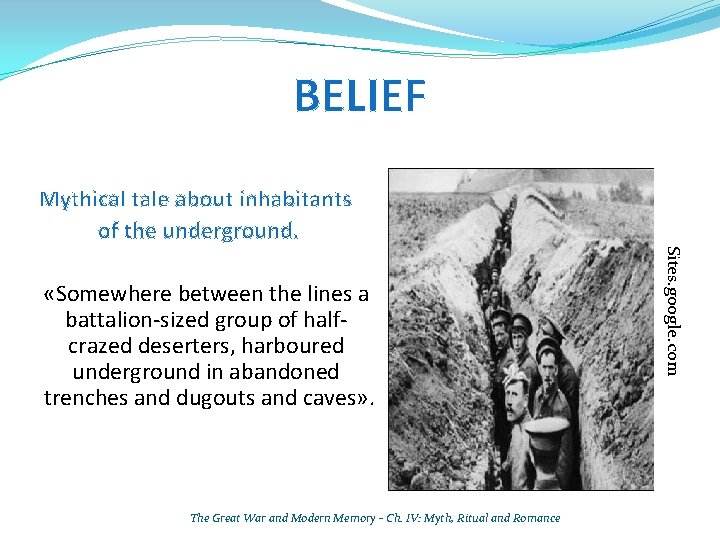
BELIEF Mythical tale about inhabitants of the underground. The Great War and Modern Memory - Ch. IV: Myth, Ritual and Romance Sites. google. com «Somewhere between the lines a battalion-sized group of halfcrazed deserters, harboured underground in abandoned trenches and dugouts and caves» .
POSSIBLE MEANINGS �Virtual and sardonic image of orderly trench life. �Universal fantasy of flagrant disobedience to authority. �Belief that the real enemy is the war. �Universal feeling of shame about abandoning the wounded to spend nights suffering alone between lines. The Great War and Modern Memory - Ch. IV: Myth, Ritual and Romance
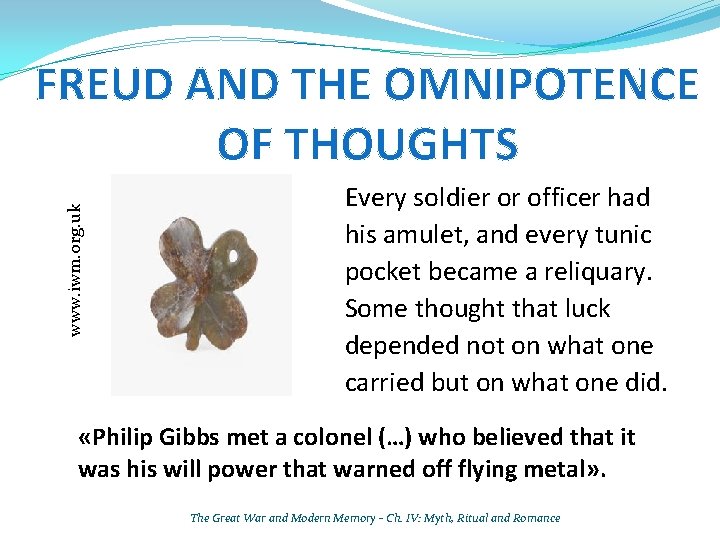
www. iwm. org. uk FREUD AND THE OMNIPOTENCE OF THOUGHTS Every soldier or officer had his amulet, and every tunic pocket became a reliquary. Some thought that luck depended not on what one carried but on what one did. «Philip Gibbs met a colonel (…) who believed that it was his will power that warned off flying metal» . The Great War and Modern Memory - Ch. IV: Myth, Ritual and Romance
THREES
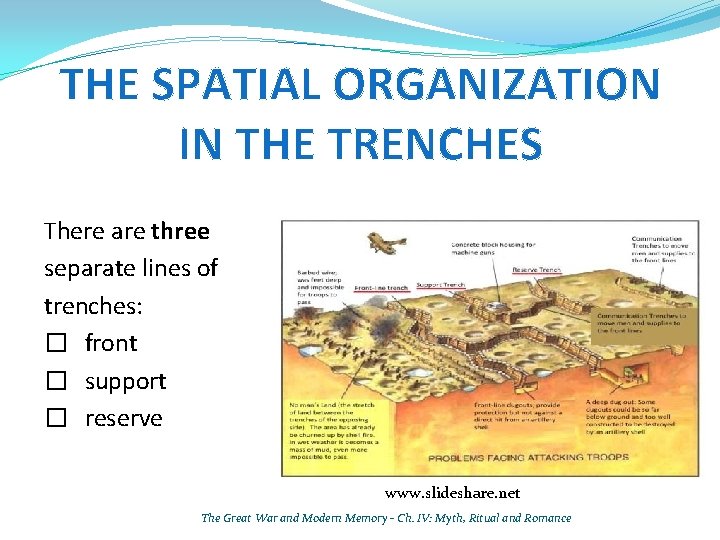
THE SPATIAL ORGANIZATION IN THE TRENCHES There are three separate lines of trenches: � front � support � reserve www. slideshare. net The Great War and Modern Memory - Ch. IV: Myth, Ritual and Romance
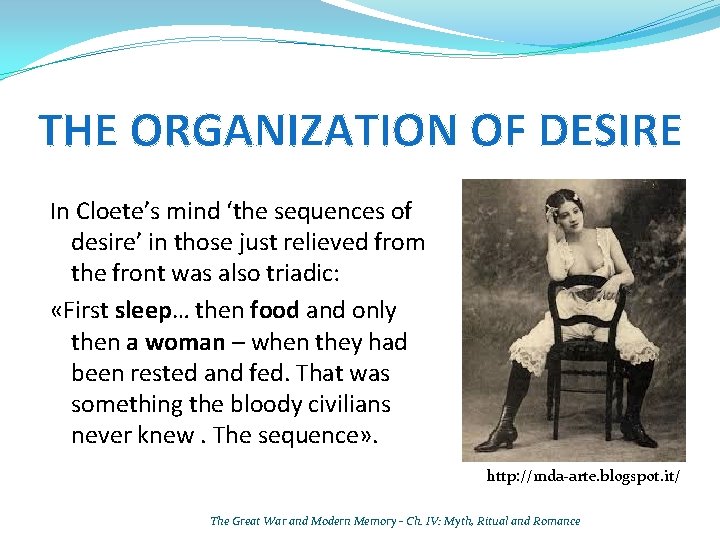
THE ORGANIZATION OF DESIRE In Cloete’s mind ‘the sequences of desire’ in those just relieved from the front was also triadic: «First sleep… then food and only then a woman – when they had been rested and fed. That was something the bloody civilians never knew. The sequence» . http: //mda-arte. blogspot. it/ The Great War and Modern Memory - Ch. IV: Myth, Ritual and Romance
TRAINING IN MILITARY MANOEUVRE �Preparation �Execution �Critique www. wikipedia. org The Great War and Modern Memory - Ch. IV: Myth, Ritual and Romance
THE TRANSFORMATION According to the poet Charles Sorley the transformation of man into corpse is a three-part action: �man �when hit, animal, writhing and thrashing in articulate agony or making horrible snoring noises �then a ‘thing’ www. lagrandeguerra. net The Great War and Modern Memory - Ch. IV: Myth, Ritual and Romance
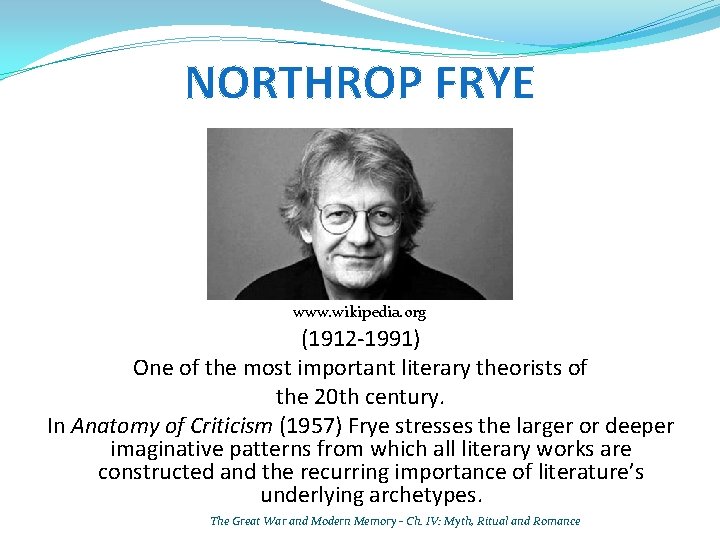
NORTHROP FRYE www. wikipedia. org (1912 -1991) One of the most important literary theorists of the 20 th century. In Anatomy of Criticism (1957) Frye stresses the larger or deeper imaginative patterns from which all literary works are constructed and the recurring importance of literature’s underlying archetypes. The Great War and Modern Memory - Ch. IV: Myth, Ritual and Romance
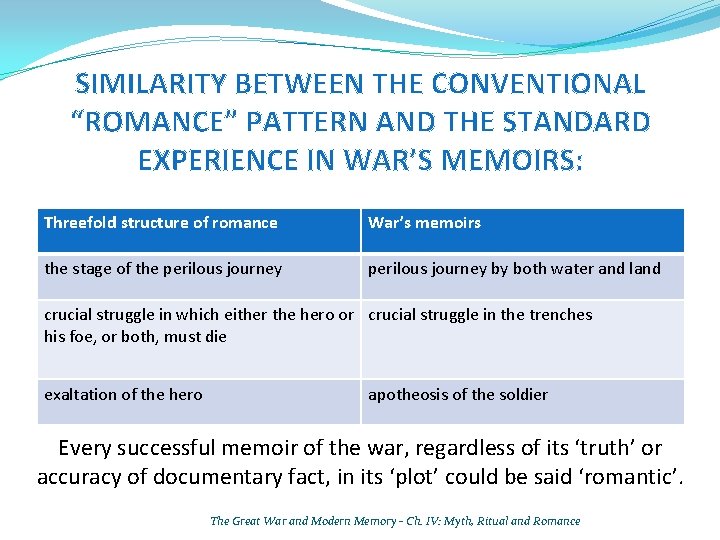
SIMILARITY BETWEEN THE CONVENTIONAL “ROMANCE” PATTERN AND THE STANDARD EXPERIENCE IN WAR’S MEMOIRS: Threefold structure of romance War’s memoirs the stage of the perilous journey by both water and land crucial struggle in which either the hero or crucial struggle in the trenches his foe, or both, must die exaltation of the hero apotheosis of the soldier Every successful memoir of the war, regardless of its ‘truth’ or accuracy of documentary fact, in its ‘plot’ could be said ‘romantic’. The Great War and Modern Memory - Ch. IV: Myth, Ritual and Romance
THE MOVEMENT IN THE LITERATURE The dominant movement in the literature of the Great War was towards fiction, in other words towards a revival of the cultic, the mystical, the sacrificial, the prophetic, the sacramental, and the universally significant. The Great War and Modern Memory - Ch. IV: Myth, Ritual and Romance
THE GOLDEN VIRGIN
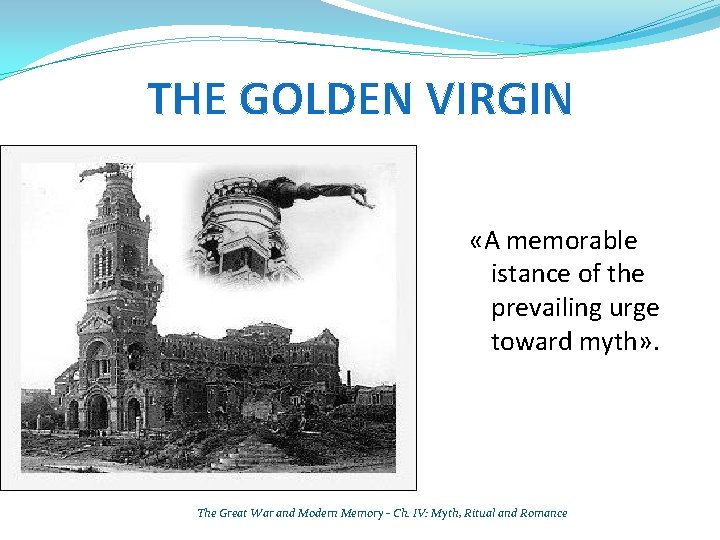
THE GOLDEN VIRGIN «A memorable istance of the prevailing urge toward myth» . The Great War and Modern Memory - Ch. IV: Myth, Ritual and Romance
ANOTHER MYTH: �When? During the First World War. �Where? At Albert: a commune in Northern France. �What? In 1915 the statue of Mary and infant Jesus on the Basilica of Notre-Dame de Brebieres was hit by a shell and remained in an horizontal position. In April 1918 the statue was knocked down after the British had given Albert to Germans; British decided to bomb it every morning until it falled. The Great War and Modern Memory - Ch. IV: Myth, Ritual and Romance
METAPHORS AND MYTH RELATED TO THE STATUE �Mystical prophecy �Emblem of pathos �Act of mercy �Symbol of grief �Act of Suicide �Archaic and poetic idea The Great War and Modern Memory - Ch. IV: Myth, Ritual and Romance
THE ROMANCE QUEST
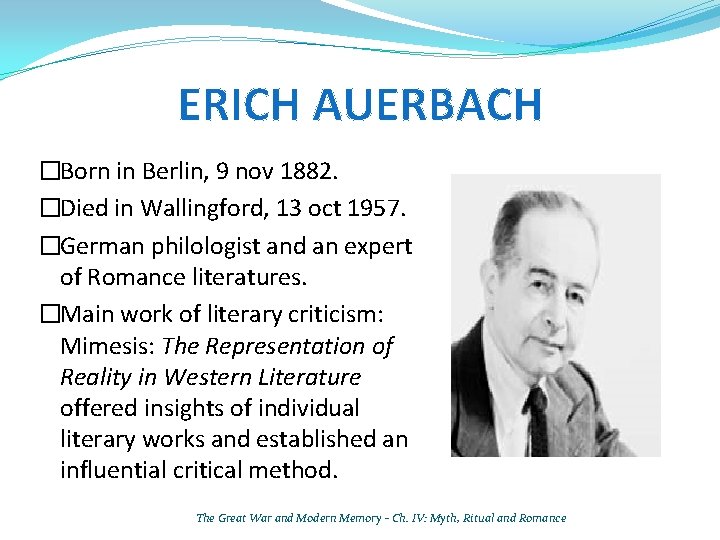
ERICH AUERBACH �Born in Berlin, 9 nov 1882. �Died in Wallingford, 13 oct 1957. �German philologist and an expert of Romance literatures. �Main work of literary criticism: Mimesis: The Representation of Reality in Western Literature offered insights of individual literary works and established an influential critical method. The Great War and Modern Memory - Ch. IV: Myth, Ritual and Romance
MEDIEVAL ROMANCE IN AUERBACH’S VIEW �PROTAGONIST: he has to overcome many trials in order to reach his final destination where a crucial test awaits him. �LANDSCAPE: the testing places are isolated from the settings of the normal world. �SOCIAL STRATA: a) rich: privileged and aloof. b) poor: numerous, colourful, grotesque. �COMMUNITY OF THE ELECT: the ones who are involved in these dangerous missions become part of this community. �TRAINING: the hero constantly practices his skills to succesfully achieve his task. The Great War and Modern Memory - Ch. IV: Myth, Ritual and Romance
THE SOLDIER AND THE HERO According to Fussell, the experience of a soldier of the Great War cannot help seeming to him like those of a hero of medieval romance, if his imagination has been steeped in Victorian pseudo-medieval romance: William Morris’ The Well at the World’s end (1896) and John Bunyan’s Pilgrim’s Progress (1678). The Great War and Modern Memory - Ch. IV: Myth, Ritual and Romance
From www. wordpress. com From www. readebookonline. com In May 1915, weekly’s article featured a caption similar to a chapter of The Well at the World’s End, so soldiers reading it had to value the romance. In nov 1918 a columnist of the Daily Express quoted a phrase from Pilgrim’s Progress because he knew he would be understood. The Great War and Modern Memory - Ch. IV: Myth, Ritual and Romance
ROMANTIC TOPICS Morris’ end of the world is «a cliff overlooking a boundless sea, very unlike the world ending with the British front line» . The Great War and Modern Memory - Ch. IV: Myth, Ritual and Romance
Bunyan’s Slough of despond and the Valley of the Shadow of Death In war memoirs «the Slough of despond is invoked as the only adequate designation for churned-up mud morasses pummelled by icy rain and heavy shells. It becomes one of the inevitable clichés of memory. The Valley of the Shadow of Death, where ‘lay blood, bones, ashes, and mangled bodies of men, even of Pilgrims that had gone this way formerly’. Major Pilditch invokes that valley to help him describe the indescribable […]» . The Great War and Modern Memory - Ch. IV: Myth, Ritual and Romance
The soldiers’ burden �The soldier has to bear a burden like Christian’s one in Pilgrim’s Progress. �During a march, as Quigley writes, the soldiers’ perception dies and he thinks only of his burden, like Christian. �Soldier’s responsibility fades away only when his equipment blew off his burden, so he can reach the end of a pilgrim’s progress. The Great War and Modern Memory - Ch. IV: Myth, Ritual and Romance
Christian’s certificate in Bunyan �Christian’s certificate admits him to the Celestial City and it takes two forms in Hale’s memoir. �The first is the slip of paper marked C-2 attesting his status as a low category man and constituting for a time his defence against his own Slough of Despond. �The second form that Christian’s certificate takes in Hale’s experience is the magical Yellow Paper admitting the bearer to the Celestial City of demobilization and home. The Great War and Modern Memory - Ch. IV: Myth, Ritual and Romance
ARCHETYPS AND NEW MEANINGS �According to E. D. Hirsch’s theory no one would ever understand new types of meaning unless he was capable of making novel subsumptions under previously known types. . . Something genuinely new is realised. �In Fussell’s view the new types of meaning are the terms of the new industrialized mass trench warfare, the previously known types are the motifs and images of popular romance and the something genuinely new is the “artistic” memories of the war. The Great War and Modern Memory - Ch. IV: Myth, Ritual and Romance
THE HONOURABLE MISCARRIAGE OF IN PARENTHESIS
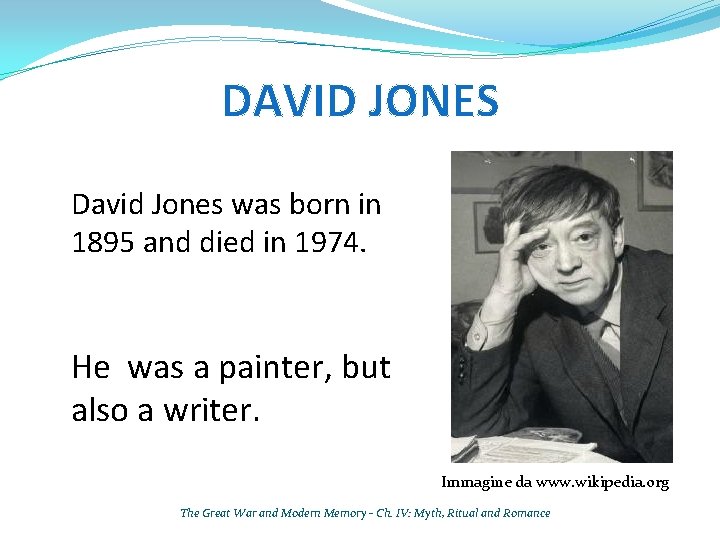
DAVID JONES David Jones was born in 1895 and died in 1974. He was a painter, but also a writer. Immagine da www. wikipedia. org The Great War and Modern Memory - Ch. IV: Myth, Ritual and Romance
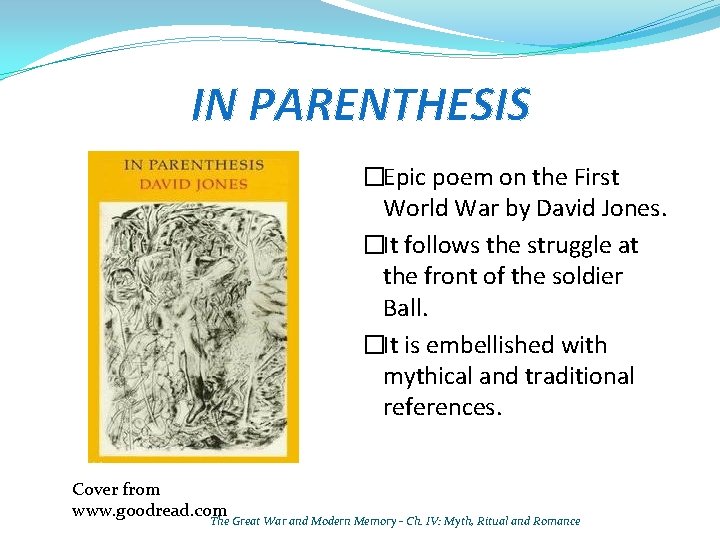
IN PARENTHESIS �Epic poem on the First World War by David Jones. �It follows the struggle at the front of the soldier Ball. �It is embellished with mythical and traditional references. Cover from www. goodread. com The Great War and Modern Memory - Ch. IV: Myth, Ritual and Romance
�Part 1 Introduction of the main character. �Part 2 The training. �Part 3 The battalion in the trench. �Part 4 A typical day in the trench. �Part 5 Preparation for the attack to Somme. �Part 6 “Proletarian holiday”. �Part 7 Final attack. The Great War and Modern Memory - Ch. IV: Myth, Ritual and Romance
JONES’ METHOD �Method of association: he mines the “deposits” clustering around traditional meanings, anxious that not a one be lost. �The experience of the soldier is taken as representative of essential human experience. The Great War and Modern Memory - Ch. IV: Myth, Ritual and Romance
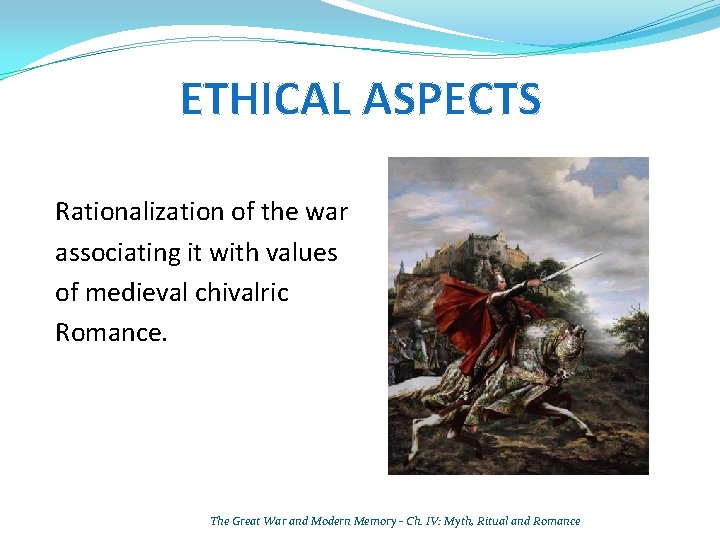
ETHICAL ASPECTS Rationalization of the war associating it with values of medieval chivalric Romance. The Great War and Modern Memory - Ch. IV: Myth, Ritual and Romance
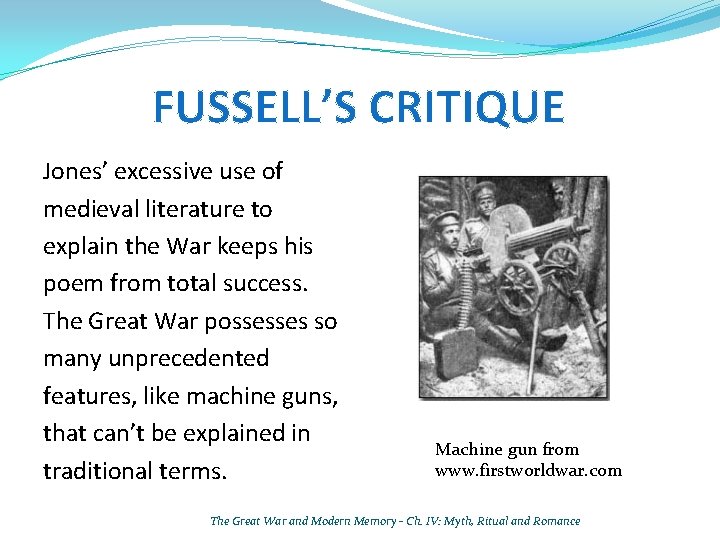
FUSSELL’S CRITIQUE Jones’ excessive use of medieval literature to explain the War keeps his poem from total success. The Great War possesses so many unprecedented features, like machine guns, that can’t be explained in traditional terms. Machine gun from www. firstworldwar. com The Great War and Modern Memory - Ch. IV: Myth, Ritual and Romance
FUSSELL’S ACKNOWLEDGEMENT This poem is «profoundly decent» and conveys true humanity, which itself declares that war can’t really be related to medieval romance. «It is too human for that» . The Great War and Modern Memory - Ch. IV: Myth, Ritual and Romance
THE END