
Library of Congress Subject Headings University of California
Library of Congress Subject Headings University of California, Berkeley School of Information Management and Systems SIMS 245: Organization of Information In Collections 10/21/98 Organization of Information in Collections
Review • Indexing Languages • Types of Indexing Languages • Thesauri 10/21/98 Organization of Information in Collections
Announcements • Away Nov. 8 -11 at TREC • Visiting Lecture(? ) • Midterm info. 10/21/98 Organization of Information in Collections
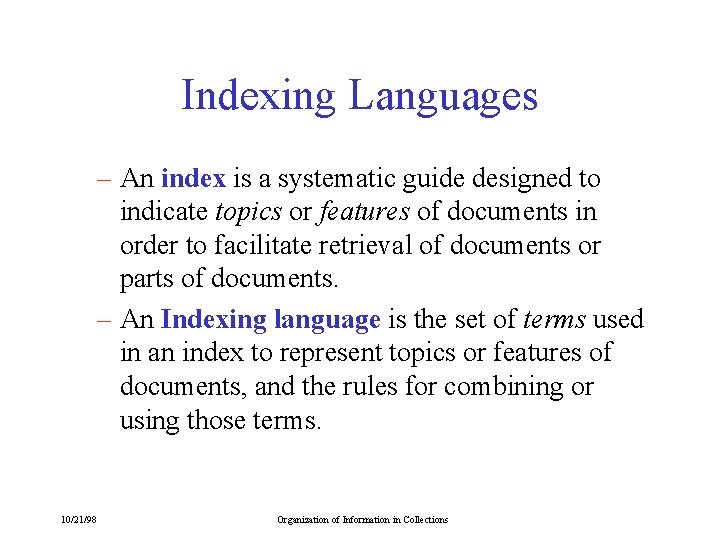
Indexing Languages – An index is a systematic guide designed to indicate topics or features of documents in order to facilitate retrieval of documents or parts of documents. – An Indexing language is the set of terms used in an index to represent topics or features of documents, and the rules for combining or using those terms. 10/21/98 Organization of Information in Collections
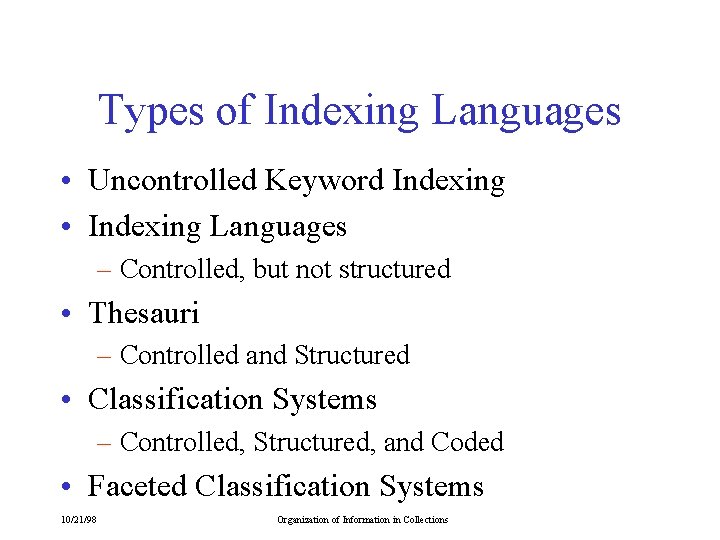
Types of Indexing Languages • Uncontrolled Keyword Indexing • Indexing Languages – Controlled, but not structured • Thesauri – Controlled and Structured • Classification Systems – Controlled, Structured, and Coded • Faceted Classification Systems 10/21/98 Organization of Information in Collections
Thesauri • A Thesaurus is a collection of selected vocabulary (preferred terms or descriptors) with links among Synonymous, Equivalent, Broader, Narrower and other Related Terms 10/21/98 Organization of Information in Collections
Classification Systems • A classification system is an indexing language often based on a broad ordering of topical areas. Thesauri and classification systems both use this broad ordering and maintain a structure of broader, narrower, and related topics. Classification schemes commonly use a coded notation for representing a topic and it’s place in relation to other terms. 10/21/98 Organization of Information in Collections
Today • Verbal Subject Analysis • Library of Congress Subject Headings 10/21/98 Organization of Information in Collections
Objectives of Subject Cataloging • To provide assess by subject to all relevant material. • To provide subject access to materials through all suitable principles of subject organization (e. g. Matter, process, applications, etc. ) • To bring together references to materials which treat of substantially the same subject regardless of disparities in terminology, disparities which have resulted from national differences, differences among groups of subject specialists, and/or from the changing nature of the concepts within the discipline itself From Shera & Egan 10/21/98 Organization of Information in Collections
Objectives (cont. ) • To show affiliations among subject fields, affiliations which may depend upon similarities of matter studied, or method, or of point of view, or upon use or application of a field of knowledge. • To provide entry to any subject field at any level of analysis, from the most general to the most specific. • To provide entry through any vocabulary common to any considerable group of users, specialized or lay. 10/21/98 Organization of Information in Collections
Objectives (cont. ) • To provide a formal description of the subject content of any bibliographic unit in the most precise, or specific, terms possible, whether the description be in the form of a word or a brief phrase or in the form of a class number or symbol. • To provide means for the user to make selection from among all items in any particular category, according to any chosen set of criteria such as: most thorough, most recent, most elementary, etc. 10/21/98 Organization of Information in Collections
Subject Heading Objectives • To identify pertinent material on a given subject or topic • To enable the inquirer to find material on related subjects • Both of these objectives assume some match can be found between the language of the searcher and the language of the indexer for a given topic or concept. 10/21/98 Organization of Information in Collections
Principles for the choice of Subject Heading Terms • The reader as focus – Should be what the user would use • Unity – Bring together all items on a topic regardless of expression • Usage – Should be common usage • Specificity – The heading should be as specific as the topic it is intended to cover 10/21/98 Organization of Information in Collections
Cutter on Specific Entry • Enter a work under its subject heading, not under the heading of the class that includes that subject … Put Lady Cust’s book on “the cat” under “Cat” and not under Zoology or Mammal, or Domestic animals… Some subjects have no name. They are spoken of by a phrase or phrases not definite enough to be used as headings. It is not always easy to decide what is a distinct subject… Possible matters of investigation … must attain a certain individuality as objects of inquiry and be given some sort of name, otherwise we must assign them class-entry. C. A. Cutter, 1876 10/21/98 Organization of Information in Collections
LCSH • LCSH Structure and Practice 10/21/98 Organization of Information in Collections
- Slides: 15