
Library of Congress Classification Part 1 April 20
Library of Congress Classification (Part 1) April 20, 2005 1
Overview l l l l 2 History Characteristics System Structure Notational Structure Double Cutters Tables Demo of Classification Plus
History l l l 3 LC Classification schedules developed 18981910 Emphasized LC’s collection strengths: social sciences (political science, law, history) Originally, little emphasis on humanities, religion & philosophy
History (cont. ) l l l In early years, schedules revised periodically Today, schedules are revised continuously (see Weekly Lists) Some schedules only recently published: – – 4 KBR, history of canon law, 2001 KBU, law of the Roman Catholic Church, 2001 KBM, Jewish law, 2002 KBP, Islamic law, 2002
Characteristics l l l 5 Enumerative - every topic explicitly listed No synthetic features 3½ shelf feet long!
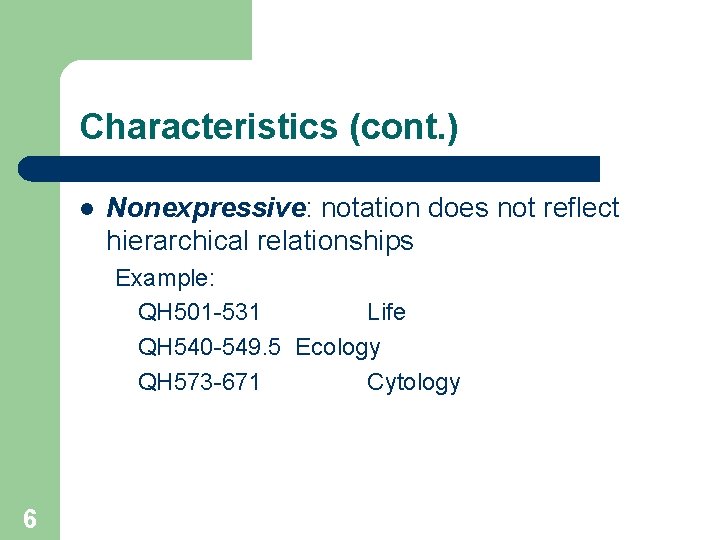
Characteristics (cont. ) l Nonexpressive: notation does not reflect hierarchical relationships Example: QH 501 -531 Life QH 540 -549. 5 Ecology QH 573 -671 Cytology 6
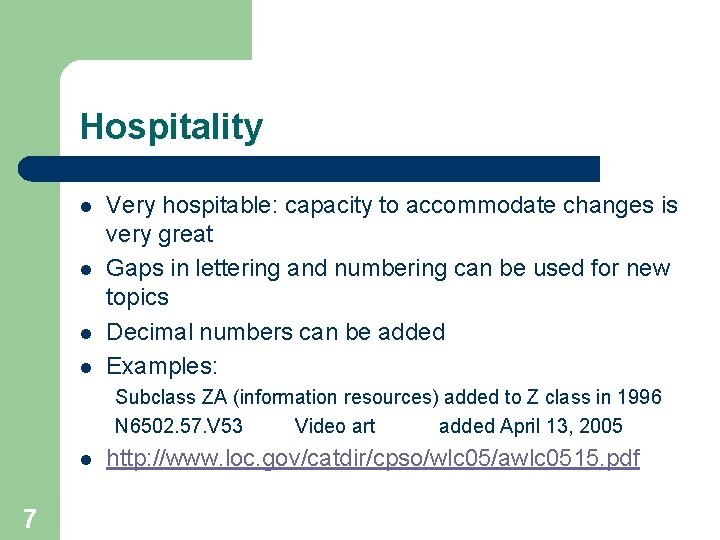
Hospitality l l Very hospitable: capacity to accommodate changes is very great Gaps in lettering and numbering can be used for new topics Decimal numbers can be added Examples: Subclass ZA (information resources) added to Z class in 1996 N 6502. 57. V 53 Video art added April 13, 2005 l 7 http: //www. loc. gov/catdir/cpso/wlc 05/awlc 0515. pdf
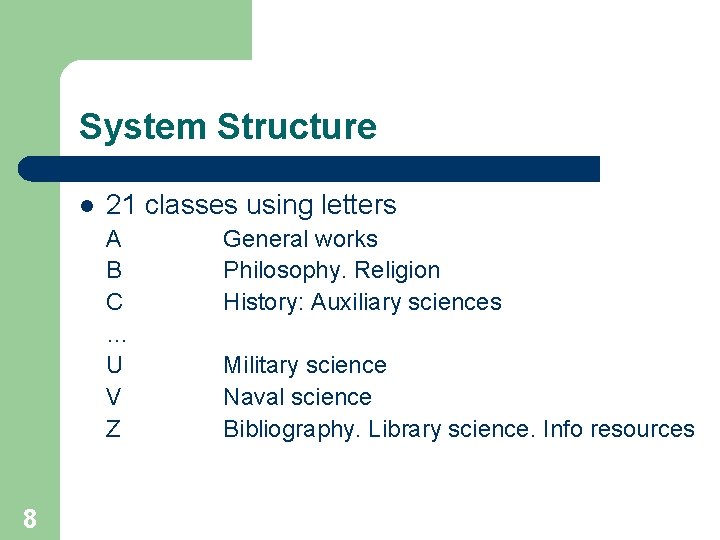
System Structure l 21 classes using letters A B C … U V Z 8 General works Philosophy. Religion History: Auxiliary sciences Military science Naval science Bibliography. Library science. Info resources
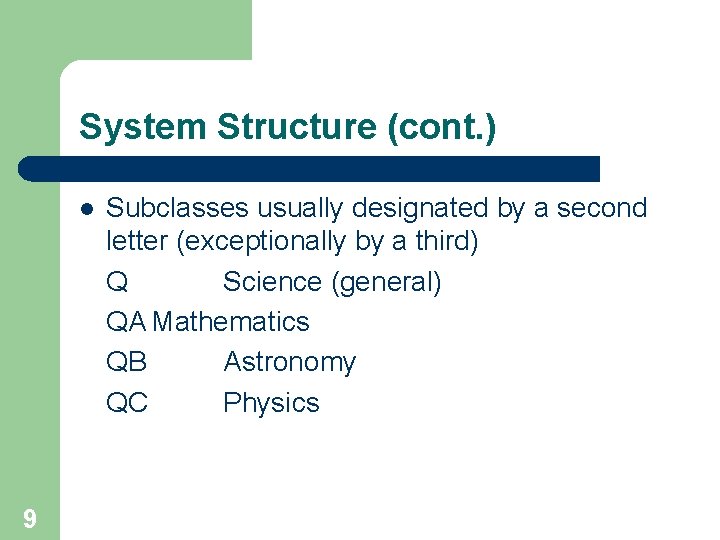
System Structure (cont. ) l 9 Subclasses usually designated by a second letter (exceptionally by a third) Q Science (general) QA Mathematics QB Astronomy QC Physics
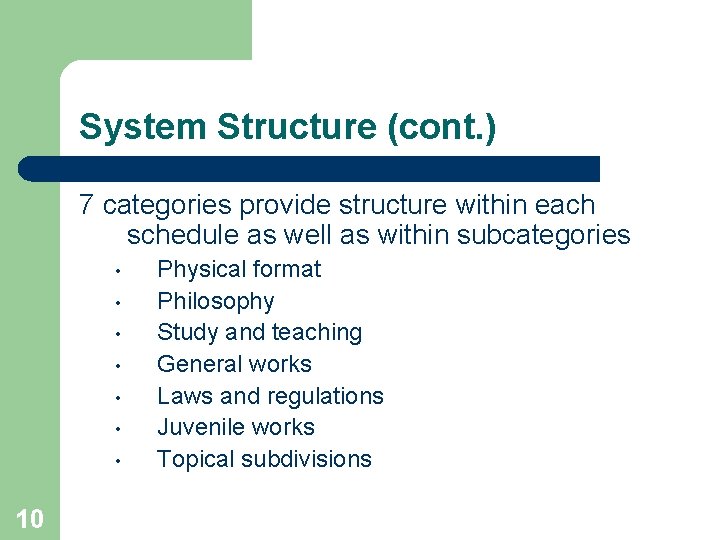
System Structure (cont. ) 7 categories provide structure within each schedule as well as within subcategories • • 10 Physical format Philosophy Study and teaching General works Laws and regulations Juvenile works Topical subdivisions
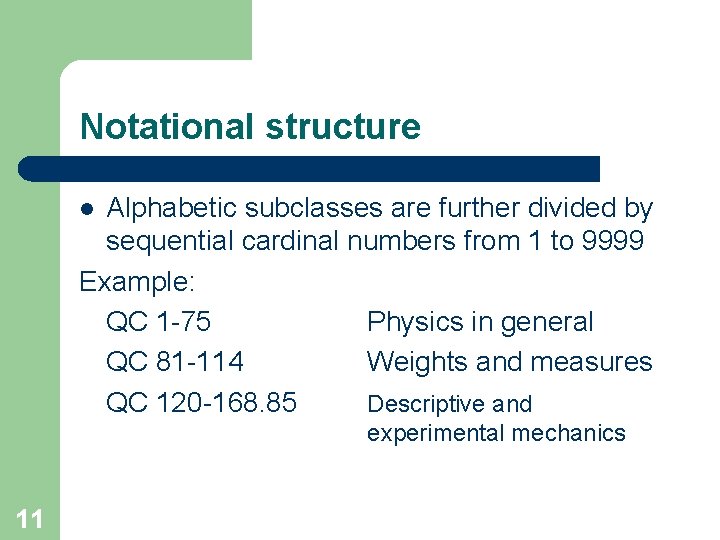
Notational structure Alphabetic subclasses are further divided by sequential cardinal numbers from 1 to 9999 Example: QC 1 -75 Physics in general QC 81 -114 Weights and measures QC 120 -168. 85 Descriptive and l experimental mechanics 11
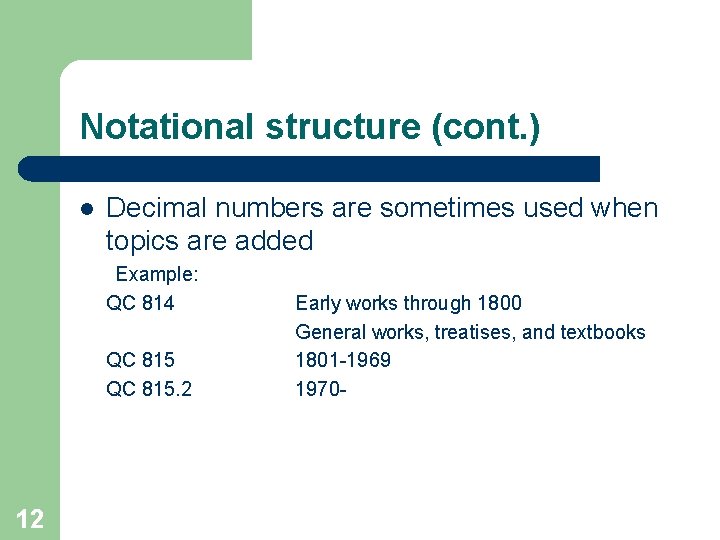
Notational structure (cont. ) l Decimal numbers are sometimes used when topics are added Example: QC 814 QC 815. 2 12 Early works through 1800 General works, treatises, and textbooks 1801 -1969 1970 -
Cutter Numbers in Classification l Cutter numbers developed for shelflisting – l 13 Arranges all works in a class by main entry (author or title) In LCCS, cutter numbers are sometimes used to subdivide classes
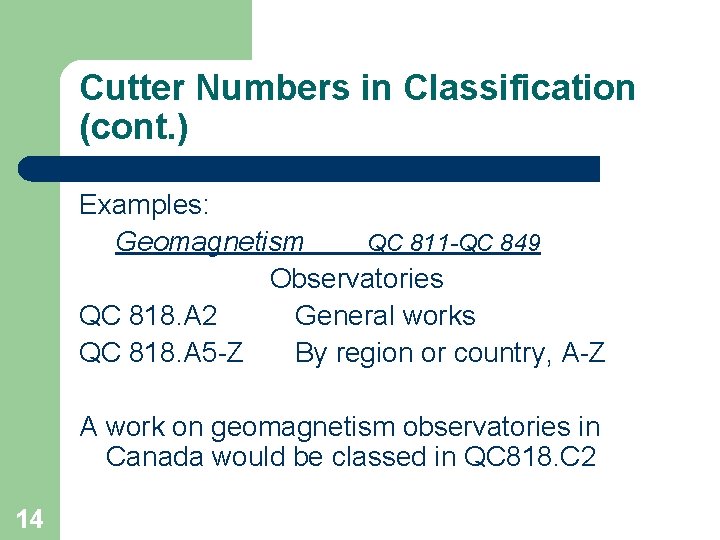
Cutter Numbers in Classification (cont. ) Examples: Geomagnetism QC 811 -QC 849 Observatories QC 818. A 2 General works QC 818. A 5 -Z By region or country, A-Z A work on geomagnetism observatories in Canada would be classed in QC 818. C 2 14
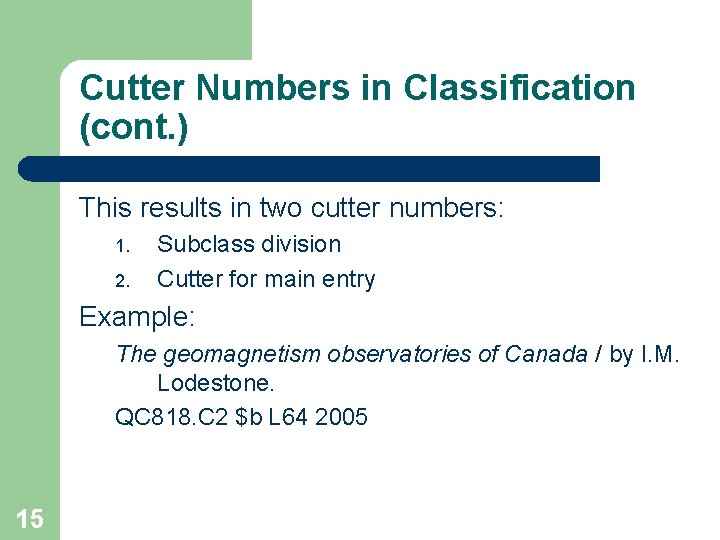
Cutter Numbers in Classification (cont. ) This results in two cutter numbers: 1. 2. Subclass division Cutter for main entry Example: The geomagnetism observatories of Canada / by I. M. Lodestone. QC 818. C 2 $b L 64 2005 15
Cutter Numbers in Classification (cont. ) l l Except in Class G, no more than two cutter numbers are allowed In some cases, two cutter numbers are used in the classification tables. – – – 16 The 1 st cutter is for a topical subclass The 2 nd cutter is for a geographic country or locality or name of a corporate body, etc. A digit is added to the second cutter for the main entry
Cutter Numbers in Classification (cont. ) Example: Propaganda and censorship during Canada’s great war / by Jeff Keshen, 1996. D 639 class number for World War I. P 7 subclass for propaganda C 24 sub-subclass for Canada; added digit for Keshen 1996 year of publication 17
Tables in LCCS l l l Recurring patterns of subdivisions appear in tables References to tables appear in the schedules Tables may contain: – – 18 cutter numbers to be added to a base class, or Arabic numbers to be added to a base number
In-class exercise: classifying beavers 19 Classify the following topics: Mammals of the world Mammals of the Czech Republic Beaver reproduction Rodent reproduction Ecology of beavers Aquatic mammals of Central Europe Fossil beavers
- Slides: 19