
Library Collection Management Through the Years and Beyond
Library Collection Management Through the Years and Beyond By: Sabrina Gonzalez Microcomputer Applications Lib/Info Centers LIS 5268 Professor Austin December 1, 2017
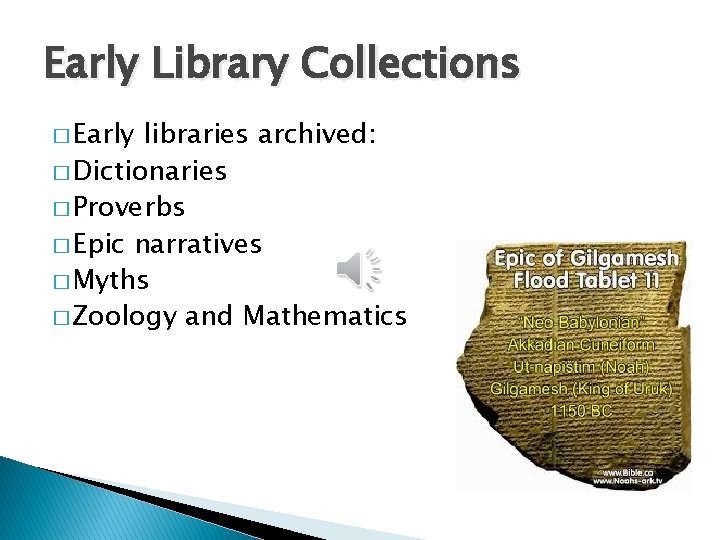
Early Library Collections � Early libraries archived: � Dictionaries � Proverbs � Epic narratives � Myths � Zoology and Mathematics
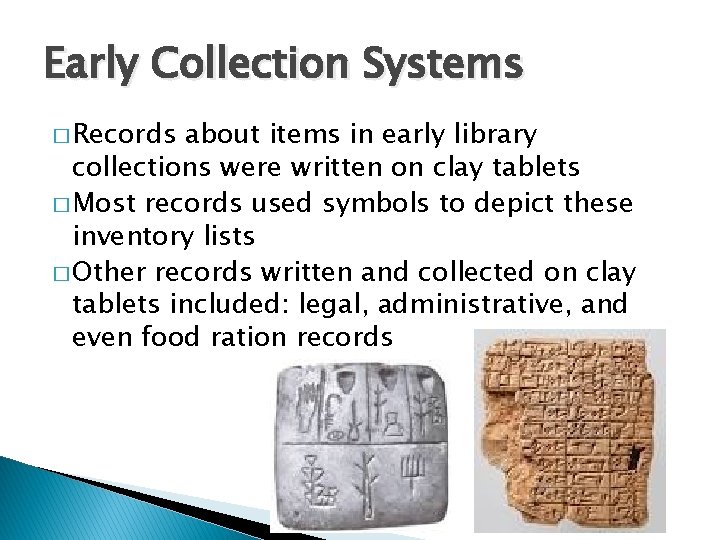
Early Collection Systems � Records about items in early library collections were written on clay tablets � Most records used symbols to depict these inventory lists � Other records written and collected on clay tablets included: legal, administrative, and even food ration records

The Printing Press & Collection Management � Library collections shifted from using clay tablets to scrolls and early rudimentary forms of print � Collection management systems followed suit � The advent of the printing press brought about an ‘explosion of information’ � Libraries added print materials to their collections at a rapid rate � Bibliographies and classification schemes developed, laying the foundation for collection management for the next four centuries
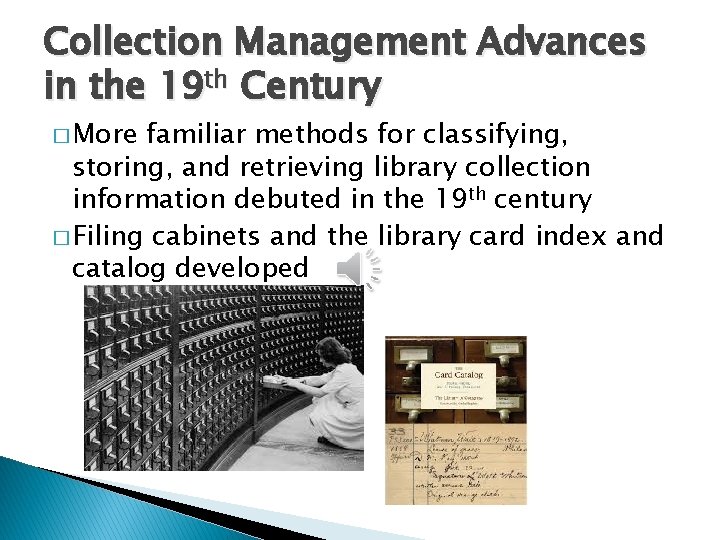
Collection Management Advances in the 19 th Century � More familiar methods for classifying, storing, and retrieving library collection information debuted in the 19 th century � Filing cabinets and the library card index and catalog developed
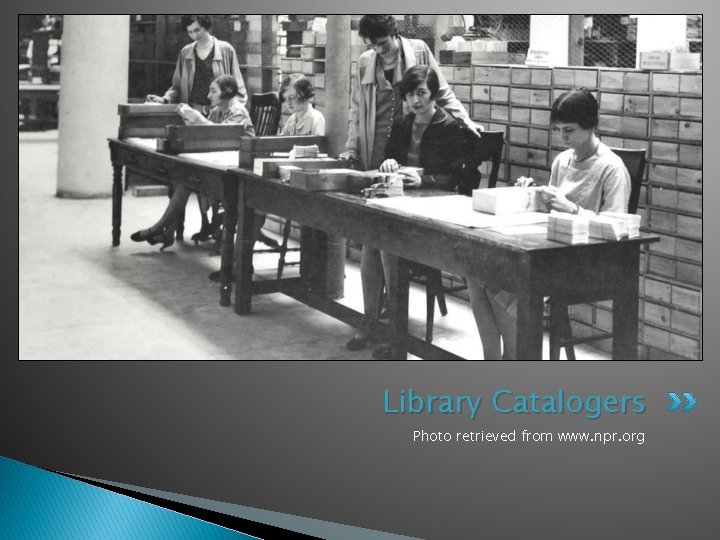
Library Catalogers Photo retrieved from www. npr. org
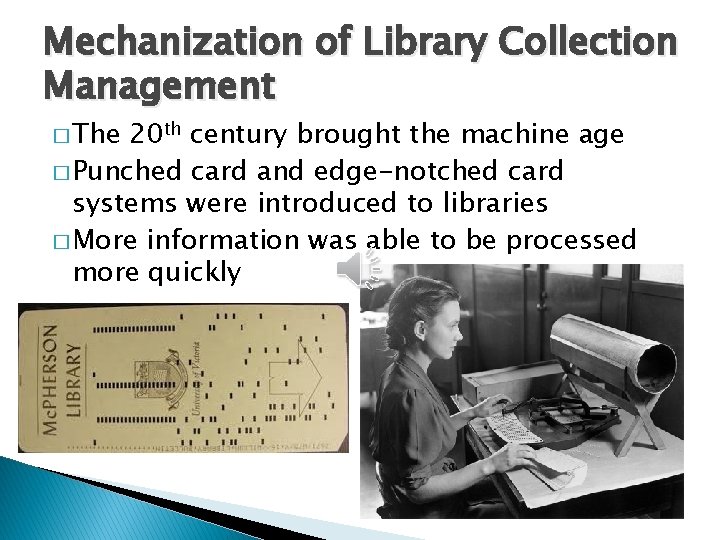
Mechanization of Library Collection Management � The 20 th century brought the machine age � Punched card and edge-notched card systems were introduced to libraries � More information was able to be processed more quickly
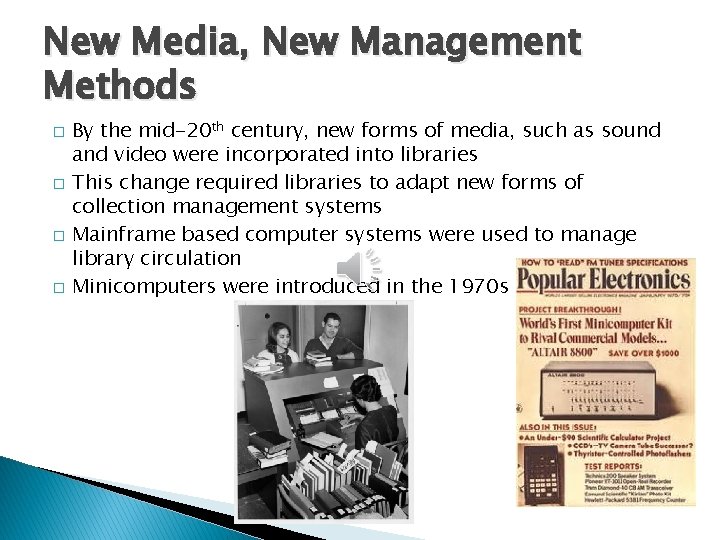
New Media, New Management Methods � � By the mid-20 th century, new forms of media, such as sound and video were incorporated into libraries This change required libraries to adapt new forms of collection management systems Mainframe based computer systems were used to manage library circulation Minicomputers were introduced in the 1970 s
The Internet and Library Collection Management � With the introduction of Internet usage among the general public and in libraries, information delivery systems saw a dramatic change some say was and is even greater than the introduction of the printing press � Electronic databases places information quickly at the fingertips of library staff and patrons
New Challenges with Electronic Media and Collection Systems � Libraries attempting to use traditional methods of cataloging and filing databases can become weary and frustrated with an overload of information � Electronic journals and articles cannot be interfiled with print materials � The immateriality, mutability, and instability of electronic resources creates even more of a challenge for library collection management
Internet-based Software for Library Management � Fortunately, software has been created to handle the management of electronic materials in libraries � Within the last decade, software such as Data Fountains and i. Via, have used keywords to enable electronic documents to be classified, stored, and retrieved
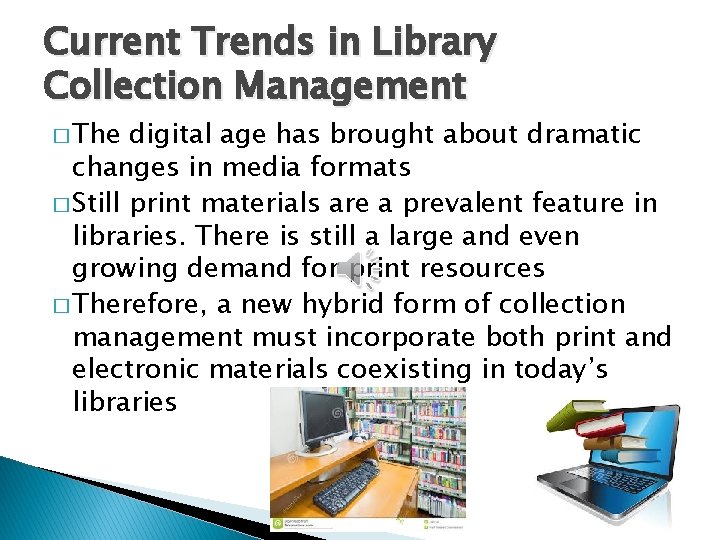
Current Trends in Library Collection Management � The digital age has brought about dramatic changes in media formats � Still print materials are a prevalent feature in libraries. There is still a large and even growing demand for print resources � Therefore, a new hybrid form of collection management must incorporate both print and electronic materials coexisting in today’s libraries
Criteria for Purchasing New Collection Management Software � “A configurable entry level menu for all applications � Linking of guidance to paper and electronic resources � Functional integration of applications to allow users to move from one source to another without having to exit one application before re-entering another” (Nwosu, 2017, p. 42).
Future Implications � Library collection management shifts from software upgrades to a cloud based storage system � Tipasa is an example of a cloud based system � Cloud based systems allow large amounts of information to be accommodated into a collection system without the need for frequent software upgrades
Future Implications (continued) � Key qualities necessary for library management systems to continue to keep up with the changing times: � Flexibility � Integration � Collaboration (i. e. emphasis on ILL Inter Library Loans)
- Slides: 15