
LIBRARY COLLECTION DEVELOPMENT Every library and librarian supports
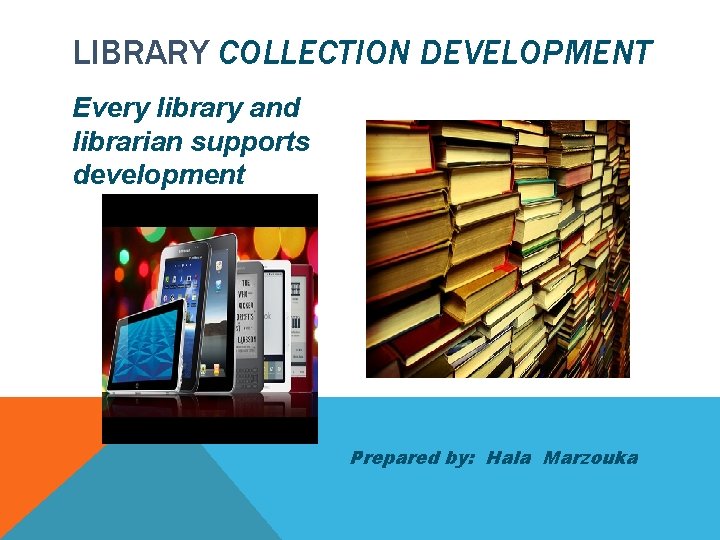
LIBRARY COLLECTION DEVELOPMENT Every library and librarian supports development Prepared by: Hala Marzouka

LIBRARY COLLECTION DEVELOPMENT Ø Library collection development is the process of meeting the information needs of the people (a service population, and at Bethlehem University, an academic community) in a timely and economical manner using information resources locally held, as well as from other organizations. Ø According to the International Federation of Library Associations and Institutions (IFLA), acquisition and collection development focuses on methodological and topical themes pertaining to acquisition of print and other analogue library materials (by purchase, exchange, gift, legal deposit), and the licensing and purchase of electronic information resources. *http: //en. wikipedia. org/wiki/Collection_development

WHY IS COLLECTION DEVELOPMENT IMPORTANT TO THE LIBRARY: Ø Collection development is the process of acquiring books/documents and non-print media needed to satisfy request for the information needs and to attain systems objectives and helps citizens to be educated. Ø It will enrich the library collection & resources. Ø It will boost the staff, for better performance and for a continuous, consistent and balanced growth of the library. …. .

WHY IS COLLECTION DEVELOPMENT IMPORTANT TO THE LIBRARY? Ø It will include more resources such us: books, journals, encyclopedias, e-journals, e-books and online databases. Ø It will ensure that the resources you care about are archived for continuity of access into the future.
COLLECTION DEVELOPMENT IS A PROCESS WHICH HAS FOUR ELEMENTS: Collection development includes four elements: Ø FIRST ELEMENT: • Policy: Written statement of principles guiding the library’s selection and de-selection of materials including the criteria used in making selection, decisions and policies concerning gifts and exchange. Technology- related factors have to be incorporated in the policy. *http: //www. google. ps/url? sa=t&rct=j&q=&esrc=s&frm=1&source=web&cd=1&ved=0 CB 0 QFj. AA&url=http%3 A %2 F%2 Fgndec. ac. in%2 F~librarian%2 FLib. Sc. Refresher 2008%2 FCOLLECTION%2520 DEVELOPMENT%2520 AND%2520 PRESERVATION%2520 OF%2520 LIBRARY%2520 RESOURCES. ppt&ei=o 7 CWU 5 Hx. Ne. WO 7 Ab 06 I GQCg&usg=AFQj. CNHh. KGtq. STCUFyvl. JMNFIEj 7 Rq. Gx 0 Q
COLLECTION DEVELOPMENT IS A PROCESS WHICH HAS FOUR ELEMENTS: Ø SECOND ELEMENT: • Selection: purpose of the Materials Selection Policy is to ensure the planned and systematic growth, development and maintenance of library collections that meet the user's needs for information and which are of interest, value and significance to the community while preserving each individual's right to intellectual freedom. The Materials Selection Policy applies to all formats including print, nonprint, audio-visual, and electronic materials. *http: //www. sudburylibraries. ca/en/aboutus/materialsselectionpolicy. asp.
COLLECTION DEVELOPMENT AS A PROCESS HAS FOUR ELEMENTS: Ø THIRD ELEMENT: • Evaluation: includes strengths and weaknesses in different areas. Ø FOURTH ELEMENT: • Weeding: is the process of removing materials that are no longer appropriate nor supportive of the university curriculum from the library collection. Removing such materials improves the overall quality of the collection and saves place. *http: //bethlehem. edu/library/policies/weeding.
THE CHALLENGES WHICH ARE FACING THE LIBRARIES: Ø Wide range of collection. Ø Selection process itself which includes large-scale management issues such as budget, policy, personnel, and technology. Ø Academic libraries' increasing demands for electronic searching capabilities. Ø Staff workload and training of the users. …. .
THE CHALLENGES WHICH ARE FACING THE LIBRARIES: Ø The need for rethinking collection development policy, both to support the new philosophy of the institution and to better deal with new types of resources on a day-to-day basis. Ø Collection development responsibilities for digital libraries have been, therefore, expanded to include: community analysis, planning for collection building, collection development policies, selection tools, publishing, intellectual freedom and censorship, weeding, and collection evaluation (Nisonger, 1994). *http: //www. google. ps/url? sa=t&rct=j&q=&esrc=s&frm=1&source=web&cd=1&ved=0 CB 0 QFj. AA&url=http% 3 A%2 F%2 Flibrary. upmin. edu. ph%2 Flibrariansresources%2 Ffile%2 Fbasiclevel%2 Fselection%26 acquisiti onof_multimedia%2 FCollection%2520 Development%2520 in%2520 an%2520 Electronic%2520 Age. ppt&ei= y 7 SWU 4 WZL 8 m. M 7 Qa. YYCo. Ag&usg=AFQj. CNHVLv 5 Vr. Ma 3 Ry. Jwb. Sw. LBBADE 4 t. F 8 w&bvm=bv. 68693194, bs. 1, d. b. GQ
FINALLY: Ø The libraries should be ready for the new age of technology and should develop their collection accordingly. Ø These are interesting times for libraries of all kinds. Ø The libraries will not disappear, but they will change.
*REFERENCES USED: *HTTP: //EN. WIKIPEDIA. ORG/WIKI/COLLECTION_DEVELOPMENT *HTTP: //WWW. GOOGLE. PS/URL? SA=T&RCT=J&Q=&ESRC=S&FRM=1&SOURCE= WEB&CD=1&VED=0 CB 0 QFJAA&URL=HTTP%3 A%2 F%2 FGNDEC. AC. IN%2 F~LIBRA RIAN%2 FLIB. SC. REFRESHER 2008%2 FCOLLECTION%2520 DEVELOPMENT%2520 A ND%2520 PRESERVATION%2520 OF%2520 LIBRARY%2520 RESOURCES. PPT&EI=O 7 CWU 5 HXNEWO 7 AB 06 IGQCG&USG=AFQJCNHHKGTQSTCUFYVLJMNFIEJ 7 RQGX 0 Q *HTTP: //WWW. GOOGLE. PS/URL? SA=T&RCT=J&Q=&ESRC=S&FRM=1&SOURCE=W EB&CD=1&VED=0 CB 0 QFJAA&URL=HTTP%3 A%2 F%2 FLIBRARY. UPMIN. EDU. PH%2 FLIBRARIANSRESOURCES%2 FFILE%2 FBASICLEVEL%2 FSELECTION%26 ACQUISI TIONOF_MULTIMEDIA%2 FCOLLECTION%2520 DEVELOPMENT%2520 IN%2520 AN% 2520 ELECTRONIC%2520 AGE. PPT&EI=Y 7 SWU 4 WZL 8 MM 7 QAYYCOAG&USG=AFQJCNHVLV 5 VRMA 3 RYJWBSWLBBADE 4 TF 8 W&BVM=BV. 6869319 4, BS. 1, D. BGQ *HTTP: //BETHLEHEM. EDU/LIBRARY/POLICIES/WEEDING *HTTP: //WWW. SUDBURYLIBRARIES. CA/EN/ABOUTUS/MATERIALSSELECTIONPOL ICY. ASP
Thanks
- Slides: 12