
Librarianship as a Profession and Professional Ethics Introduction
Librarianship as a Profession and Professional Ethics
Introduction The general meaning of ethics is that it is a set of moral principles. These may be considered as rules of conduct recognized with respect to a particular class of human actions, culture etc. Professional Associations are keen to develop ethical values, as to ethical codes to be followed by professionals.
The ageold professionals like medicine, education, law, religion and others, have been constantly reviewing the need for ethical codes for their professionals to set minimum standards of performance. The implementation of these in professional practice is however self imposed issue mainly because it is not possible for others to enforce these codes on professional practitioners.
Another issue that confronts most professionals today is that they are under tremendous pressures due to the application of various Technological advances in professional techniques and practices and consequent social changes. These destabilizes the relationship between customer and practitioners. For Ex. Doctors and Patients; Librarians and Users The profession of Librarianship is also under pressure.
The dimensions of Library and Information Science have been widened, with application IT, Information need of Users, and Information Explosion, Social changes and others. These developments generate new problems and issues that are often creating conflicting approaches in setting ethical standards in professional performance. However the LIS professional Associations in USA and UK have come out with ethical codes of ethical standards for professional performance. Although these codes are not mandatory.
In India The subject of professional ethics in the practice of librarianship is still to take roots. The ILA and IASLIC and Information centres have professional ethics as on important aspect of work listed in their programme of activities. Infact IASLIC discussed professional ethics in its National Seminar at Calcutta in 1984.
General Ethics Websters International Dictionary Defines Ethics as: 1. The discipline dealing with what is good and bad or right or wrong with moral duty and obligations; 2. A group of moral principles or set of values; a particular theory or system or moral values; the principles of conduct governing an individual or a profession; standards of behavior; 3. The objective ‘Ethical’ connotes conformity to professionally endorced principles and practice or a system/ Philosophy of conduct and principles practiced by a person or group.
Profession, Professional & Professionalism A Profession As an occupation, especially that one requires extensive education in a branch of Science or Arts. Or Body of persons engaged in such an occupation. Synonymous with 'profession' such as vocation, employment, occupation, business, trade etc. All refers to the activity to which person regularly devotes himself. It requires special knowledge and training in some science of learning.
A Professional Is one who is engaged in an activity such as a means of livelihood for a gain or pertaining to all connected with a profession. For example: - A Professional Tennis Player; A Researcher; A Musician. Who are all competent, experts in their respective occupations
A Professionalism Is the professional character spirit or methods, the other practices of a professional as distinguished from another. An expertise is expected of professionals with full involvement in and committment to those who receive services from them. The age-old professionals like Agriculture, Medicine, Education, Music etc recognized and respected by the society. But the 20 th century has witnessed the growth and development of many professions including librarianship
Professional Ethics Professional ethics is considered as an expression of the ethos (i. e. Character, Spirit, Culture, Practice) of an occupation. It should be based upon, the basic values associated with the occupation. It should reveal what the occupation is, what the practitioners think about their place in society. The quality of service that makes them distinguished.
Very often, we refer to the quality of work of a person being highly professional, meaning thereby that they raise a near perfection in the nature of the performance, the intellectual and technical expertise and their sense of responsibility and commitment to the customers. Although there are maybe an occasions poor performance too. In order to sustain social recognition and to give their best, almost every profession, attempts to evolve a code of conduct or code of professional behaviour to guide practitioners.
For example: Medical profession has solid foundations & practice including principles and value to promote relationship between Doctors and Patients.
Librarianship as a Profession
A code of Professional Ethics for librarians describes that: "The goal of librarianship is to mediate between humanity and humanity's store of recorded knowledge and information; To encourage an informed, enlightened and empowered citizenry; and To join with others in the fight for intellectual freedom and access to information".
To build up this image for the LIS profession and to establish quality a set of ethical codes has to be formulated and is to be practiced by librarians and information professionals. But before the discussion of these codes. It is better to realise at what extent librarianship can be deemed to be a profession.
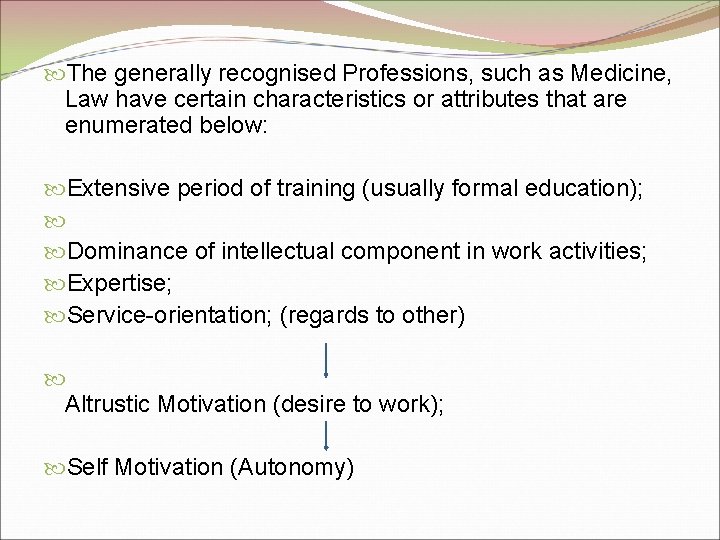
The generally recognised Professions, such as Medicine, Law have certain characteristics or attributes that are enumerated below: Extensive period of training (usually formal education); Dominance of intellectual component in work activities; Expertise; Service-orientation; (regards to other) Altrustic Motivation (desire to work); Self Motivation (Autonomy)
Another set of criteria for a vocation to be considered a Profession, is as follows: A fairly complex, Personalised client-professional relationship Usually involving fee; A certain amount of independence on the part of the professional (he is rarely closely supervised, and is rarely responsible to anyone to a greater degree than he is to his client); A clear cut body of professional technique & practice held in common by all practitioners;
A professional association with real power i. e. power of enforcement and power of certification. Taking consideration these sets of criteria, librarianship cannot, perhaps be placed on par with the more well established profession like Medicine, Law, Accountancy etc. However, there is certainly a clear cut body of professional techniques in librarianship that would involve its recognition as a profession.
Librarianship, fulfills some of the other characteristics like; intellectual component, expertise, service orientation, altrusive motivation, selfmotivation and autonomy. The five laws of Library science by Dr. S. R. Ranganathan provide some set of guiding principles, to motivate persons towards service orientation, intellectual involvement in developing tools and techniques and a body of professional knowledge to get recognition for librarianship as a profession.
The LA of UK recognized and the importance of an urgent need for giving some broad definition of professional library work to indicate employers the particular skills which professional librarians can bring to organizations, and to help librarians themselves to identify and assert the special skills which they have. One of the reasons for low, pay and recognition and images of professionals is undoubtedly there is a lack of clarity, among LIS professionals, about they what actually do?
The Association produced a report in two sections One aimed at employers; and Other aimed at professionals. Aimed at employers provided a brief guide to the special skills that LIS professionals have and they apply them. It include a note on professional qualifications, a description of professional skills and activities and gave the following definition:
“Professional librarians formulate, plan, direct and deliver library and information services by identifying the needs & demands of actual and potential users; Collecting, retrieving and organizing knowledge and ideas in a variety of forms, from books, MSS to computerized the databases; and Disseminating and marketing library and information services to clients”.
Professional Ethics in Librarianship It is easy to think of ethical values, as essential to ensure the quality of performance. But it is very difficult to design an universally acceptable standard code for (performance) professional ethics. There also differences in the conceptions of ethical behaviour in the different societies, and cultures.
In order to be effective, therefore, professional ethics have to be pursued at various levels, appropriate to different cultures and situations. These levels maybe: Primary - Institutional. Professional –National and International.
Primary levels: Set of guiding principles which are fundamental to human behaviour with reference to any activity, such as honesty, good conduct, adherence to truth etc. Professional At the Professional and Organisational levels: - There are likely to be occasional conflicts, particularly when a person has to make Judgment in making choice for a course of action.
For Instance Professional Ethics may at times clash with organisational loyalty. Similarly, there may be conflicts between Professional, National and International Ethics in performing a particular task. These types of conflicts appear in any Professional Activity. Therefore, designing ethical codes becomes not only too ideal to be realistic, but also it is difficult to implement, particularly because no ethical code can never be enforced as they are not statutory laws.
US Experience Despite all problems and difficulties, attempts have been made to design code of (conduct) ethics for LIS professionals. The ALA, after prolonged debates and discussions adopted a professional code in 1938. They are related to: Ø The governing authority; Ø Their constituency; Ø Their fellow employees within the library; Ø Their profession; and Ø Society
In 1975 ALA adopted a new statement on professional ethics which replaced the 1938 code. The same year constituted a standing committee on professional ethics. In 1981 ALA meeting the code was officially accepted and adopted.
In 1990, the American Association for Information Science (ASIS) aslo published a draft of ASIS code of Ethics for Information Professionals in its Bulletin. This code comprises a preamble and four categories of ethical responsibilities to: Ø Individual persons; Ø Society; Ø The sponsor; Ø The Client or Employer; and Ø Profession. But still it is under pending acceptance by the Association and Directors
UK Experience In 1978 LA was established working party on professional ethics to develop a draft code of ethics. The final code of professional conduct was adopted by the Council of the UK Library Association at its 100 th Annual General Meeting in 1983. The code includes the procedures and regulatory actions that will follow a breach of the code by a member of a LA.
A unique feature of LA’s code it is implementation mechanism that involves the sanctiones imposed by the LA's Disciplinary Committee on those who ignore the professional conduct set by the Association.
The features of code relate to: a) The competency of the librarians; b) The question of discretion and respect of a client privacy; c) Professional independence and Intellectual freedom; d) The impartiality of the library profession; e) Financial ethics; and f) The integrity of members.
Indian Situation Indian adventure of designing a professional code of ethics have remained at the level of efforts to survey literature on professional ethics and no more. IASLIC national conference in 1984. A. K. Mukherji - in his book 'Librarianship-it's Philosophy and History (1966)’. R. L. Mittal’s - Library Administration (1964).
Two article by Meganand -in Indian Librarian in 1962. A Literature survey by Amitabh Chaterjee appearing in IASLIC Bulletin in September 1965. The only efforts to consider this subject seriously in a professional forum appears to be at the IASLIC conference in 1984. There were 10 papers presented at the conference.
5 exclusively on professional ethics. Persons working in a Universities, special and other institutional libraries. Another of Ranganathan's Five Laws vis-a-vis Professional ethics with special reference to a research library. All these papers are containing good number of references which would facilitate for the readings on the subject.
Librarianship Profession or Vocation
Profession? A profession warrants: A. A specialised knowledge of the field scientific, historical and scholarly. B. Intensive preparation for acquiring needed skills and methods to put the knowledge to work. C. A set of principles, a social code of ethics.
D. An organisation that will bind all the numbers together for: 1. Concerted opinion; 2. To achieve high standards in performance; and 3. To act as force to achieve common goal and work for collective thinking. E. Working with prime purpose of rendering a public service.
Vocation: A vocation involves: A. An activity of some kind-routing physical or scholarly. B. A craft, trade or profession. C. Need certain or no skills; and D. Mainly an activity involving service against fee or free.
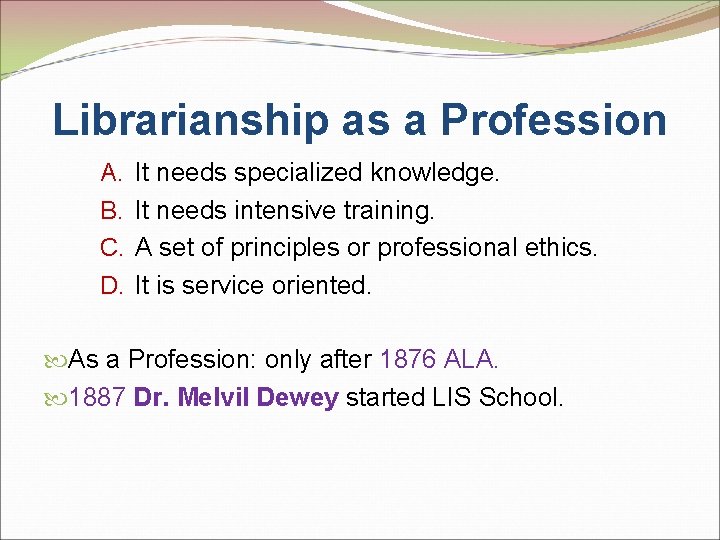
Librarianship as a Profession A. B. C. D. It needs specialized knowledge. It needs intensive training. A set of principles or professional ethics. It is service oriented. As a Profession: only after 1876 ALA. 1887 Dr. Melvil Dewey started LIS School.
- Slides: 41