
LIBERTY EQUALITY FRATERNITY French Revolution 1789 1799 The
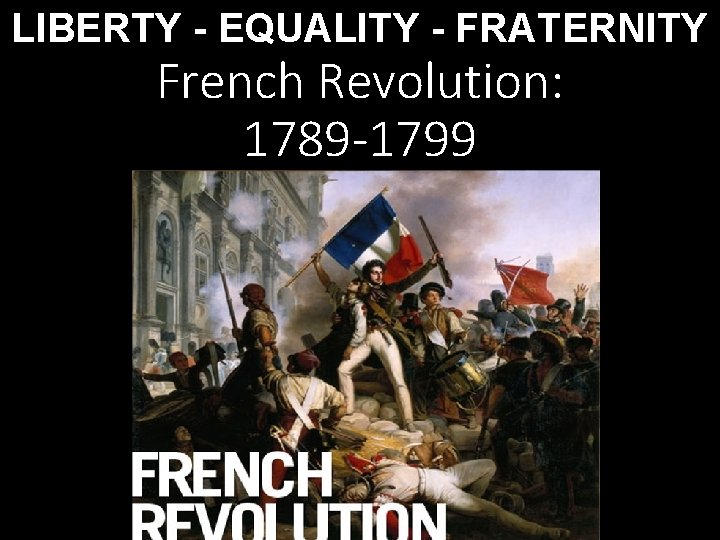
LIBERTY - EQUALITY - FRATERNITY French Revolution: 1789 -1799
The 4 Stages of the French Revolution • The Moderate Stage • The Reign of Terror • Reactionary Stage • The Napoleonic Stage LIBERTY - EQUALITY - FRATERNITY
The SAD situation in France • Law: The Parliament (local judges) tried cases for theft, murder. They responsible for fixing the price of bread. They were hated by everyone. • Finances: By 1789, France was bankrupt because of US Revolution. (National Debt) • The American Revolution / 7 Years War: served as a great lesson - tyranny could be challenged. • The Enlightenment attacked the established order together with authority of any kind, their ideas helped to produce what can only be called a revolutionary mentality
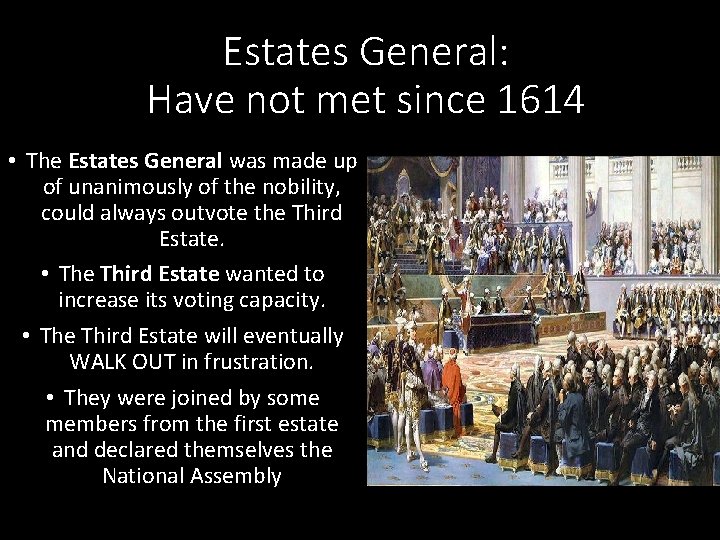
Estates General: Have not met since 1614 • The Estates General was made up of unanimously of the nobility, could always outvote the Third Estate. • The Third Estate wanted to increase its voting capacity. • The Third Estate will eventually WALK OUT in frustration. • They were joined by some members from the first estate and declared themselves the National Assembly
The National Assembly • They were fired up by Rousseau, ideas about social contracts and rights. • They met in a local tennis court when they were locked out of their typical meeting place. • They swore an oath not to disband until they had drawn up a new constitution for France: this is the famous Tennis Court Oath
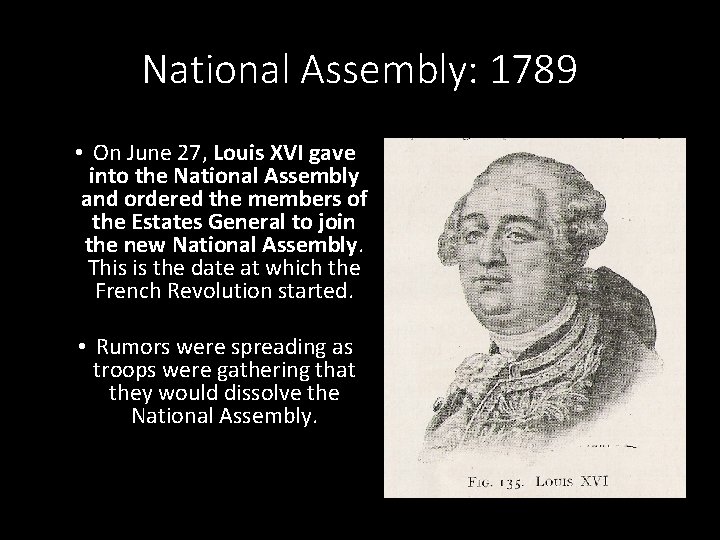
National Assembly: 1789 • On June 27, Louis XVI gave into the National Assembly and ordered the members of the Estates General to join the new National Assembly. This is the date at which the French Revolution started. • Rumors were spreading as troops were gathering that they would dissolve the National Assembly.
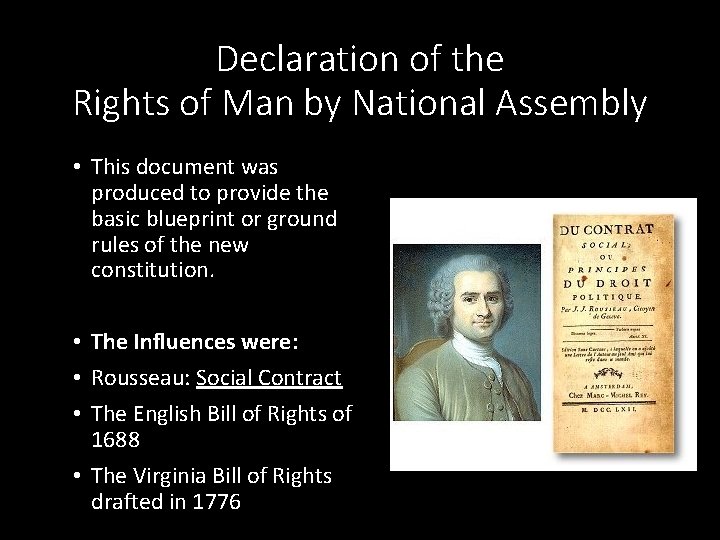
Declaration of the Rights of Man by National Assembly • This document was produced to provide the basic blueprint or ground rules of the new constitution. • The Influences were: • Rousseau: Social Contract • The English Bill of Rights of 1688 • The Virginia Bill of Rights drafted in 1776
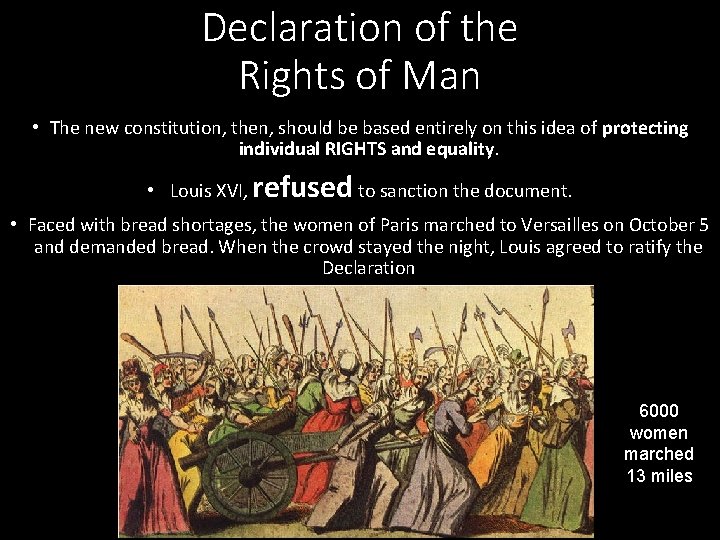
Declaration of the Rights of Man • The new constitution, then, should be based entirely on this idea of protecting individual RIGHTS and equality. • Louis XVI, refused to sanction the document. • Faced with bread shortages, the women of Paris marched to Versailles on October 5 and demanded bread. When the crowd stayed the night, Louis agreed to ratify the Declaration 6000 women marched 13 miles
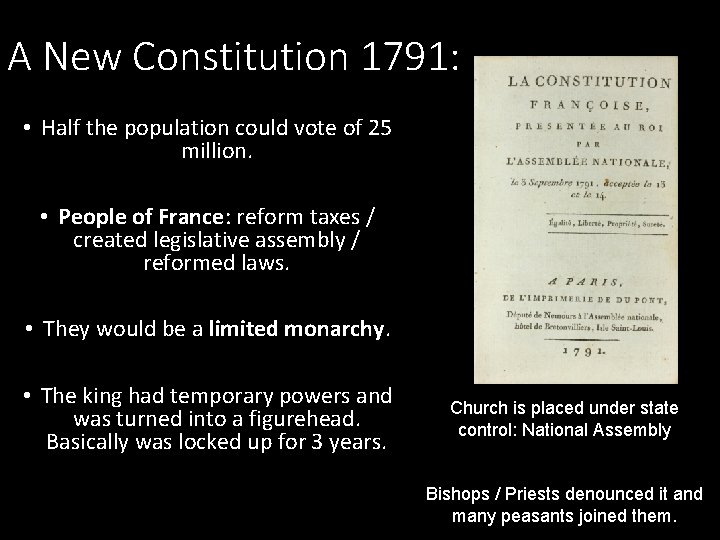
A New Constitution 1791: • Half the population could vote of 25 million. • People of France: reform taxes / created legislative assembly / reformed laws. • They would be a limited monarchy. • The king had temporary powers and was turned into a figurehead. Basically was locked up for 3 years. Church is placed under state control: National Assembly Bishops / Priests denounced it and many peasants joined them.
The 4 Stages of the French Revolution • The Moderate Stage • The Reign of Terror • Reactionary Stage • The Napoleonic Stage BLOCK OUT THE 1 ST and 2 ND ESTATE LIBERTY EQUALITY FRATERNITY
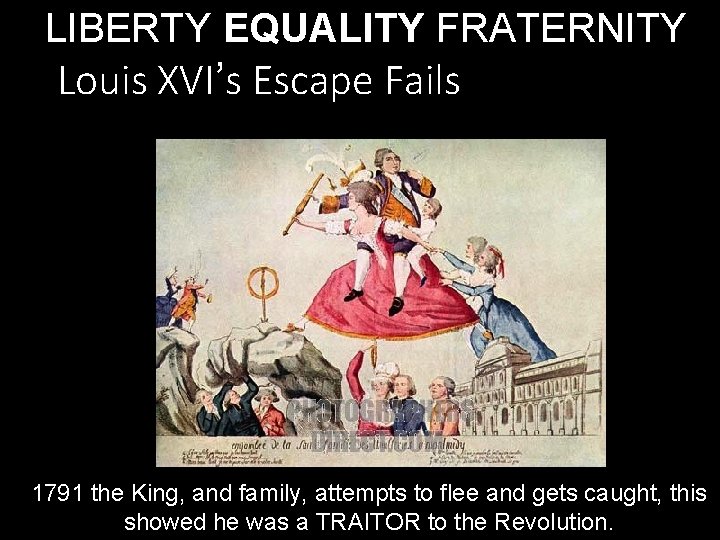
LIBERTY EQUALITY FRATERNITY Louis XVI’s Escape Fails 1791 the King, and family, attempts to flee and gets caught, this showed he was a TRAITOR to the Revolution.
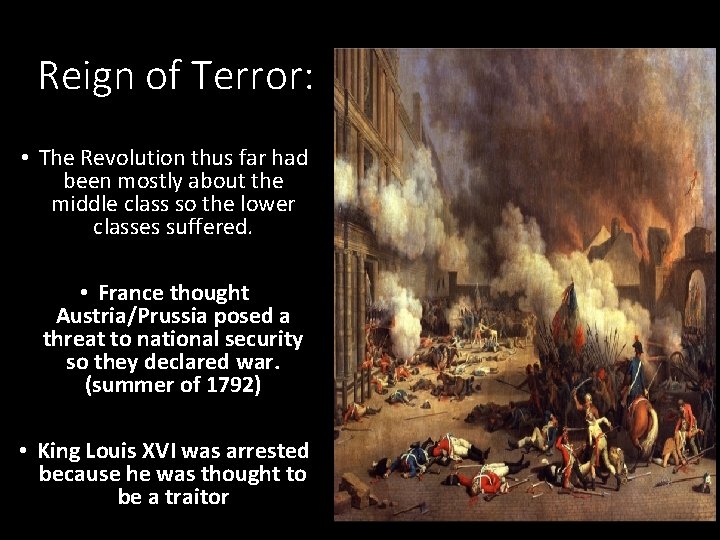
Reign of Terror: • The Revolution thus far had been mostly about the middle class so the lower classes suffered. • France thought Austria/Prussia posed a threat to national security so they declared war. (summer of 1792) • King Louis XVI was arrested because he was thought to be a traitor
Reign of Terror: 1792 • The Revolution was NOT universally accepted in France or in Europe. • Many Clergy and Nobles were fleeing France (Emigres), this was called the French Plague. Border patrols were increased and Catherine the Great burned Voltaire’s letters. • Enlightenment supporters were pleased
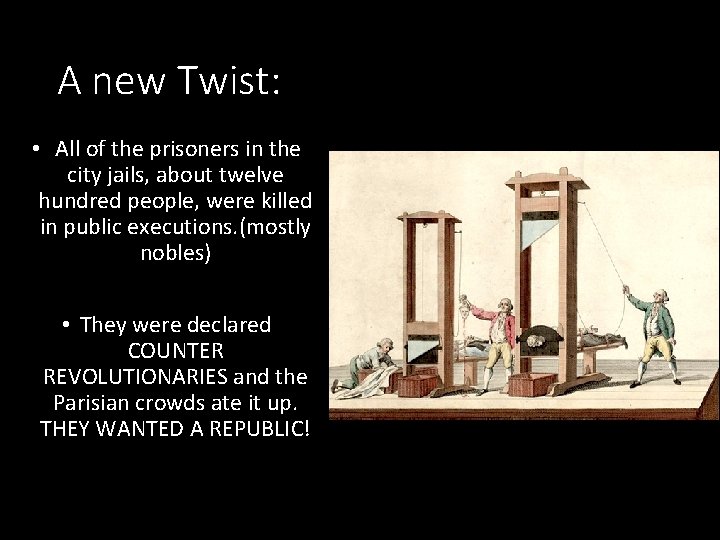
A new Twist: • All of the prisoners in the city jails, about twelve hundred people, were killed in public executions. (mostly nobles) • They were declared COUNTER REVOLUTIONARIES and the Parisian crowds ate it up. THEY WANTED A REPUBLIC!
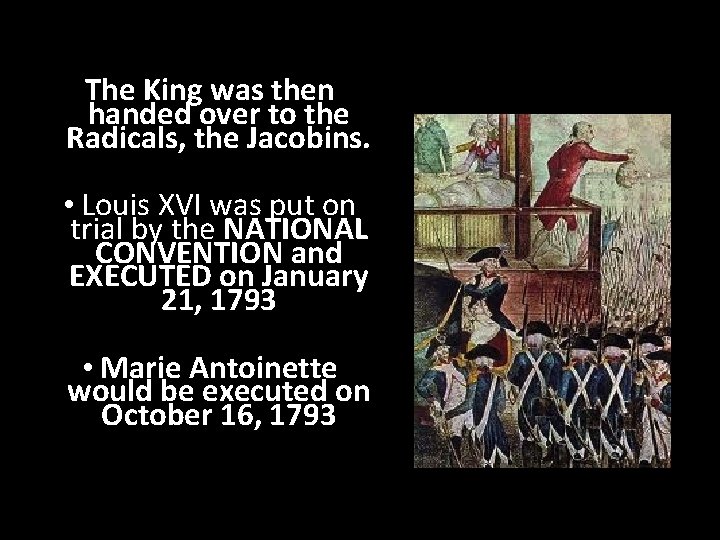
The King was then handed over to the Radicals, the Jacobins. • Louis XVI was put on trial by the NATIONAL CONVENTION and EXECUTED on January 21, 1793 • Marie Antoinette would be executed on October 16, 1793
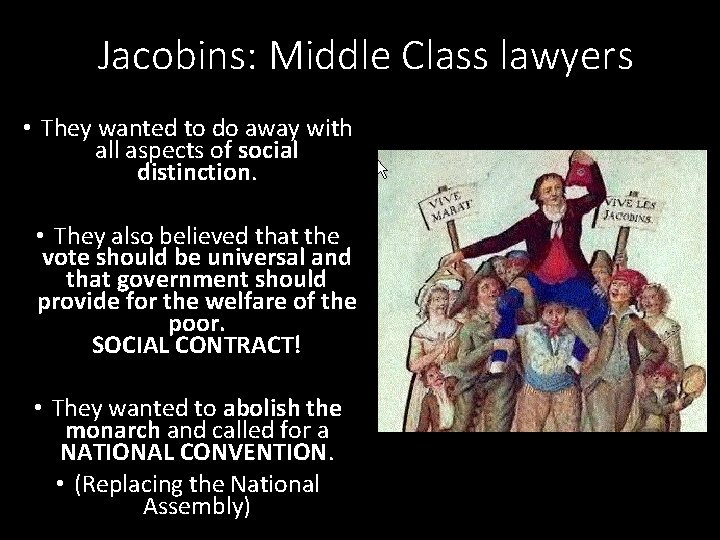
Jacobins: Middle Class lawyers • They wanted to do away with all aspects of social distinction. • They also believed that the vote should be universal and that government should provide for the welfare of the poor. SOCIAL CONTRACT! • They wanted to abolish the monarch and called for a NATIONAL CONVENTION. • (Replacing the National Assembly)
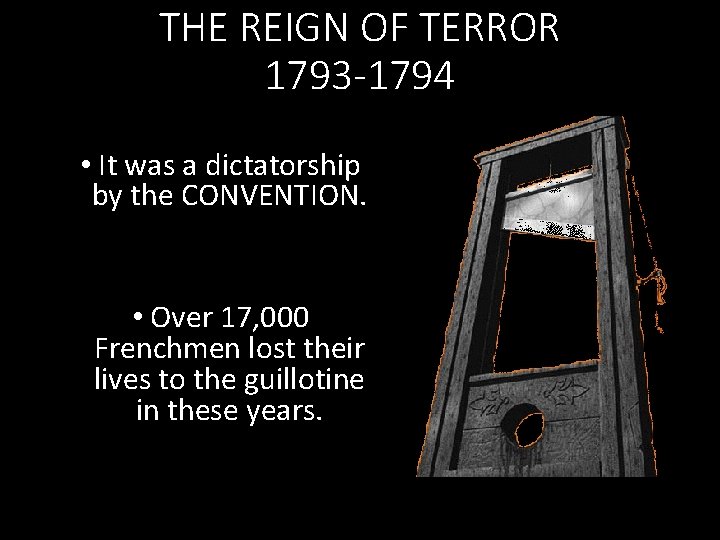
THE REIGN OF TERROR 1793 -1794 • It was a dictatorship by the CONVENTION. • Over 17, 000 Frenchmen lost their lives to the guillotine in these years.
The 4 Stages of the French Revolution • The Moderate Stage • The Reign of Terror • Reactionary Stage 1794 -1799 • The Napoleonic Stage
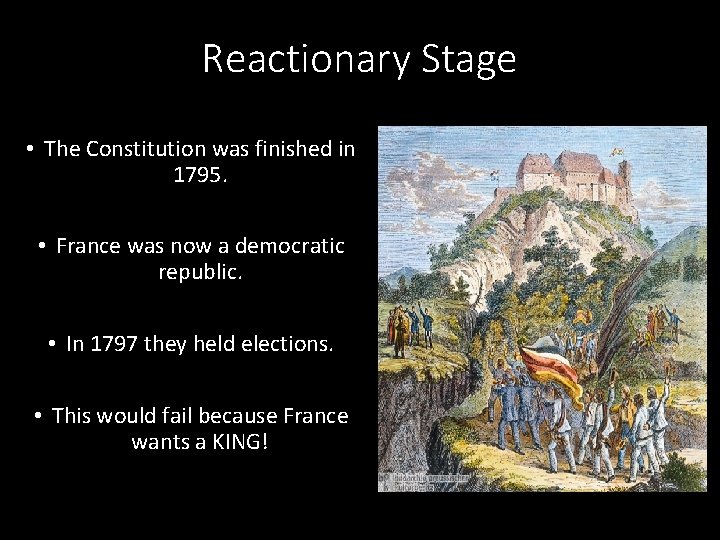
Reactionary Stage • The Constitution was finished in 1795. • France was now a democratic republic. • In 1797 they held elections. • This would fail because France wants a KING!
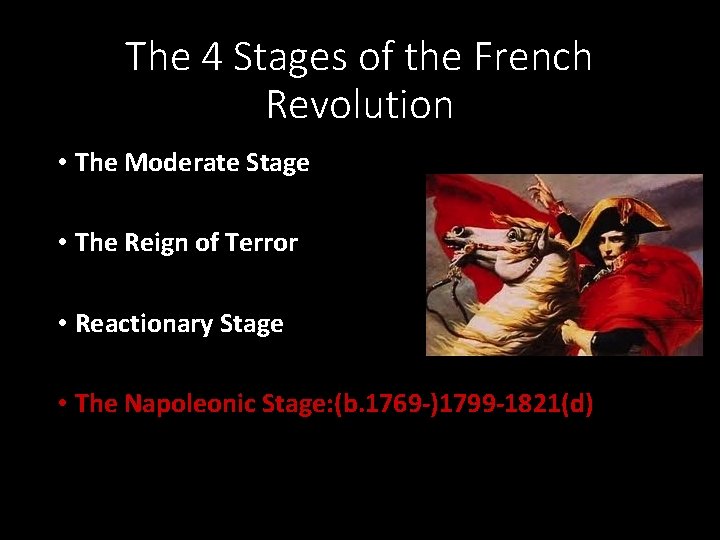
The 4 Stages of the French Revolution • The Moderate Stage • The Reign of Terror • Reactionary Stage • The Napoleonic Stage: (b. 1769 -)1799 -1821(d)
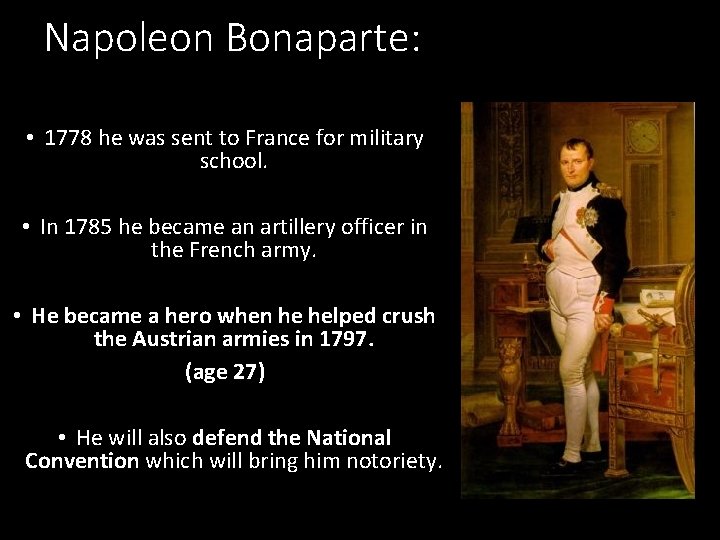
Napoleon Bonaparte: • 1778 he was sent to France for military school. • In 1785 he became an artillery officer in the French army. • He became a hero when he helped crush the Austrian armies in 1797. (age 27) • He will also defend the National Convention which will bring him notoriety.
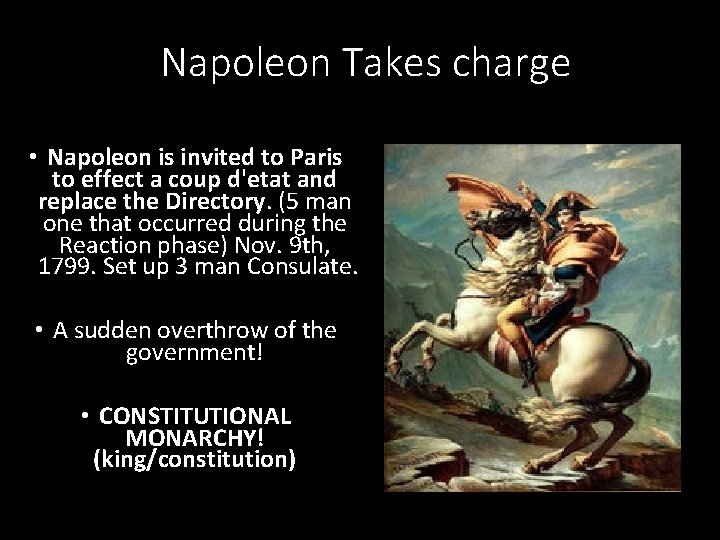
Napoleon Takes charge • Napoleon is invited to Paris to effect a coup d'etat and replace the Directory. (5 man one that occurred during the Reaction phase) Nov. 9 th, 1799. Set up 3 man Consulate. • A sudden overthrow of the government! • CONSTITUTIONAL MONARCHY! (king/constitution)
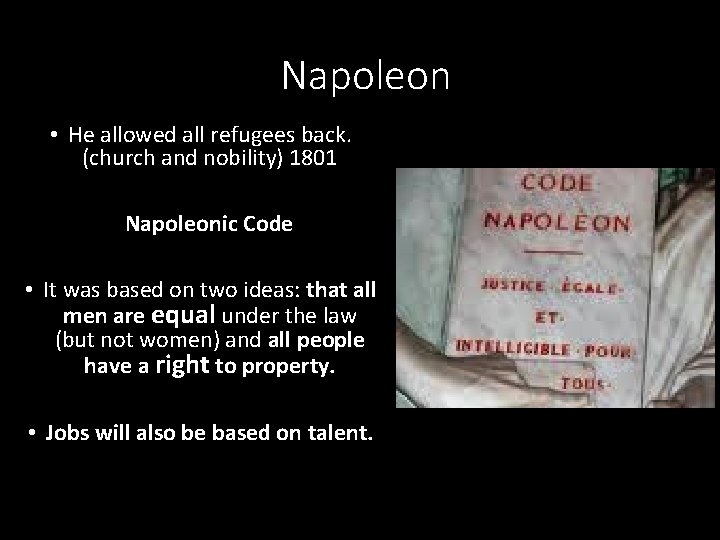
Napoleon • He allowed all refugees back. (church and nobility) 1801 Napoleonic Code • It was based on two ideas: that all men are equal under the law (but not women) and all people have a right to property. • Jobs will also be based on talent.
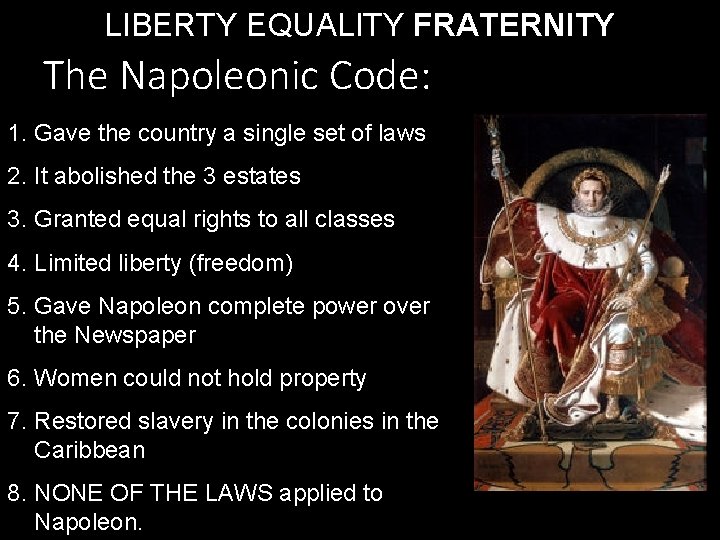
LIBERTY EQUALITY FRATERNITY The Napoleonic Code: 1. Gave the country a single set of laws 2. It abolished the 3 estates 3. Granted equal rights to all classes 4. Limited liberty (freedom) 5. Gave Napoleon complete power over the Newspaper 6. Women could not hold property 7. Restored slavery in the colonies in the Caribbean 8. NONE OF THE LAWS applied to Napoleon.
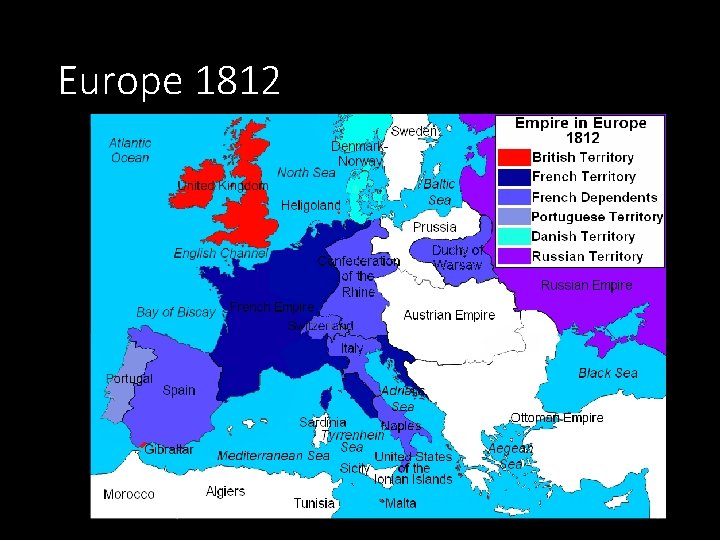
Europe 1812
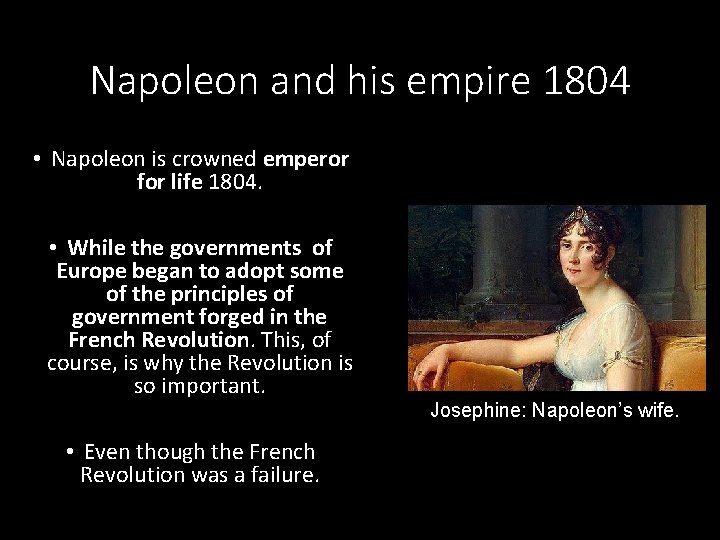
Napoleon and his empire 1804 • Napoleon is crowned emperor for life 1804. • While the governments of Europe began to adopt some of the principles of government forged in the French Revolution. This, of course, is why the Revolution is so important. • Even though the French Revolution was a failure. Josephine: Napoleon’s wife.
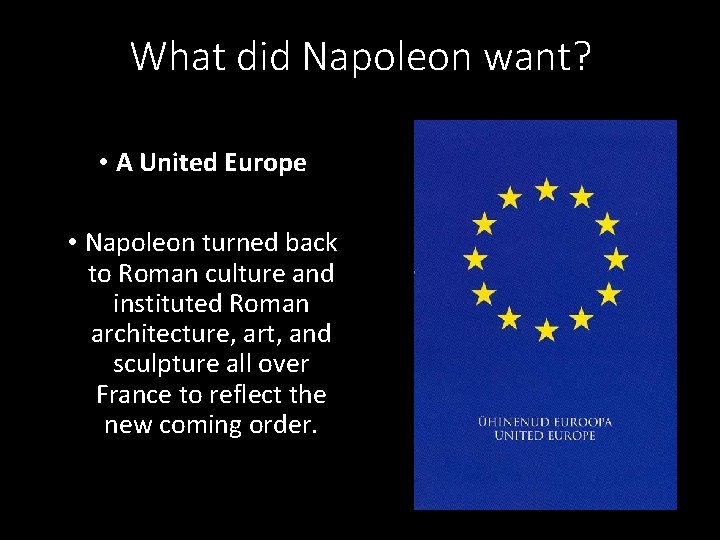
What did Napoleon want? • A United Europe • Napoleon turned back to Roman culture and instituted Roman architecture, art, and sculpture all over France to reflect the new coming order.
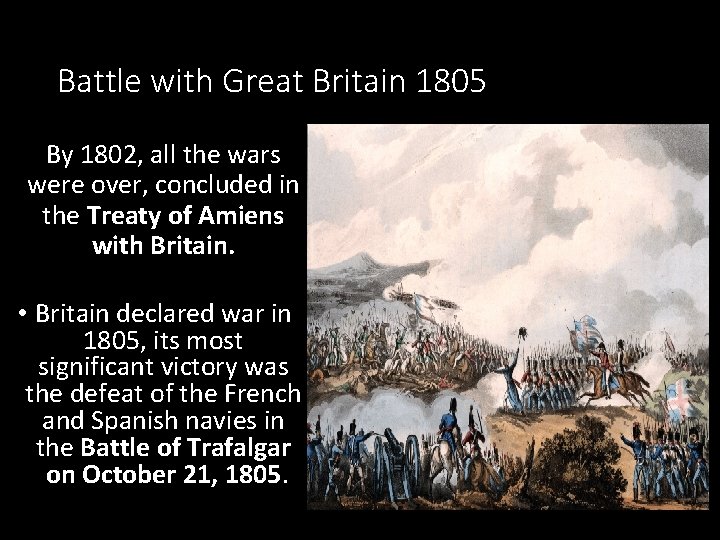
Battle with Great Britain 1805 By 1802, all the wars were over, concluded in the Treaty of Amiens with Britain. • Britain declared war in 1805, its most significant victory was the defeat of the French and Spanish navies in the Battle of Trafalgar on October 21, 1805.
Battle with Great Britain 1805 • This Battle will solidify Britain's dominance over world trade. • Napoleon tried to blockade all trading with Great Britain but smugglers still got goods through. • AKA: Continental System.
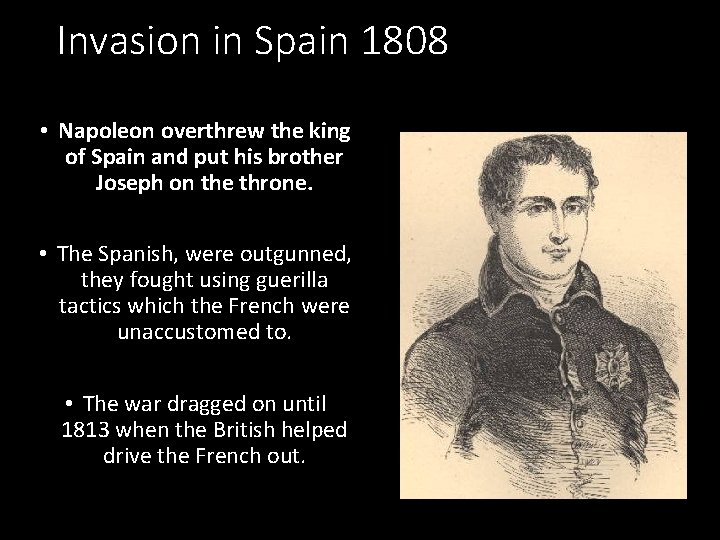
Invasion in Spain 1808 • Napoleon overthrew the king of Spain and put his brother Joseph on the throne. • The Spanish, were outgunned, they fought using guerilla tactics which the French were unaccustomed to. • The war dragged on until 1813 when the British helped drive the French out.
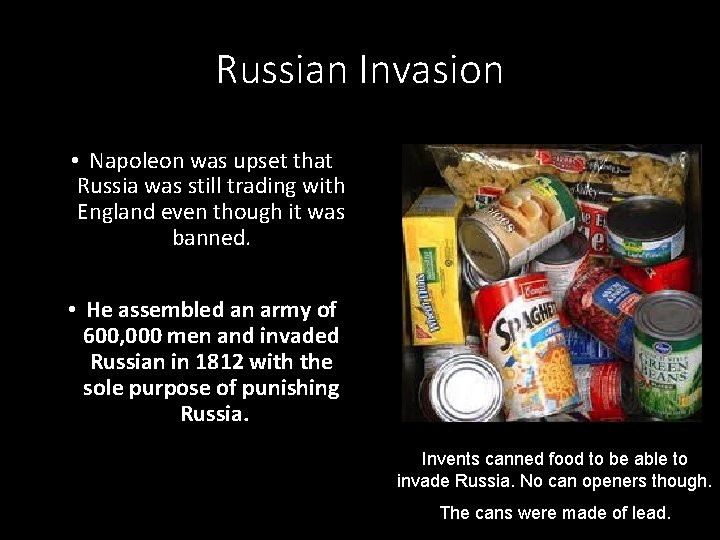
Russian Invasion • Napoleon was upset that Russia was still trading with England even though it was banned. • He assembled an army of 600, 000 men and invaded Russian in 1812 with the sole purpose of punishing Russia. Invents canned food to be able to invade Russia. No can openers though. The cans were made of lead.
• As he got closer to Russia the Russians retreated. • He reached the capital and burned it. • He will then go back to France but it is too late. • WINTER IS HERE.
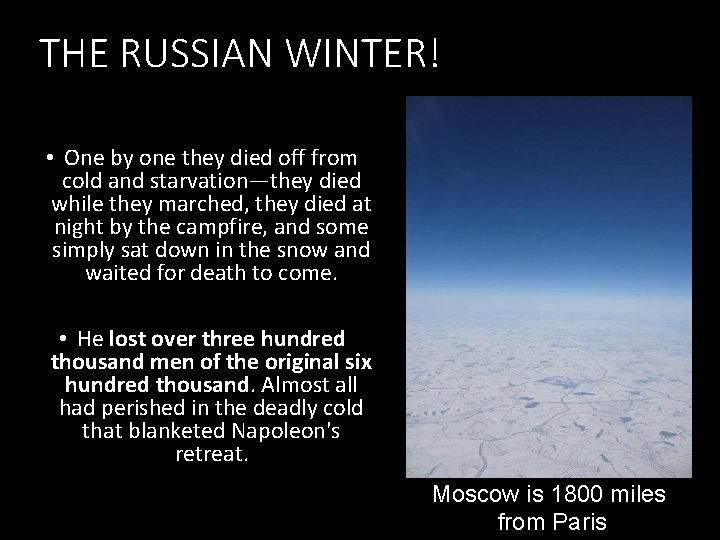
THE RUSSIAN WINTER! • One by one they died off from cold and starvation—they died while they marched, they died at night by the campfire, and some simply sat down in the snow and waited for death to come. • He lost over three hundred thousand men of the original six hundred thousand. Almost all had perished in the deadly cold that blanketed Napoleon's retreat. Moscow is 1800 miles from Paris
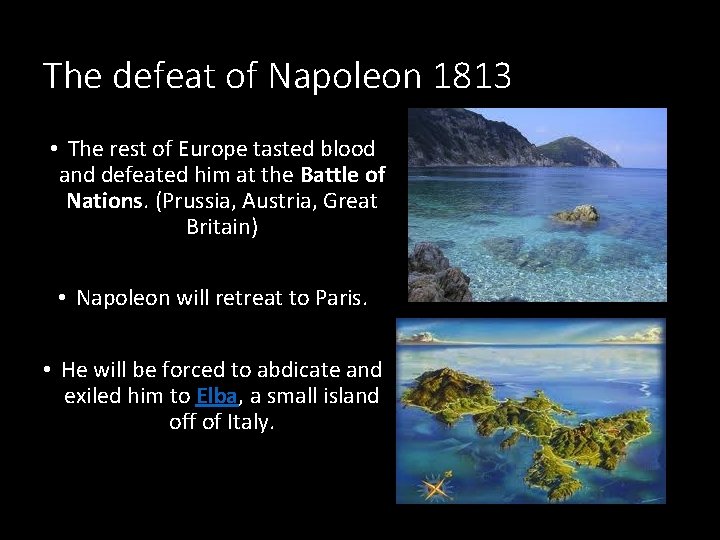
The defeat of Napoleon 1813 • The rest of Europe tasted blood and defeated him at the Battle of Nations. (Prussia, Austria, Great Britain) • Napoleon will retreat to Paris. • He will be forced to abdicate and exiled him to Elba, a small island off of Italy.
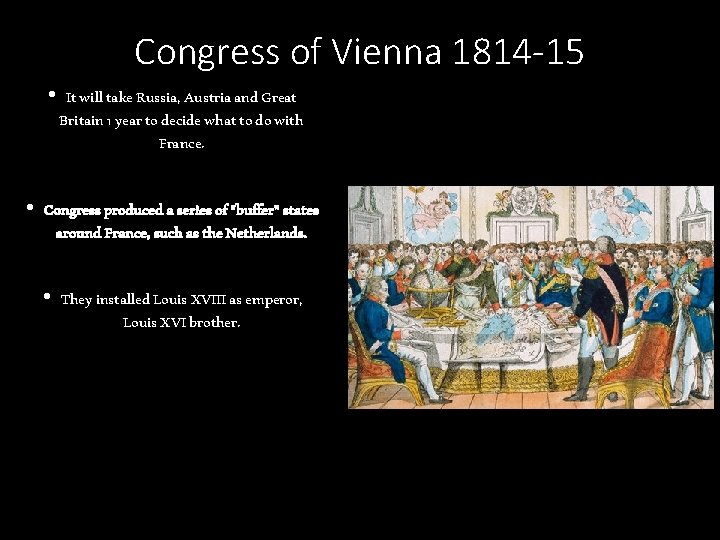
Congress of Vienna 1814 -15 • It will take Russia, Austria and Great Britain 1 year to decide what to do with France. • Congress produced a series of "buffer" states around France, such as the Netherlands. • They installed Louis XVIII as emperor, Louis XVI brother.
He’s BACK! March 1, 1815 • Napoleon breaks free from the island • Napoleon’s army was loyal and banned together for his last One hundred days before sent back into exile. • Battle of Waterloo is where Napoleon will attack Great Britain one more time.
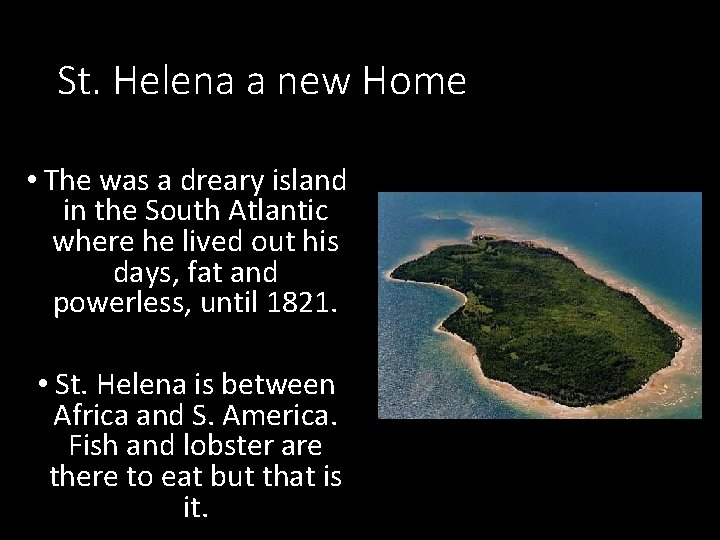
St. Helena a new Home • The was a dreary island in the South Atlantic where he lived out his days, fat and powerless, until 1821. • St. Helena is between Africa and S. America. Fish and lobster are there to eat but that is it.
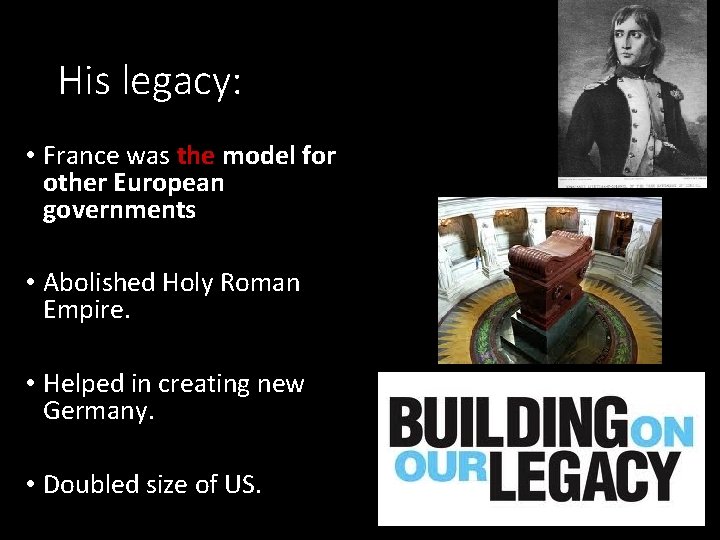
His legacy: • France was the model for other European governments • Abolished Holy Roman Empire. • Helped in creating new Germany. • Doubled size of US.
- Slides: 38