
Liberation Theologys influence on transformational development Gutierrez liberation
+ Liberation Theology’s influence on transformational development
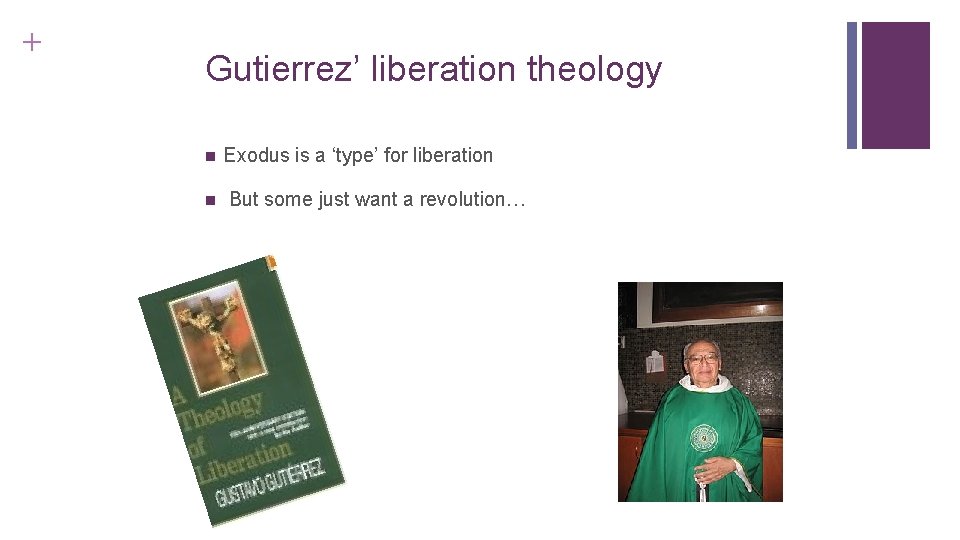
+ Gutierrez’ liberation theology n n Exodus is a ‘type’ for liberation But some just want a revolution…
+ What exactly is salvation for liberation theologians? n “The question regarding theological meaning of liberation is in truth, a question about the very meaning of Christianity and the mission of the church. ” n “We cannot separate the discourse about God from the historical process of liberation” n “The historical process in which Latin America has been involved, and the experiences of many Christians in this process, led liberation theology to speak of salvation in Christ in terms of liberation” n “The building of a just society…to participate in the process of liberation is already, in a certain sense, a salvific work. ” n “God is only known by doing justice” [that is, through a Marxist revolution]
+ Conversion for liberation theologians n “To be converted its to commit oneself to the process of the liberation of the poor and oppressed, to commit oneself lucidly, realistically and concretely. (p 205) n Question: Was the Philippian jailor really asking in Acts 16 “How can I overthrow the government? ”
+ “Preferential option for the poor” n “This is the context of a theme that is central in liberation theology and has now been widely accepted in the universal church: the preferential option for the poor. ” n “In face of the under developed countries, the church is, and wants to be, the church of all and especially the church of the poor” (September 11, 1962 - Pope John Paul 23) n “The poor deserve preference not because they are morally or religiously better than others, but because God is God, in whose eyes “the last are first. ” This statement clashes with our narrow understanding of justice, the very reference reminds us, therefore, that God’s ways are not ours” n “The whole climate of the gospel is a continual demand for the right of the poor to make themselves heard, to be considered preferentially by society”
+ Theological cause of poverty n “a breach of friendship with God and others- is according to the bible the ultimate cause of poverty, injustice, and the oppression in which persons live. ”
+ What liberation theologians mean by “solidarity” n Our communion with the prayer of Jesus…reaching a point of “agony” (Greek agonia) n To be a Christian is to accept and to live-in solidarity, in faith, hope and charity- the meaning that the word of the Lord and our encounter with that Word gave to the historical becoming of humankind on the way toward total communion. ”
+ Development, or Liberation? n “Liberation expresses the aspirations of oppressed peoples and social classes, emphasizing the conflictual aspect of the economic, social, and political process which puts them at odds with wealthy nations and oppressive classes. In contrast, the word development, and above all the policies characterized as developmentalist, appear somewhat aseptic, giving a false picture of a tragic and conflictual reality. ”
+ Liberation theology, Marxism and revolution n “The revolutionary situation which prevails today, especially in the Third World, is an expression of this growing radicalizaiton. To support the social revolution means to abolish the present status quo and to attempt to replace it with a qualitatively different one; it means to build a just society based on new relationships of production; it means to attempt to put an end to the domination of some countries by others, of some social classes by others, of some persons by others. ” n “The dynamics of the capitalist economy lead to the establishment of a center and a periphery, simultaneously generating progress and growing wealth for the few, and social imbalances, political tensions…” n “liberation form the domination exercised by the great capitalist countries and especially by the most powerful, the United States of America” n The problem is, while Marx predicted (falsely) that revolution would come from the poor rising up, those who speak of revolution in Liberation theology are not the poor- they are elite theologians
+ How do you reconcile liberation theology with…? n “you shall not be partial to a poor man in his lawsuit…you shall not pervert the justice due to your poor in his lawsuit” Ex 23: 3 n “You shall not do injustices in court…do not be partial to the poor or defer to the great” Lev 19: 15
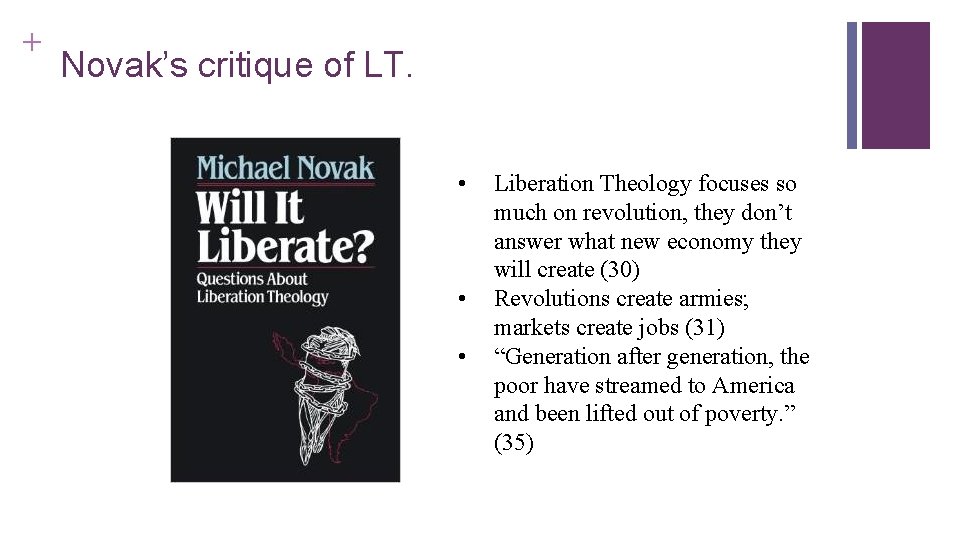
+ Novak’s critique of LT. • • • Liberation Theology focuses so much on revolution, they don’t answer what new economy they will create (30) Revolutions create armies; markets create jobs (31) “Generation after generation, the poor have streamed to America and been lifted out of poverty. ” (35)
+ But does it liberate? Premise A: “Our economy isn’t just” Premise B: “Our economy is capitalist” Therefore: “Liberation theologians are against Capitalism” Premise C: “The other economic system is socialism” Therefore: Liberation theologians recommend socialism We could challenge premise B. A is a given. But the real problem with liberation theology is that it erroneously called Latin American economics “Capitalist. ” They have been more feudal, or pre-capitalist The government owns 50 -60% of land (Novak, 28)
+ Novak’s criticisms n Who, historically, have had to be liberated most If often? The communists! n There are many causes of poverty, and Liberation theologians recognized only one (power differential, inequality) (24)
+ Summary n Liberation theology n Raised the consciousness of Christians regarding social action n But requires an un-conventional hermeneutic (redefining texts in terms of Marxist revolutions) n may encourage economic policies that hurt the people it claims to help n Advocates a revolution but doesn’t describe the revolution

+ End of lecture
- Slides: 15