
Liaison Psychiatry Through The Ages An Interactive Expert




- Slides: 57
Liaison Psychiatry Through The Ages An Interactive Expert Panel Workshop With special thanks to Dr Matthew Cahill for his contributions
Our Experts…… Dr Consultant Liaison Psychiatrist
Our Experts…… Dr Consultant Liaison Psychiatrist
Our Experts…… Dr Consultant Liaison Psychiatrist CAMHS
Our Experts…… Dr Consultant Liaison Psychiatrist Older Adults
Four Groups: Patient Mother / Partner Psychiatrist Medic You may want to write some bullet points down to keep track of history!
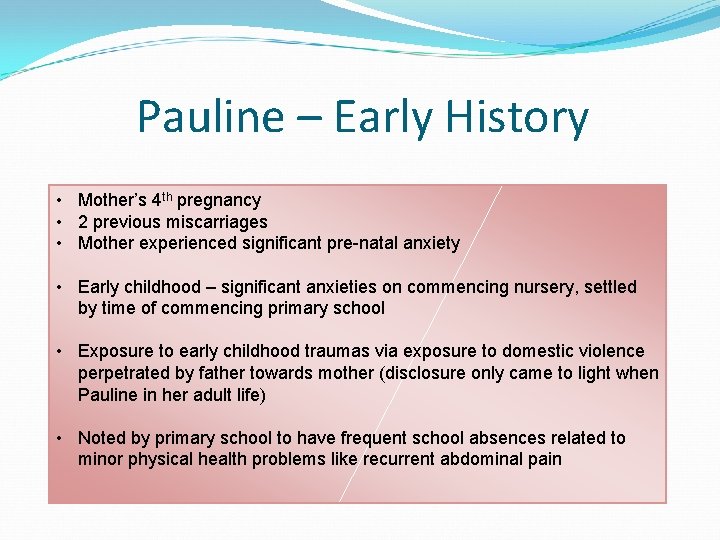
Pauline – Early History • Mother’s 4 th pregnancy • 2 previous miscarriages • Mother experienced significant pre-natal anxiety • Early childhood – significant anxieties on commencing nursery, settled by time of commencing primary school • Exposure to early childhood traumas via exposure to domestic violence perpetrated by father towards mother (disclosure only came to light when Pauline in her adult life) • Noted by primary school to have frequent school absences related to minor physical health problems like recurrent abdominal pain
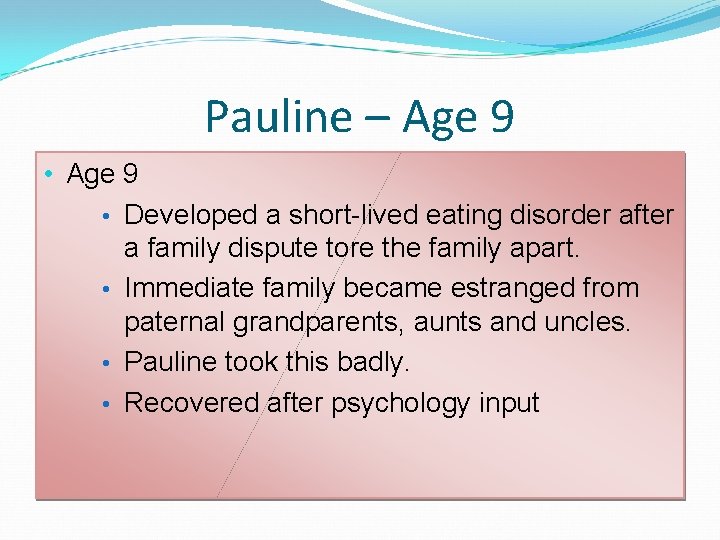
Pauline – Age 9 • Developed a short-lived eating disorder after a family dispute tore the family apart. • Immediate family became estranged from paternal grandparents, aunts and uncles. • Pauline took this badly. • Recovered after psychology input
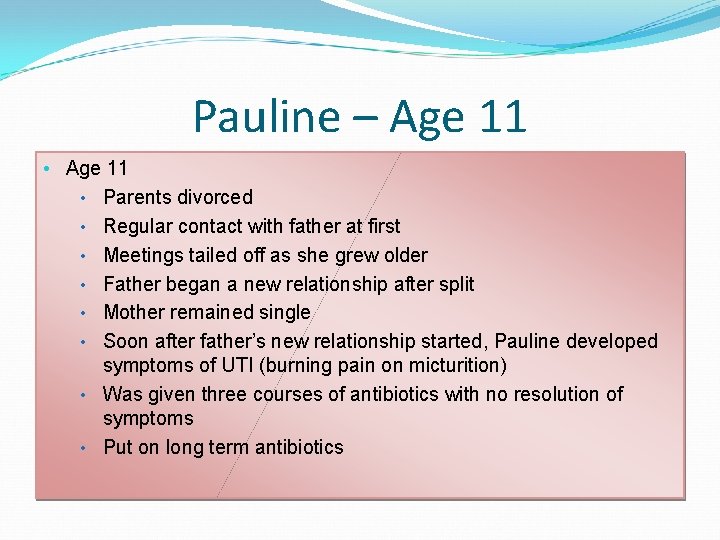
Pauline – Age 11 • Parents divorced • Regular contact with father at first • Meetings tailed off as she grew older • Father began a new relationship after split • Mother remained single • Soon after father’s new relationship started, Pauline developed symptoms of UTI (burning pain on micturition) • Was given three courses of antibiotics with no resolution of symptoms • Put on long term antibiotics
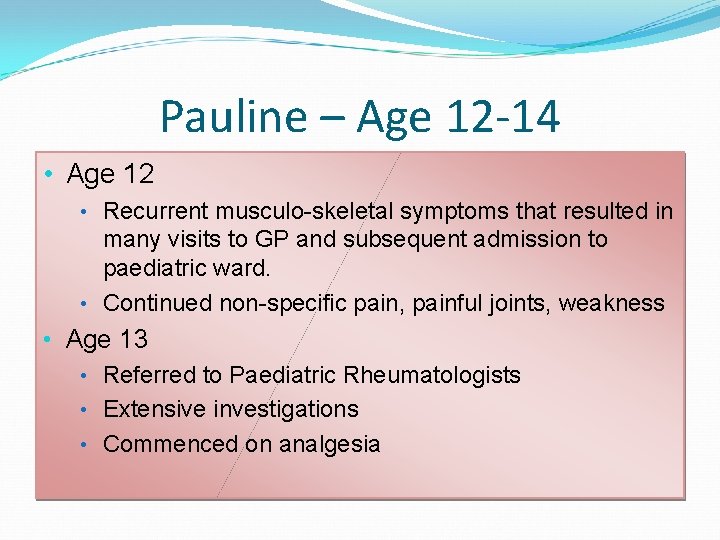
Pauline – Age 12 -14 • Age 12 • Recurrent musculo-skeletal symptoms that resulted in many visits to GP and subsequent admission to paediatric ward. • Continued non-specific pain, painful joints, weakness • Age 13 • Referred to Paediatric Rheumatologists • Extensive investigations • Commenced on analgesia
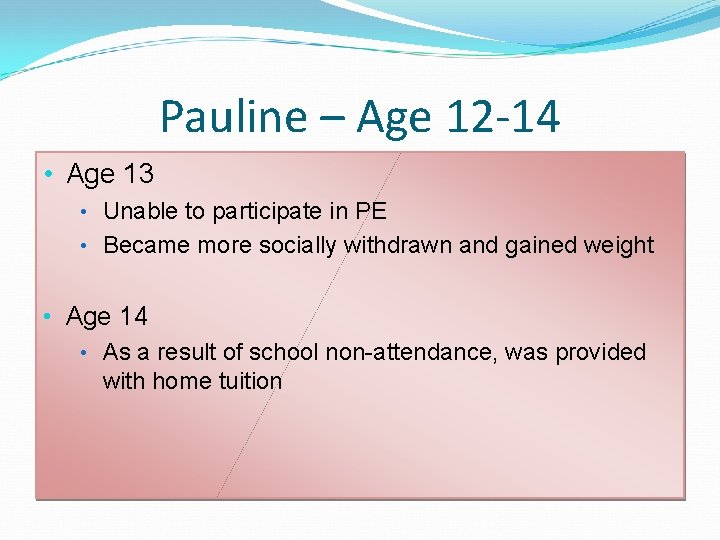
Pauline – Age 12 -14 • Age 13 • Unable to participate in PE • Became more socially withdrawn and gained weight • Age 14 • As a result of school non-attendance, was provided with home tuition
Workshop EXERCISE 1 What are your thoughts so far? What are your current worries and concerns? What more information do you need? What would you like to see happen next?
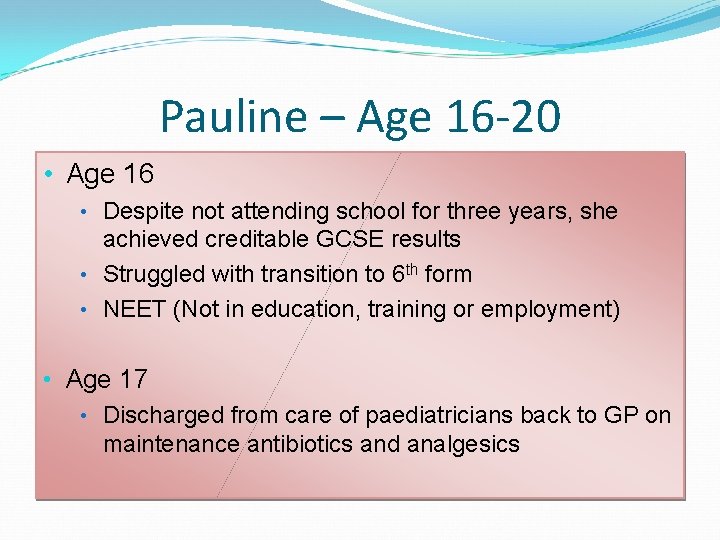
Pauline – Age 16 -20 • Age 16 • Despite not attending school for three years, she achieved creditable GCSE results • Struggled with transition to 6 th form • NEET (Not in education, training or employment) • Age 17 • Discharged from care of paediatricians back to GP on maintenance antibiotics and analgesics
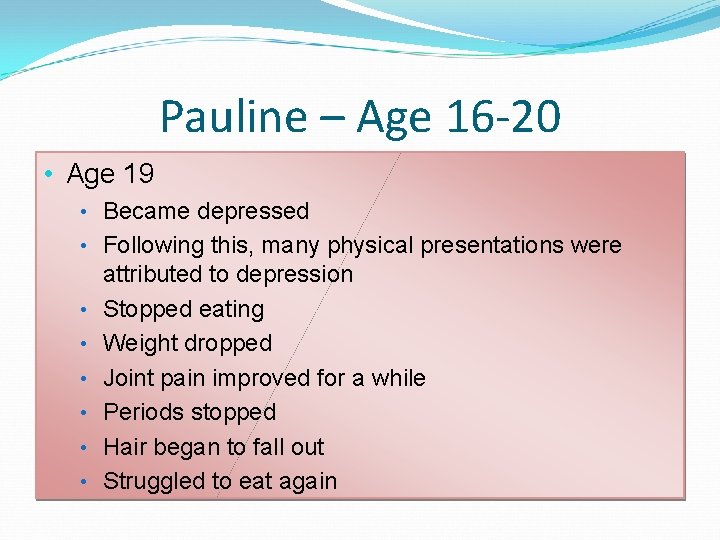
Pauline – Age 16 -20 • Age 19 • Became depressed • Following this, many physical presentations were • • • attributed to depression Stopped eating Weight dropped Joint pain improved for a while Periods stopped Hair began to fall out Struggled to eat again
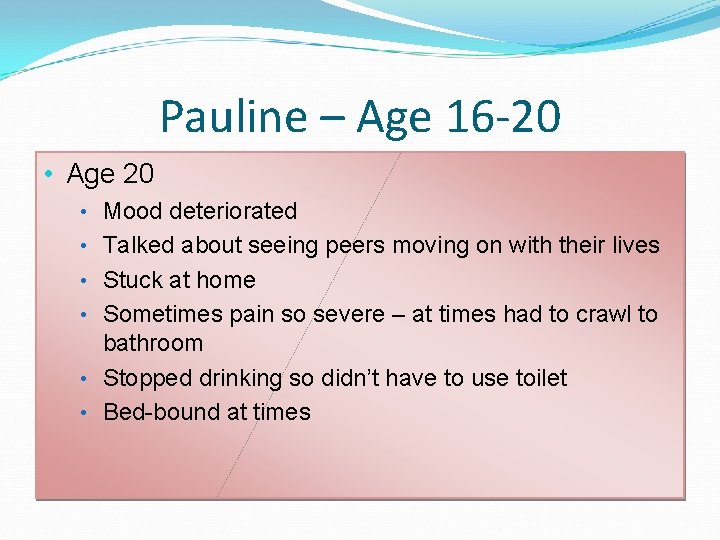
Pauline – Age 16 -20 • Age 20 • Mood deteriorated • Talked about seeing peers moving on with their lives • Stuck at home • Sometimes pain so severe – at times had to crawl to bathroom • Stopped drinking so didn’t have to use toilet • Bed-bound at times
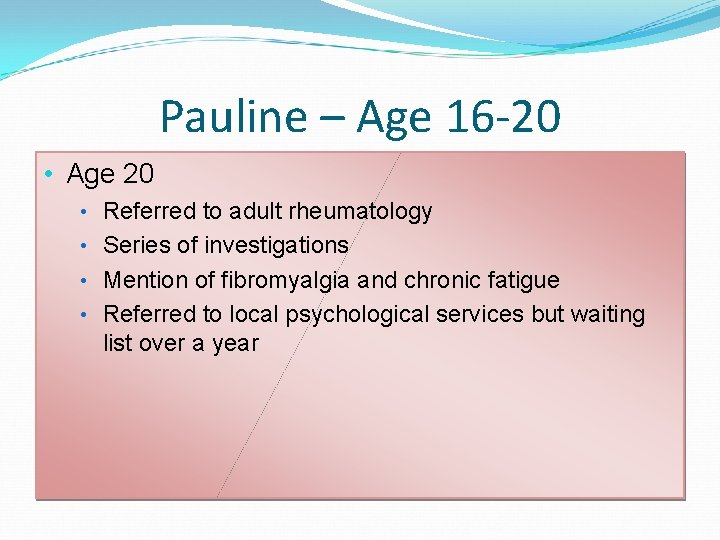
Pauline – Age 16 -20 • Age 20 • Referred to adult rheumatology • Series of investigations • Mention of fibromyalgia and chronic fatigue • Referred to local psychological services but waiting list over a year
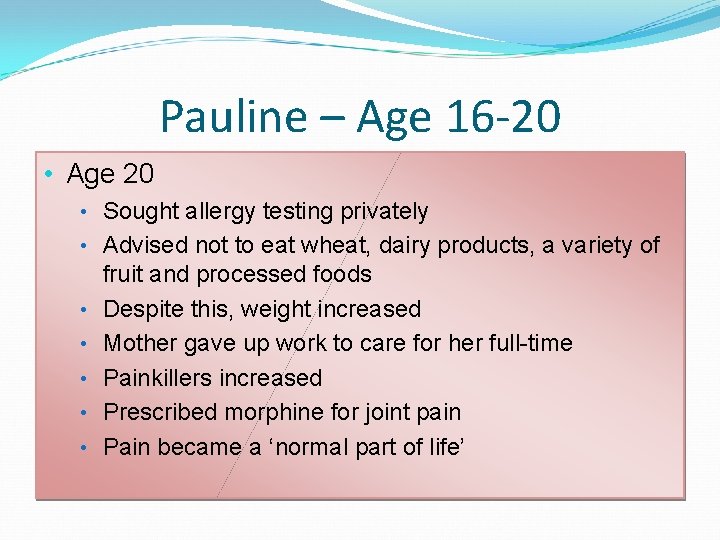
Pauline – Age 16 -20 • Age 20 • Sought allergy testing privately • Advised not to eat wheat, dairy products, a variety of • • • fruit and processed foods Despite this, weight increased Mother gave up work to care for her full-time Painkillers increased Prescribed morphine for joint pain Pain became a ‘normal part of life’
Workshop EXERCISE 2 What are your thoughts so far? What are your current worries and concerns? What more information do you need? What would you like to see happen next? What are the potential risks going forward?
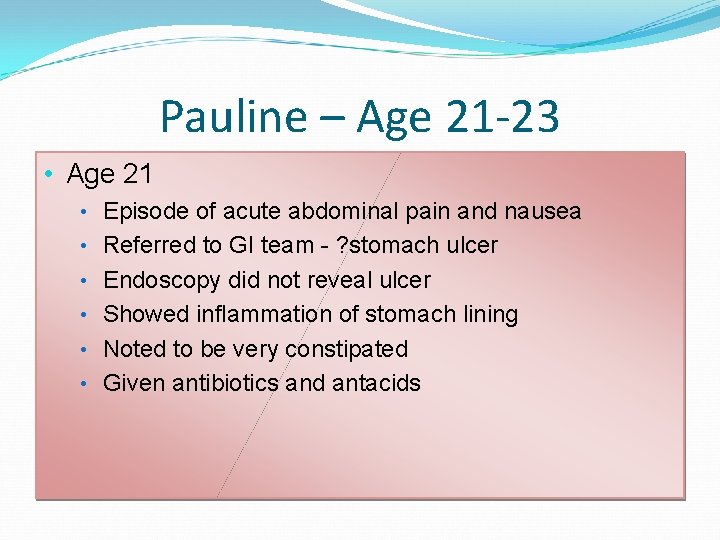
Pauline – Age 21 -23 • Age 21 • Episode of acute abdominal pain and nausea • Referred to GI team - ? stomach ulcer • Endoscopy did not reveal ulcer • Showed inflammation of stomach lining • Noted to be very constipated • Given antibiotics and antacids
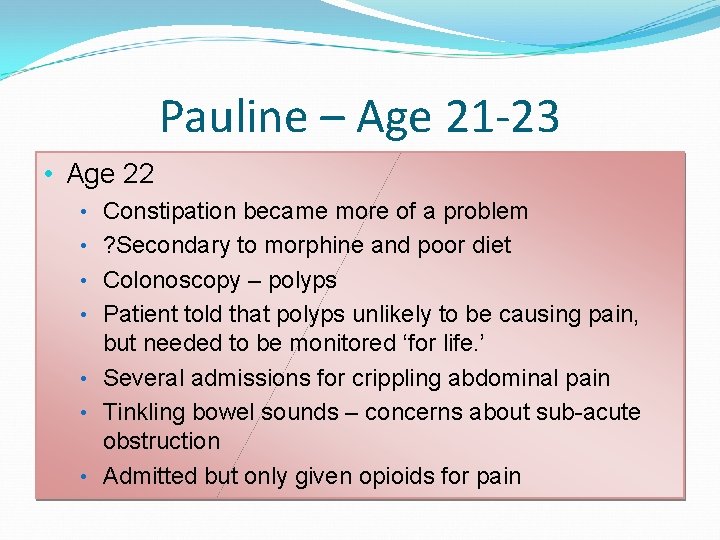
Pauline – Age 21 -23 • Age 22 • Constipation became more of a problem • ? Secondary to morphine and poor diet • Colonoscopy – polyps • Patient told that polyps unlikely to be causing pain, but needed to be monitored ‘for life. ’ • Several admissions for crippling abdominal pain • Tinkling bowel sounds – concerns about sub-acute obstruction • Admitted but only given opioids for pain
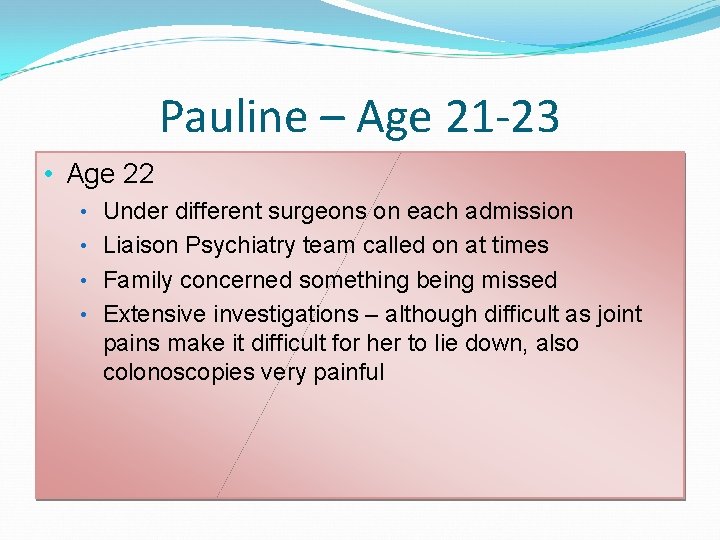
Pauline – Age 21 -23 • Age 22 • Under different surgeons on each admission • Liaison Psychiatry team called on at times • Family concerned something being missed • Extensive investigations – although difficult as joint pains make it difficult for her to lie down, also colonoscopies very painful
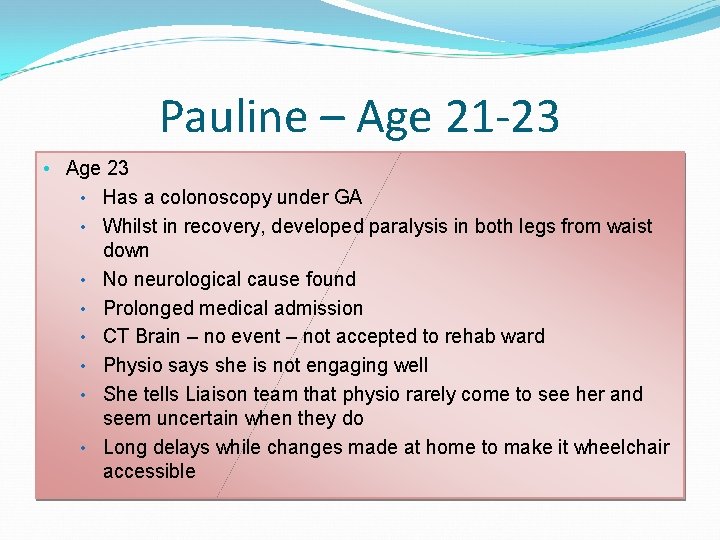
Pauline – Age 21 -23 • Age 23 • Has a colonoscopy under GA • Whilst in recovery, developed paralysis in both legs from waist down • No neurological cause found • Prolonged medical admission • CT Brain – no event – not accepted to rehab ward • Physio says she is not engaging well • She tells Liaison team that physio rarely come to see her and seem uncertain when they do • Long delays while changes made at home to make it wheelchair accessible
Workshop EXERCISE 3 What are your main difficulties at the moment? How do you feel about everything at this point? How do you feel about the other people involved in this case (including Pauline)?
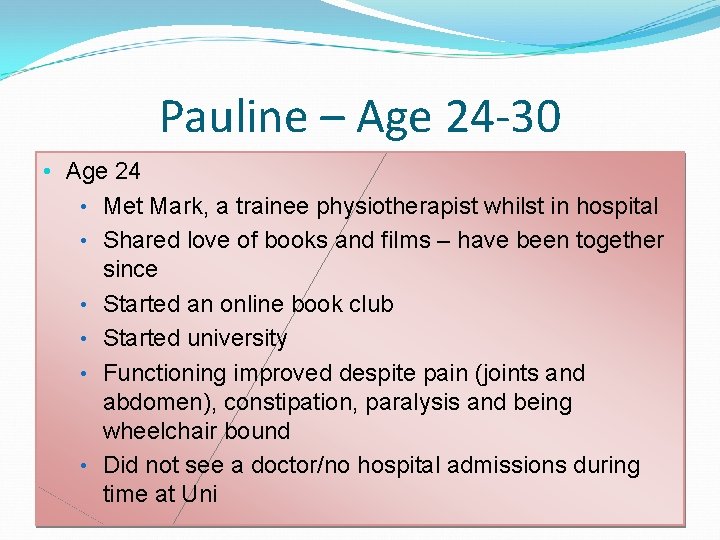
Pauline – Age 24 -30 • Age 24 • Met Mark, a trainee physiotherapist whilst in hospital • Shared love of books and films – have been together since • Started an online book club • Started university • Functioning improved despite pain (joints and abdomen), constipation, paralysis and being wheelchair bound • Did not see a doctor/no hospital admissions during time at Uni
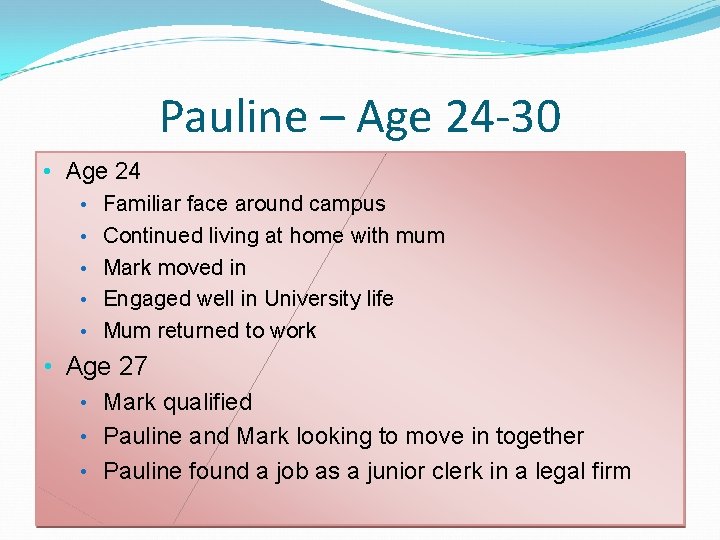
Pauline – Age 24 -30 • Age 24 • Familiar face around campus • Continued living at home with mum • Mark moved in • Engaged well in University life • Mum returned to work • Age 27 • Mark qualified • Pauline and Mark looking to move in together • Pauline found a job as a junior clerk in a legal firm
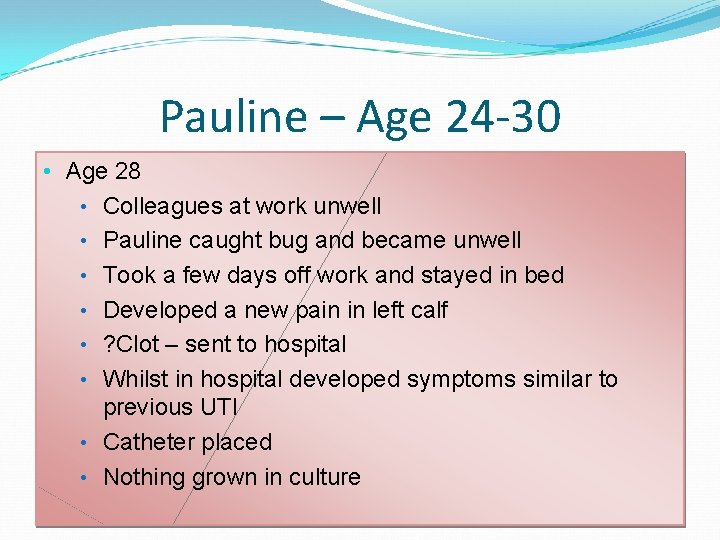
Pauline – Age 24 -30 • Age 28 • Colleagues at work unwell • Pauline caught bug and became unwell • Took a few days off work and stayed in bed • Developed a new pain in left calf • ? Clot – sent to hospital • Whilst in hospital developed symptoms similar to previous UTI • Catheter placed • Nothing grown in culture
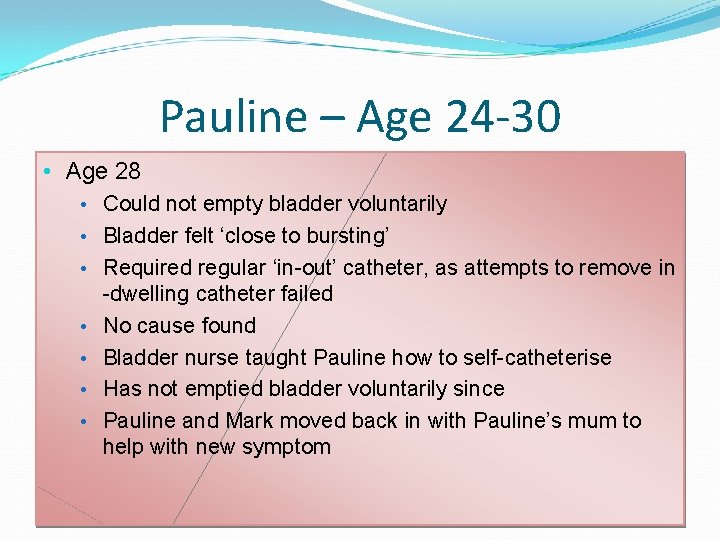
Pauline – Age 24 -30 • Age 28 • Could not empty bladder voluntarily • Bladder felt ‘close to bursting’ • Required regular ‘in-out’ catheter, as attempts to remove in • • -dwelling catheter failed No cause found Bladder nurse taught Pauline how to self-catheterise Has not emptied bladder voluntarily since Pauline and Mark moved back in with Pauline’s mum to help with new symptom
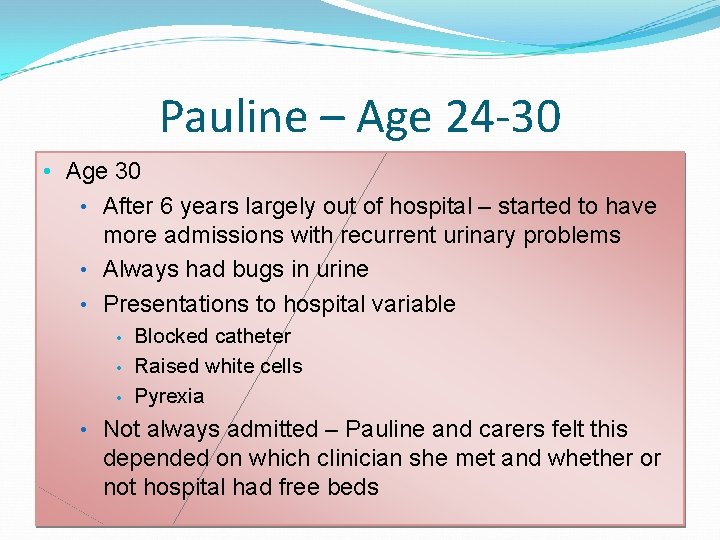
Pauline – Age 24 -30 • Age 30 • After 6 years largely out of hospital – started to have more admissions with recurrent urinary problems • Always had bugs in urine • Presentations to hospital variable • • • Blocked catheter Raised white cells Pyrexia • Not always admitted – Pauline and carers felt this depended on which clinician she met and whether or not hospital had free beds
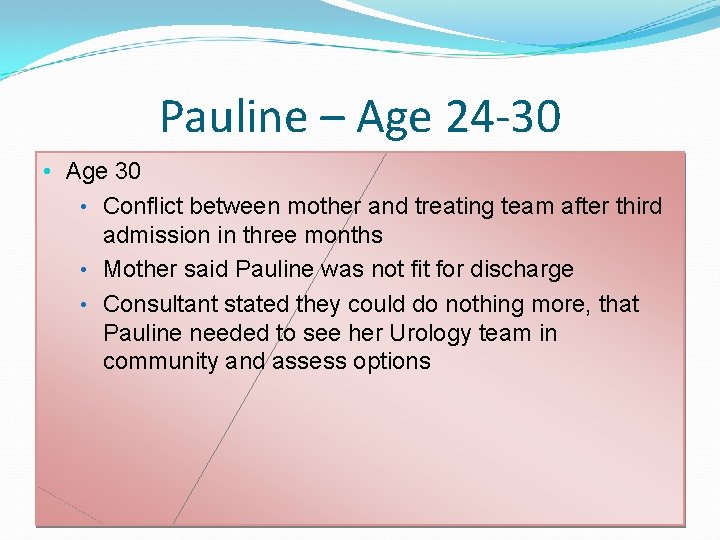
Pauline – Age 24 -30 • Age 30 • Conflict between mother and treating team after third admission in three months • Mother said Pauline was not fit for discharge • Consultant stated they could do nothing more, that Pauline needed to see her Urology team in community and assess options
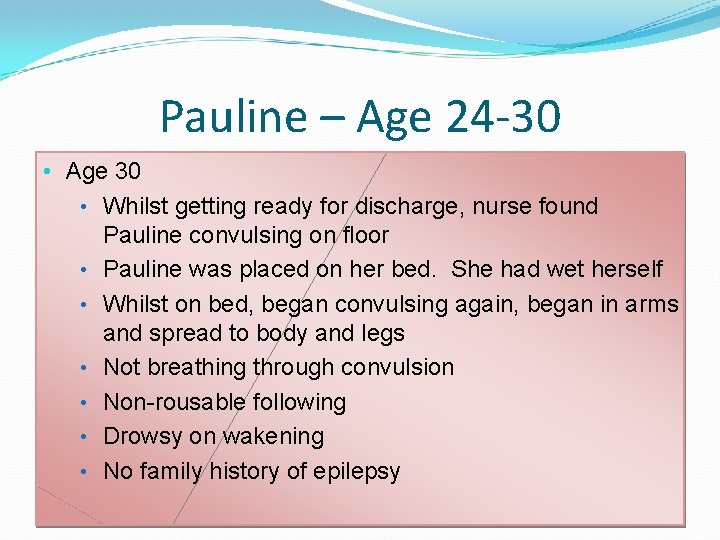
Pauline – Age 24 -30 • Age 30 • Whilst getting ready for discharge, nurse found Pauline convulsing on floor • Pauline was placed on her bed. She had wet herself • Whilst on bed, began convulsing again, began in arms and spread to body and legs • Not breathing through convulsion • Non-rousable following • Drowsy on wakening • No family history of epilepsy
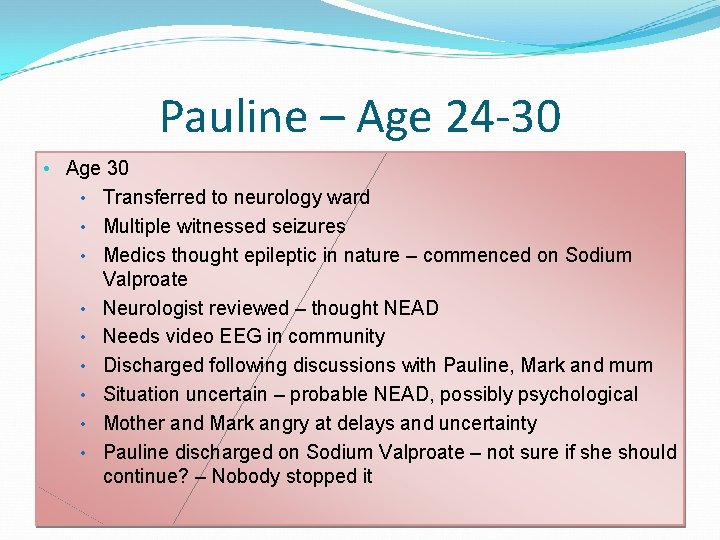
Pauline – Age 24 -30 • Age 30 • Transferred to neurology ward • Multiple witnessed seizures • Medics thought epileptic in nature – commenced on Sodium Valproate • Neurologist reviewed – thought NEAD • Needs video EEG in community • Discharged following discussions with Pauline, Mark and mum • Situation uncertain – probable NEAD, possibly psychological • Mother and Mark angry at delays and uncertainty • Pauline discharged on Sodium Valproate – not sure if she should continue? – Nobody stopped it
Workshop EXERCISE 4 What are the current challenges you are facing? Can you think of anything you can do to help the situation? What do you think are the main difficulties at the moment?
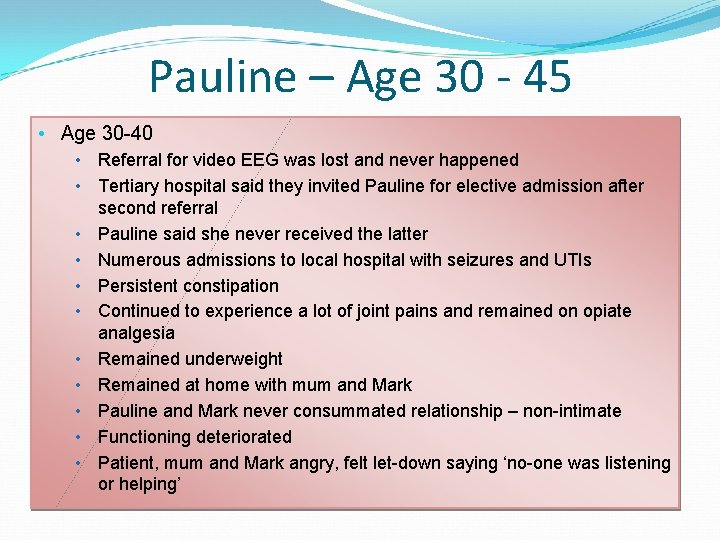
Pauline – Age 30 - 45 • Age 30 -40 • • • Referral for video EEG was lost and never happened Tertiary hospital said they invited Pauline for elective admission after second referral Pauline said she never received the latter Numerous admissions to local hospital with seizures and UTIs Persistent constipation Continued to experience a lot of joint pains and remained on opiate analgesia Remained underweight Remained at home with mum and Mark Pauline and Mark never consummated relationship – non-intimate Functioning deteriorated Patient, mum and Mark angry, felt let-down saying ‘no-one was listening or helping’
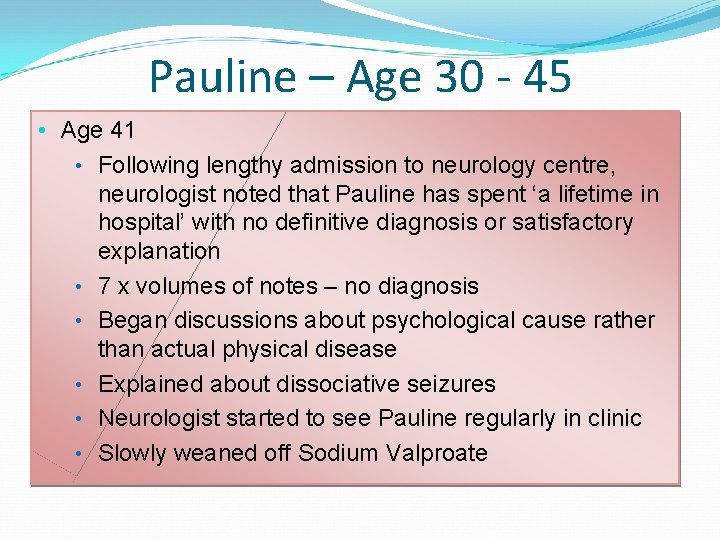
Pauline – Age 30 - 45 • Age 41 • Following lengthy admission to neurology centre, neurologist noted that Pauline has spent ‘a lifetime in hospital’ with no definitive diagnosis or satisfactory explanation • 7 x volumes of notes – no diagnosis • Began discussions about psychological cause rather than actual physical disease • Explained about dissociative seizures • Neurologist started to see Pauline regularly in clinic • Slowly weaned off Sodium Valproate
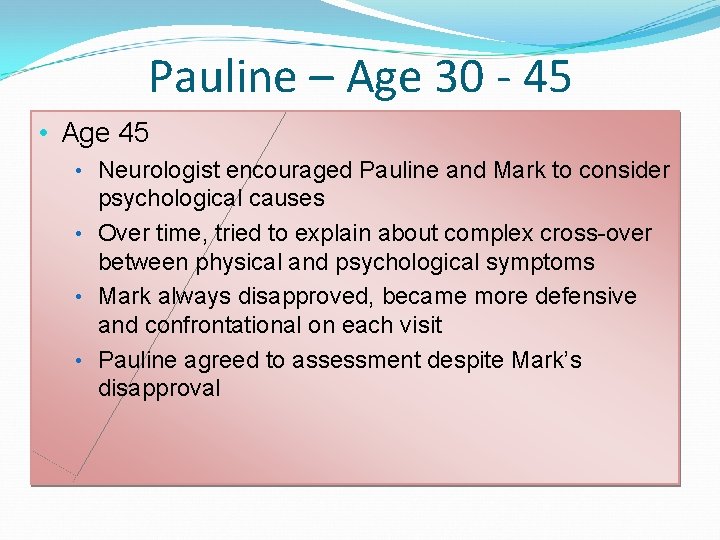
Pauline – Age 30 - 45 • Age 45 • Neurologist encouraged Pauline and Mark to consider psychological causes • Over time, tried to explain about complex cross-over between physical and psychological symptoms • Mark always disapproved, became more defensive and confrontational on each visit • Pauline agreed to assessment despite Mark’s disapproval
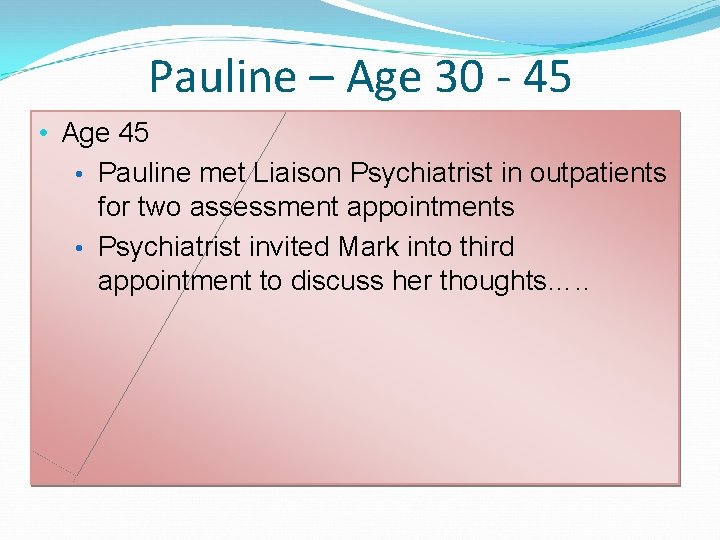
Pauline – Age 30 - 45 • Age 45 • Pauline met Liaison Psychiatrist in outpatients for two assessment appointments • Psychiatrist invited Mark into third appointment to discuss her thoughts…. .
Role-Play! EXERCISE 5 What parts of the discussion went well? What didn’t go so well? What was difficult? What did you notice about communication and the different roles being played out?
Pauline – Age 45 -50 • During psychiatry input, Pauline accepted possibility that stress made seizures worse • Fewer hospital visits but continued to experience chronic pain and fatigue • Remained on opiate analgesia • Got on well with support worker • Linked in with local women’s group • Started on online petition for wheelchair access to local resources
Pauline – Age 45 -50 • Age 47 • Started on antidepressant • Agreed to see team psychologist • Revealed domestic violence she had witnessed • Later, also hinted at sexual abuse from father • Continued to describe medical care over the years as inconsistent, inadequate and driven by financial restrictions • Although spoke highly of neurologist and CMHT • Resisted attempts to reduce her opiates, but other medications were slowly reduced
Building a Formulation EXERCISE 6 Can you try to build a formulation for Pauline and her difficulties?
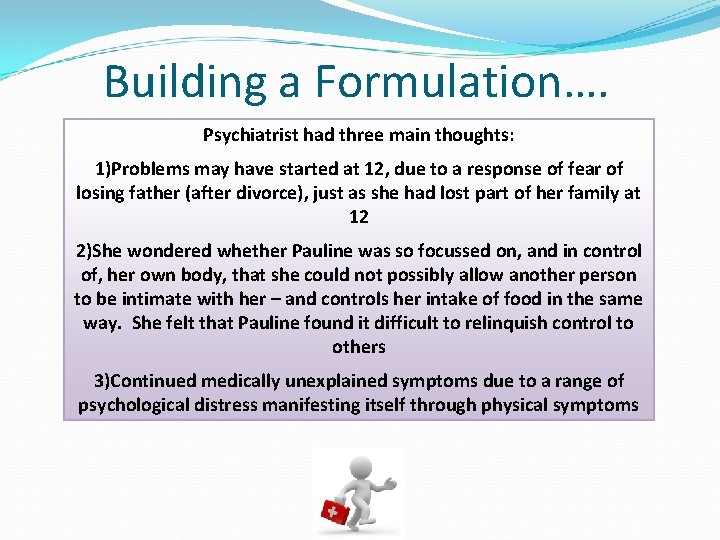
Building a Formulation…. Psychiatrist had three main thoughts: 1)Problems may have started at 12, due to a response of fear of losing father (after divorce), just as she had lost part of her family at 12 2)She wondered whether Pauline was so focussed on, and in control of, her own body, that she could not possibly allow another person to be intimate with her – and controls her intake of food in the same way. She felt that Pauline found it difficult to relinquish control to others 3)Continued medically unexplained symptoms due to a range of psychological distress manifesting itself through physical symptoms
Pauline – Age 50 -60 • At 54, developed acute severe back pain • Compression fractures in several vertabrae • No comment on links between protracted low weight and long term opiate use – never discussed with Pauline or her family • Fractures led to further loss of mobility – admitted to hospital for care and physio • Whilst in hospital, mother died at age 88 • Pauline and Mark had lived with her for 27 years
Pauline – Age 50 -60 • Pauline left with curvature of spine • Affected breathing, due to mechanical factors, sleep apnoea and mild heart failure • Opiates were reduced – very distressing for Pauline, but they understood • Went better than expected • Pauline required an extensive package of care (visits qds) • Mark resigned from his career in a trade union as required at home
Pauline – Age 50 -60 • After extensive lobbying, they were allowed to move into an older person’s sheltered housing given that Pauline’s needs were so extensive • Pauline’s general well-being seemed better in her fifties and sixties than when she was younger, although her physical health and level of function was probably worse
Bringing It All Together… EXERCISE 7 What are the challenges in working with a patient, and their carers, like in Pauline’s case What approaches/interventions could help in such situations? What three things can you take from this workshop, to help you manage a similar case in the future?
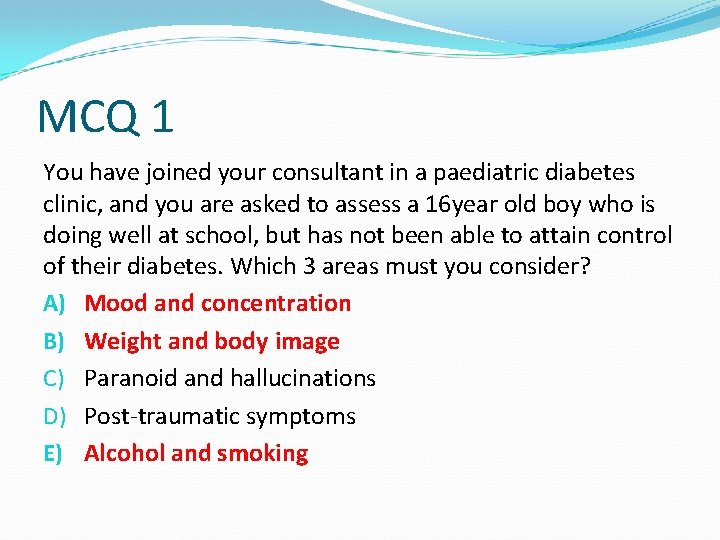
MCQ 1 You have joined your consultant in a paediatric diabetes clinic, and you are asked to assess a 16 year old boy who is doing well at school, but has not been able to attain control of their diabetes. Which 3 areas must you consider? A) Mood and concentration B) Weight and body image C) Paranoid and hallucinations D) Post-traumatic symptoms E) Alcohol and smoking
MCQ 1 You have joined your consultant in a paediatric diabetes clinic, and you are asked to assess a 16 year old boy who is doing well at school, but has not been able to attain control of their diabetes. Which 3 areas must you consider? A) Mood and concentration B) Weight and body image C) Paranoid and hallucinations D) Post-traumatic symptoms E) Alcohol and smoking
MCQ 2 You are contacted about 14 year old girl who has been treated for a paracetamol overdose in A&E. Her father has arrived and offered to take her home and bring her to see you tomorrow. He does not want her admitted into the paediatric bed that has been identified. What 3 things do you do? A) Meet with the father and child and obtain consent to interview the child alone B) Contact social services as this sounds suspicious C) Meet with the father and child and ask why he wants to take her home D) Admit the child to the ward under the Mental Health Act E) Speak to the nurses in A&E to learn more about the child's presentation before the father arrived, and what their interaction has been like
MCQ 2 You are contacted about 14 year old girl who has been treated for a paracetamol overdose in A&E. Her father has arrived and offered to take her home and bring her to see you tomorrow. He does not want her admitted into the paediatric bed that has been identified. What 3 things do you do? A) Meet with the father and child and obtain consent to interview the child alone B) Contact social services as this sounds suspicious C) Meet with the father and child and ask why he wants to take her home D) Admit the child to the ward under the Mental Health Act E) Speak to the nurses in A&E to learn more about the child's presentation before the father arrived, and what their interaction has been like
MCQ 3 Factitious disorder: A Is more common in Males B Is less common in Healthcare workers C Comprise 20% of referrals from General Medicine to Psychiatry D Rarely involves presentations of chest pain E Is commonly associated with depression
MCQ 3 Factitious disorder: A Is more common in Males B Is less common in Healthcare workers C Comprise 20% of referrals from General Medicine to Psychiatry D Rarely involves presentations of chest pain E Is commonly associated with depression
MCQ 4 Which of the following is not true : A Pancreatic cancer confers high risk of developing depression B Paraneoplastic syndromes are commonly associated with small cell lung cancer C Autoimmune Limbic encephalitis is always associated with neoplasms D Body image disturbance is present in 50% of women with breast cancer E Treatment with steroids can result in development of psychotic symptoms
MCQ 4 Which of the following is not true : A Pancreatic cancer confers high risk of developing depression B Paraneoplastic syndromes are commonly associated with small cell lung cancer C Autoimmune Limbic encephalitis is always associated with neoplasms D Body image disturbance is present in 50% of women with breast cancer E Treatment with steroids can result in development of psychotic symptoms
MCQ 5 Which is true with regards to differences in pharmacokinetics in older vs younger adults? A) Older adults have reduced body fat B) Older adults have increased body water C) Creatinine and GFR are not effected by age D) Volume of distribution of lipophilic drugs increases in older adults E) The T½ of psychotropic drugs is constant across the adult age range
MCQ 5 Which is true with regards to differences in pharmacokinetics in older vs younger adults? A) Older adults have reduced body fat B) Older adults have increased body water C) Creatinine and GFR are not effected by age D) Volume of distribution of lipophilic drugs increases in older adults E) The T½ of psychotropic drugs is constant across the adult age range
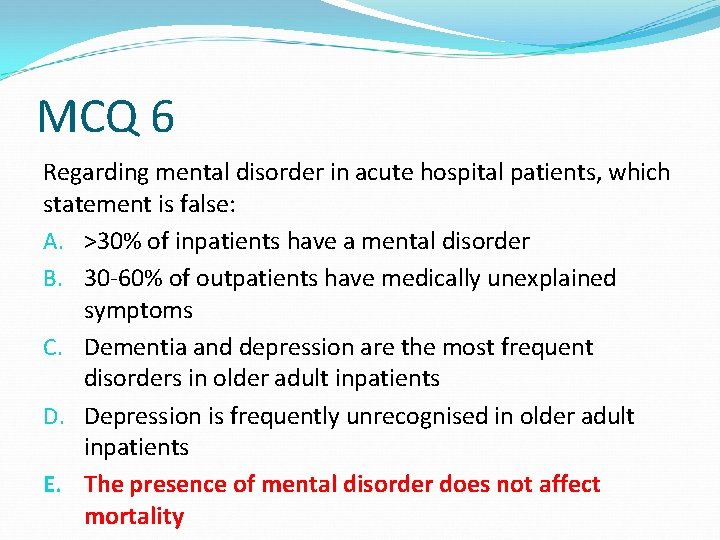
MCQ 6 Regarding mental disorder in acute hospital patients, which statement is false: A. >30% of inpatients have a mental disorder B. 30 -60% of outpatients have medically unexplained symptoms C. Dementia and depression are the most frequent disorders in older adult inpatients D. Depression is frequently unrecognised in older adult inpatients E. The presence of mental disorder does not affect mortality
MCQ 6 Regarding mental disorder in acute hospital patients, which statement is false: A. >30% of inpatients have a mental disorder B. 30 -60% of outpatients have medically unexplained symptoms C. Dementia and depression are the most frequent disorders in older adult inpatients D. Depression is frequently unrecognised in older adult inpatients E. The presence of mental disorder does not affect mortality