
Liability Storms and How to Quantify Their Effect
Liability Storms and How to Quantify Their Effect Casualty Actuarial Society Annual Meeting November 11 & 12, 2002 William R. Azzara Bruce D. Fell, FCAS, MAAA, CFA 184
Outline n Overview of Liability Exposures n Reasons to be Proactive and Quantify n A Method to Use 184 2
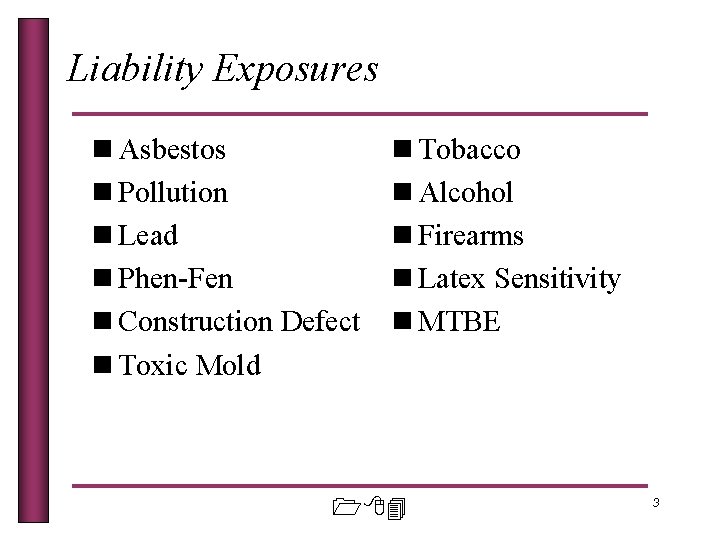
Liability Exposures n Asbestos n Pollution n Lead n Phen-Fen n Construction Defect n Toxic Mold n Tobacco n Alcohol n Firearms n Latex Sensitivity n MTBE 184 3
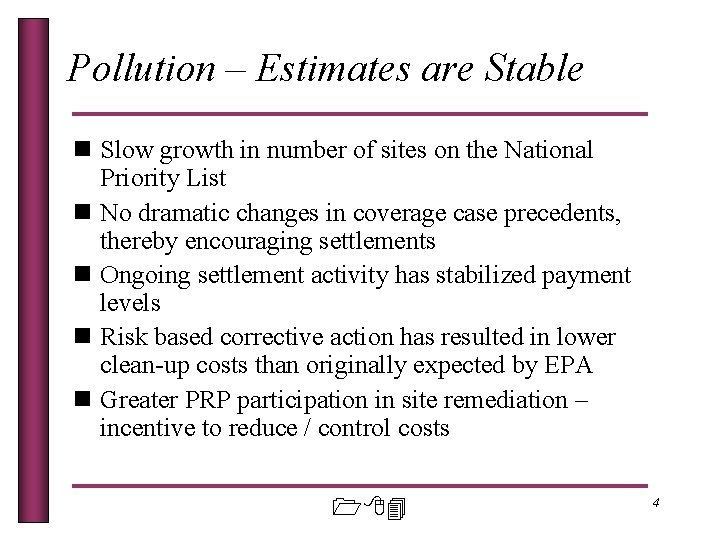
Pollution – Estimates are Stable n Slow growth in number of sites on the National Priority List n No dramatic changes in coverage case precedents, thereby encouraging settlements n Ongoing settlement activity has stabilized payment levels n Risk based corrective action has resulted in lower clean-up costs than originally expected by EPA n Greater PRP participation in site remediation – incentive to reduce / control costs 184 4
Pollution – Net U. S. Estimates n A. M. Best’s estimate of ultimate losses & ALAE = $56 billion n More recent estimates from other sources have been lowered to $30 -$40 billion n A. M. Best believes that its estimate is still reasonably accurate, if not somewhat on the conservative side. 184 5
Phen-Fen n Diet drug manufactured by American Home Products (now Wyeth) n Serious health problems allegedly caused by product (e. g. heart valve and often fatal lung condition) n Wyeth settled large class for $3. 5 billion but claims continue to be received n Wyeth recently added $910 million to its Phen-Fen reserve bringing total to $14+ billion 184 6
Construction Defect (CD) n “If you build it, they will sue” n Claims allegedly caused by negligence in the construction process q General construction q Toxic Mold q EIFS/Synthetic stucco n Claims have resulted in changes in practices by insurers q Pulling out of states q Eliminating classes of business 184 7
Toxic Mold n High profile exposure to industry is primarily due to First Party Coverages q Homeowners, Commercial Property, WC q Recent CA case resulting in $18 million in punitive damages in direct action against HO carrier n Limited claim activity from Third Party Coverages q If liability emerges in future, will the Pollution Exclusion apply? n Fitch recently concluded “Mold is not the next asbestos” 184 8
Tobacco n Significant claim activity for manufacturers q Some for distributors, advertisers, suppliers n Types of exposures include q Private lawsuits q Reimbursement actions ØGovernment recovery of medical costs ØPrivate reimbursement actions n Class Action suits have been certified 184 9
Tobacco n State medical cost recovery actions q q Settlement of 46 states Medicaid actions Payment of at least $206 billion Includes changes in business practices Voluntary settlement did not remove potential for future liability q Note recent CA verdicts of $28 billion and $3 billion respectively for two individual claimants n Insurance industry exposure remains uncertain 184 10
Tobacco n Foreign Exposure q Canada has several reimbursement actions pending (Quebec suing for $200 million) q EU, Colombia, Guatemala, Israel and others have also filed actions (Spain has first European local government action) q Australian market faces large class action suit q There may be no operable exclusions 184 11
Lead n Contamination from lead paint & plumbing n Primary defendants include: q Building owners q Paint and pigment manufacturers or distributors q Plumbing manufacturers and distributors n Plaintiffs include government agencies and building tenants 184 12
Lead n Frequency of claims has been less than the industry’s initial expectations n Plaintiffs have failed in certifying class actions n Landmark RI suit against lead paint industry recently ended in mistrial q Similar litigation filed by Chicago, Milwaukee, St. Louis & counties in TX and CA q Additional litigation possible in CT, WV, NJ, MA, NH and OH n Concern that Market Share Distribution of liability could result in significant costs q Lead paint remains in 330, 000 private homes and public buildings in RI alone 184 13
Alcohol n Types of claimants: q q Consumers of alcoholic beverages Third parties injured by alcohol consumers Victims of FAS (fetal alcohol syndrome) Government agencies and health care providers who provide care for alcohol related injuries 184 14
Alcohol n Alcohol industry has successfully defended itself against all alcohol consumption suits, to date n Concern over products liability exposure similar to asbestos q No apparent contract exclusions q However, product warnings do exist 184 15
Firearms n Products Liability actions are a recent phenomenon n Lawsuits include: q Private and public recovery actions modeled after government’s efforts against the tobacco industry n Against defendants that include: q Manufacturers q Retailers and Resellers q Firearms Trade Associations 184 16
Firearms n Difficult to predict insurance implications due to recent activity q Several manufacturers have placed their carriers on notice q There are generally no specific applicable exclusions q Market Share Distribution of liability remains speculative but of concern for industry q Plaintiffs are watching a Brooklyn case in which it is alleged that manufacturers did nothing to prevent product misuse q Public appeal to have bullet shell “fingerprinting” by manufacturer 184 17
Latex Sensitivity n About 2. 5% of the population is sensitive to the proteins contained in latex n Increased demand due to AIDS led to higher levels of protein in gloves n Hyper-sensitivity can cause skin and respiratory reactions leading to disability or death 184 18
Latex Sensitivity n Types of Claimants include: q Healthcare workers q Patients n The potential impact to the insurance industry appears manageable q Courts have generally frustrated the plaintiff bar’s attempts to certify class actions q Most courts now address product identification before allowing additional discovery 184 19
Methyl Tertiary Butyl Ether (MTBE) n Gasoline additive used as anti-knock compound (1979) and to improve combustion and reduce CO emissions (1992) n 1995 – mandatory “Reformulated Gasoline” use results in 30% of nationwide gasoline sales contain MTBE n Use of MTBE will stop in 2003 -CA to delay n Identified as a possible carcinogen 184 20
MTBE n Alleged groundwater contamination from petroleum containing MTBE n Non-specific symptoms may lead to claims n Pollution exclusion may not apply (Products Liability) n Government’s virtual mandate of use will likely be used as a defense n Recent jury verdict against refiners in Lake Tahoe drinking water contamination 184 21
Other Developing Exposures n Advertising Injury / Intellectual Property n Genetically Modified Crops n Managed Care n SV-40 184 22
The Problem n Industry estimates of liability from latent exposures are significantly higher than the sum of amounts disclosed by companies n Some companies: q Are slow to identify/quantify latent exposures q Are under-reserved q Have elected the business strategy of recognizing the liabilities as claims develop 184 23
The Problem n Quantitative Effects q Immediate and direct effect on current earnings and equity/surplus of reflecting liability q Uncertainty of future earnings drag if future costs exceed established reserve n Qualitative Effects q Management abilities questioned q Mergers & Acquisitions limited by uncertainty 184 24
What is Needed n Identification of Exposure q Coverages that might result in exposure q Time span coverage was afforded n Quantify Ultimate Cost q q Potential frequency Potential severity Timing of future claim filings & payments Potential defense costs 184 25
Method to Quantify n Determine a company’s Latent Loss Liability using: q Company’s own data q Claim Specialists with working knowledge of Latent Liability Losses q Industry-wide data 184 26
Method to Quantify n Management Interviews n Detailed Claim File Review to determine Amount and Timing of Losses n Actuarial Projections using Company Specific and Industry data to estimate IBNR n Reinsurance Considerations 184 27
Method – File Selection n Target Claims selected for review based on: q q q Current reserve size Presence of Declaratory Judgment (DJ) reserves Defendant name recognition Loss Type – Asbestos, Pollution, etc. Claim Status – Open, Closed, Re-open Year – Accident, Policy, or Underwriting n Random Claims – selected from remaining population 184 28
Method – File Review n Detailed Claim File Reviews q End-of-Day Ultimate Losses are estimated on a claim-by-claim basis for Target and Random Claims q Ultimate Losses are based on Industry Experience and the working knowledge of claim specialists 184 29
Method – File Review n Detailed Claim File Reviews (cont’d) q Ultimate Losses include provisions for: ØLoss Expense ØDJ Expense ØExpected Timing of Claim Payments 184 30
Method – IBNR Estimate n Provision for IBNR (Incurred But Not Reported) is split into two components: q IBNER – Incurred But Not Enough Reported ØAdditional amount of reserve for known and unknown claims involving known insureds, known contracts and known/reported claim types q IBNYR – Incurred But Not Yet Reported ØProvision for unreported claims involving unknown insureds and unknown contracts for known claim types 184 31
Method – IBNER Estimate n Estimate utilizes the results of: q Target Claims file review q Random Claims file review q Loading for remaining claims based on Random Claim file review ØAverage Ultimate Loss estimate is extrapolated over the Non-Target Claims to develop an estimate of Ultimate Losses for this group 184 32
Method – IBNYR Estimate n Provision for IBNYR Losses based on: q Industry estimates of Ultimate Losses q Claim Specialists’ estimate of “stage of development” for the particular book q “Traditional” Actuarial Approaches ØSurvival Ratios ØMarket Share Evaluation 184 33
Method – Reinsurance n Using a sample of claim files, the relationship of reinsurance to direct/gross liabilities is determined q Intended vs. collected cessions n Based on these relationships, any ceded reinsurance liabilities are determined n How much uncollectible reinsurance? 184 34
Advantages of Method n Analysis performed at claim level q Source of exposure and differences in claim estimates can be pinpointed to specific types of claims, claimants, policies, etc. n Uses fewer global assumptions q Can more effectively quantify the qualitative aspects and uniqueness of the book 184 35
Advantages of Method n Claim Specialists perform a large part of the review q Hands-on experience enables more accurate estimate of potential exposure by tailoring analysis to specific factual damage and coverage information involved at claim level q Specific consideration of development stage and timing n Actuaries are involved where global assumptions are made 184 36
- Slides: 36