
Li TGen a lightweight traffic generator application to

- Slides: 20
Li. TGen, a lightweight traffic generator: application to mail and P 2 P wireless traffic Chloé Rolland*, Julien Ridoux+ and Bruno Baynat* * Laboratoire LIP 6 – CNRS Université Pierre et Marie Curie – Paris 6 + ARC Special Research Center for Ultra-Broadband Communications (CUBIN), The University of Melbourne
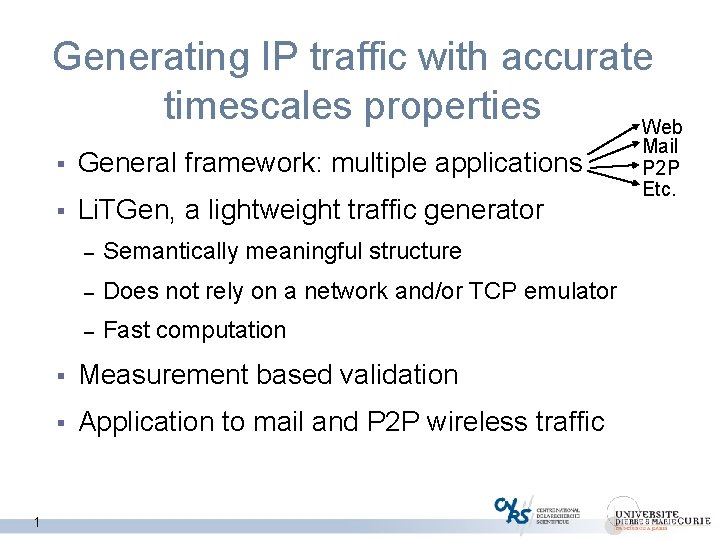
Generating IP traffic with accurate timescales properties Web 1 § General framework: multiple applications § Li. TGen, a lightweight traffic generator – Semantically meaningful structure – Does not rely on a network and/or TCP emulator – Fast computation § Measurement based validation § Application to mail and P 2 P wireless traffic Mail P 2 P Etc.
Li. TGen’s underlying model 2 § Focus on the download path § Do not consider up/down interactions § Focus on TCP traffic § Approach – Application oriented & User oriented – Semantically meaningful hierarchical model
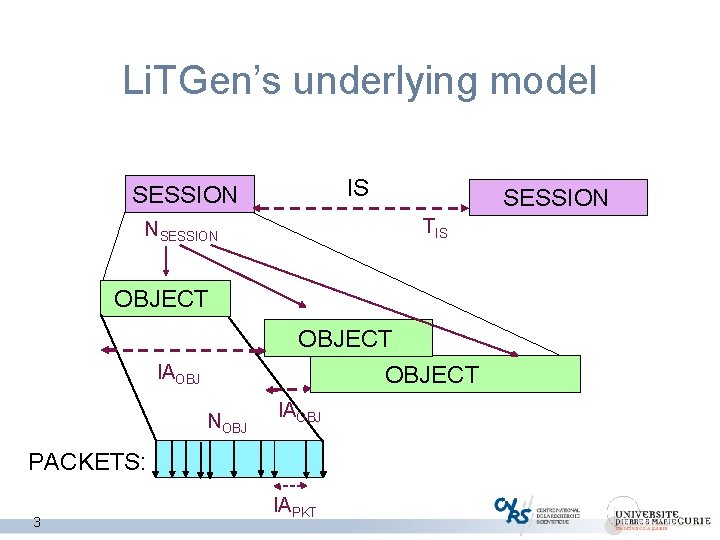
Li. TGen’s underlying model IS SESSION TIS NSESSION OBJECT IAOBJ NOBJ IAOBJ PACKETS: 3 IAPKT
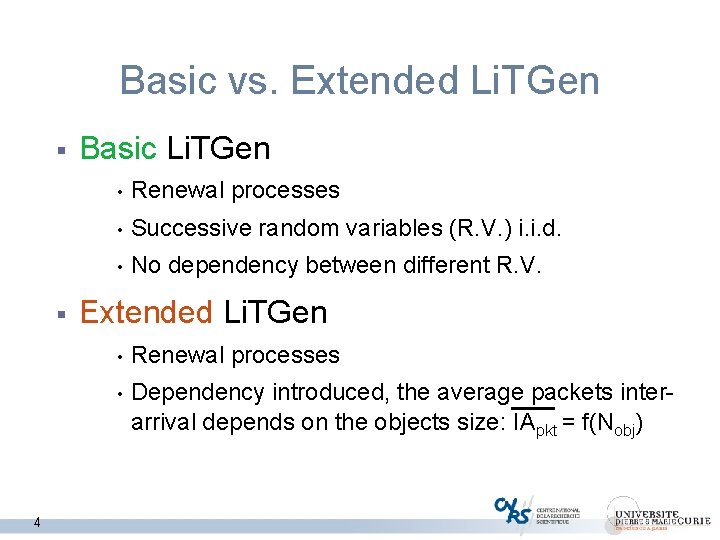
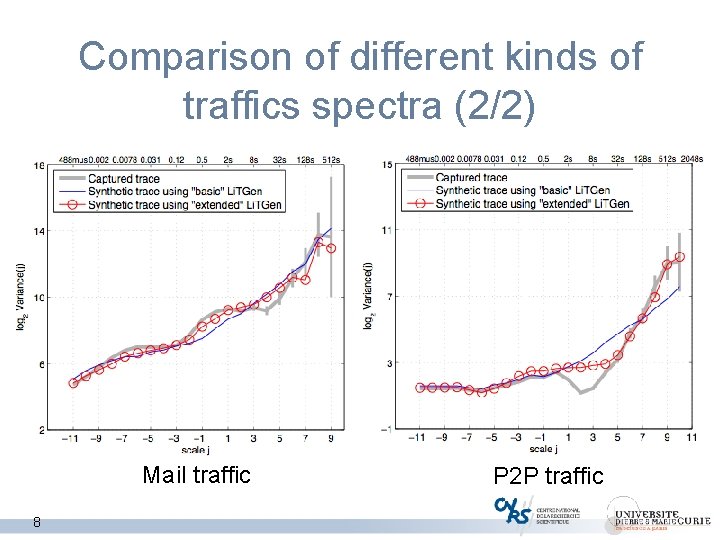
Basic vs. Extended Li. TGen § § 4 Basic Li. TGen • Renewal processes • Successive random variables (R. V. ) i. i. d. • No dependency between different R. V. Extended Li. TGen • Renewal processes • Dependency introduced, the average packets interarrival depends on the objects size: IApkt = f(Nobj)
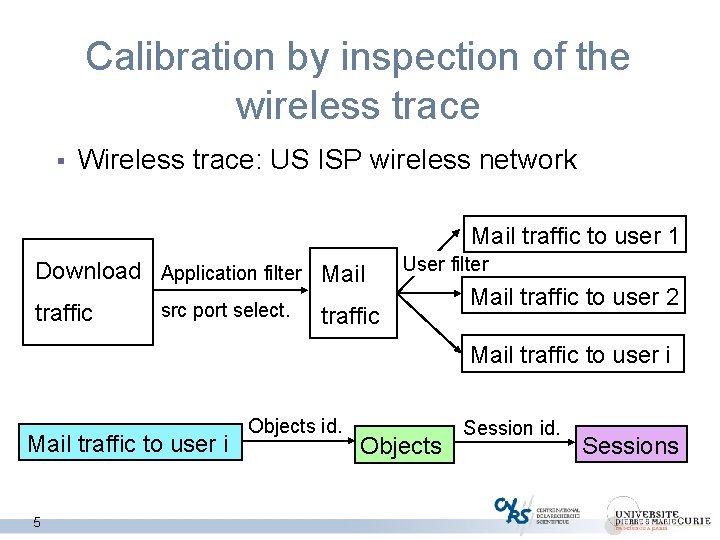
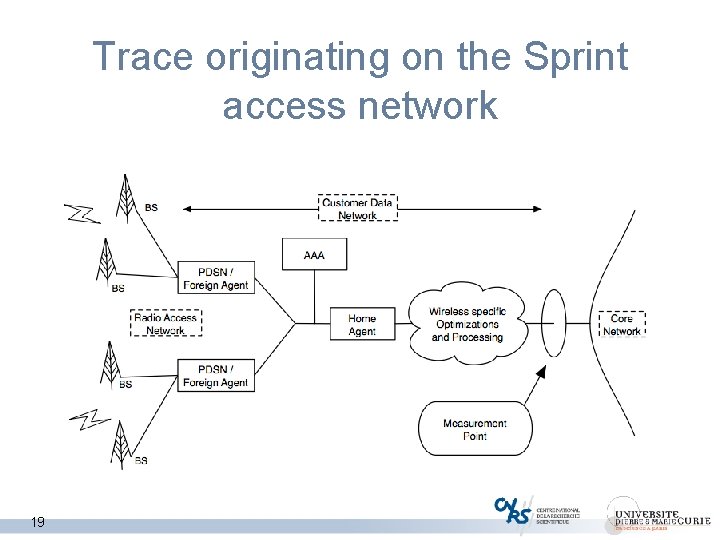
Calibration by inspection of the wireless trace § Wireless trace: US ISP wireless network Mail traffic to user 1 Download Application filter Mail traffic src port select. User filter traffic Mail traffic to user 2 Mail traffic to user i 5 Objects id. Objects Session id. Sessions
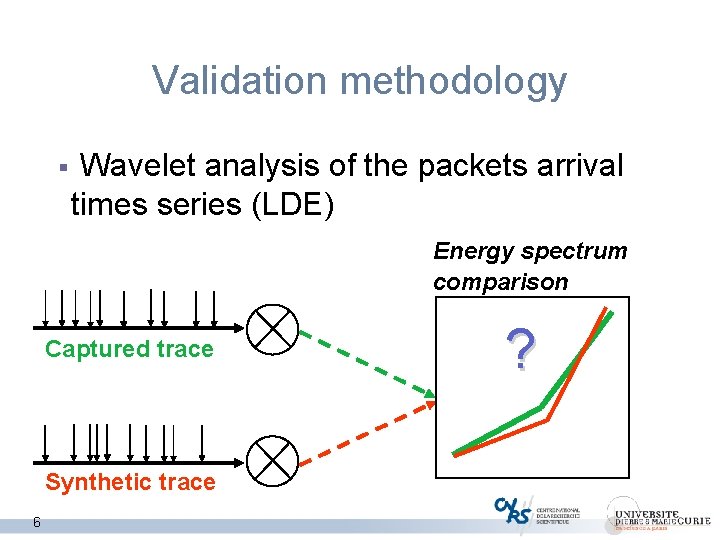
Validation methodology § Wavelet analysis of the packets arrival times series (LDE) Energy spectrum comparison Captured trace Synthetic trace 6 ?
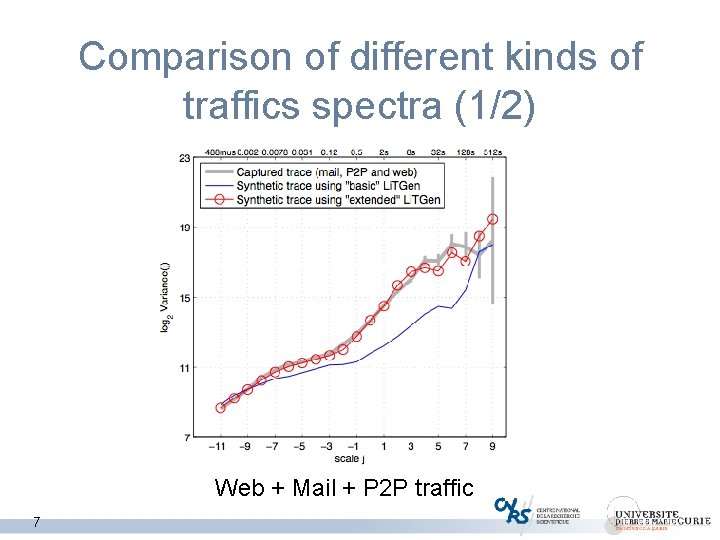
Comparison of different kinds of traffics spectra (1/2) Web + Mail + P 2 P traffic 7
Comparison of different kinds of traffics spectra (2/2) Mail traffic 8 P 2 P traffic
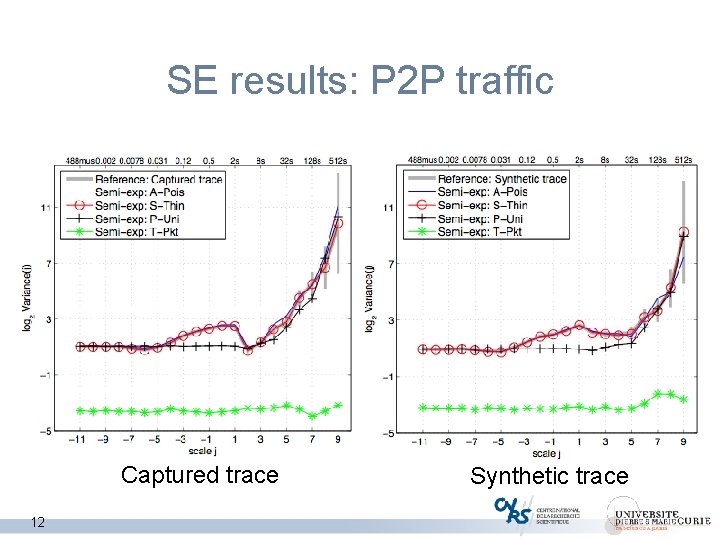
Further validation: semi-experiments (SE) § § Does Li. TGen reproduces the traffic internal structure? Semi-experiments Manipulation of internal parameters – Impact of the manipulation: importance of the parameters modified ? – 9
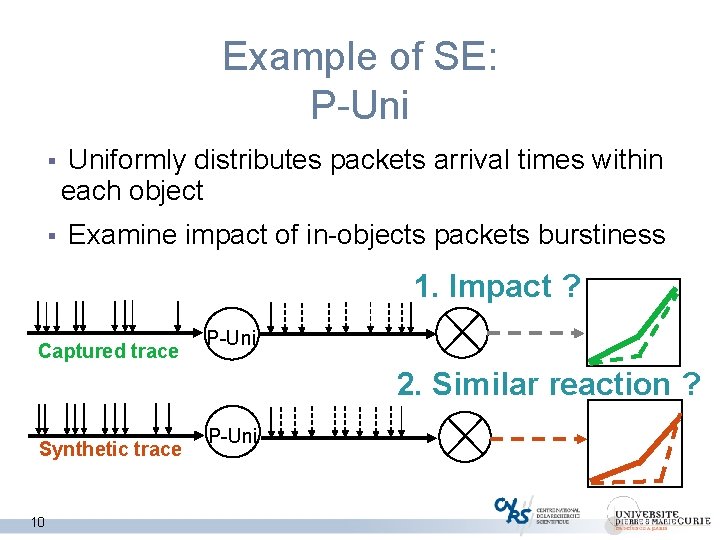
Example of SE: P-Uni § Uniformly distributes packets arrival times within each object § Examine impact of in-objects packets burstiness 1. Impact ? Captured trace P-Uni 2. Similar reaction ? Synthetic trace 10 P-Uni
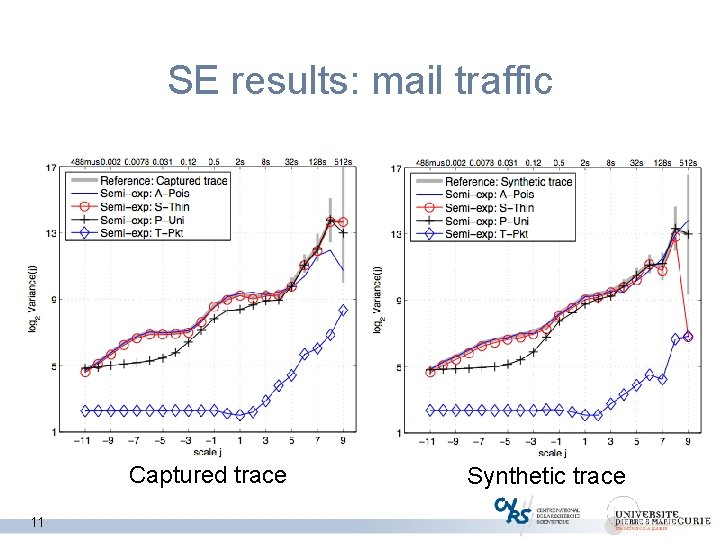
SE results: mail traffic Captured trace 11 Synthetic trace
SE results: P 2 P traffic Captured trace 12 Synthetic trace
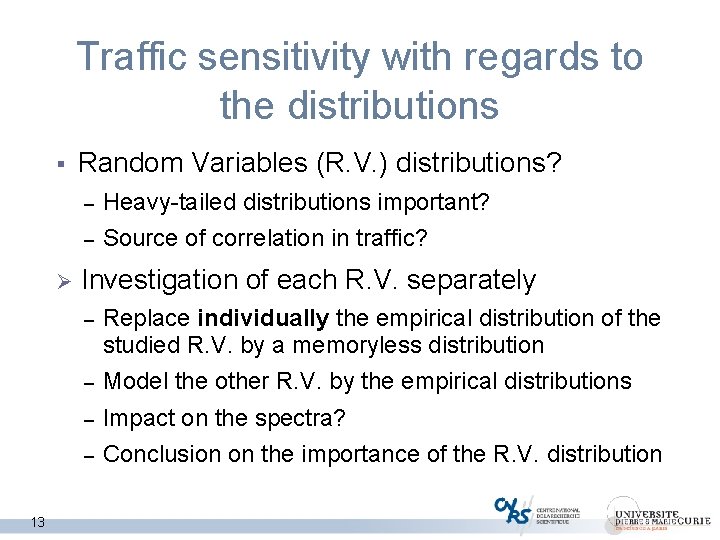
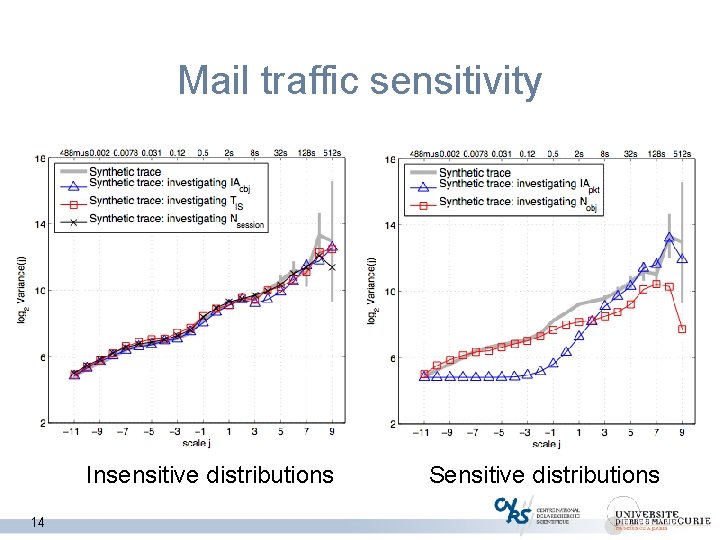
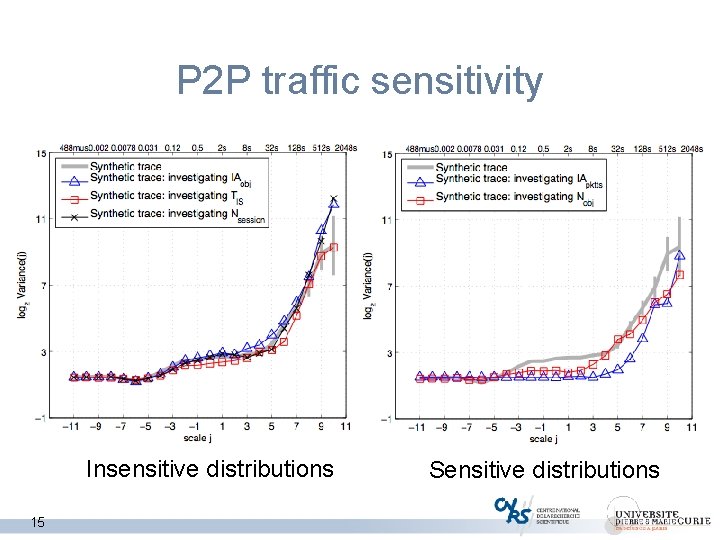
Traffic sensitivity with regards to the distributions § Ø 13 Random Variables (R. V. ) distributions? – Heavy-tailed distributions important? – Source of correlation in traffic? Investigation of each R. V. separately – Replace individually the empirical distribution of the studied R. V. by a memoryless distribution – Model the other R. V. by the empirical distributions – Impact on the spectra? – Conclusion on the importance of the R. V. distribution
Mail traffic sensitivity Insensitive distributions 14 Sensitive distributions
P 2 P traffic sensitivity Insensitive distributions 15 Sensitive distributions
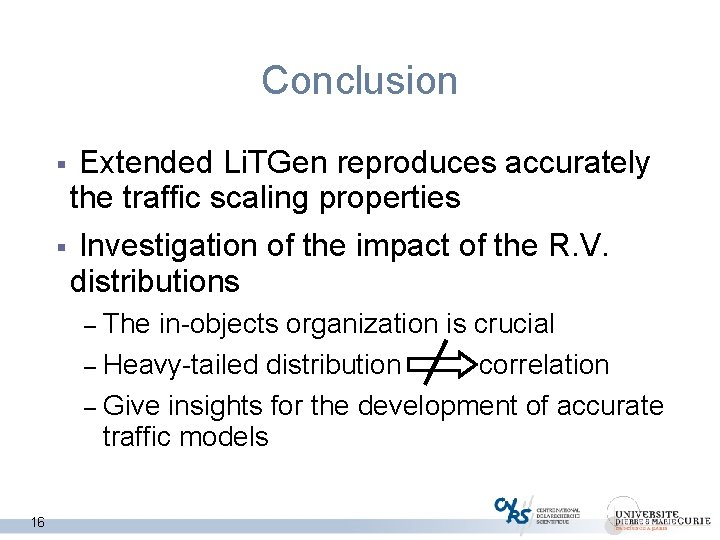
Conclusion § Extended Li. TGen reproduces accurately the traffic scaling properties § Investigation of the impact of the R. V. distributions The in-objects organization is crucial – Heavy-tailed distribution correlation – Give insights for the development of accurate traffic models – 16
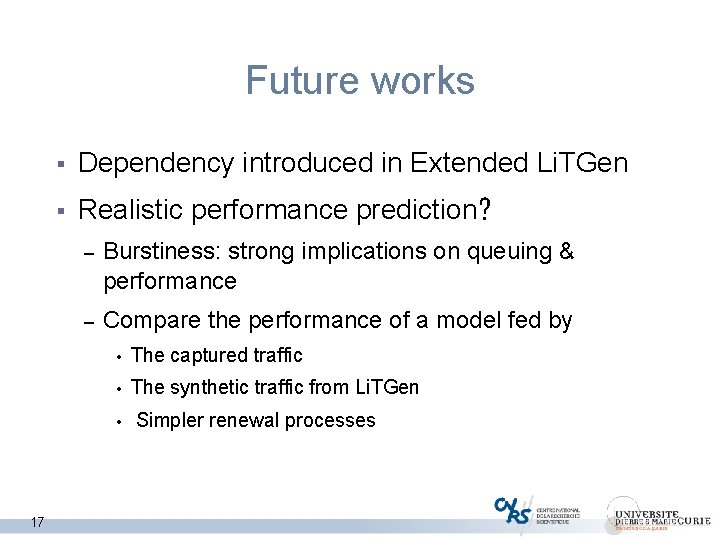
Future works § Dependency introduced in Extended Li. TGen § Realistic performance prediction? – Burstiness: strong implications on queuing & performance – Compare the performance of a model fed by • The captured traffic • The synthetic traffic from Li. TGen • 17 Simpler renewal processes
Thank you ! 18
Trace originating on the Sprint access network 19