
LHCb Sci Fi The new Fibre Tracker for
LHCb Sci. Fi The new Fibre Tracker for LHCb Christian Joram CERN PH/DT ECFA High Luminosity LHC Experiments Workshop - 2014 The LHCb Sci. Fi project: Brazil (CBPF) - China (Tsinghua) - France (LPC, LAL, LPNHE) - Germany (Aachen, Dortmund, Heidelberg, Rostock) - Netherlands (Nikhef) - Poland (Warsaw) - Russia (PNPI, ITEP, INR, IHEP, NRC KI) - Spain (Barcelona, Valencia) - Switzerland (CERN, EPFL) - UK (Imperial College) Christian Joram CERN PH/DT 22 October 2014 1
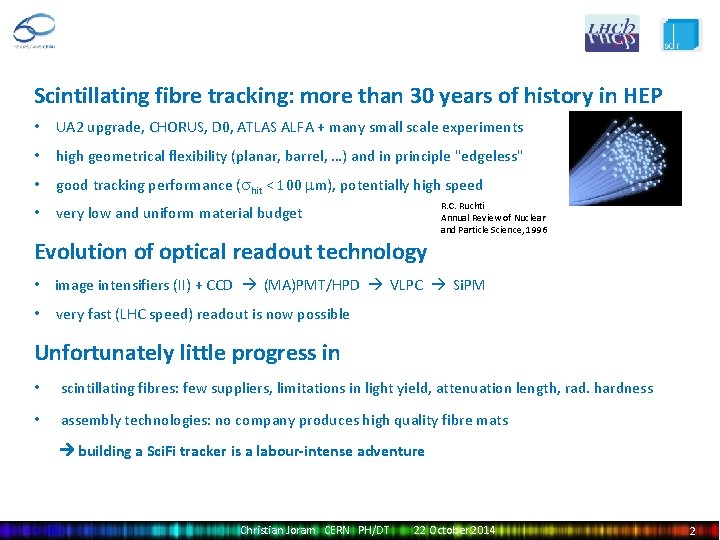
Scintillating fibre tracking: more than 30 years of history in HEP • UA 2 upgrade, CHORUS, D 0, ATLAS ALFA + many small scale experiments • high geometrical flexibility (planar, barrel, …) and in principle "edgeless" • good tracking performance (shit < 100 mm), potentially high speed • very low and uniform material budget Evolution of optical readout technology R. C. Ruchti Annual Review of Nuclear and Particle Science, 1996 • image intensifiers (II) + CCD (MA)PMT/HPD VLPC Si. PM • very fast (LHC speed) readout is now possible Unfortunately little progress in • scintillating fibres: few suppliers, limitations in light yield, attenuation length, rad. hardness • assembly technologies: no company produces high quality fibre mats building a Sci. Fi tracker is a labour-intense adventure Christian Joram CERN PH/DT 22 October 2014 2
Outline • The LHCb Sci. Fi Tracker • The main challenges o Fibres with high light yield and attenuation length o Building large-size detector modules o Radiation damage to scintillating fibres o Optimised Si. PM detectors and their radiation hardness o Fast readout with manageable data volume o Integration (incl. operation at -40 °C) Christian Joram CERN PH/DT 22 October 2014 3
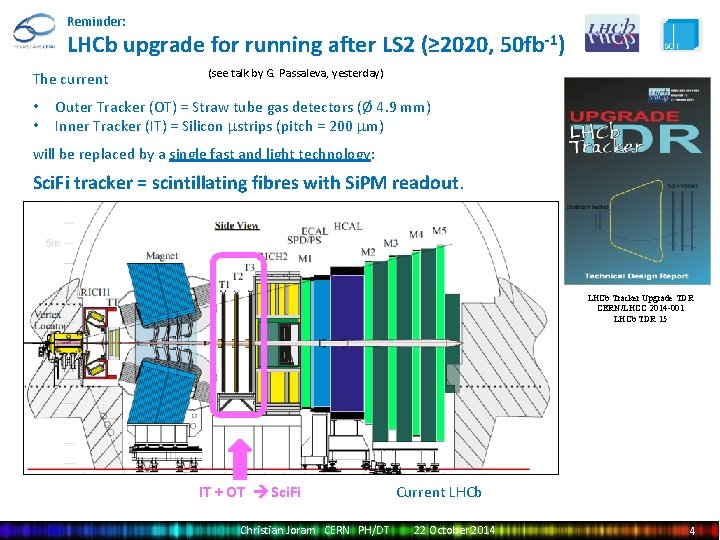
Reminder: LHCb upgrade for running after LS 2 (≥ 2020, 50 fb-1) The current • • (see talk by G. Passaleva, yesterday) Outer Tracker (OT) = Straw tube gas detectors (Ø 4. 9 mm) Inner Tracker (IT) = Silicon mstrips (pitch = 200 mm) will be replaced by a single fast and light technology: Sci. Fi tracker = scintillating fibres with Si. PM readout. LHCb Tracker Upgrade TDR CERN/LHCC 2014 -001 LHCb TDR 15 IT + OT Sci. Fi Christian Joram CERN PH/DT Current LHCb 22 October 2014 4
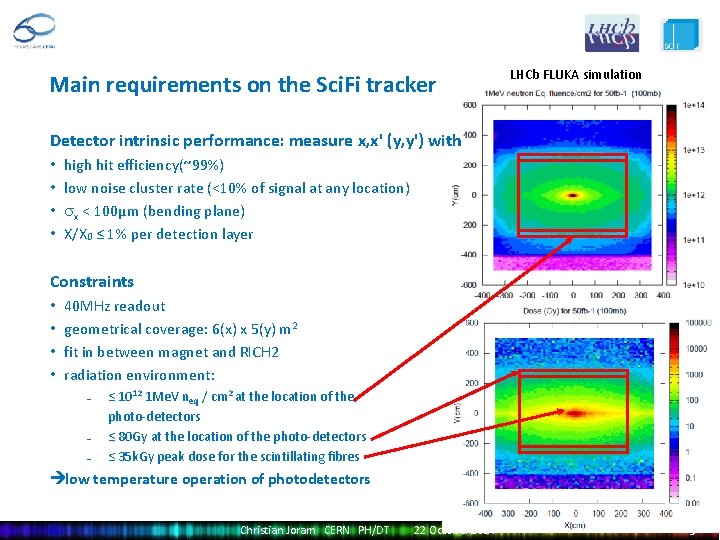
Main requirements on the Sci. Fi tracker LHCb FLUKA simulation Detector intrinsic performance: measure x, x' (y, y') with • • high hit efficiency(~99%) low noise cluster rate (<10% of signal at any location) sx < 100μm (bending plane) X/X 0 ≤ 1% per detection layer Constraints • • 40 MHz readout geometrical coverage: 6(x) x 5(y) m 2 fit in between magnet and RICH 2 radiation environment: ₋ ₋ ₋ ≤ 1012 1 Me. V neq / cm 2 at the location of the photo-detectors ≤ 80 Gy at the location of the photo-detectors ≤ 35 k. Gy peak dose for the scintillating fibres low temperature operation of photodetectors Christian Joram CERN PH/DT 22 October 2014 5
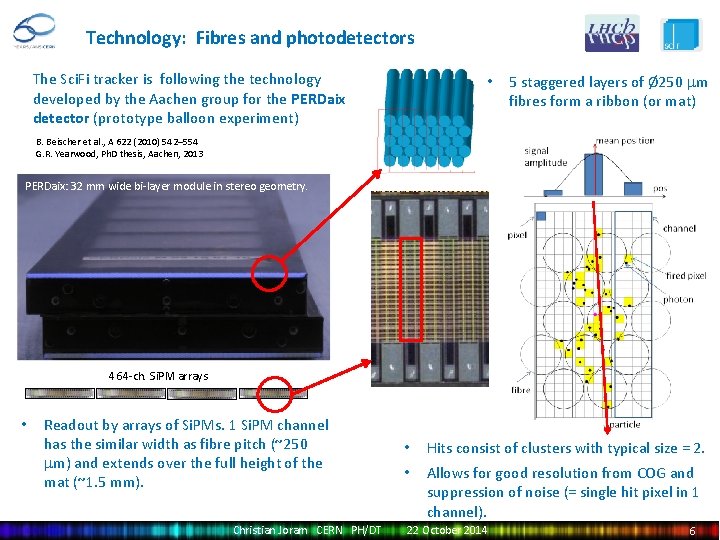
Technology: Fibres and photodetectors The Sci. Fi tracker is following the technology developed by the Aachen group for the PERDaix detector (prototype balloon experiment) • 5 staggered layers of Ø 250 mm fibres form a ribbon (or mat) B. Beischer et al. , A 622 (2010) 542– 554 G. R. Yearwood, Ph. D thesis, Aachen, 2013 PERDaix: 32 mm wide bi-layer module in stereo geometry. 4 64 -ch. Si. PM arrays • Readout by arrays of Si. PMs. 1 Si. PM channel has the similar width as fibre pitch (~250 mm) and extends over the full height of the mat (~1. 5 mm). Christian Joram CERN PH/DT • Hits consist of clusters with typical size = 2. • Allows for good resolution from COG and suppression of noise (= single hit pixel in 1 channel). 22 October 2014 6
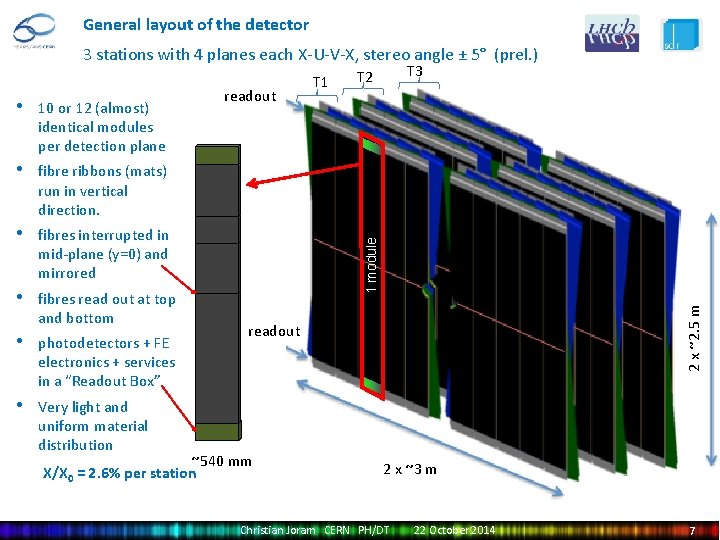
General layout of the detector 3 stations with 4 planes each X-U-V-X, stereo angle ± 5° (prel. ) • fibre ribbons (mats) run in vertical direction. • fibres interrupted in mid-plane (y=0) and mirrored • fibres read out at top and bottom • photodetectors + FE electronics + services in a “Readout Box” • Very light and uniform material distribution readout 2 x ~2. 5 m 10 or 12 (almost) identical modules per detection plane T 3 T 2 1 module • T 1 readout ~540 mm X/X 0 = 2. 6% per station 2 x ~3 m Christian Joram CERN PH/DT 22 October 2014 7
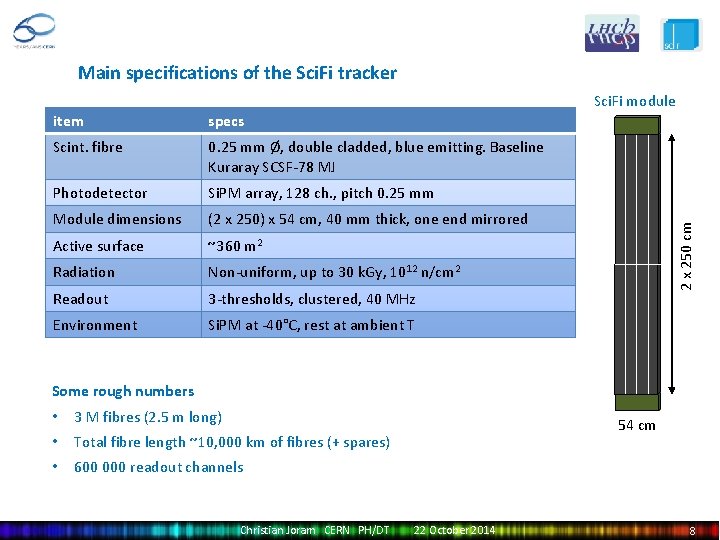
Main specifications of the Sci. Fi tracker item specs Scint. fibre 0. 25 mm Ø, double cladded, blue emitting. Baseline Kuraray SCSF-78 MJ Photodetector Si. PM array, 128 ch. , pitch 0. 25 mm Module dimensions (2 x 250) x 54 cm, 40 mm thick, one end mirrored Active surface ~360 m 2 Radiation Non-uniform, up to 30 k. Gy, 1012 n/cm 2 Readout 3 -thresholds, clustered, 40 MHz Environment Si. PM at -40°C, rest at ambient T 2 x 250 cm Sci. Fi module Some rough numbers • 3 M fibres (2. 5 m long) • Total fibre length ~10, 000 km of fibres (+ spares) • 600 000 readout channels Christian Joram CERN PH/DT 54 cm 22 October 2014 8
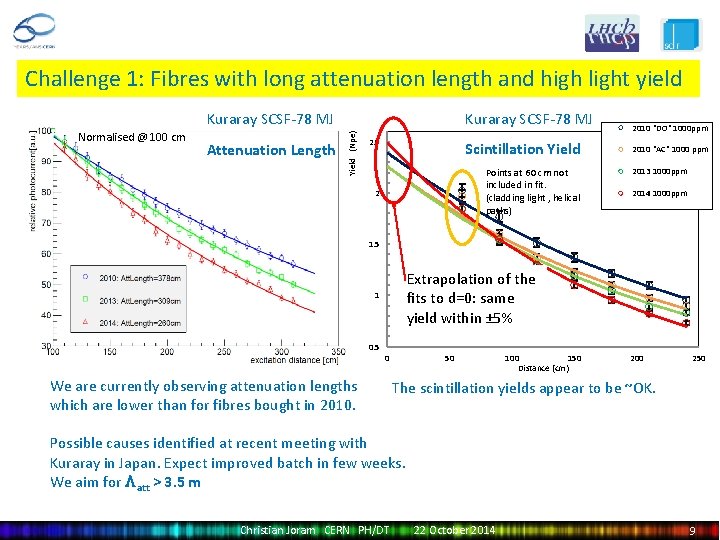
Challenge 1: Fibres with long attenuation length and high light yield Kuraray SCSF-78 MJ Normalised @ 100 cm Attenuation Length Yield (Npe) Kuraray SCSF-78 MJ 2. 5 Scintillation Yield Points at 60 cm not included in fit. (cladding light , helical paths) 2 2010 "DO" 1000 ppm 2010 "AC" 1000 ppm 2013 1000 ppm 2014 1000 ppm 1. 5 Extrapolation of the fits to d=0: same Scintillation light yield within ± 5%, of one 0. 25 mm fibre 1 measured by a PMT 0. 5 0 We are currently observing attenuation lengths which are lower than for fibres bought in 2010. 50 100 150 Distance (cm) 200 250 The scintillation yields appear to be ~OK. Possible causes identified at recent meeting with Kuraray in Japan. Expect improved batch in few weeks. We aim for Latt > 3. 5 m Christian Joram CERN PH/DT 22 October 2014 9
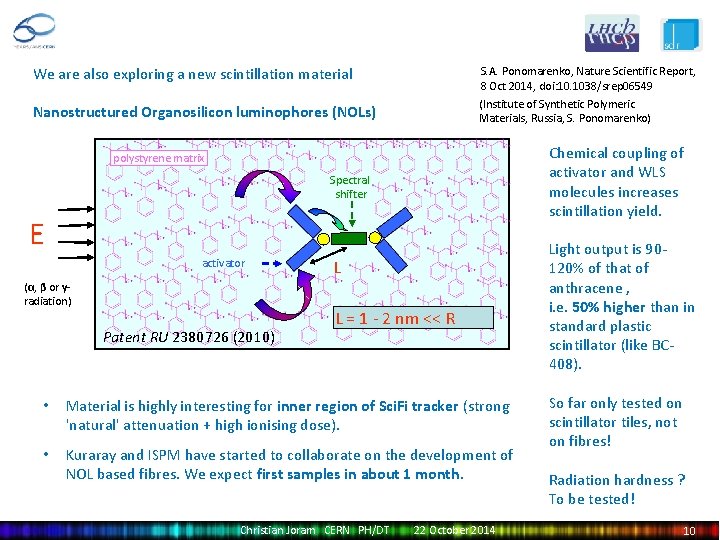
We are also exploring a new scintillation material S. A. Ponomarenko, Nature Scientific Report, 8 Oct 2014, doi: 10. 1038/srep 06549 Nanostructured Organosilicon luminophores (NOLs) (Institute of Synthetic Polymeric Materials, Russia, S. Ponomarenko) Chemical coupling of activator and WLS molecules increases scintillation yield. polystyrene matrix Spectral shifter Е activator (α, β or γradiation) Patent RU 2380726 (2010) L L = 1 - 2 nm << R • Material is highly interesting for inner region of Sci. Fi tracker (strong 'natural' attenuation + high ionising dose). • Kuraray and ISPM have started to collaborate on the development of NOL based fibres. We expect first samples in about 1 month. Christian Joram CERN PH/DT 22 October 2014 Light output is 90120% of that of anthracene , i. e. 50% higher than in standard plastic scintillator (like BC 408). So far only tested on scintillator tiles, not on fibres! Radiation hardness ? To be tested! 10
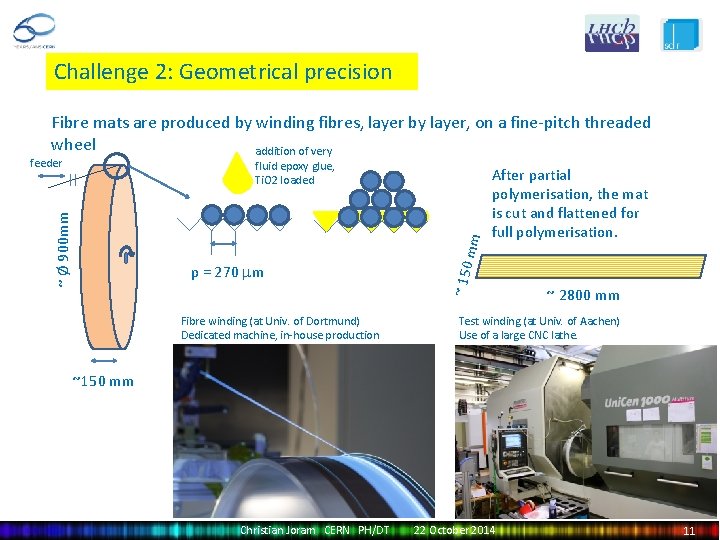
Challenge 2: Geometrical precision Fibre mats are produced by winding fibres, layer by layer, on a fine-pitch threaded wheel addition of very feeder p = 270 mm Fibre winding (at Univ. of Dortmund) Dedicated machine, in-house production After partial polymerisation, the mat is cut and flattened for full polymerisation. ~ 150 mm ~ Ø 900 mm fluid epoxy glue, Ti. O 2 loaded ~ 2800 mm Test winding (at Univ. of Aachen) Use of a large CNC lathe. ~150 mm Christian Joram CERN PH/DT 22 October 2014 11
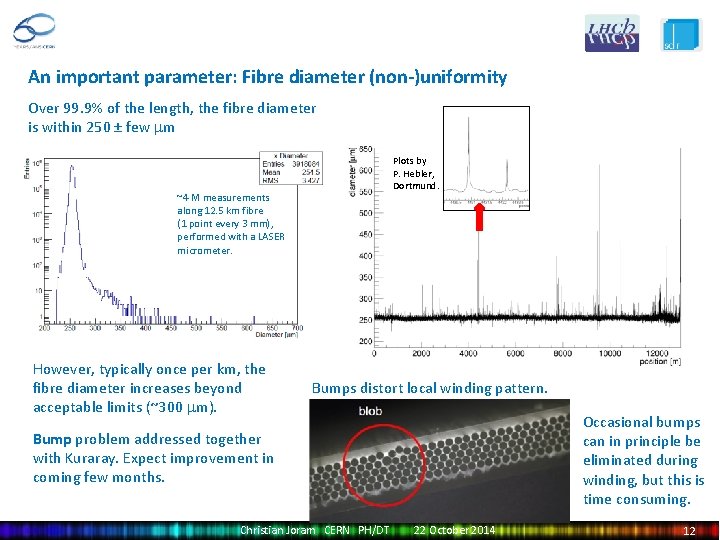
An important parameter: Fibre diameter (non-)uniformity Over 99. 9% of the length, the fibre diameter is within 250 ± few mm Plots by P. Hebler, Dortmund. ~4 M measurements along 12. 5 km fibre (1 point every 3 mm), performed with a LASER micrometer. However, typically once per km, the fibre diameter increases beyond acceptable limits (~300 mm). Bumps distort local winding pattern. Occasional bumps can in principle be eliminated during winding, but this is time consuming. Bump problem addressed together with Kuraray. Expect improvement in coming few months. Christian Joram CERN PH/DT 22 October 2014 12
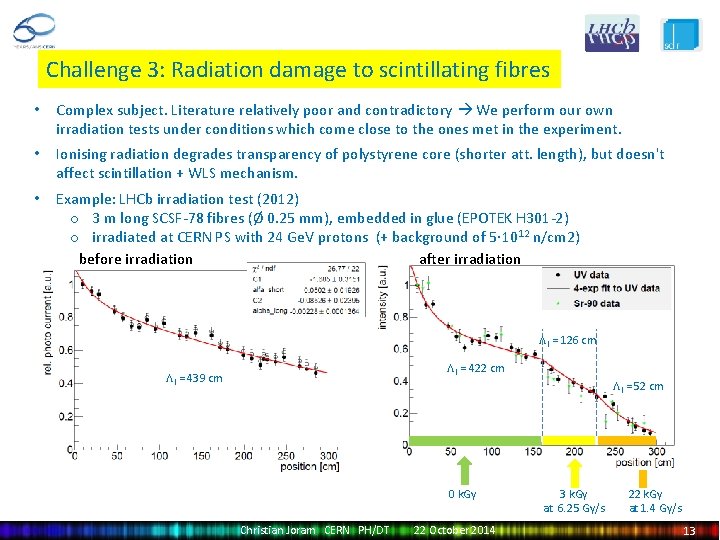
Challenge 3: Radiation damage to scintillating fibres • Complex subject. Literature relatively poor and contradictory We perform our own irradiation tests under conditions which come close to the ones met in the experiment. • Ionising radiation degrades transparency of polystyrene core (shorter att. length), but doesn't affect scintillation + WLS mechanism. • Example: LHCb irradiation test (2012) o 3 m long SCSF-78 fibres (Ø 0. 25 mm), embedded in glue (EPOTEK H 301 -2) o irradiated at CERN PS with 24 Ge. V protons (+ background of 5· 1012 n/cm 2) before irradiation after irradiation Ll = 126 cm Ll = 422 cm Ll = 439 cm Ll = 52 cm 0 k. Gy Christian Joram CERN PH/DT 22 October 2014 3 k. Gy at 6. 25 Gy/s 22 k. Gy at 1. 4 Gy/s 13
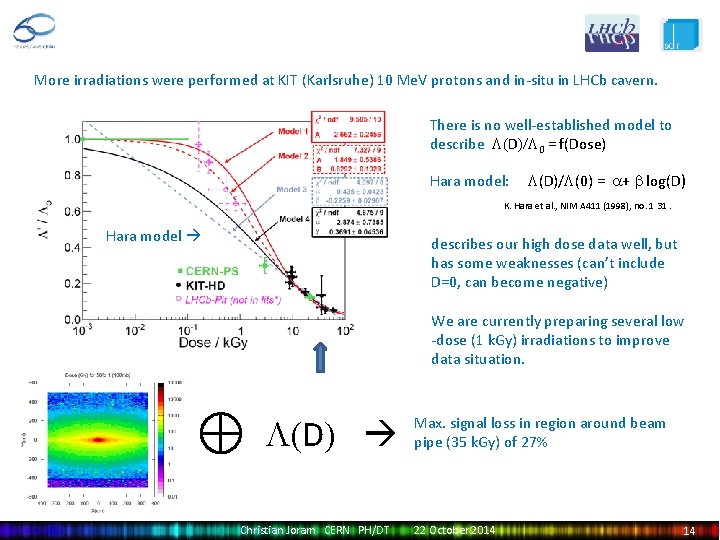
More irradiations were performed at KIT (Karlsruhe) 10 Me. V protons and in-situ in LHCb cavern. There is no well-established model to describe L(D)/L 0 = f(Dose) Hara model: L(D)/L(0) = a+ b log(D) K. Hara et al. , NIM A 411 (1998), no. 1 31. Hara model describes our high dose data well, but has some weaknesses (can’t include D=0, can become negative) We are currently preparing several low -dose (1 k. Gy) irradiations to improve data situation. L(D) Christian Joram CERN PH/DT Max. signal loss in region around beam pipe (35 k. Gy) of 27% 22 October 2014 14
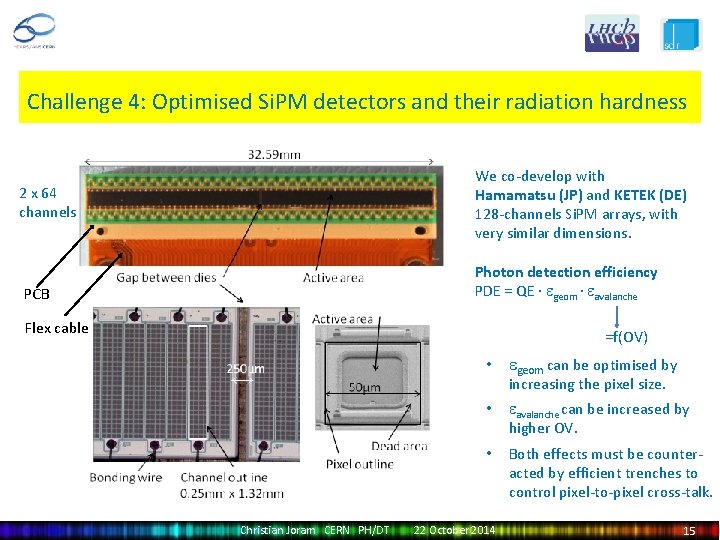
Challenge 4: Optimised Si. PM detectors and their radiation hardness We co-develop with Hamamatsu (JP) and KETEK (DE) 128 -channels Si. PM arrays, with very similar dimensions. 2 x 64 channels Photon detection efficiency PDE = QE · egeom · eavalanche PCB Flex cable =f(OV) • egeom can be optimised by increasing the pixel size. Christian Joram CERN PH/DT • eavalanche can be increased by higher OV. • Both effects must be counteracted by efficient trenches to control pixel-to-pixel cross-talk. 22 October 2014 15
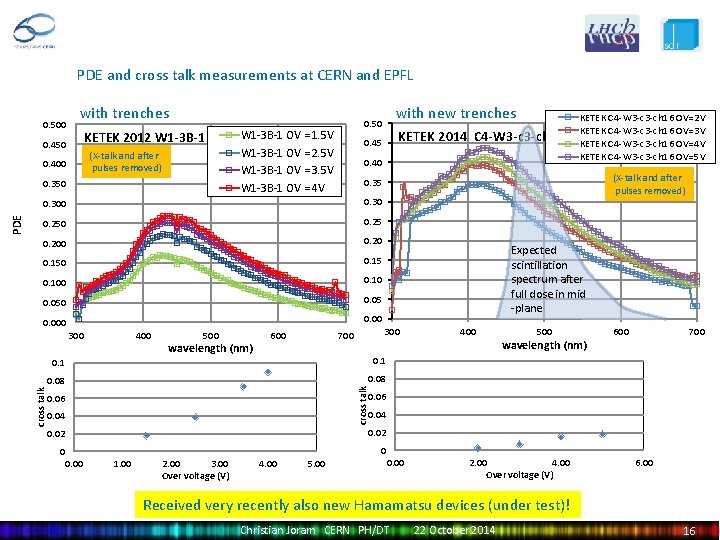
PDE and cross talk measurements at CERN and EPFL 0. 500 with trenches KETEK 2012 W 1 -3 B-1 0. 450 (X-talk and after pulses removed) 0. 400 W 1 -3 B-1 OV = 1. 5 V W 1 -3 B-1 OV = 2. 5 V W 1 -3 B-1 OV = 3. 5 V W 1 -3 B-1 OV = 4 V 0. 40 0. 25 0. 200 0. 20 0. 15 0. 100 0. 10 0. 05 0. 000 0. 00 400 500 wavelength (nm) 600 700 (X-talk and after pulses removed) Expected scintillation spectrum after full dose in mid -plane 300 0. 1 0. 08 cross talk 0. 1 0. 06 0. 04 KETEK C 4 -W 3 -ch 16 OV=2 V KETEK C 4 -W 3 -ch 16 OV=3 V KETEK C 4 -W 3 -ch 16 OV=4 V KETEK C 4 -W 3 -ch 16 OV=5 V 0. 35 0. 30 300 KETEK 2014 C 4 -W 3 -ch 16 0. 45 0. 300 cross talk PDE 0. 350 with new trenches 0. 50 400 500 wavelength (nm) 600 700 0. 06 0. 04 0. 02 0 0 0. 00 1. 00 2. 00 3. 00 Over voltage (V) 4. 00 5. 00 0. 00 2. 00 4. 00 Over voltage (V) 6. 00 Received very recently also new Hamamatsu devices (under test)! Christian Joram CERN PH/DT 22 October 2014 16
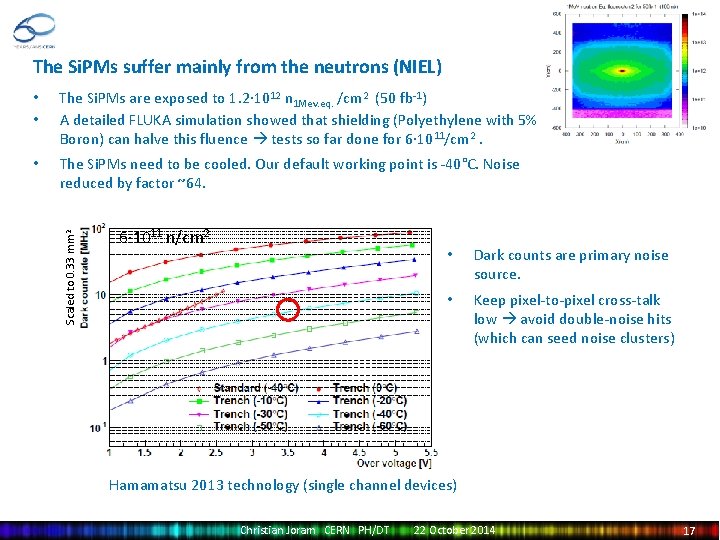
The Si. PMs suffer mainly from the neutrons (NIEL) The Si. PMs are exposed to 1. 2· 1012 n 1 Mev. eq. /cm 2 (50 fb-1) A detailed FLUKA simulation showed that shielding (Polyethylene with 5% Boron) can halve this fluence tests so far done for 6· 1011/cm 2. • The Si. PMs need to be cooled. Our default working point is -40°C. Noise reduced by factor ~64. Scaled to 0. 33 mm 2 • • 6· 1011 n/cm 2 • Dark counts are primary noise source. • Keep pixel-to-pixel cross-talk low avoid double-noise hits (which can seed noise clusters) Hamamatsu 2013 technology (single channel devices) Christian Joram CERN PH/DT 22 October 2014 17
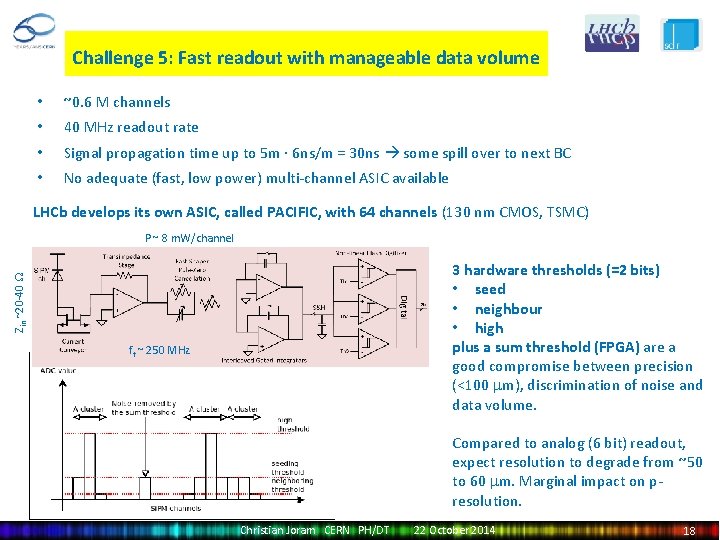
Challenge 5: Fast readout with manageable data volume • ~0. 6 M channels • 40 MHz readout rate • Signal propagation time up to 5 m · 6 ns/m = 30 ns some spill over to next BC • No adequate (fast, low power) multi-channel ASIC available LHCb develops its own ASIC, called PACIFIC, with 64 channels (130 nm CMOS, TSMC) P ~ 8 m. W/channel Zin ~20 -40 W 3 hardware thresholds (=2 bits) • seed • neighbour • high plus a sum threshold (FPGA) are a good compromise between precision (<100 mm), discrimination of noise and data volume. ff ~ 250 MHz Compared to analog (6 bit) readout, expect resolution to degrade from ~50 to 60 mm. Marginal impact on presolution. Christian Joram CERN PH/DT 22 October 2014 18
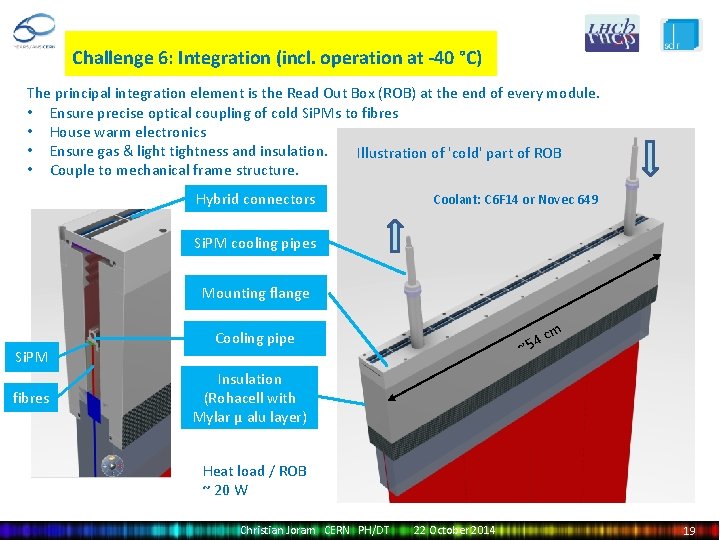
Challenge 6: Integration (incl. operation at -40 °C) The principal integration element is the Read Out Box (ROB) at the end of every module. • Ensure precise optical coupling of cold Si. PMs to fibres • House warm electronics • Ensure gas & light tightness and insulation. Illustration of 'cold' part of ROB • Couple to mechanical frame structure. Hybrid connectors Coolant: C 6 F 14 or Novec 649 Si. PM cooling pipes Mounting flange Si. PM fibres Cooling pipe 4 ~5 cm Insulation (Rohacell with Mylar µ alu layer) Heat load / ROB ~ 20 W Christian Joram CERN PH/DT 22 October 2014 19
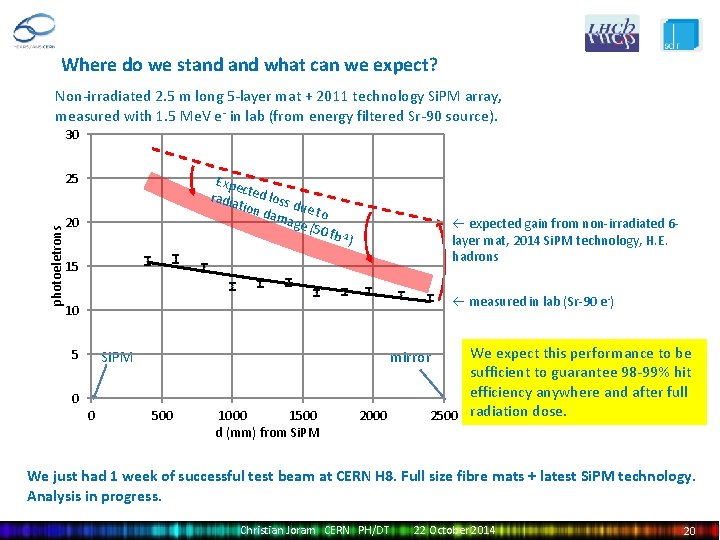
Where do we stand what can we expect? Non-irradiated 2. 5 m long 5 -layer mat + 2011 technology Si. PM array, measured with 1. 5 Me. V e- in lab (from energy filtered Sr-90 source). 30 photoeletrons 25 Expe c radia ted loss d tion dam ue to age (50 f -1 b ) 20 expected gain from non-irradiated 6 layer mat, 2014 Si. PM technology, H. E. hadrons 15 measured in lab (Sr-90 e-) 10 5 Si. PM 0 0 We expect this performance to be sufficient to guarantee 98 -99% hit efficiency anywhere and after full 2500 radiation dose. mirror 500 1000 1500 d (mm) from Si. PM 2000 We just had 1 week of successful test beam at CERN H 8. Full size fibre mats + latest Si. PM technology. Analysis in progress. Christian Joram CERN PH/DT 22 October 2014 20
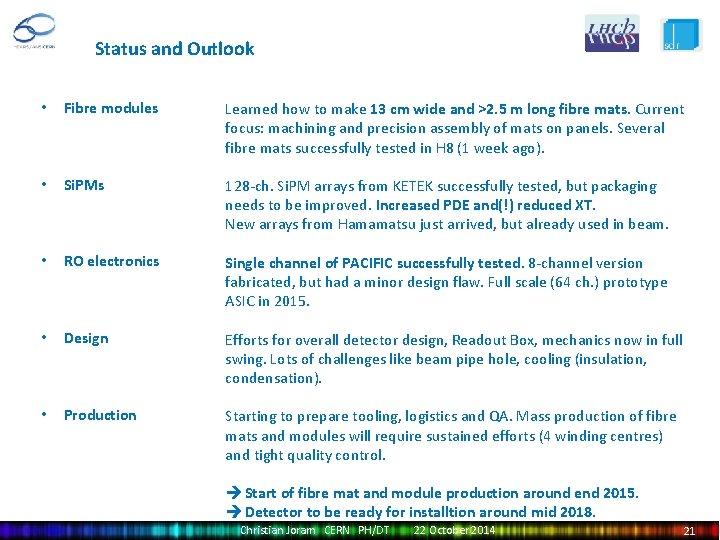
Status and Outlook • Fibre modules Learned how to make 13 cm wide and >2. 5 m long fibre mats. Current focus: machining and precision assembly of mats on panels. Several fibre mats successfully tested in H 8 (1 week ago). • Si. PMs 128 -ch. Si. PM arrays from KETEK successfully tested, but packaging needs to be improved. Increased PDE and(!) reduced XT. New arrays from Hamamatsu just arrived, but already used in beam. • RO electronics Single channel of PACIFIC successfully tested. 8 -channel version fabricated, but had a minor design flaw. Full scale (64 ch. ) prototype ASIC in 2015. • Design Efforts for overall detector design, Readout Box, mechanics now in full swing. Lots of challenges like beam pipe hole, cooling (insulation, condensation). • Production Starting to prepare tooling, logistics and QA. Mass production of fibre mats and modules will require sustained efforts (4 winding centres) and tight quality control. Start of fibre mat and module production around end 2015. Detector to be ready for installtion around mid 2018. Christian Joram CERN PH/DT 22 October 2014 21
- Slides: 21