
LHCb Rare Decays Status WG 6 CKM 2006
LHCb Rare Decays Status WG 6 – CKM 2006 Nagoya, Japan Jeremy Dickens on behalf of the LHCb Collaboration
Outline § LHCb detector § Bs mm § Bd K*mm § § § Signal yield and B/S Forward-backward asymmetry sensitivity Tranversity angles sensitivity § Measurement of RK § Radiative decays § § § Bd K * g Bs fg Lb Lg 14/12/06 Jeremy Dickens 2
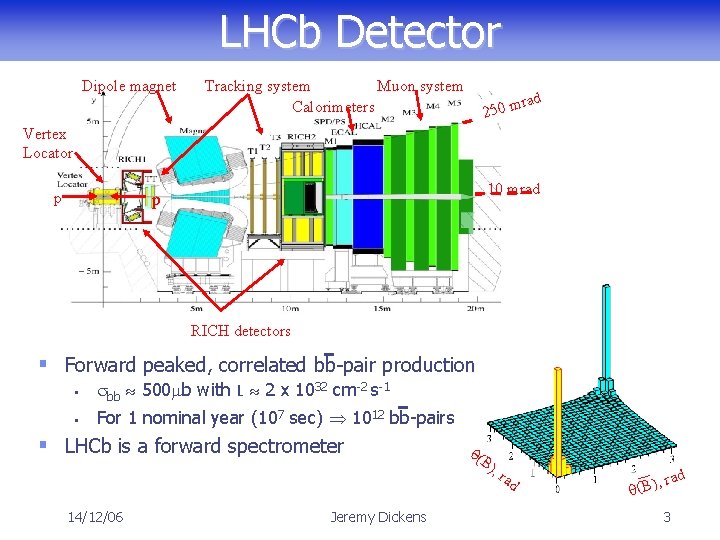
LHCb Detector Dipole magnet Tracking system Muon system Calorimeters ad r 250 m Vertex Locator 10 mrad p p RICH detectors § Forward peaked, correlated bb-pair production § bb 500 mb with L 2 x 1032 cm-2 s-1 § For 1 nominal year (107 sec) 1012 bb-pairs § LHCb is a forward spectrometer q( B) , r ad 14/12/06 Jeremy Dickens , rad q(B) 3
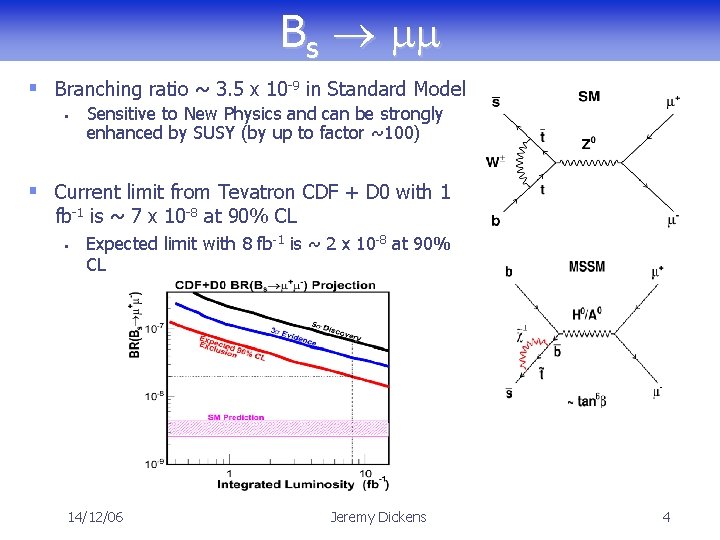
Bs mm § Branching ratio ~ 3. 5 x 10 -9 in Standard Model § Sensitive to New Physics and can be strongly enhanced by SUSY (by up to factor ~100) § Current limit from Tevatron CDF + D 0 with 1 fb-1 is ~ 7 x 10 -8 at 90% CL § Expected limit with 8 fb-1 is ~ 2 x 10 -8 at 90% CL 14/12/06 Jeremy Dickens 4
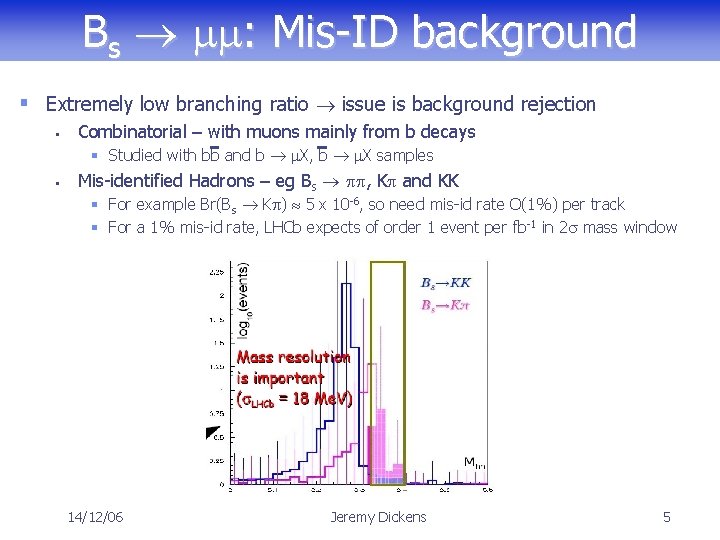
Bs mm: Mis-ID background § Extremely low branching ratio issue is background rejection § Combinatorial – with muons mainly from b decays § Studied with bb and b m. X, b m. X samples § Mis-identified Hadrons – eg Bs pp, Kp and KK § For example Br(Bs Kp) 5 x 10 -6, so need mis-id rate O(1%) per track § For a 1% mis-id rate, LHCb expects of order 1 event per fb-1 in 2 mass window 14/12/06 Jeremy Dickens 5
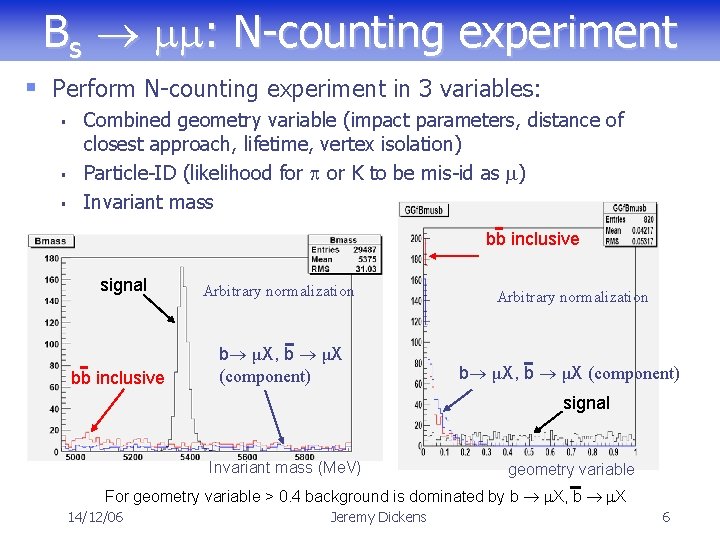
Bs mm: N-counting experiment § Perform N-counting experiment in 3 variables: § § § Combined geometry variable (impact parameters, distance of closest approach, lifetime, vertex isolation) Particle-ID (likelihood for p or K to be mis-id as m) Invariant mass bb inclusive signal bb inclusive Arbitrary normalization b μX, b μX (component) signal Invariant mass (Me. V) geometry variable For geometry variable > 0. 4 background is dominated by b m. X, b m. X 14/12/06 Jeremy Dickens 6
Bs mm: N-counting experiment § For example, with a cut on geometry (> 0. 4) and invariant mass (± 30 Me. V) expect: § § No cut actually applied in the analysis fb-1 ~19 signal events per (SM) [54, 295] background events per fb-1 (90% CL) § Better sensitivity from N-counting method § Each variable is divided into several bins § b m-X, b m+X used to compute expected background in each 3 D bin § Limited MC statistics many bins have little or zero background § Background is shifted upward in each bin so that total background has 90% probability to be below this value § Compute confidence levels for observation and exclusion 14/12/06 Jeremy Dickens 7
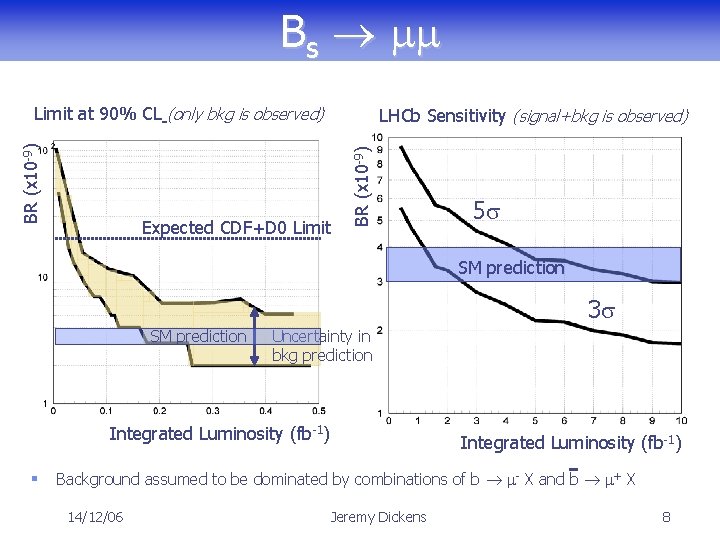
Bs mm LHCb Sensitivity (signal+bkg is observed) Expected CDF+D 0 Limit BR (x 10 -9) Limit at 90% CL (only bkg is observed) 5 SM prediction 3 SM prediction Uncertainty in bkg prediction Integrated Luminosity (fb-1) § Integrated Luminosity (fb-1) Background assumed to be dominated by combinations of b m- X and b m+ X 14/12/06 Jeremy Dickens 8
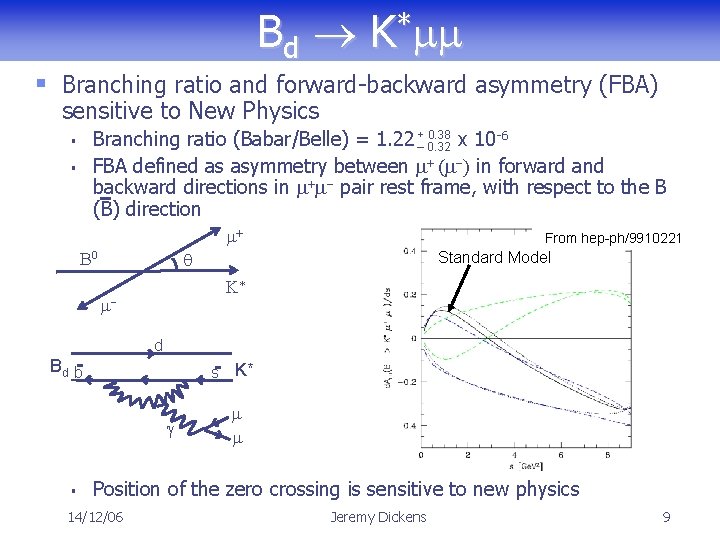
Bd K*mm § Branching ratio and forward-backward asymmetry (FBA) sensitive to New Physics 0. 38 Branching ratio (Babar/Belle) = 1. 22 +– 0. 32 x 10 -6 FBA defined as asymmetry between m+ (m-) in forward and backward directions in m+m- pair rest frame, with respect to the B (B) direction § § m+ B 0 From hep-ph/9910221 q Standard Model K* md Bd b s g § K* m m Position of the zero crossing is sensitive to new physics 14/12/06 Jeremy Dickens 9
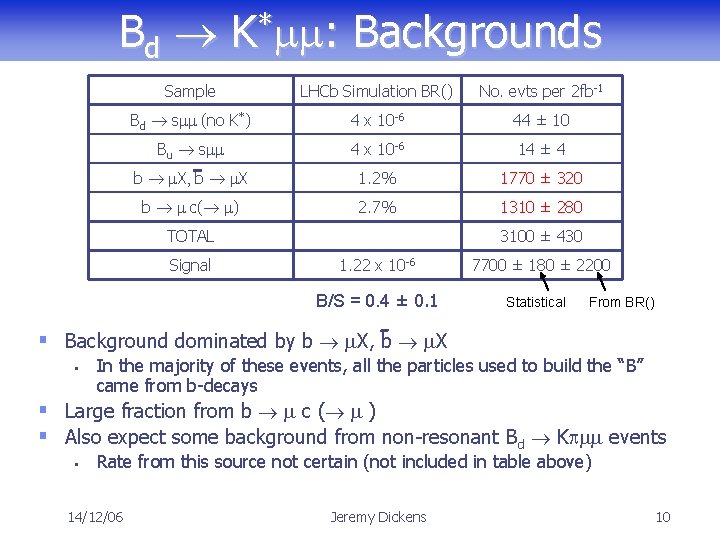
Bd K*mm: Backgrounds Sample LHCb Simulation BR() No. evts per 2 fb-1 Bd smm (no K*) 4 x 10 -6 44 ± 10 Bu smm 4 x 10 -6 14 ± 4 b m. X, b m. X 1. 2% 1770 ± 320 b m c( m) 2. 7% 1310 ± 280 TOTAL Signal 3100 ± 430 1. 22 x 10 -6 B/S = 0. 4 ± 0. 1 7700 ± 180 ± 2200 Statistical From BR() § Background dominated by b m. X, b m. X § In the majority of these events, all the particles used to build the “B” came from b-decays § Large fraction from b m c ( m ) § Also expect some background from non-resonant Bd Kpmm events § Rate from this source not certain (not included in table above) 14/12/06 Jeremy Dickens 10

Bd K*mm: FBA sensitivity § Toy model based on LHCb simulation: § § § Large sample of generator level events Smaller sample of fully simulated events (include detector effects) Take resolutions, acceptances and background from the fully simulated events, in bins of Mmm (0 3 Ge. V) and q. FBA (0 p) § Mmm (q. FBA) resolution ~ 10 Me. V (4 mrad) ~3% (~1%) of bin width § § § Sample from (fluctuated) generator level distributions, applying the acceptance functions, to simulate a large number of 2 (10) fb -1 experiments. Calculate and fit FBA for each data set to find the zero-crossing point Quoted sensitivity is then the standard deviation of the fitted zero points from a large number of experiments 14/12/06 Jeremy Dickens 11
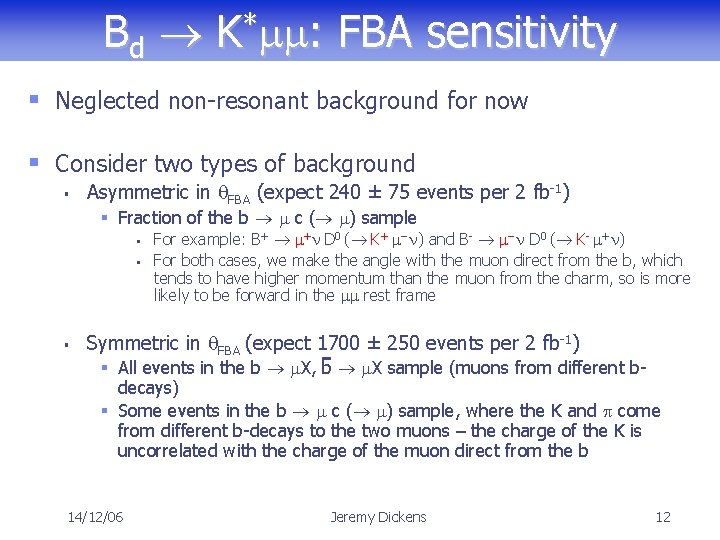
Bd K*mm: FBA sensitivity § Neglected non-resonant background for now § Consider two types of background § Asymmetric in q. FBA (expect 240 ± 75 events per 2 fb-1) § Fraction of the b m c ( m) sample § § § For example: B+ m+ n D 0 ( K+ m- n) and B- m- n D 0 ( K- m+ n) For both cases, we make the angle with the muon direct from the b, which tends to have higher momentum than the muon from the charm, so is more likely to be forward in the mm rest frame Symmetric in q. FBA (expect 1700 ± 250 events per 2 fb-1) § All events in the b m. X, b m. X sample (muons from different bdecays) § Some events in the b m c ( m) sample, where the K and p come from different b-decays to the two muons – the charge of the K is uncorrelated with the charge of the muon direct from the b 14/12/06 Jeremy Dickens 12
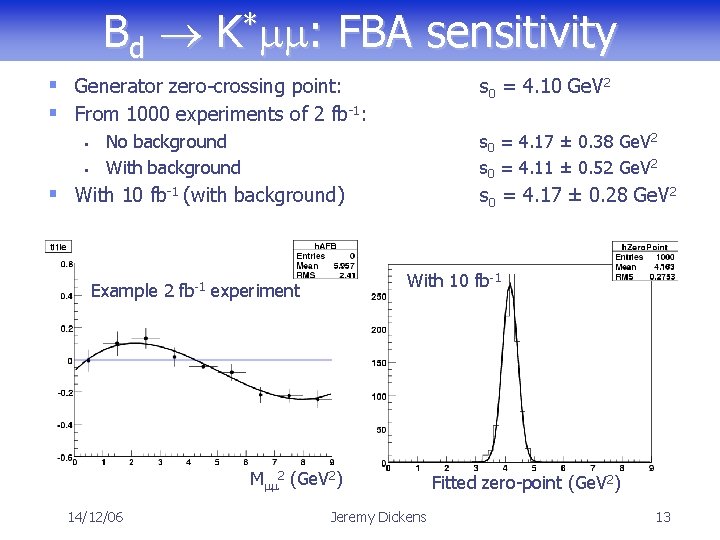
Bd K*mm: FBA sensitivity § Generator zero-crossing point: § From 1000 experiments of 2 fb-1: § § s 0 = 4. 10 Ge. V 2 No background With background s 0 = 4. 17 ± 0. 38 Ge. V 2 s 0 = 4. 11 ± 0. 52 Ge. V 2 § With 10 fb-1 (with background) Example 2 fb-1 s 0 = 4. 17 ± 0. 28 Ge. V 2 With 10 fb-1 experiment Mmm 2 (Ge. V 2) 14/12/06 Jeremy Dickens Fitted zero-point (Ge. V 2) 13
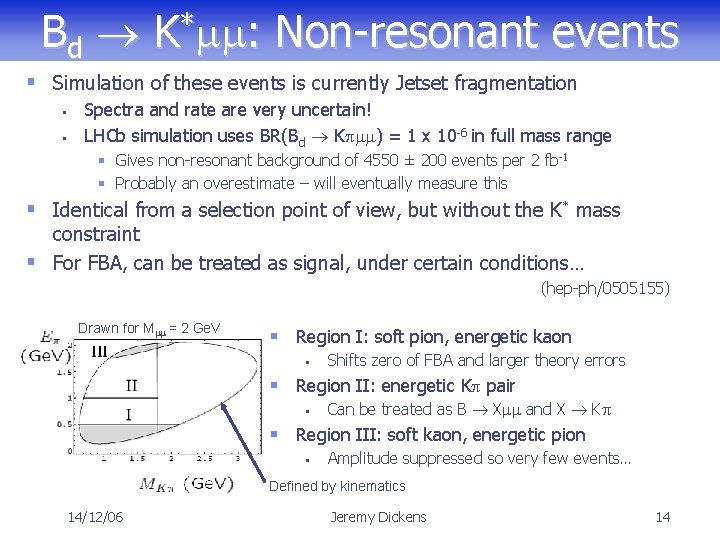
Bd K*mm: Non-resonant events § Simulation of these events is currently Jetset fragmentation § § Spectra and rate are very uncertain! LHCb simulation uses BR(Bd Kpmm) = 1 x 10 -6 in full mass range § Gives non-resonant background of 4550 ± 200 events per 2 fb-1 § Probably an overestimate – will eventually measure this § Identical from a selection point of view, but without the K* mass constraint § For FBA, can be treated as signal, under certain conditions… (hep-ph/0505155) Drawn for Mmm = 2 Ge. V § Region I: soft pion, energetic kaon § Shifts zero of FBA and larger theory errors § Region II: energetic Kp pair § Can be treated as B Xmm and X Kp § Region III: soft kaon, energetic pion § Amplitude suppressed so very few events… Defined by kinematics 14/12/06 Jeremy Dickens 14
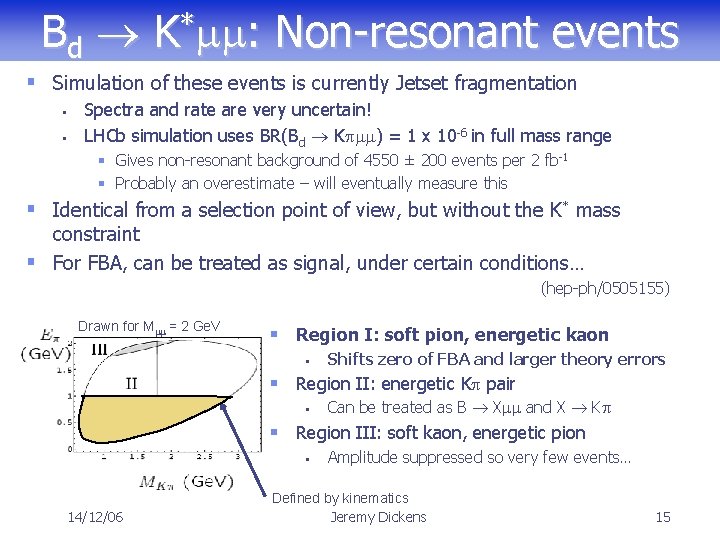
Bd K*mm: Non-resonant events § Simulation of these events is currently Jetset fragmentation § § Spectra and rate are very uncertain! LHCb simulation uses BR(Bd Kpmm) = 1 x 10 -6 in full mass range § Gives non-resonant background of 4550 ± 200 events per 2 fb-1 § Probably an overestimate – will eventually measure this § Identical from a selection point of view, but without the K* mass constraint § For FBA, can be treated as signal, under certain conditions… (hep-ph/0505155) Drawn for Mmm = 2 Ge. V § Region I: soft pion, energetic kaon § Shifts zero of FBA and larger theory errors § Region II: energetic Kp pair § Can be treated as B Xmm and X Kp § Region III: soft kaon, energetic pion § 14/12/06 Amplitude suppressed so very few events… Defined by kinematics Jeremy Dickens 15

Bd K*mm: Non-resonant events § Simulation of these events is currently Jetset fragmentation § § Spectra and rate are very uncertain! LHCb simulation uses BR(Bd Kpmm) = 1 x 10 -6 in full mass range § Gives non-resonant background of 4550 ± 200 events per 2 fb-1 § Probably an overestimate – will eventually measure this § Identical from a selection point of view, but without the K* mass constraint § For FBA, can be treated as signal, under certain conditions… (hep-ph/0505155) Drawn for Mmm = 2 Ge. V § Region I: soft pion, energetic kaon § Shifts zero of FBA and larger theory errors § Region II: energetic Kp pair § Can be treated as B Xmm and X Kp § Region III: soft kaon, energetic pion § 14/12/06 Amplitude suppressed so very few events… Defined by kinematics Jeremy Dickens 16
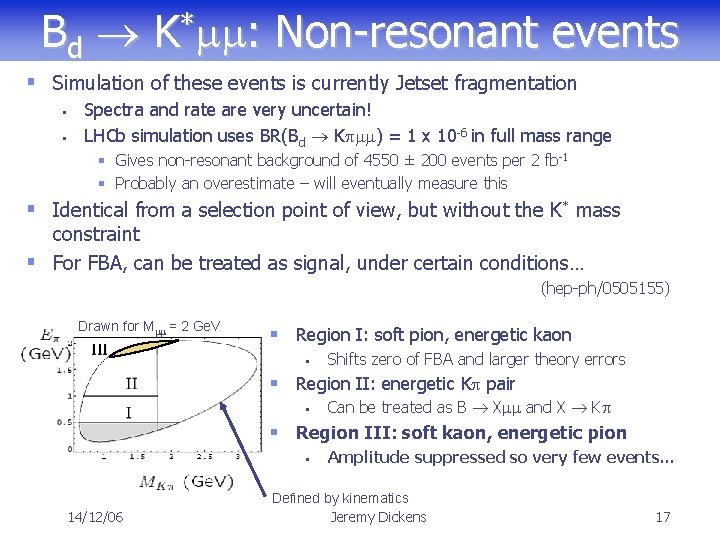
Bd K*mm: Non-resonant events § Simulation of these events is currently Jetset fragmentation § § Spectra and rate are very uncertain! LHCb simulation uses BR(Bd Kpmm) = 1 x 10 -6 in full mass range § Gives non-resonant background of 4550 ± 200 events per 2 fb-1 § Probably an overestimate – will eventually measure this § Identical from a selection point of view, but without the K* mass constraint § For FBA, can be treated as signal, under certain conditions… (hep-ph/0505155) Drawn for Mmm = 2 Ge. V § Region I: soft pion, energetic kaon § Shifts zero of FBA and larger theory errors § Region II: energetic Kp pair § Can be treated as B Xmm and X Kp § Region III: soft kaon, energetic pion § 14/12/06 Amplitude suppressed so very few events… Defined by kinematics Jeremy Dickens 17
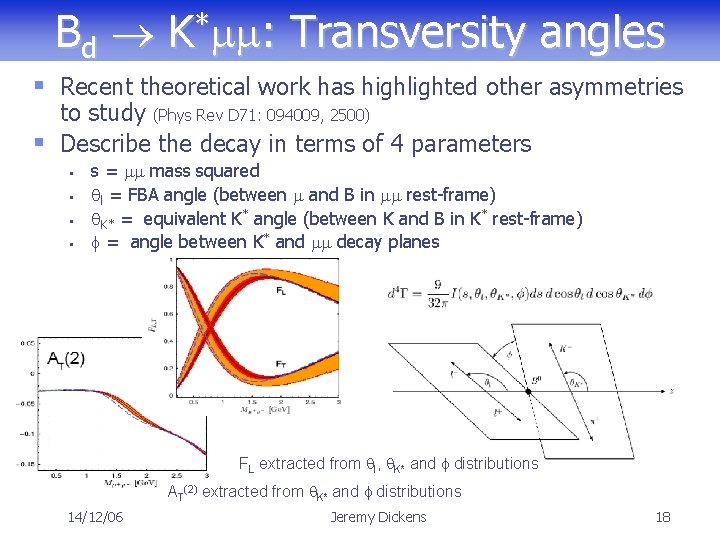
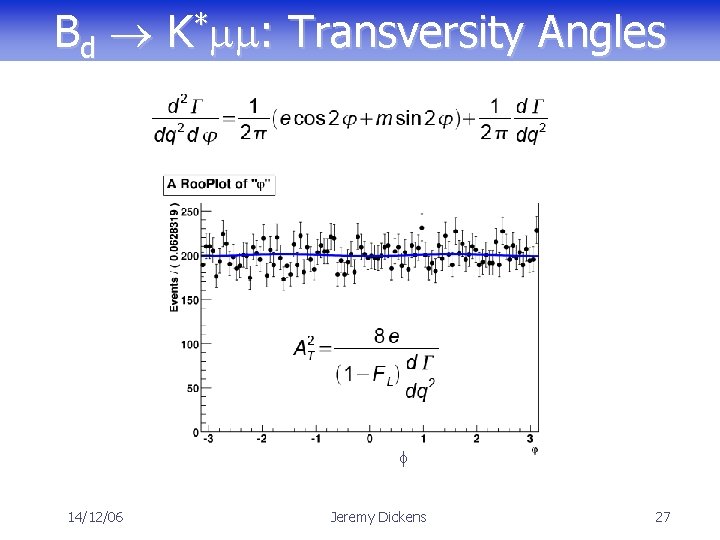
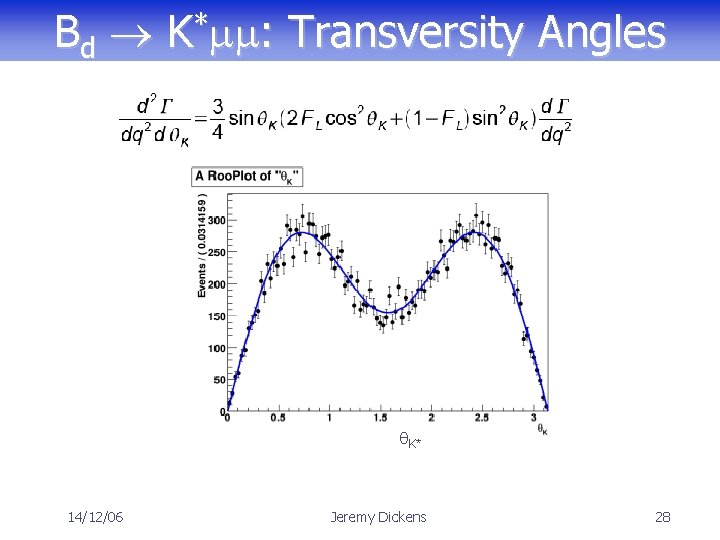
Bd K*mm: Transversity angles § Recent theoretical work has highlighted other asymmetries to study (Phys Rev D 71: 094009, 2500) § Describe the decay in terms of 4 parameters § § s = mm mass squared ql = FBA angle (between m and B in mm rest-frame) q. K* = equivalent K* angle (between K and B in K* rest-frame) f = angle between K* and mm decay planes FL extracted from ql, q. K* and f distributions AT(2) extracted from q. K* and f distributions 14/12/06 Jeremy Dickens 18
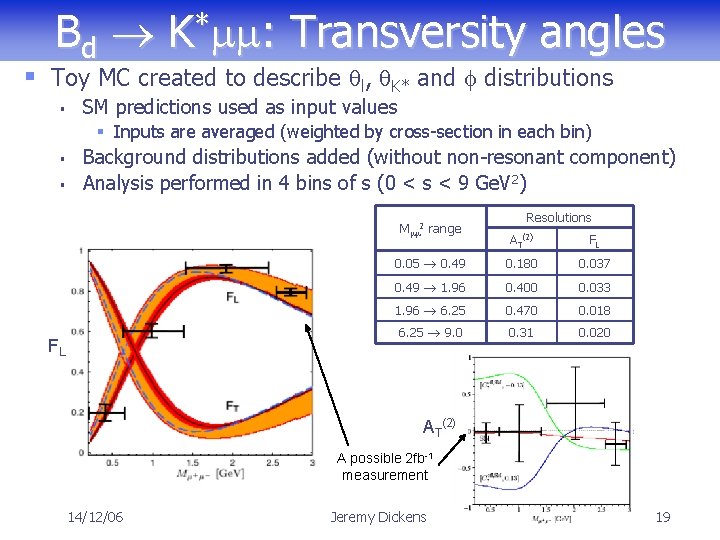
Bd K*mm: Transversity angles § Toy MC created to describe ql, q. K* and f distributions § SM predictions used as input values § Inputs are averaged (weighted by cross-section in each bin) § § Background distributions added (without non-resonant component) Analysis performed in 4 bins of s (0 < s < 9 Ge. V 2) Mmm 2 range FL Resolutions AT(2) FL 0. 05 0. 49 0. 180 0. 037 0. 49 1. 96 0. 400 0. 033 1. 96 6. 25 0. 470 0. 018 6. 25 9. 0 0. 31 0. 020 AT(2) A possible 2 fb-1 measurement 14/12/06 Jeremy Dickens 19
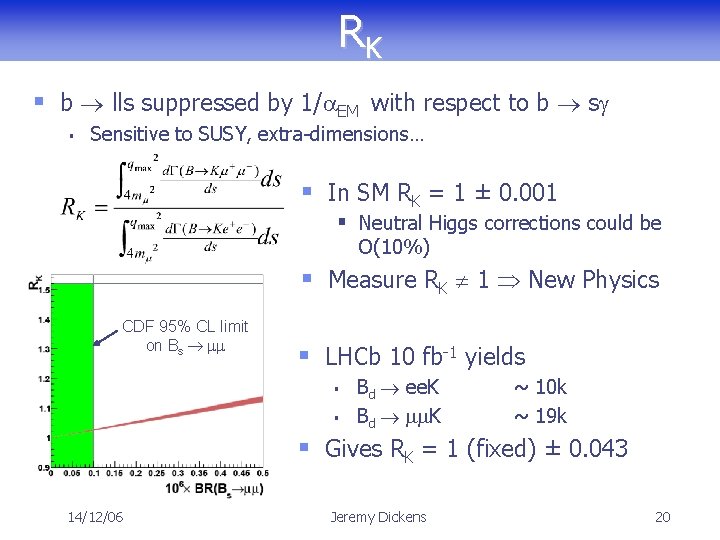
RK § b lls suppressed by 1/a. EM with respect to b sg § Sensitive to SUSY, extra-dimensions… § In SM RK = 1 ± 0. 001 § Neutral Higgs corrections could be O(10%) § Measure RK 1 New Physics CDF 95% CL limit on Bs mm § LHCb 10 fb-1 yields § § Bd ee. K Bd mm. K ~ 10 k ~ 19 k § Gives RK = 1 (fixed) ± 0. 043 14/12/06 Jeremy Dickens 20
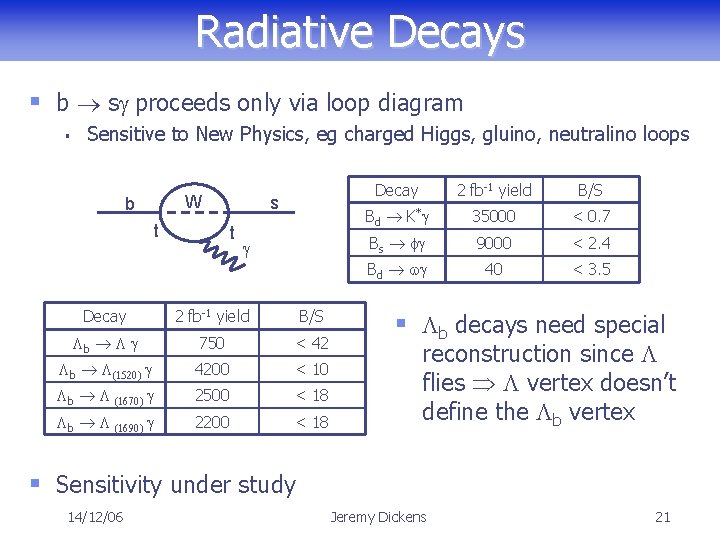
Radiative Decays § b sg proceeds only via loop diagram Sensitive to New Physics, eg charged Higgs, gluino, neutralino loops W b t s § t g Decay 2 fb-1 yield B/S Lb L g 750 < 42 Lb L(1520) g 4200 < 10 Lb L (1670) g 2500 < 18 Lb L (1690) g 2200 < 18 Decay 2 fb-1 yield B/S Bd K*g 35000 < 0. 7 Bs fg 9000 < 2. 4 Bd wg 40 < 3. 5 § Lb decays need special reconstruction since L flies L vertex doesn’t define the Lb vertex § Sensitivity under study 14/12/06 Jeremy Dickens 21
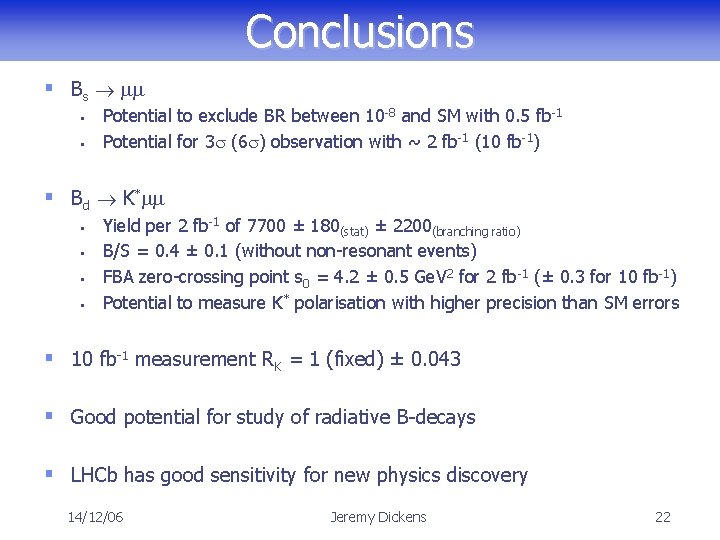
Conclusions § Bs mm § § Potential to exclude BR between 10 -8 and SM with 0. 5 fb-1 Potential for 3 (6 ) observation with ~ 2 fb-1 (10 fb-1) § Bd K*mm § § Yield per 2 fb-1 of 7700 ± 180(stat) ± 2200(branching ratio) B/S = 0. 4 ± 0. 1 (without non-resonant events) FBA zero-crossing point s 0 = 4. 2 ± 0. 5 Ge. V 2 for 2 fb-1 (± 0. 3 for 10 fb-1) Potential to measure K* polarisation with higher precision than SM errors § 10 fb-1 measurement RK = 1 (fixed) ± 0. 043 § Good potential for study of radiative B-decays § LHCb has good sensitivity for new physics discovery 14/12/06 Jeremy Dickens 22
SPARE 14/12/06 Jeremy Dickens 23
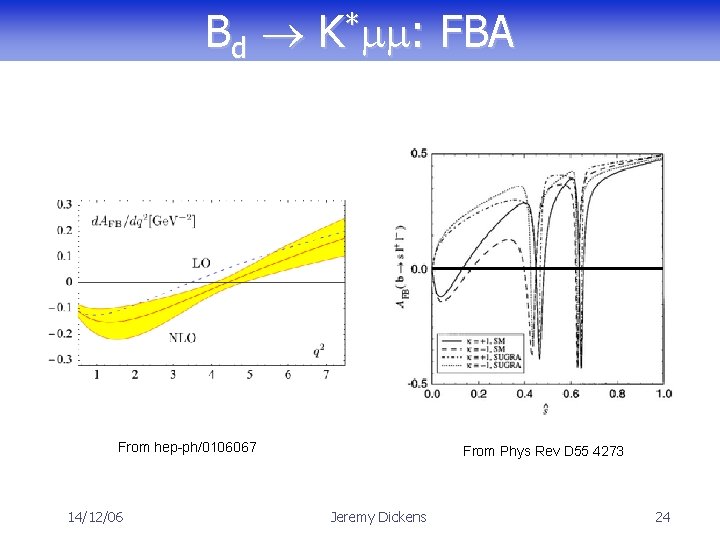
Bd K*mm: FBA From hep-ph/0106067 14/12/06 From Phys Rev D 55 4273 Jeremy Dickens 24
Bd K*mm § Non-resonant background (Bd Kpmm) § Current branching ratio in LHCb simulation is 1 x 10 -6 § Not yet observed – may be too large? § Recent theoretical work suggests that in some kinematic regions (requires energetic Kp pair), these events should have the same FBA as the signal (resonant) events § May be able to treat the events as signal 14/12/06 (hep-ex/0604007) Jeremy Dickens (hep-ph/0505155) 25
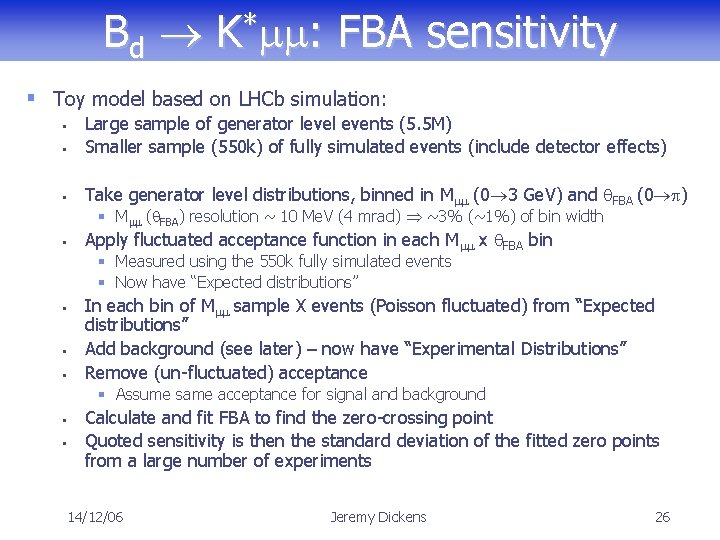
Bd K*mm: FBA sensitivity § Toy model based on LHCb simulation: § Large sample of generator level events (5. 5 M) Smaller sample (550 k) of fully simulated events (include detector effects) § Take generator level distributions, binned in Mmm (0 3 Ge. V) and q. FBA (0 p) § § Mmm (q. FBA) resolution ~ 10 Me. V (4 mrad) ~3% (~1%) of bin width § Apply fluctuated acceptance function in each Mmm x q. FBA bin § Measured using the 550 k fully simulated events § Now have “Expected distributions” § § § In each bin of Mmm sample X events (Poisson fluctuated) from “Expected distributions” Add background (see later) – now have “Experimental Distributions” Remove (un-fluctuated) acceptance § Assume same acceptance for signal and background § § Calculate and fit FBA to find the zero-crossing point Quoted sensitivity is then the standard deviation of the fitted zero points from a large number of experiments 14/12/06 Jeremy Dickens 26
Bd K*mm: Transversity Angles f 14/12/06 Jeremy Dickens 27
Bd K*mm: Transversity Angles q. K* 14/12/06 Jeremy Dickens 28
- Slides: 28