
LHC signals q Can we interpret the new



- Slides: 46
LHC signals q Can we interpret the new physics when it is discovered? q Can we relate it to the underlying theory? Gordy Kane SUSY 08, Seoul, June 08
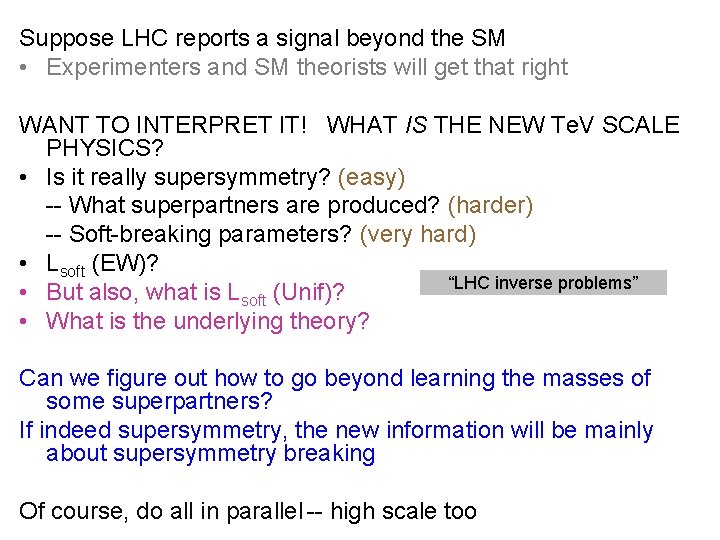
Suppose LHC reports a signal beyond the SM • Experimenters and SM theorists will get that right WANT TO INTERPRET IT! WHAT IS THE NEW Te. V SCALE PHYSICS? • Is it really supersymmetry? (easy) -- What superpartners are produced? (harder) -- Soft-breaking parameters? (very hard) • Lsoft (EW)? “LHC inverse problems” • But also, what is Lsoft (Unif)? • What is the underlying theory? Can we figure out how to go beyond learning the masses of some superpartners? If indeed supersymmetry, the new information will be mainly about supersymmetry breaking Of course, do all in parallel -- high scale too
Philosophy All clues we have are consistent with and suggestive of an underlying theory that unifies all forces at a short distance scale not far from the Planck scale, and is perturbative to the unification scale In that theory most important questions can be addressed – matter spectrum, dark matter, matter asymmetry, EWSB, hierarchy problem, CPV, supersymmetry breaking, unification of forces, etc Assume this framework is correct until forced to give it up – an attractive world, in which we can understand much – don’t give up addressing important questions
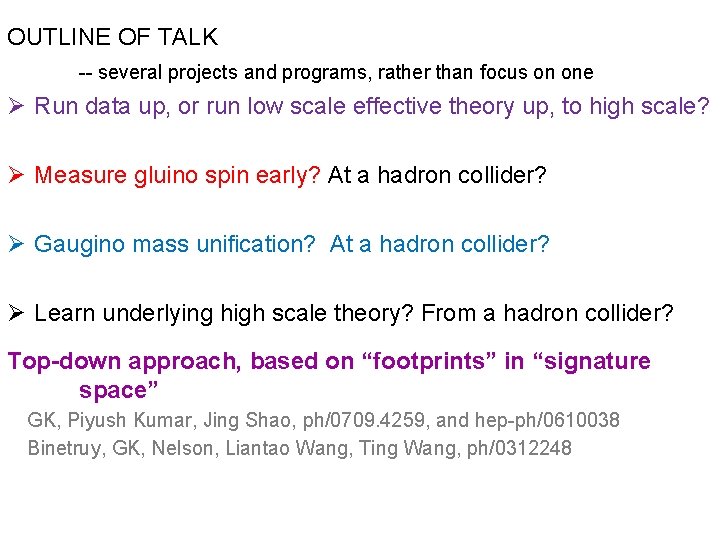
OUTLINE OF TALK -- several projects and programs, rather than focus on one Ø Run data up, or run low scale effective theory up, to high scale? Ø Measure gluino spin early? At a hadron collider? Ø Gaugino mass unification? At a hadron collider? Ø Learn underlying high scale theory? From a hadron collider? Top-down approach, based on “footprints” in “signature space” GK, Piyush Kumar, Jing Shao, ph/0709. 4259, and hep-ph/0610038 Binetruy, GK, Nelson, Liantao Wang, Ting Wang, ph/0312248
Already some study of EW scale LHC inverse problems -- LHCO, effective theories, degeneracies, marmoset … But little study of physics obstacles to extrapolating up correctly, even with accurate data -- Kumar, GK, Morrissey, Toharia (ph/0612287) -- Cohen, Roy, Schmaltz hidden sector effects -- much more work needed here
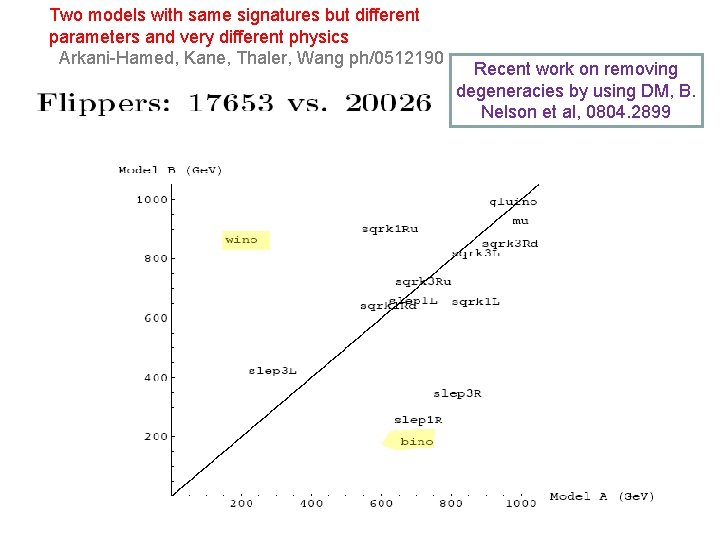
Two models with same signatures but different parameters and very different physics Arkani-Hamed, Kane, Thaler, Wang ph/0512190 Recent work on removing degeneracies by using DM, B. Nelson et al, 0804. 2899
SIGNATURES Think about what experimenters actually report -“signatures”, e. g. -- number of events with ET > 100 Ge. V, 2 or more jets (E>50 Ge. V), etc, and distribution of such events vs. PT of most energetic jet, etc – number of events with lepton pairs with same sign charge and opposite flavor and ET>100 Ge. V, etc From these, can we figure out what new physics is produced, and how to interpret it? Very difficult to measure most superpartner masses, tan , etc But it is possible to study gaugino mass unification, LSP, underlying theory, etc, using such signatures
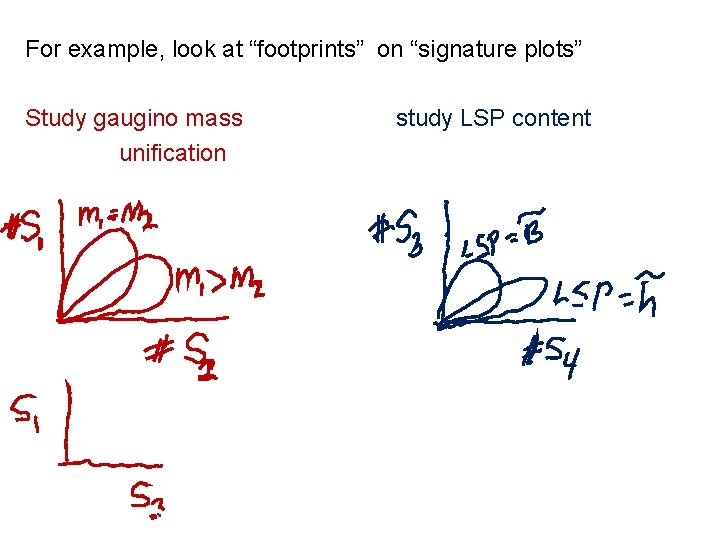
For example, look at “footprints” on “signature plots” Study gaugino mass unification study LSP content
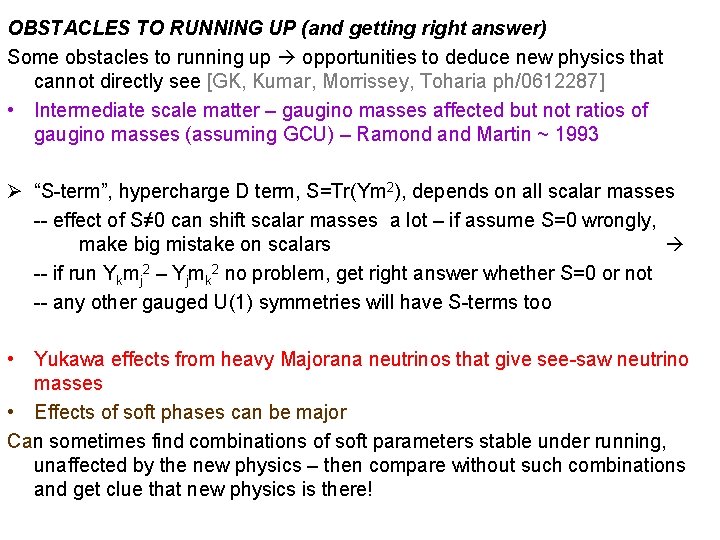
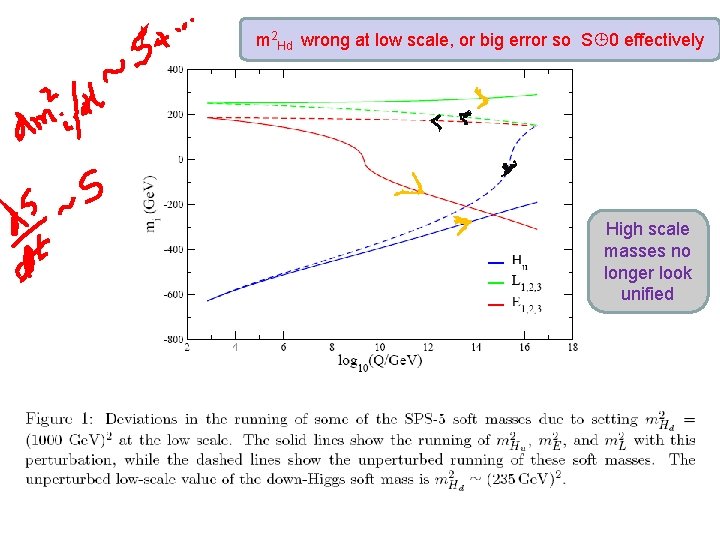
OBSTACLES TO RUNNING UP (and getting right answer) Some obstacles to running up opportunities to deduce new physics that cannot directly see [GK, Kumar, Morrissey, Toharia ph/0612287] • Intermediate scale matter – gaugino masses affected but not ratios of gaugino masses (assuming GCU) – Ramond and Martin ~ 1993 Ø “S-term”, hypercharge D term, S=Tr(Ym 2), depends on all scalar masses -- effect of S≠ 0 can shift scalar masses a lot – if assume S=0 wrongly, make big mistake on scalars -- if run Ykmj 2 – Yjmk 2 no problem, get right answer whether S=0 or not -- any other gauged U(1) symmetries will have S-terms too • Yukawa effects from heavy Majorana neutrinos that give see-saw neutrino masses • Effects of soft phases can be major Can sometimes find combinations of soft parameters stable under running, unaffected by the new physics – then compare without such combinations and get clue that new physics is there!
m 2 Hd wrong at low scale, or big error so S 0 effectively High scale masses no longer look unified
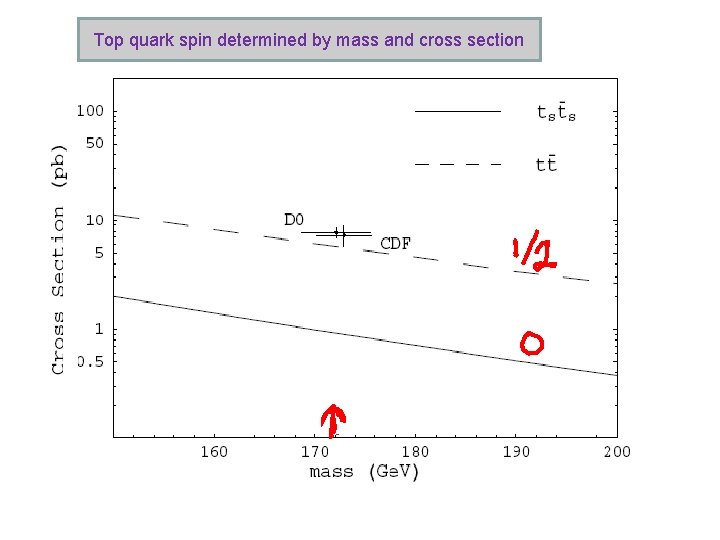
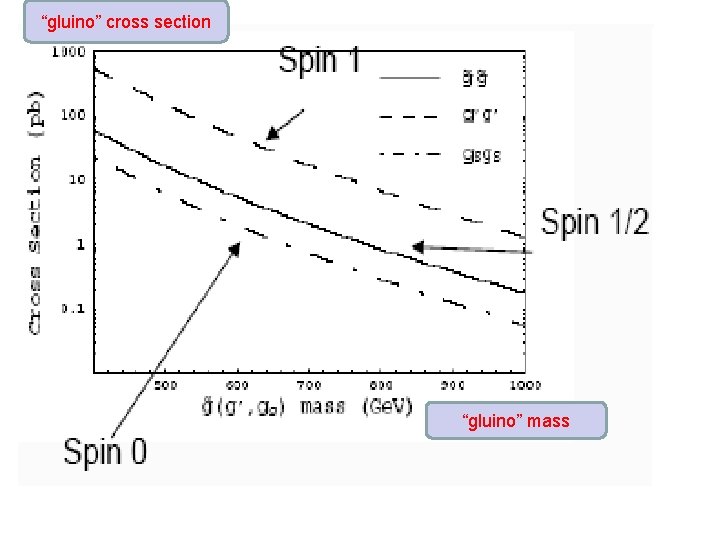
IS IT SUSY? MEASURE GLUINO SPIN! Early? GK, Petrov, Shao, Wang 0805. 1387 § Suppose a good signal is found at LHC § Gluino? Or little running large KK extra …? § Want to determine spin – gluino spin ½, others integer § Suppose measure mass – then production cross section uniquely predicted § Spin quantized, usually quite different rates for different spins § For larger signals production usually QCD, in general SM, so rate known § Only use total rate(s), not bins, so should work early § But could be seeing mass difference rather than mass, or have several contributions – then heavier alternative could fake gluino – can break degeneracy with any observables sensitive to relative strengths of say gluino pair, squark-gluino, squark-squark – measure several rates instead of mass § Not guaranteed to always work, but should work for most “worlds” – initially assume standard color and other quantum numbers, couplings, later check § Currently applying method to benchmark models – will also get more accurate estimates of needed luminosity See also Hubisz, Lykken, Pierini, Spiropulu 0805. 2398
Top quark spin determined by mass and cross section
“gluino” cross section “gluino” mass
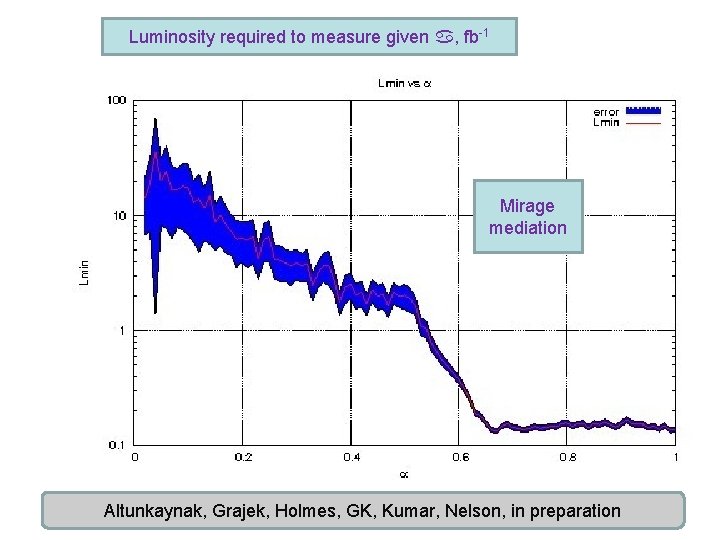
GAUGINO MASS UNIFICATION Would like to learn if gaugino masses unified at high scale -- could be an important way to favor certain theories Unlikely to measure all gaugino masses, or to run them up and get precision result But signatures are sensitive to the high scale gaugino masses – so can find several signatures that allow testing GMU -- paper gives signatures, why sensitive Initial study for one parameter mirage mediation (K. Choi et al) – more complicated analyses underway See also Choi and Nilles, ph/0702146; Everett, Kim, Ouyang, Zurek, 0804. 0592
Luminosity required to measure given , fb-1 Mirage mediation Altunkaynak, Grajek, Holmes, GK, Kumar, Nelson, in preparation
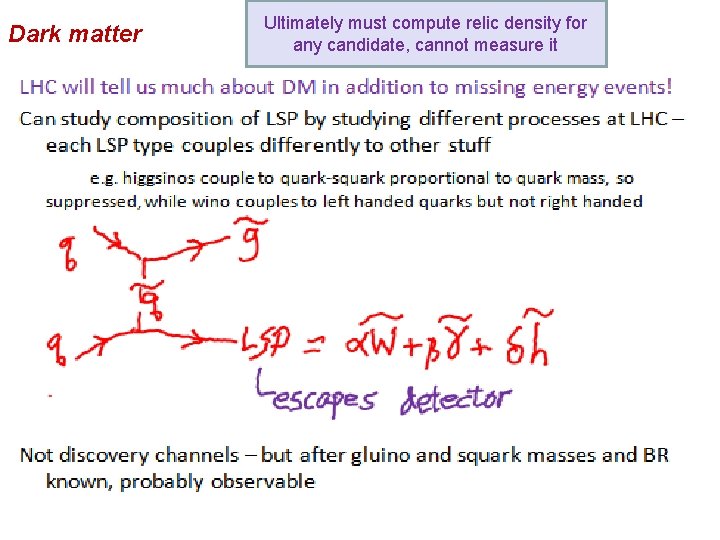
Dark matter Ultimately must compute relic density for any candidate, cannot measure it
UNDERLYING THEORY ? Most work relating to underlying theory so far: Calculate top-down example, with specific guessed parameters -- hope what is found can be recognized as what was calculated Today – instead argue that phenomenologically it makes sense to analyze semi-realistic classes of underlying (e. g. string) theory motivated vacua – makes sense to try to map LHC signatures onto these, connect patters of signatures to classes of such vacua -- systematic procedure Supersymmetric weak scale effective theories have “ 105 parameters” – but supersymmetric low scale theories from an underlying high scale theory may have only a few parameters!
Note degeneracy issue from point of view of underlying theory – underlying (e. g. string) theory will have some not-yet-determined parameters (that affect collider results) at its natural scale Mpl – the low scale effective theory has many parameters, e. g 105 – but all calculable from the underlying theory – if express the (7 --20) collider parameters in terms of the high scale theory parameters, many degeneracies eliminated Of course, don’t know the correct underlying theory (yet) But the signatures do depend on the parameters, and so the patterns of signatures reflect the parameters – so try to approach data in the context of underlying theory to improve situation
Could (and should) pursue this approach in any “theory” – prefer to use string theory here since well motivated -- string theories address all issues (but maybe Λ) – have string-based models that essentially have SM, GCU, softly broken supersymmetry, DM, EW symmetry breaking, etc -- can do reliable calculations in some cases with moduli stabilized, in valid supergravity approximation – currently several semirealistic examples known, so can compare So two themes here: q General approach to relating LHC data and underlying theory q Focus on relating string-motivated theories to low scale data, LHC
Not trying to make stronger claims about what is known about string theories than what is justified – no full constructions yet – making models that appear to be reasonable from point of view of what is known – assumptions are plausible Do NOT want to find or argue for extensive generic predictions of string theory – on the contrary, want and expect if change string theory or compactification or supersymmetry breaking or most assumptions it will change the predictions – then we can learn about the high scale theory from data Nevertheless, find for any particular string-based model some definite unavoidable predictions, sometimes generic, sometimes surprising
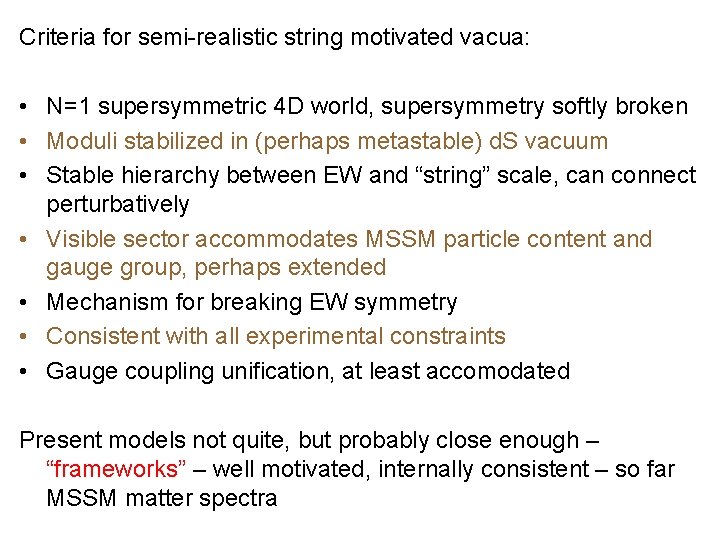
Criteria for semi-realistic string motivated vacua: • N=1 supersymmetric 4 D world, supersymmetry softly broken • Moduli stabilized in (perhaps metastable) d. S vacuum • Stable hierarchy between EW and “string” scale, can connect perturbatively • Visible sector accommodates MSSM particle content and gauge group, perhaps extended • Mechanism for breaking EW symmetry • Consistent with all experimental constraints • Gauge coupling unification, at least accomodated Present models not quite, but probably close enough – “frameworks” – well motivated, internally consistent – so far MSSM matter spectra
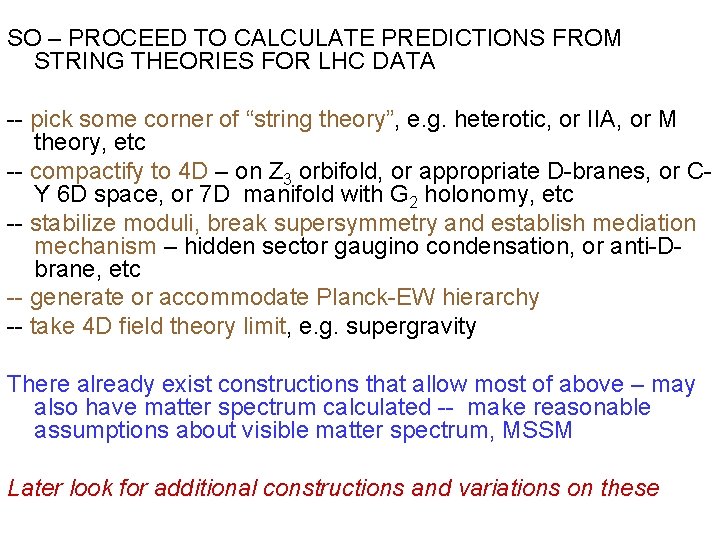
SO – PROCEED TO CALCULATE PREDICTIONS FROM STRING THEORIES FOR LHC DATA -- pick some corner of “string theory”, e. g. heterotic, or IIA, or M theory, etc -- compactify to 4 D – on Z 3 orbifold, or appropriate D-branes, or CY 6 D space, or 7 D manifold with G 2 holonomy, etc -- stabilize moduli, break supersymmetry and establish mediation mechanism – hidden sector gaugino condensation, or anti-Dbrane, etc -- generate or accommodate Planck-EW hierarchy -- take 4 D field theory limit, e. g. supergravity There already exist constructions that allow most of above – may also have matter spectrum calculated -- make reasonable assumptions about visible matter spectrum, MSSM Later look for additional constructions and variations on these
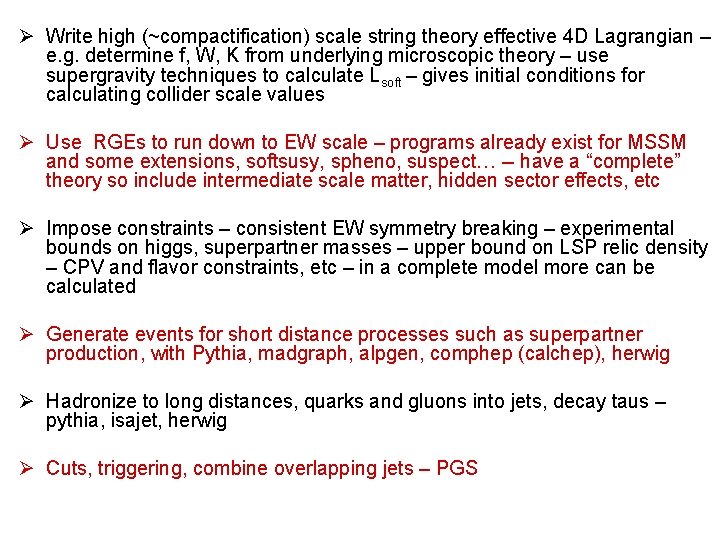
Ø Write high (~compactification) scale string theory effective 4 D Lagrangian – e. g. determine f, W, K from underlying microscopic theory – use supergravity techniques to calculate Lsoft – gives initial conditions for calculating collider scale values Ø Use RGEs to run down to EW scale – programs already exist for MSSM and some extensions, softsusy, spheno, suspect… -- have a “complete” theory so include intermediate scale matter, hidden sector effects, etc Ø Impose constraints – consistent EW symmetry breaking – experimental bounds on higgs, superpartner masses – upper bound on LSP relic density – CPV and flavor constraints, etc – in a complete model more can be calculated Ø Generate events for short distance processes such as superpartner production, with Pythia, madgraph, alpgen, comphep (calchep), herwig Ø Hadronize to long distances, quarks and gluons into jets, decay taus – pythia, isajet, herwig Ø Cuts, triggering, combine overlapping jets – PGS
Sounds complicated But software exists for every part – as a result of important efforts by number of people, and of LHC Olympics, software increasingly user friendly, and mostly linked – useable for some new physics models or MSSM plus some exotics – being improved – Entire procedure needed to translate ideas, theory into data, tests
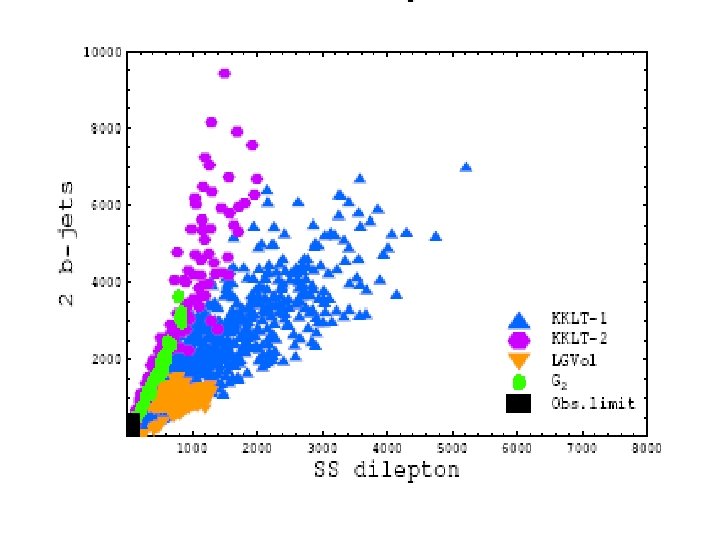
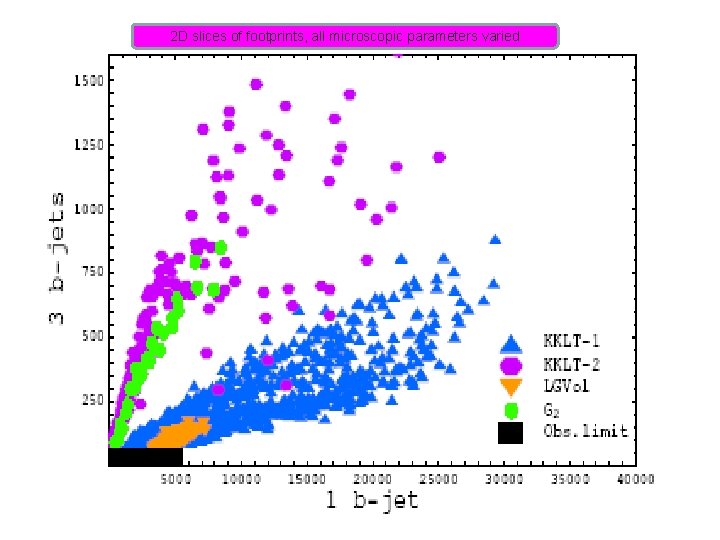
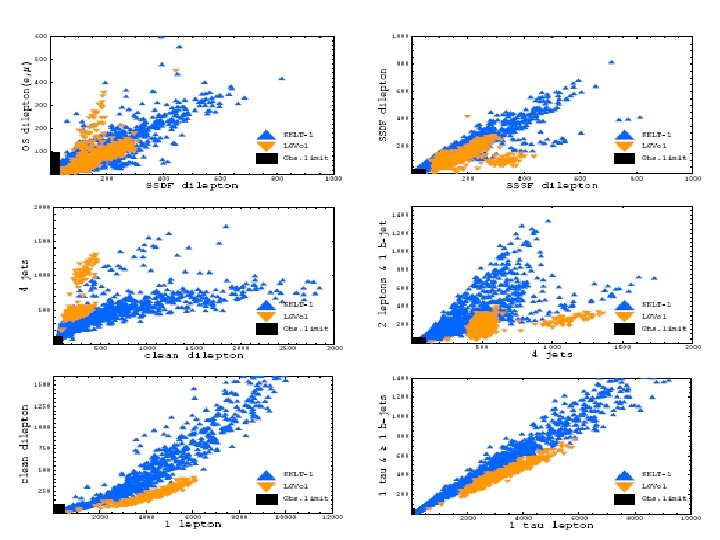
Vary all the as-yet-undetermined microscopic parameters that may affect LHC predictions – e. g. modular weights, rank of gaugino condensation groups, integer coefficients of moduli in G 2 gauge kinetic function, etc “footprint” of that string-susy-model in “signature space”
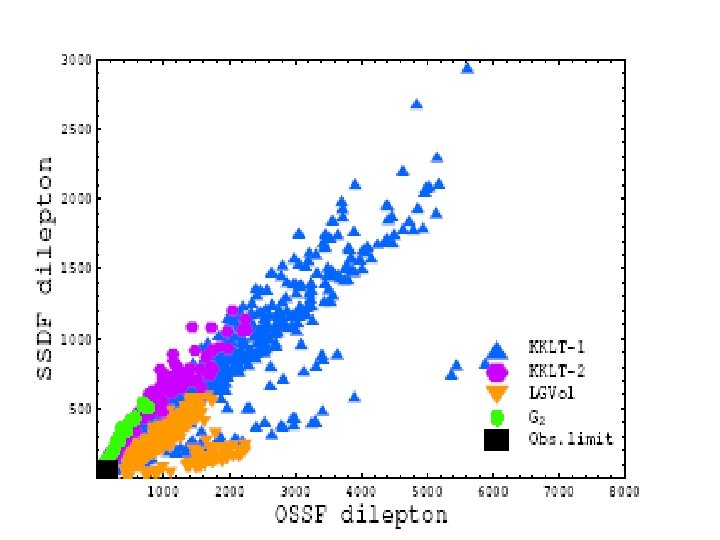
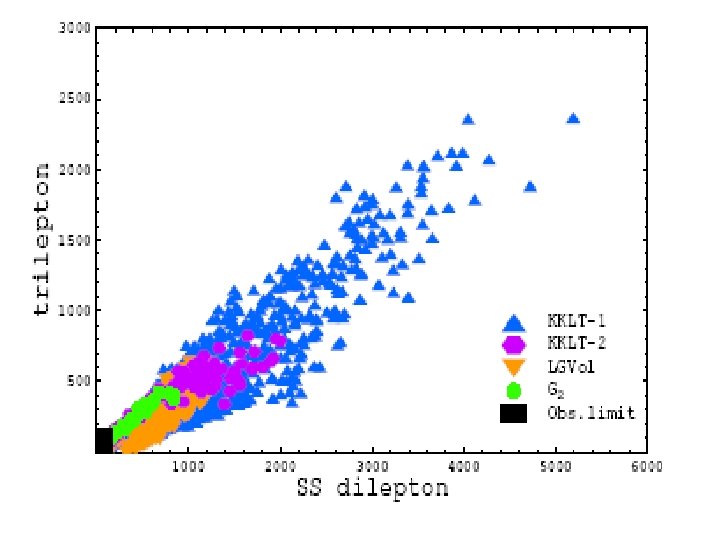
Change how compactify, repeat – change how break supersymmetry, repeat – systematically For each case, graph entire footprint, not result of a few parameters that may or may not be representative Footprints do not fill entire signature space
Even early at LHC will have many signatures and distributions • ET > 100 Ge. V • 2 or more jets, 1 or no jets, etc • No charged leptons; one lepton; two leptons with SSSF, SSDF, OSSF, OSDF; trileptons • Use b’s, τ’s too – even if not so easy initially, probably useful early for comparisons – then lots more signatures Etc – so hundreds of possible signature plots Imagine a signature space, S 1, S 2, … Sn
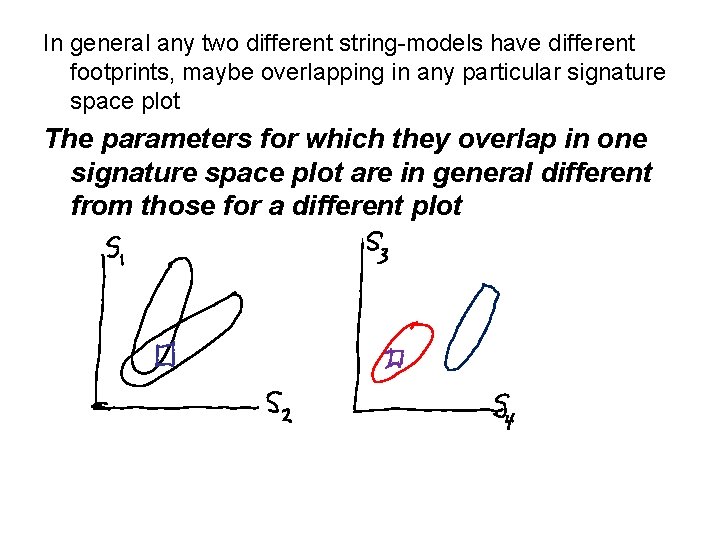
In general any two different string-models have different footprints, maybe overlapping in any particular signature space plot The parameters for which they overlap in one signature space plot are in general different from those for a different plot
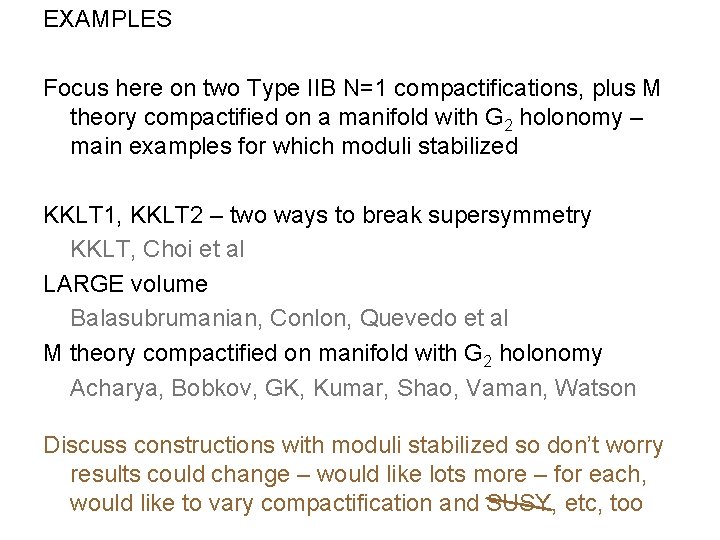
EXAMPLES Focus here on two Type IIB N=1 compactifications, plus M theory compactified on a manifold with G 2 holonomy – main examples for which moduli stabilized KKLT 1, KKLT 2 – two ways to break supersymmetry KKLT, Choi et al LARGE volume Balasubrumanian, Conlon, Quevedo et al M theory compactified on manifold with G 2 holonomy Acharya, Bobkov, GK, Kumar, Shao, Vaman, Watson Discuss constructions with moduli stabilized so don’t worry results could change – would like lots more – for each, would like to vary compactification and SUSY, etc, too
SM backgrounds? -- when there is a real signal experimenters will report the excesses – some signatures yes, some not – both contain useful information -- we have found that a good way to study issues at this stage is to estimate the level at which SM processes will enter and just indicate that on the plots All event rates for 5 fb-1 PT (jet) > 200 Ge. V, PT(lepton) > 10 Ge. V, missing ET > 100 Ge. V
2 D slices of footprints, all microscopic parameters varied
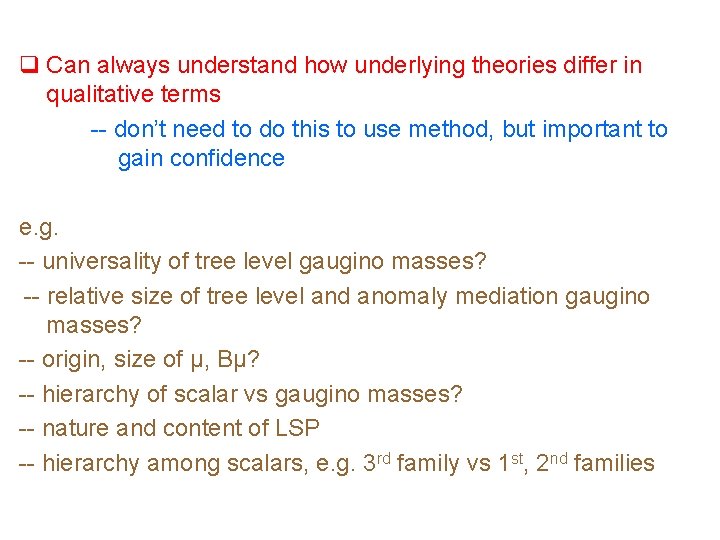
q Can always understand how underlying theories differ in qualitative terms -- don’t need to do this to use method, but important to gain confidence e. g. -- universality of tree level gaugino masses? -- relative size of tree level and anomaly mediation gaugino masses? -- origin, size of μ, Bμ? -- hierarchy of scalar vs gaugino masses? -- nature and content of LSP -- hierarchy among scalars, e. g. 3 rd family vs 1 st, 2 nd families
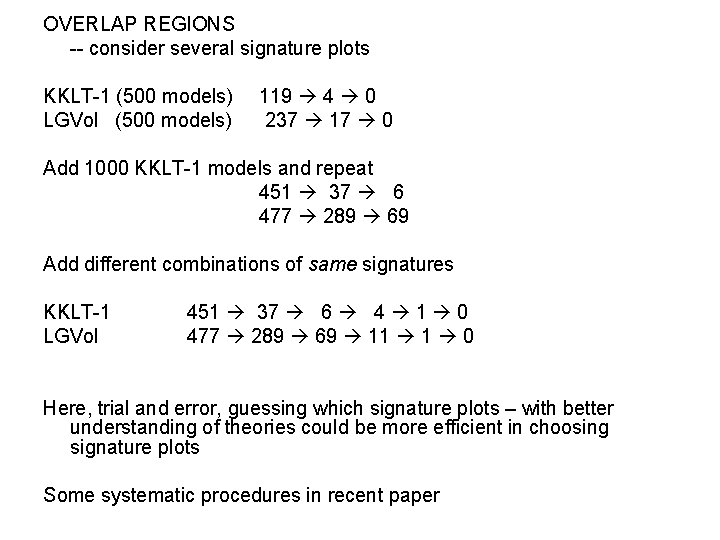
Overlaps on one signature plot correspond to different parameters from overlaps on different signature plot – can separate! Can use any type of distribution, histogram, etc
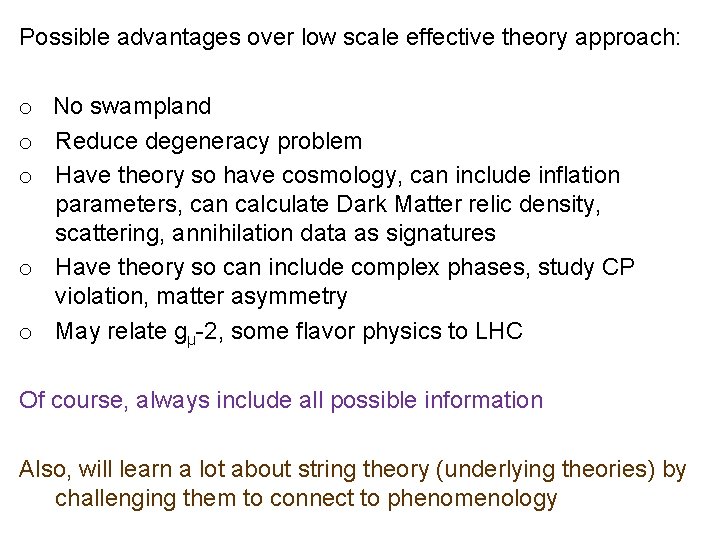
Possible advantages over low scale effective theory approach: o No swampland o Reduce degeneracy problem o Have theory so have cosmology, can include inflation parameters, can calculate Dark Matter relic density, scattering, annihilation data as signatures o Have theory so can include complex phases, study CP violation, matter asymmetry o May relate gµ-2, some flavor physics to LHC Of course, always include all possible information Also, will learn a lot about string theory (underlying theories) by challenging them to connect to phenomenology
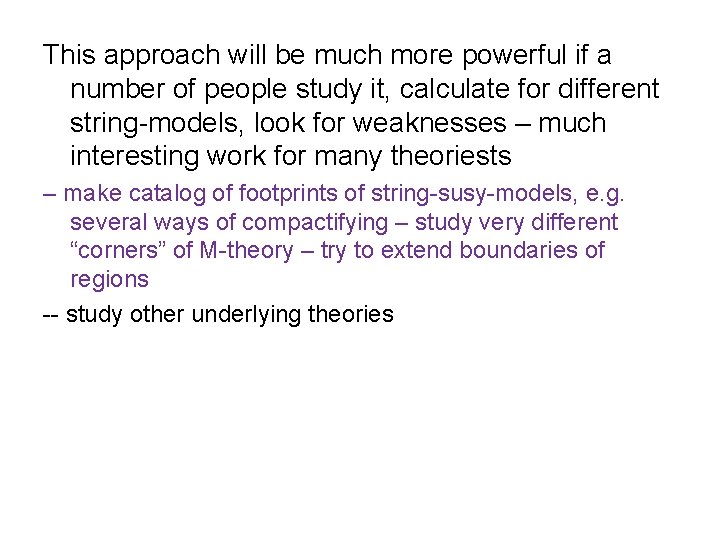
This approach will be much more powerful if a number of people study it, calculate for different string-models, look for weaknesses – much interesting work for many theoriests – make catalog of footprints of string-susy-models, e. g. several ways of compactifying – study very different “corners” of M-theory – try to extend boundaries of regions -- study other underlying theories
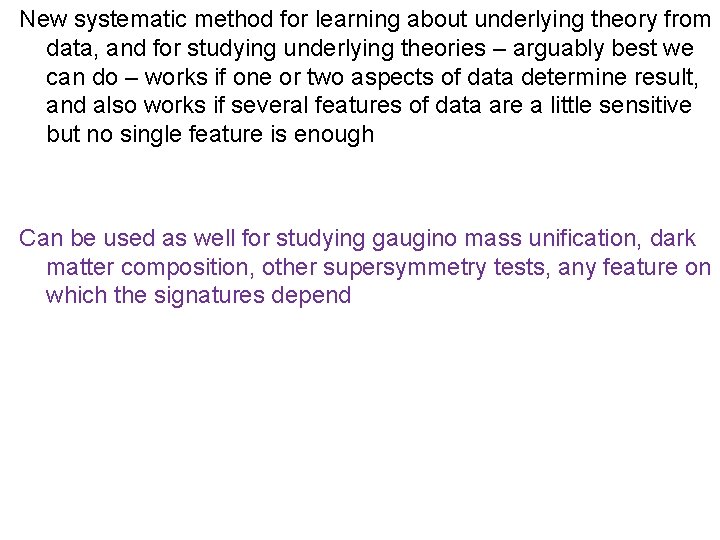
New systematic method for learning about underlying theory from data, and for studying underlying theories – arguably best we can do – works if one or two aspects of data determine result, and also works if several features of data are a little sensitive but no single feature is enough Can be used as well for studying gaugino mass unification, dark matter composition, other supersymmetry tests, any feature on which the signatures depend
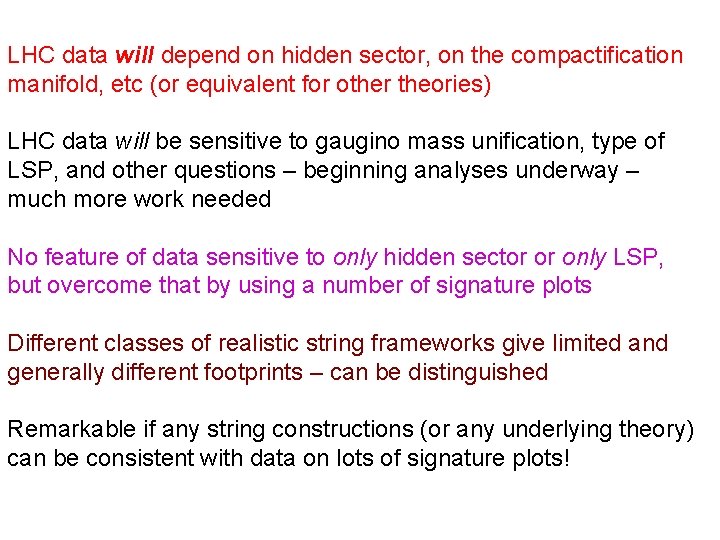
LHC data will depend on hidden sector, on the compactification manifold, etc (or equivalent for other theories) LHC data will be sensitive to gaugino mass unification, type of LSP, and other questions – beginning analyses underway – much more work needed No feature of data sensitive to only hidden sector or only LSP, but overcome that by using a number of signature plots Different classes of realistic string frameworks give limited and generally different footprints – can be distinguished Remarkable if any string constructions (or any underlying theory) can be consistent with data on lots of signature plots!
OVERLAP REGIONS -- consider several signature plots KKLT-1 (500 models) LGVol (500 models) 119 4 0 237 17 0 Add 1000 KKLT-1 models and repeat 451 37 6 477 289 69 Add different combinations of same signatures KKLT-1 LGVol 451 37 6 4 1 0 477 289 69 11 1 0 Here, trial and error, guessing which signature plots – with better understanding of theories could be more efficient in choosing signature plots Some systematic procedures in recent paper
DEGENERACIES In addition to usual issues, such as recognizing what new particles gave rise to signatures, there are degeneracies – different sets of soft-breaking parameters give rise to same LHC signatures Arkani-Hamed, GK, Thaler, Wang ph/0512190 Could make progress more difficult