
LHC Run 3 stability along the ramp transverse

LHC Run 3 stability along the ramp (transverse plane) N. Mounet & X. Buffat N. MOUNET & X. BUFFAT – LHC RUN 3 RAMP STABILTIY – HSC 29/06/2020
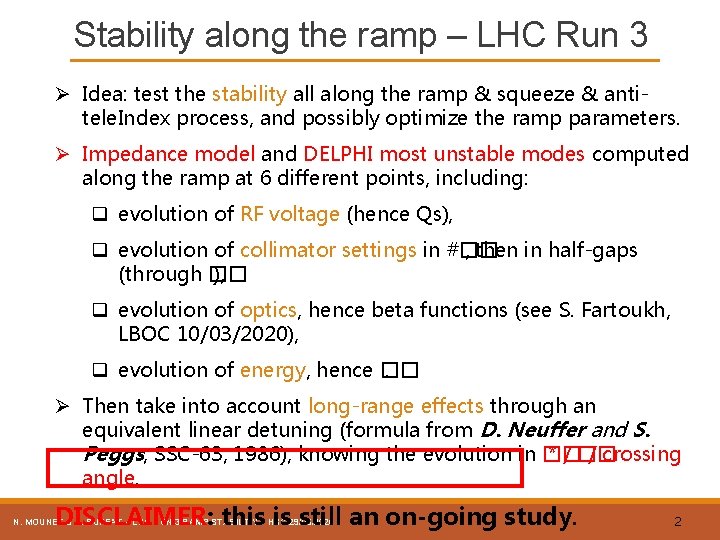
Stability along the ramp – LHC Run 3 Ø Idea: test the stability all along the ramp & squeeze & antitele. Index process, and possibly optimize the ramp parameters. Ø Impedance model and DELPHI most unstable modes computed along the ramp at 6 different points, including: q evolution of RF voltage (hence Qs), q evolution of collimator settings in #�� , then in half-gaps (through �� ), q evolution of optics, hence beta functions (see S. Fartoukh, LBOC 10/03/2020), q evolution of energy, hence ��. Ø Then take into account long-range effects through an equivalent linear detuning (formula from D. Neuffer and S. Peggs, SSC-63, 1986), knowing the evolution in �� * / �� / crossing angle. DISCLAIMER: this is still an on-going study. N. MOUNET & X. BUFFAT – LHC RUN 3 RAMP STABILTIY – HSC 29/06/2020 2

Single-beam stability Ø Including factor 2, with Gaussian transverse distribution. Positive polarity Negative polarity �Negative polarity is twice more stable as positive one, in single-beam. N. MOUNET & X. BUFFAT – LHC RUN 3 RAMP STABILTIY – HSC 29/06/2020 3
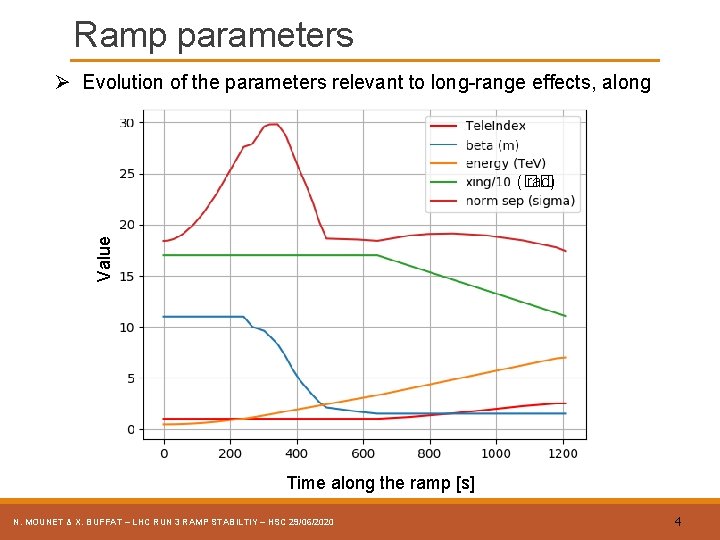
Ramp parameters Ø Evolution of the parameters relevant to long-range effects, along ramp: Value (�� rad) Time along the ramp [s] N. MOUNET & X. BUFFAT – LHC RUN 3 RAMP STABILTIY – HSC 29/06/2020 4
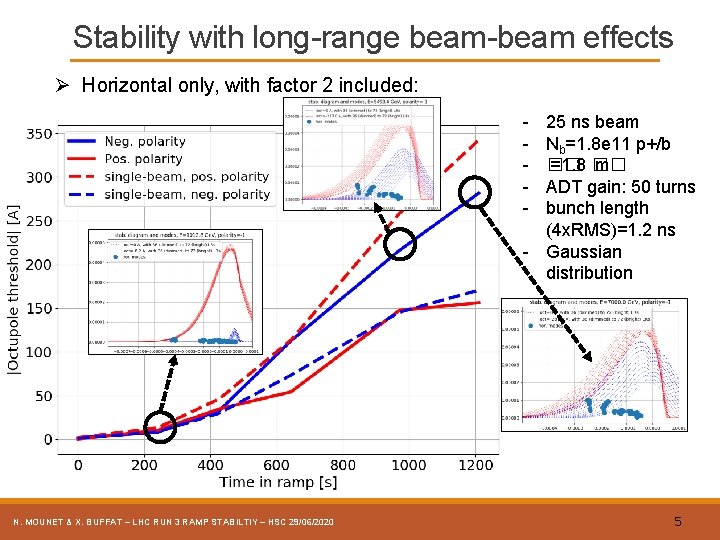
Stability with long-range beam-beam effects Ø Horizontal only, with factor 2 included: - 25 ns beam Nb=1. 8 e 11 p+/b �� =1. 8 �� m ADT gain: 50 turns bunch length (4 x. RMS)=1. 2 ns - Gaussian distribution N. MOUNET & X. BUFFAT – LHC RUN 3 RAMP STABILTIY – HSC 29/06/2020 5
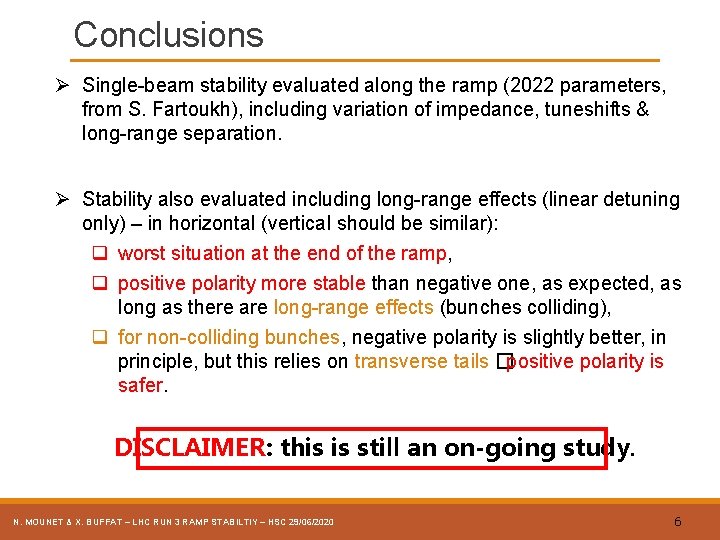
Conclusions Ø Single-beam stability evaluated along the ramp (2022 parameters, from S. Fartoukh), including variation of impedance, tuneshifts & long-range separation. Ø Stability also evaluated including long-range effects (linear detuning only) – in horizontal (vertical should be similar): q worst situation at the end of the ramp, q positive polarity more stable than negative one, as expected, as long as there are long-range effects (bunches colliding), q for non-colliding bunches, negative polarity is slightly better, in principle, but this relies on transverse tails �positive polarity is safer. DISCLAIMER: this is still an on-going study. N. MOUNET & X. BUFFAT – LHC RUN 3 RAMP STABILTIY – HSC 29/06/2020 6
- Slides: 6