
LHC Machine Protection an introduction Acknowledgments to my
![Operational margin of a superconducting magnet Applied Field [T] Bc critical Bc field quench](https://slidetodoc.com/presentation_image_h2/9cd7ddd8a7c366f5c95e9ff0b2076394/image-18.jpg "Operational margin of a superconducting magnet Applied Field [T] Bc critical Bc field quench")
- Slides: 48
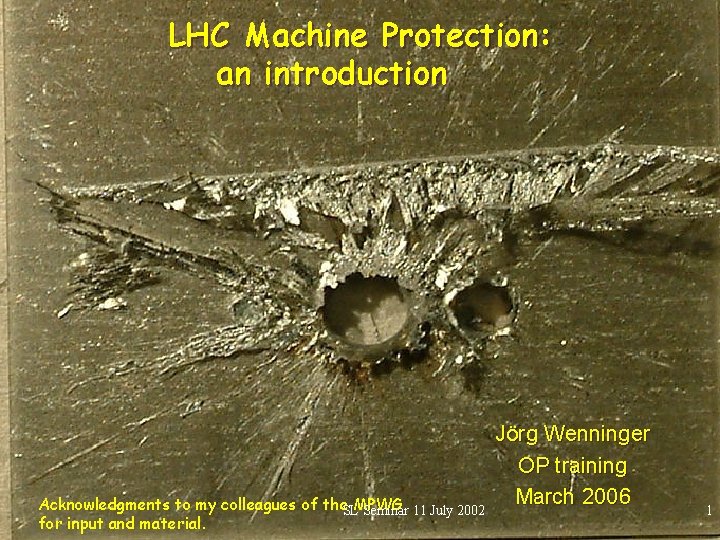
LHC Machine Protection: an introduction Acknowledgments to my colleagues of the. SLMPWG Seminar 11 July 2002 for input and material. Jörg Wenninger OP training March 2006 1
Machine protection at the LHC • Machine protection activities of the LHC are coordinated by the LHC Machine Protection Working Group (MPWG), co-chaired by R. Schmidt & J. Wenninger. http: //lhc-mpwg. web. cern. ch/lhc-mpwg/ • Since 2004 the MPWG is also coordinating machine protection at the SPS (ring & transfer lines). 2
Outline • • Energy stored in the LHC magnets and beams Charging the energy LHC dipole magnets – quench protection Beam induced damage – what is a safe beam? Beam dumping system Collimation system Strategy for Protection of the LHC machine 3
Outline • • Energy stored in the LHC magnets and beams Charging the energy LHC dipole magnets – quench protection Beam induced damage – what is a safe beam? Beam dumping system Collimation system Beam interlock system 4
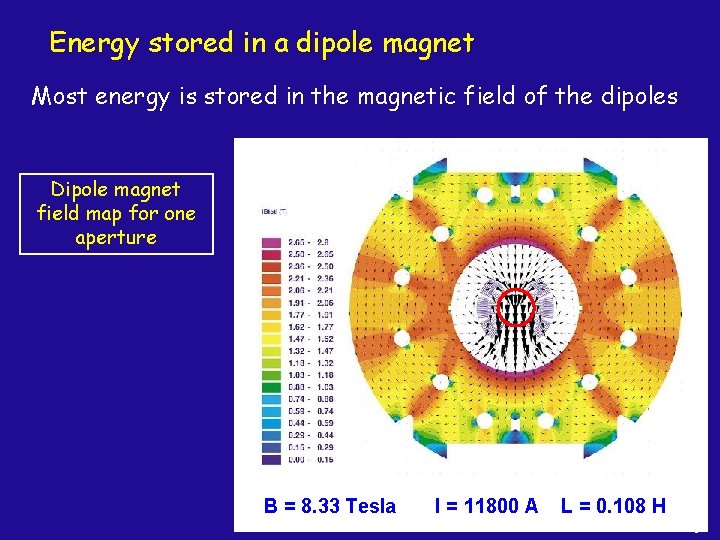
Energy stored in a dipole magnet Most energy is stored in the magnetic field of the dipoles Dipole magnet field map for one aperture B = 8. 33 Tesla I = 11800 A L = 0. 108 H 5
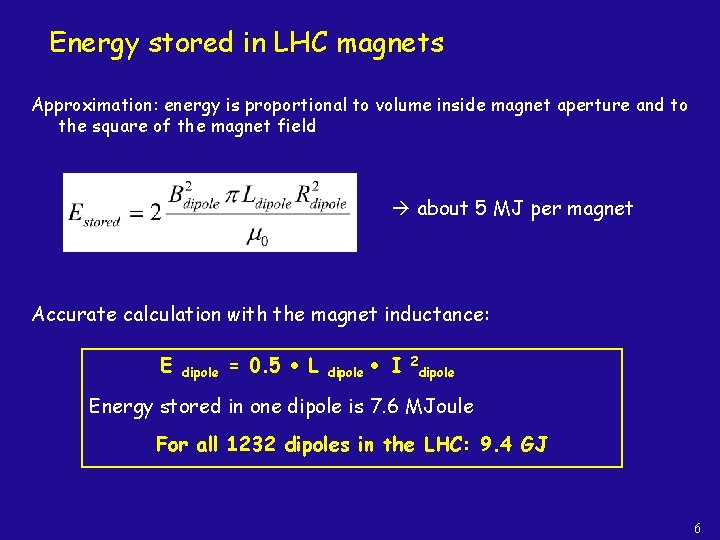
Energy stored in LHC magnets Approximation: energy is proportional to volume inside magnet aperture and to the square of the magnet field about 5 MJ per magnet Accurate calculation with the magnet inductance: E dipole = 0. 5 L dipole I 2 dipole Energy stored in one dipole is 7. 6 MJoule For all 1232 dipoles in the LHC: 9. 4 GJ 6
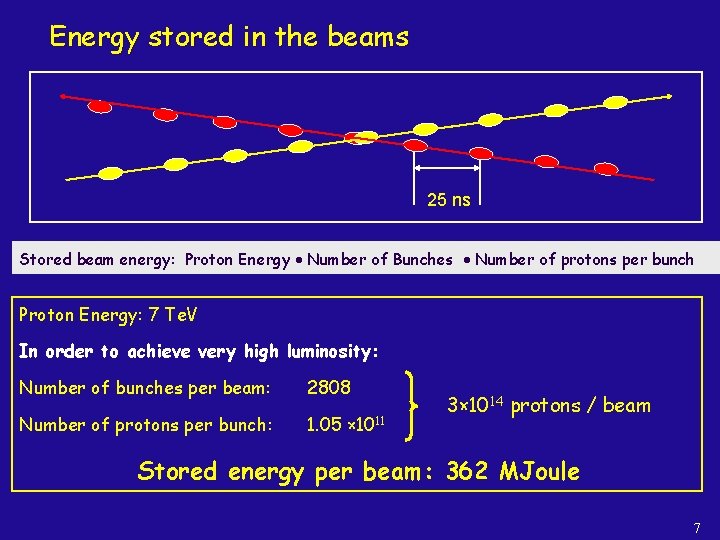
Energy stored in the beams 25 ns Stored beam energy: Proton Energy Number of Bunches Number of protons per bunch Proton Energy: 7 Te. V In order to achieve very high luminosity: Number of bunches per beam: 2808 Number of protons per bunch: 1. 05 × 1011 3× 10¹⁴ protons / beam Stored energy per beam: 362 MJoule 7
Stored energy comparison 8
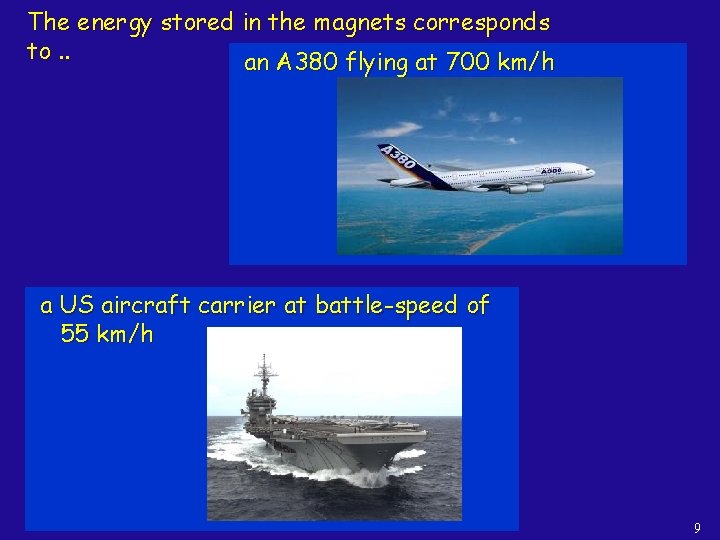
The energy stored in the magnets corresponds to. . an A 380 flying at 700 km/h a US aircraft carrier at battle-speed of 55 km/h 9
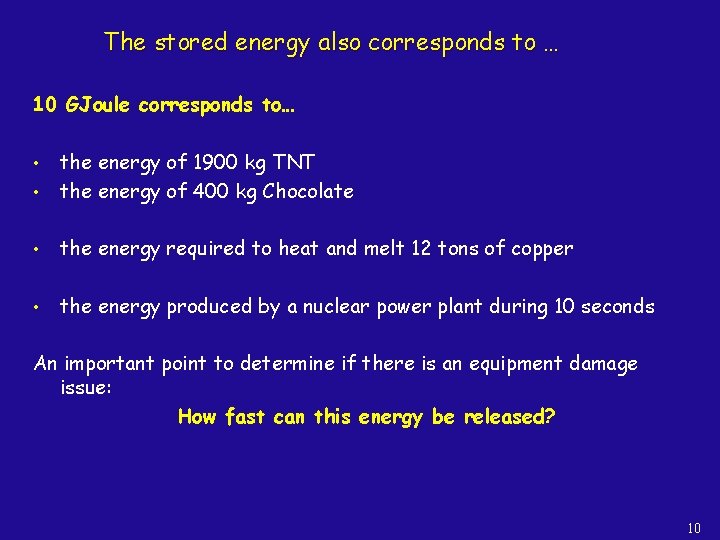
The stored energy also corresponds to … 10 GJoule corresponds to… • the energy of 1900 kg TNT the energy of 400 kg Chocolate • the energy required to heat and melt 12 tons of copper • the energy produced by a nuclear power plant during 10 seconds • An important point to determine if there is an equipment damage issue: How fast can this energy be released? 10
Outline • • Energy stored in the LHC magnets and beams Charging the energy LHC dipole magnets – quench protection Beam induced damage – what is a safe beam? Beam dumping system Collimation system Beam interlock system 11
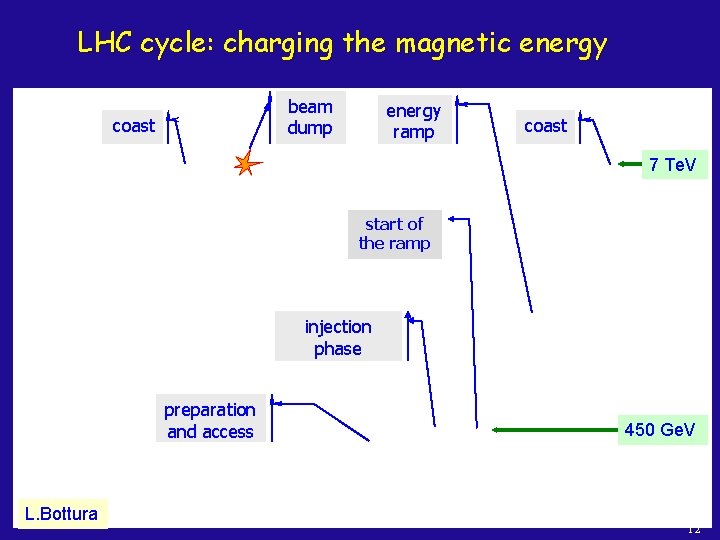
LHC cycle: charging the magnetic energy beam dump coast energy ramp coast 7 Te. V start of the ramp injection phase preparation and access L. Bottura 450 Ge. V 12
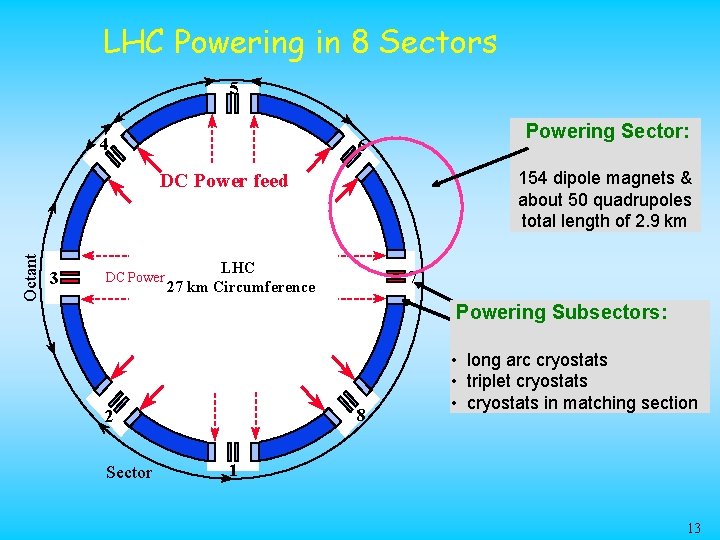
LHC Powering in 8 Sectors 5 4 Powering Sector: 6 154 dipole magnets & about 50 quadrupoles total length of 2. 9 km Octant DC Power feed 3 DC Power LHC 27 km Circumference 7 Powering Subsectors: 8 2 Sector • long arc cryostats • triplet cryostats • cryostats in matching section 1 13
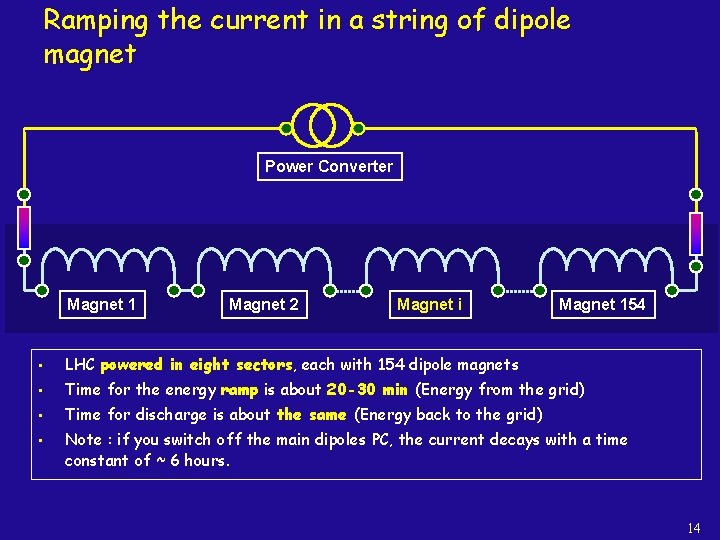
Ramping the current in a string of dipole magnet Power Converter Magnet 1 Magnet 2 Magnet i Magnet 154 • LHC powered in eight sectors, each with 154 dipole magnets • Time for the energy ramp is about 20 -30 min (Energy from the grid) • Time for discharge is about the same (Energy back to the grid) • Note : if you switch off the main dipoles PC, the current decays with a time constant of ~ 6 hours. 14
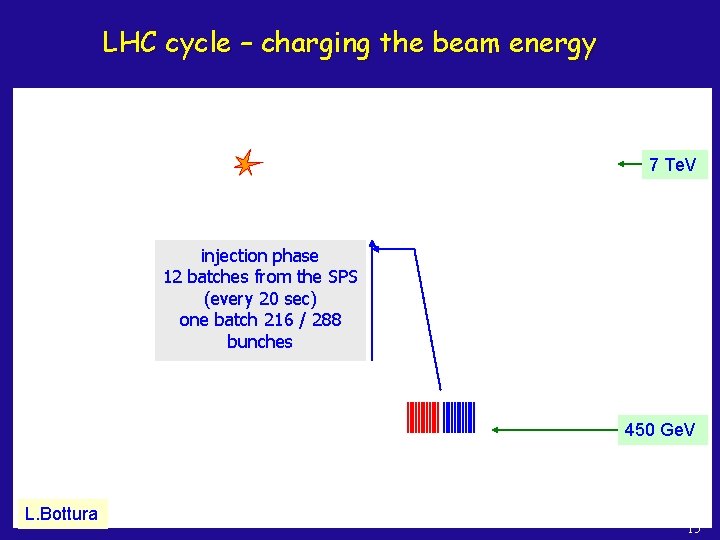
LHC cycle – charging the beam energy 7 Te. V injection phase 12 batches from the SPS (every 20 sec) one batch 216 / 288 bunches 450 Ge. V L. Bottura 15
Outline • • Energy stored in the LHC magnets and beams Charging the energy LHC dipole magnets – quench protection Beam induced damage – what is a safe beam? Beam dumping system Collimation system Beam interlock system 16
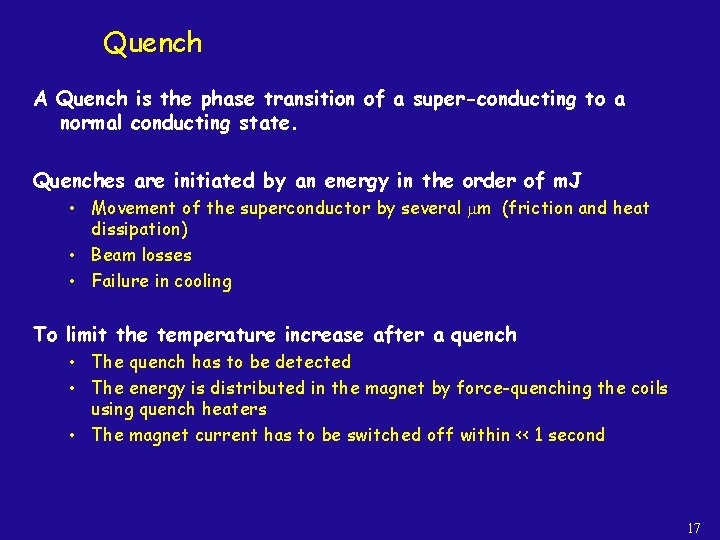
Quench A Quench is the phase transition of a super-conducting to a normal conducting state. Quenches are initiated by an energy in the order of m. J • • • Movement of the superconductor by several m (friction and heat dissipation) Beam losses Failure in cooling To limit the temperature increase after a quench • • • The quench has to be detected The energy is distributed in the magnet by force-quenching the coils using quench heaters The magnet current has to be switched off within << 1 second 17
Operational margin of a superconducting magnet Applied Field [T] Bc critical Bc field quench with fast loss of ~5× 10⁶ protons ~ 0. 00001% total no. protons/beam 8. 3 T QUENCH quench with fast loss of ~5× 10⁹ protons 0. 54 T 1. 9 K Temperature [K] Tc critical temperature Tc 9 K 18
Power into superconducting cable after a quench 19
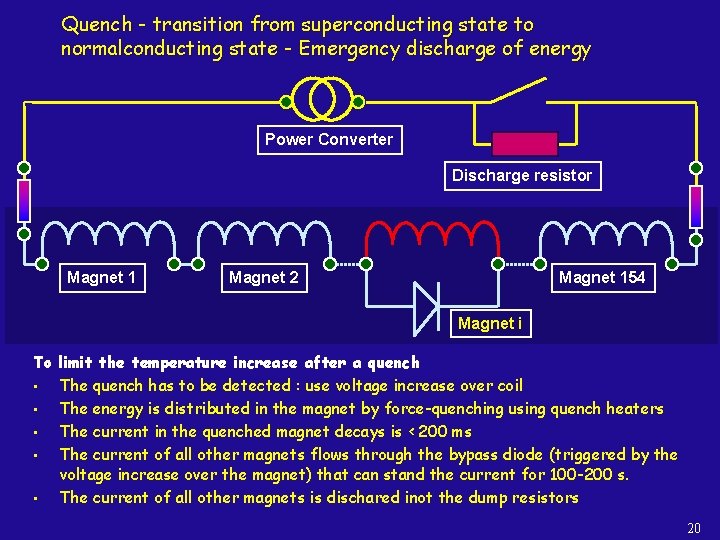
Quench - transition from superconducting state to normalconducting state - Emergency discharge of energy Power Converter Discharge resistor Magnet 1 Magnet 2 Magnet 154 Magnet i To limit the temperature increase after a quench • The quench has to be detected : use voltage increase over coil • The energy is distributed in the magnet by force-quenching using quench heaters • The current in the quenched magnet decays is < 200 ms • The current of all other magnets flows through the bypass diode (triggered by the voltage increase over the magnet) that can stand the current for 100 -200 s. • The current of all other magnets is dischared inot the dump resistors 20
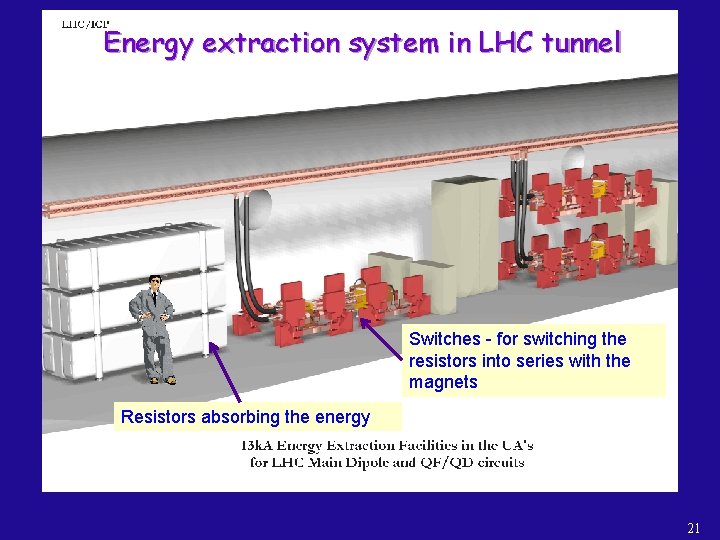
Energy extraction system in LHC tunnel Switches - for switching the resistors into series with the magnets Resistors absorbing the energy 21
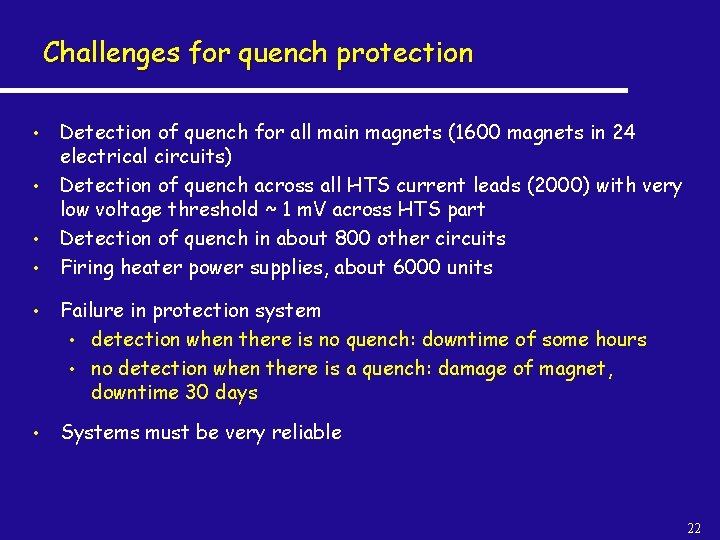
Challenges for quench protection • • Detection of quench for all main magnets (1600 magnets in 24 electrical circuits) Detection of quench across all HTS current leads (2000) with very low voltage threshold ~ 1 m. V across HTS part Detection of quench in about 800 other circuits Firing heater power supplies, about 6000 units • Failure in protection system • detection when there is no quench: downtime of some hours • no detection when there is a quench: damage of magnet, downtime 30 days • Systems must be very reliable 22
Powering Interlock • PLC-based Powering Interlock Controllers (PIC) are used to manage the interlock signal between the power converters and the quench protection system. • The PIC also interfaces to the Beam Interlock System and will request a beam dump if the electrical circuit that fails is considered to be critical for beam operation. 23
Outline • • Energy stored in the LHC magnets and beams Charging the energy LHC dipole magnets – quench protection Beam induced damage – what is a safe beam? Beam dumping system Collimation system Beam interlock system 24
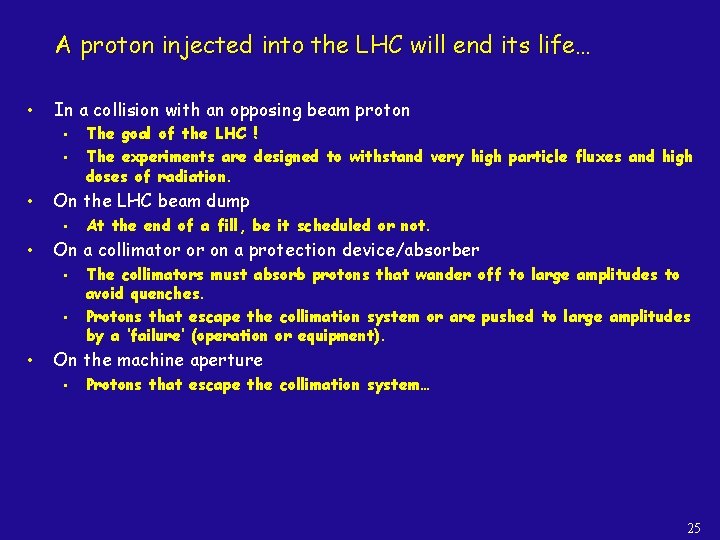
A proton injected into the LHC will end its life… • In a collision with an opposing beam proton • • • On the LHC beam dump • • At the end of a fill, be it scheduled or not. On a collimator or on a protection device/absorber • • • The goal of the LHC ! The experiments are designed to withstand very high particle fluxes and high doses of radiation. The collimators must absorb protons that wander off to large amplitudes to avoid quenches. Protons that escape the collimation system or are pushed to large amplitudes by a ‘failure’ (operation or equipment). On the machine aperture • Protons that escape the collimation system… 25
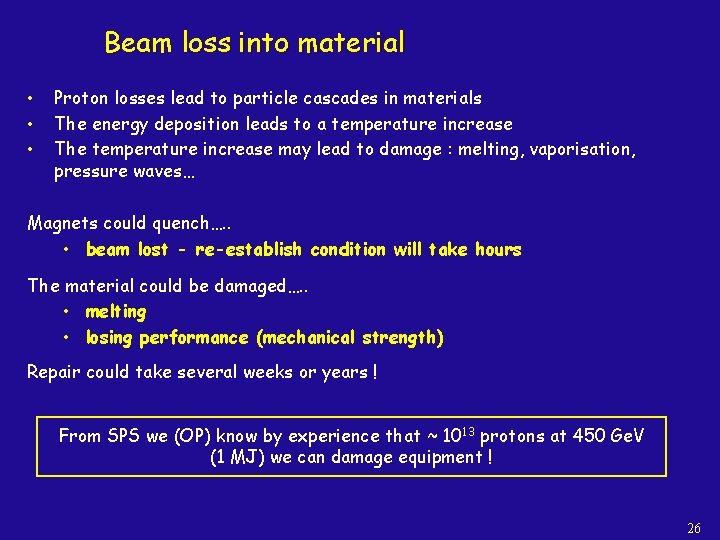
Beam loss into material • • • Proton losses lead to particle cascades in materials The energy deposition leads to a temperature increase The temperature increase may lead to damage : melting, vaporisation, pressure waves… Magnets could quench…. . • beam lost - re-establish condition will take hours The material could be damaged…. . • melting • losing performance (mechanical strength) Repair could take several weeks or years ! From SPS we (OP) know by experience that ~ 1013 protons at 450 Ge. V (1 MJ) we can damage equipment ! 26
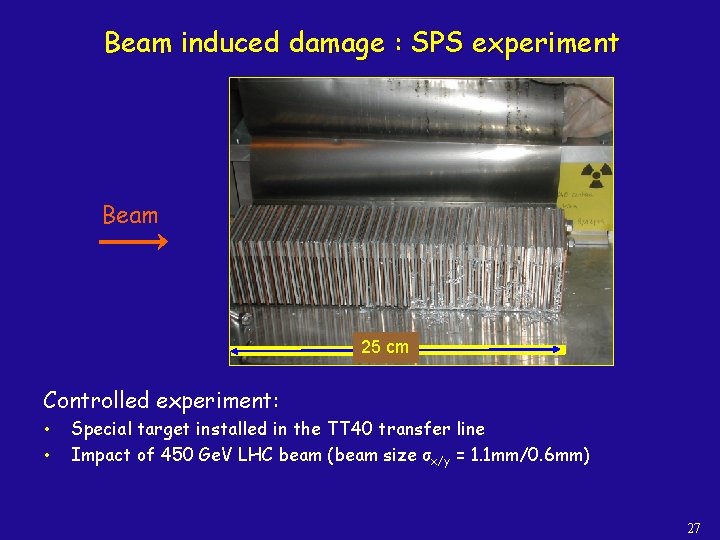
Beam induced damage : SPS experiment Beam 25 cm Controlled experiment: • • Special target installed in the TT 40 transfer line Impact of 450 Ge. V LHC beam (beam size σx/y = 1. 1 mm/0. 6 mm) 27
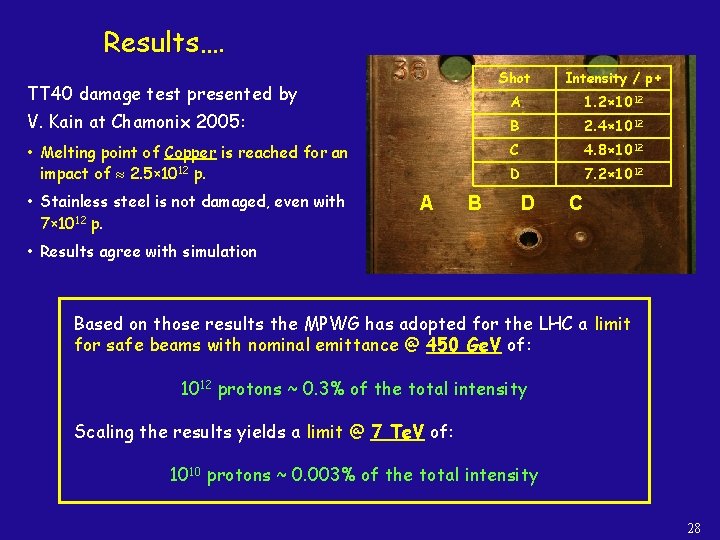
Results…. TT 40 damage test presented by V. Kain at Chamonix 2005: • Melting point of Copper is reached for an impact of 2. 5× 10¹² p. • Stainless steel is not damaged, even with 7× 10¹² p. A B Shot Intensity / p+ A 1. 2× 10¹² B 2. 4× 10¹² C 4. 8× 10¹² D 7. 2× 10¹² D C • Results agree with simulation Based on those results the MPWG has adopted for the LHC a limit for safe beams with nominal emittance @ 450 Ge. V of: 1012 protons ~ 0. 3% of the total intensity Scaling the results yields a limit @ 7 Te. V of: 1010 protons ~ 0. 003% of the total intensity 28
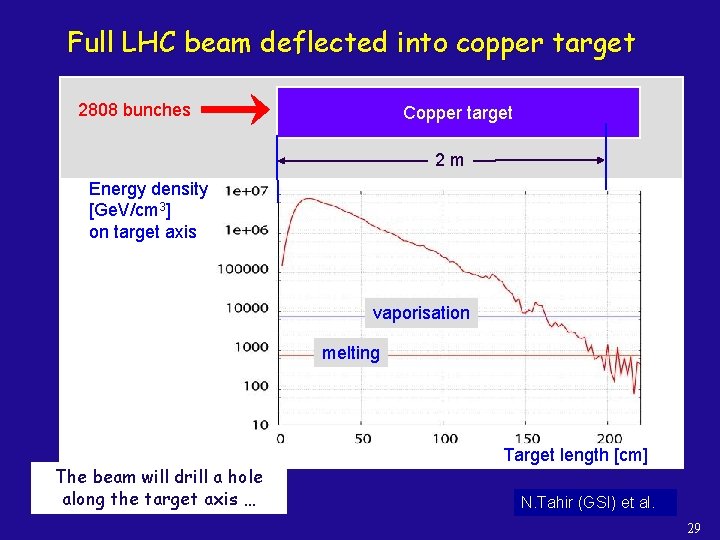
Full LHC beam deflected into copper target 2808 bunches Copper target 2 m Energy density [Ge. V/cm 3] on target axis vaporisation melting The beam will drill a hole along the target axis … Target length [cm] N. Tahir (GSI) et al. 29
Beam absorber challenges • The stored energy in the LHC beam is so huge that designing absorbers for the beams that are not destroyed by an impact is a real challenge ! • Almost all protection elements are made of Graphite or other forms of Carbon: very robust low density absorber! • The beam dump block is the ONLY element of the LHC that can safely absorb all the beam – will be discussed in a moment. • All other absorbers in the LHC (collimators and protection devices) can only stand partial losses – typically up to a full injected beam, i. e. equivalent to the energy stored in the SPS at 450 Ge. V. 30
Outline • • Energy stored in the LHC magnets and beams Charging the energy LHC dipole magnets – quench protection Beam induced damage – what is a safe beam? Beam dumping system Collimation system Beam interlock system 31
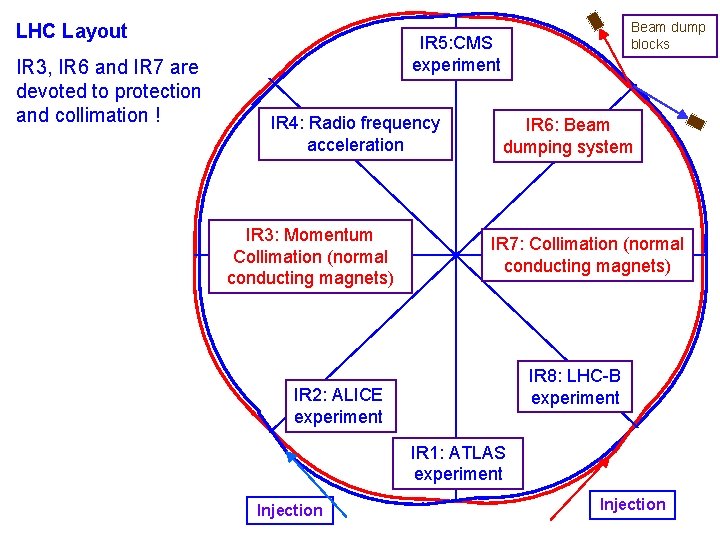
LHC Layout IR 3, IR 6 and IR 7 are devoted to protection and collimation ! Beam dump blocks IR 5: CMS experiment IR 4: Radio frequency acceleration IR 3: Momentum Collimation (normal conducting magnets) IR 6: Beam dumping system IR 7: Collimation (normal conducting magnets) IR 8: LHC-B experiment IR 2: ALICE experiment IR 1: ATLAS experiment Injection 32
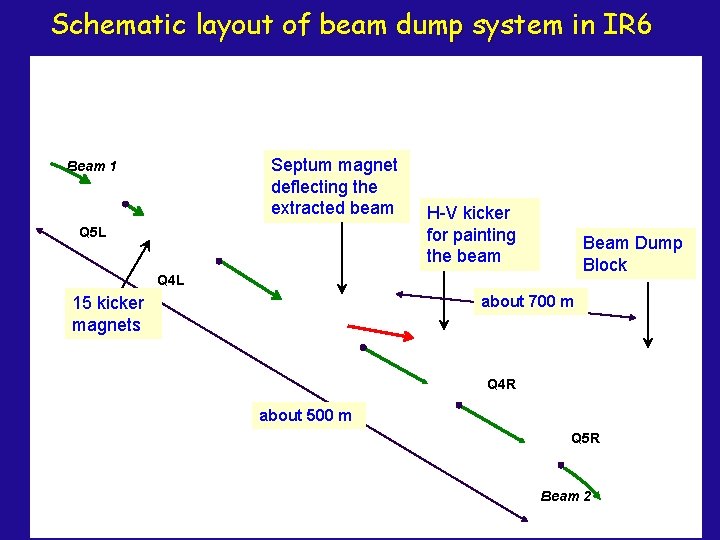
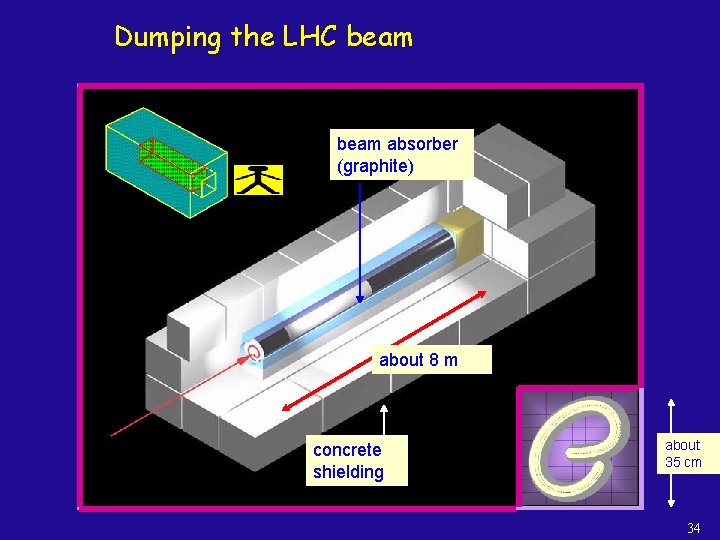
Schematic layout of beam dump system in IR 6 Septum magnet deflecting the extracted beam Beam 1 Q 5 L H-V kicker for painting the beam Beam Dump Block Q 4 L about 700 m 15 kicker magnets Q 4 R about 500 m Q 5 R Beam 2 33
Dumping the LHC beam absorber (graphite) about 8 m concrete shielding about 35 cm 34
Requirements for a clean dump • Strength of kicker and septum magnets must match the beam energy: • Very safe beam measurement based on the current of the magnets ! • Dump kickers must be synchronized to the « Particle free gap » : • Accurate and reliable synchronization. • Abort gap must be free of particles: gap cleaning with damper. Large graphite absorbers in the beam dump area protect downstream elements (including dump septa themselves) against badly ‘kicked’ particles. 35
Outline • • Energy stored in the LHC magnets and beams Charging the energy LHC dipole magnets – quench protection Beam induced damage – what is a safe beam? Beam dumping system Collimation system Beam interlock system 36
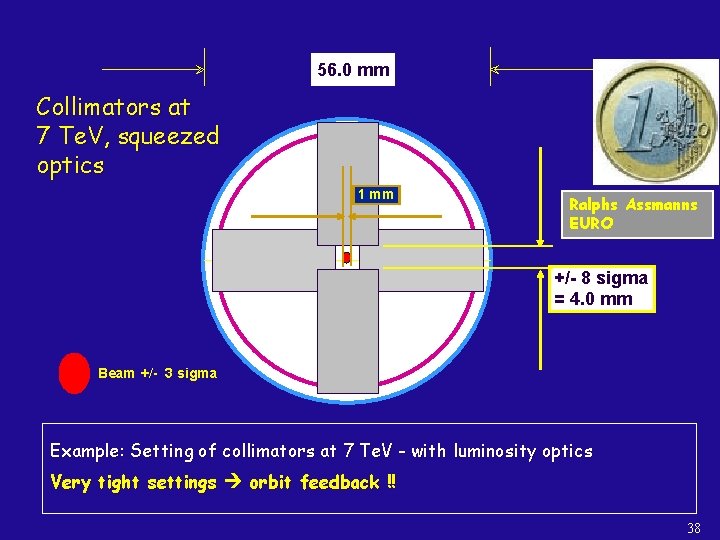
The very high stored energy, combined with a very low threshold requires a complex two-stage cleaning system: • • • 60 collimators/beam! Large amplitude protons are scattered by the primary collimator (clo The scattered particles impact on the secondary collimators that sho The efficiency of the collimation must be larger than 99. 9% to be ab reasonable conditions, i. e. with lifetimes that can drop down to less t time to time… This requires settings tolerance of < 0. 1 mm. Beam collimation (cleaning)
56. 0 mm Collimators at 7 Te. V, squeezed optics 1 mm Ralphs Assmanns EURO +/- 8 sigma = 4. 0 mm Beam +/- 3 sigma Example: Setting of collimators at 7 Te. V - with luminosity optics Very tight settings orbit feedback !! 38
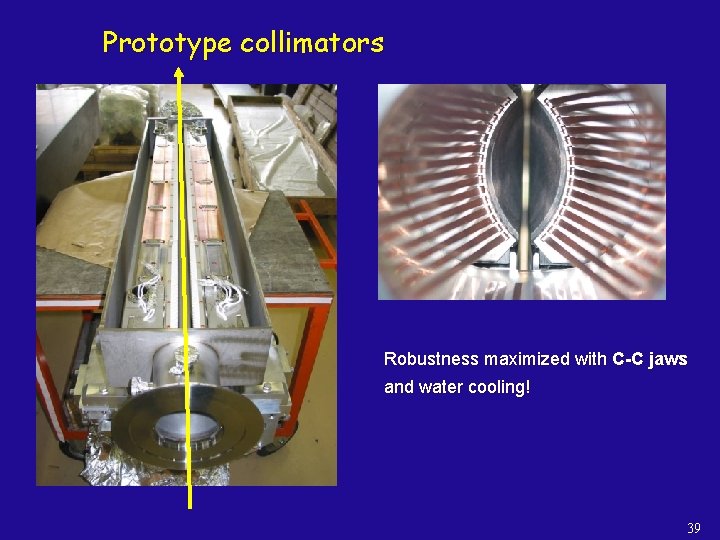
Prototype collimators Robustness maximized with C-C jaws and water cooling! 39
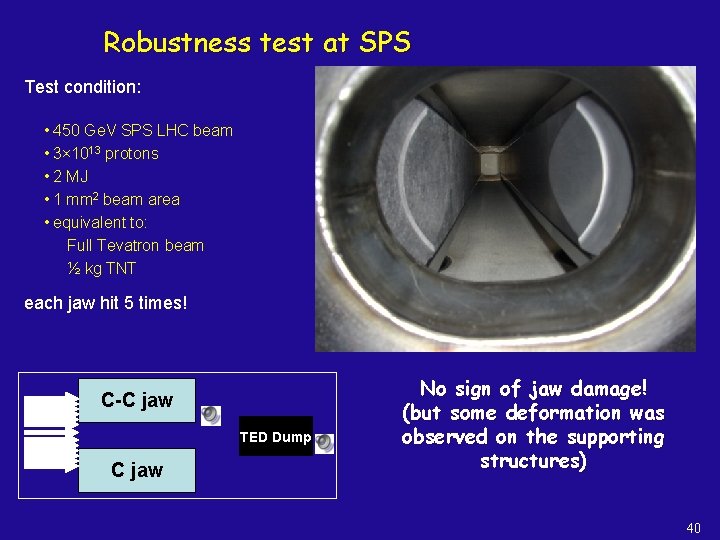
Robustness test at SPS Test condition: • 450 Ge. V SPS LHC beam • 3× 10¹³ protons • 2 MJ • 1 mm 2 beam area • equivalent to: Full Tevatron beam ½ kg TNT each jaw hit 5 times! C-C jaw TED Dump C jaw No sign of jaw damage! (but some deformation was observed on the supporting structures) 40
Outline • • Energy stored in the LHC magnets and beams Charging the energy LHC dipole magnets – quench protection Beam induced damage – what is a safe beam? Beam dumping system Collimation system Beam interlock system 41
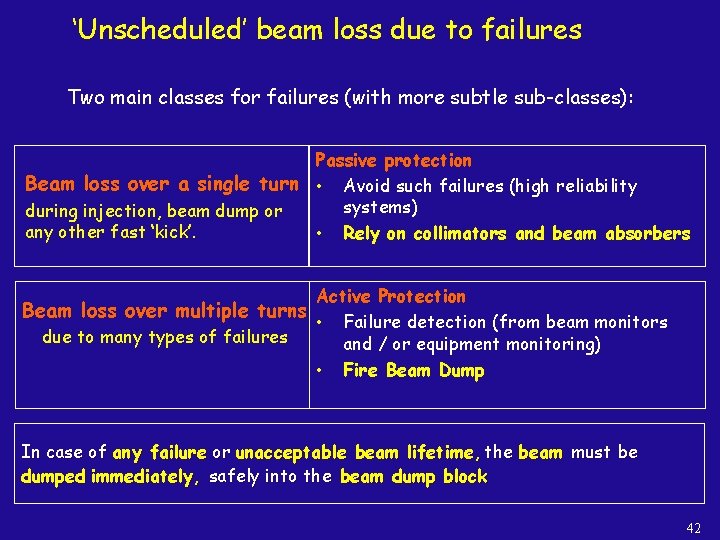
‘Unscheduled’ beam loss due to failures Two main classes for failures (with more subtle sub-classes): Passive protection Beam loss over a single turn • Avoid such failures (high reliability systems) during injection, beam dump or any other fast ‘kick’. • Rely on collimators and beam absorbers Active Protection Beam loss over multiple turns • Failure detection (from beam monitors due to many types of failures and / or equipment monitoring) • Fire Beam Dump In case of any failure or unacceptable beam lifetime, the beam must be dumped immediately, safely into the beam dump block 42
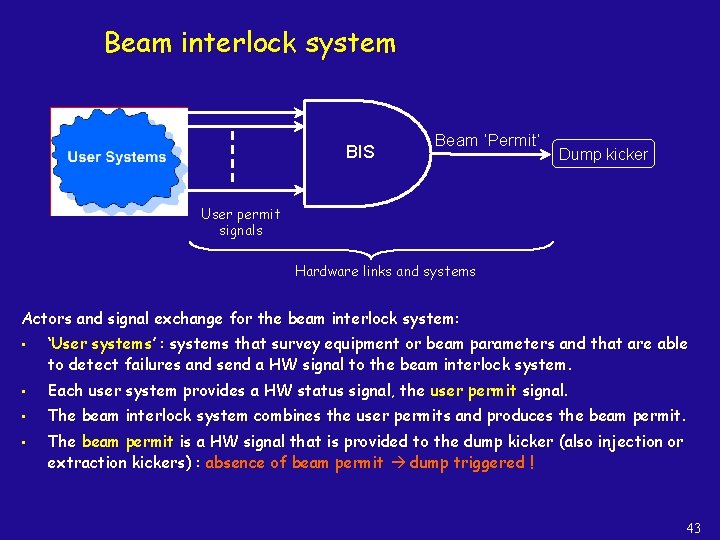
Beam interlock system BIS Beam ‘Permit’ Dump kicker User permit signals Hardware links and systems Actors and signal exchange for the beam interlock system: • ‘User systems’ : systems that survey equipment or beam parameters and that are able to detect failures and send a HW signal to the beam interlock system. • Each user system provides a HW status signal, the user permit signal. • The beam interlock system combines the user permits and produces the beam permit. • The beam permit is a HW signal that is provided to the dump kicker (also injection or extraction kickers) : absence of beam permit dump triggered ! 43
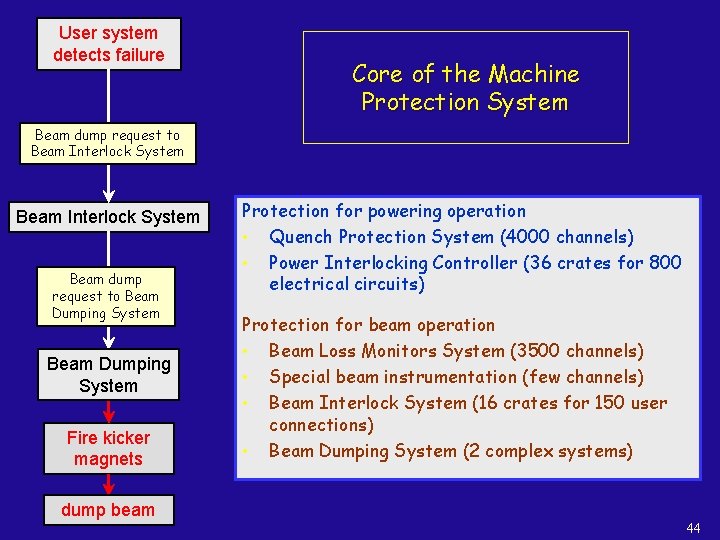
User system detects failure Core of the Machine Protection System Beam dump request to Beam Interlock System Beam dump request to Beam Dumping System Fire kicker magnets Protection for powering operation • Quench Protection System (4000 channels) • Power Interlocking Controller (36 crates for 800 electrical circuits) Protection for beam operation • Beam Loss Monitors System (3500 channels) • Special beam instrumentation (few channels) • Beam Interlock System (16 crates for 150 user connections) • Beam Dumping System (2 complex systems) dump beam 44
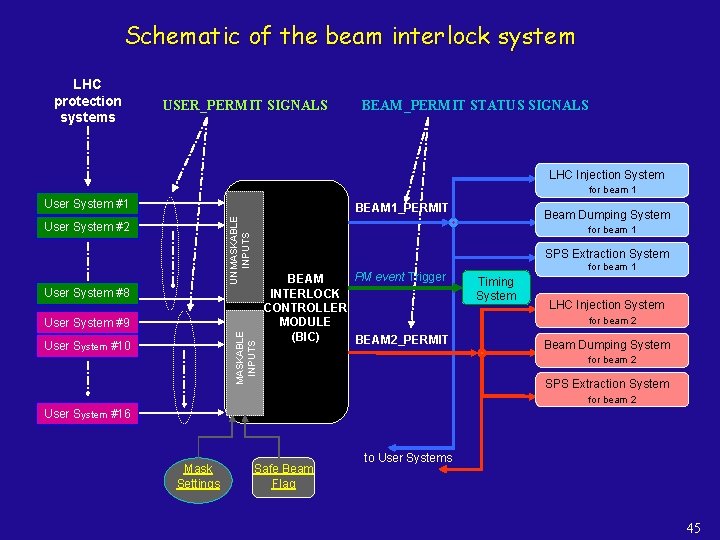
Schematic of the beam interlock system LHC protection systems USER_PERMIT SIGNALS BEAM_PERMIT STATUS SIGNALS LHC Injection System for beam 1 User System #1 UNMASKABLE INPUTS BEAM 1_PERMIT User System #2 for beam 1 SPS Extraction System User System #8 MASKABLE INPUTS User System #9 User System #10 Beam Dumping System PM event Trigger BEAM INTERLOCK CONTROLLER MODULE (BIC) BEAM 2_PERMIT for beam 1 Timing System LHC Injection System for beam 2 Beam Dumping System for beam 2 SPS Extraction System for beam 2 User System #16 Mask Settings Safe Beam Flag to User Systems 45
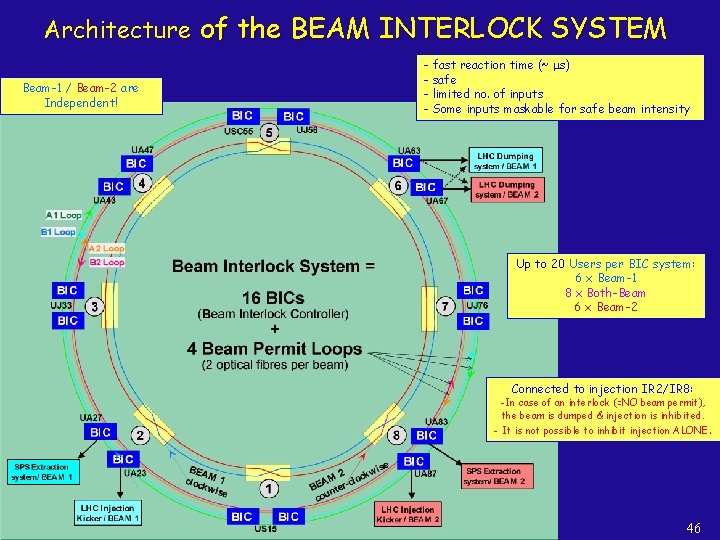
Architecture of the BEAM INTERLOCK SYSTEM Beam-1 / Beam-2 are Independent! - fast reaction time (~ s) - safe - limited no. of inputs - Some inputs maskable for safe beam intensity Up to 20 Users per BIC system: 6 x Beam-1 8 x Both-Beam 6 x Beam-2 Connected to injection IR 2/IR 8: -In case of an interlock (=NO beam permit), the beam is dumped & injection is inhibited. - It is not possible to inhibit injection ALONE. 46
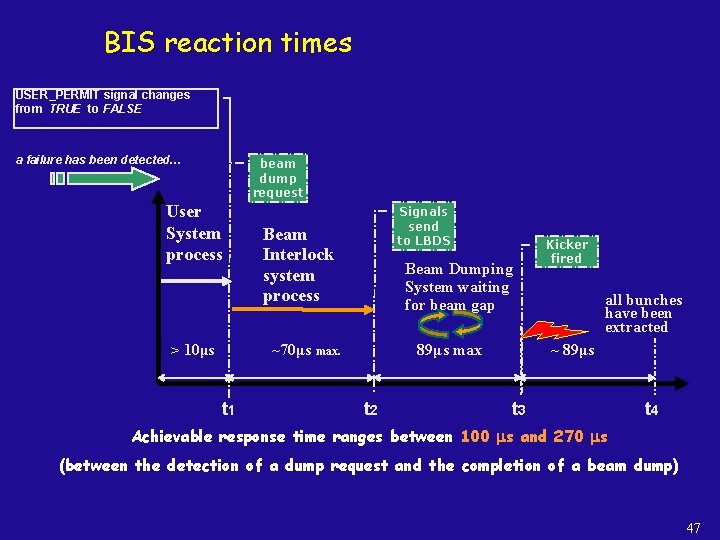
BIS reaction times USER_PERMIT signal changes from TRUE to FALSE a failure has been detected… beam dump request User System process Signals send to LBDS Beam Interlock system process Beam Dumping System waiting for beam gap ~70μs max. > 10μs t 1 89μs max t 2 Kicker fired all bunches have been extracted ~ 89μs t 3 t 4 Achievable response time ranges between 100 s and 270 s (between the detection of a dump request and the completion of a beam dump) 47
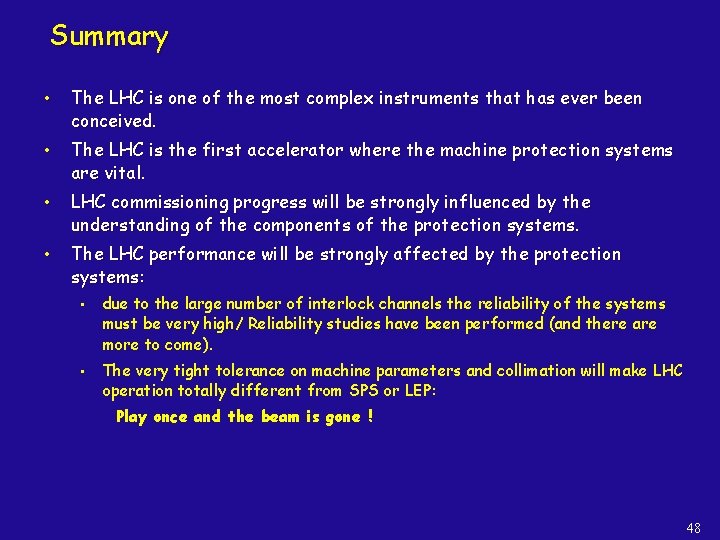
Summary • The LHC is one of the most complex instruments that has ever been conceived. • The LHC is the first accelerator where the machine protection systems are vital. • LHC commissioning progress will be strongly influenced by the understanding of the components of the protection systems. • The LHC performance will be strongly affected by the protection systems: • due to the large number of interlock channels the reliability of the systems must be very high/ Reliability studies have been performed (and there are more to come). • The very tight tolerance on machine parameters and collimation will make LHC operation totally different from SPS or LEP: Play once and the beam is gone ! 48