
LHC Injection Kicker System Cr 2 O 3

- Slides: 14
LHC Injection Kicker System: Cr 2 O 3 Coating of Ceramic (Al 2 O 3) Tube M. J. Barnes CERN TE-ABT M. J. Barnes 28/10/2016 - Polyteknik 2
Outline of Presentation Ø CERN Accelerator Complex Ø Beam Transfer – Kicker Magnets Ø LHC Kicker Magnets – brief description Ø Problems experienced with kicker magnets: Ø SEY Ø UFOs Ø Heating (see talk by Lorena) Ø Results of Cr 2 O 3 coating Ø Next steps M. J. Barnes 28/10/2016 - Polyteknik 3
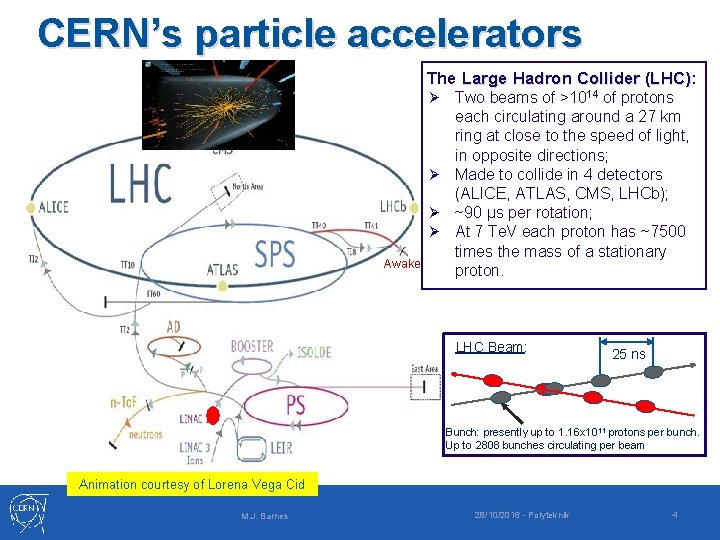
CERN’s particle accelerators The Large Hadron Collider (LHC): Two beams of >1014 of protons each circulating around a 27 km ring at close to the speed of light, in opposite directions; Ø Made to collide in 4 detectors (ALICE, ATLAS, CMS, LHCb); Ø ~90 µs per rotation; Ø At 7 Te. V each proton has ~7500 times the mass of a stationary proton. Ø Awake LHC Beam: 25 ns Bunch: presently up to 1. 16 x 1011 protons per bunch. Up to 2808 bunches circulating per beam Animation courtesy of Lorena Vega Cid M. J. Barnes 28/10/2016 - Polyteknik 4
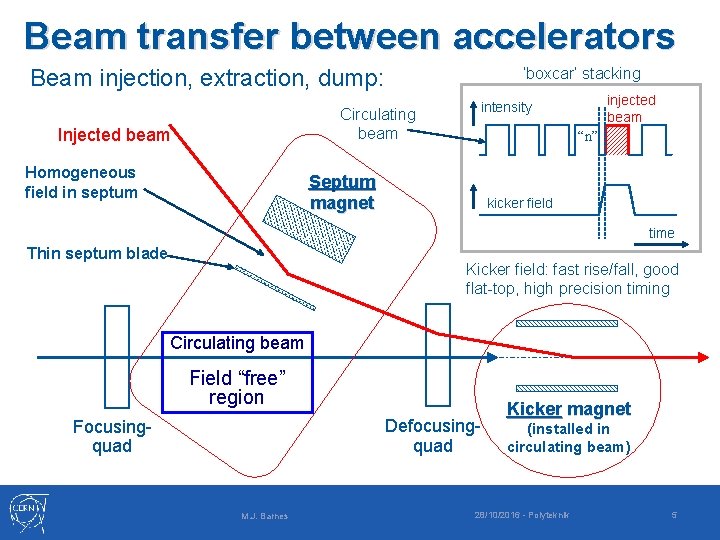
Beam transfer between accelerators Beam injection, extraction, dump: ‘boxcar’ stacking Circulating beam Injected beam Homogeneous field in septum injected beam intensity “n” Septum magnet kicker field time Thin septum blade Kicker field: fast rise/fall, good flat-top, high precision timing Circulating beam Field “free” region Defocusingquad Focusingquad M. J. Barnes Kicker magnet (installed in circulating beam) 28/10/2016 - Polyteknik 5
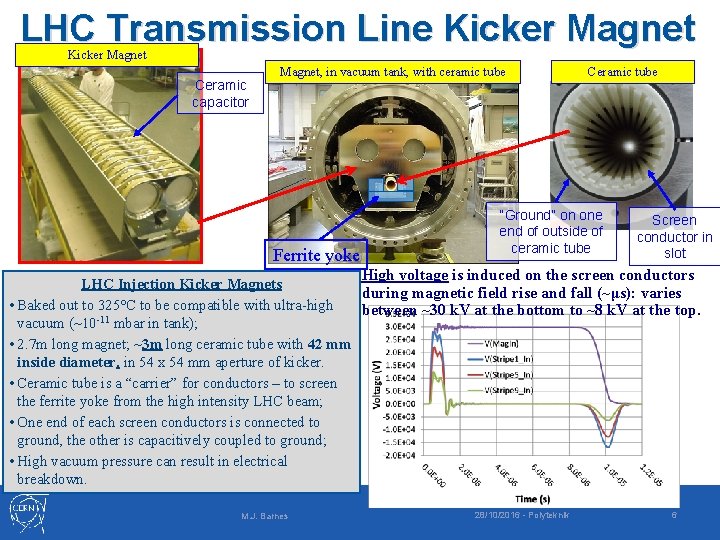
LHC Transmission Line Kicker Magnet Ceramic capacitor Magnet, in vacuum tank, with ceramic tube Ferrite yoke Ceramic tube “Ground” on one end of outside of ceramic tube Screen conductor in slot High voltage is induced on the screen conductors LHC Injection Kicker Magnets during magnetic field rise and fall (~μs): varies • Baked out to 325°C to be compatible with ultra-high between ~30 k. V at the bottom to ~8 k. V at the top. vacuum (~10 -11 mbar in tank); • 2. 7 m long magnet; ~3 m long ceramic tube with 42 mm inside diameter, in 54 x 54 mm aperture of kicker. • Ceramic tube is a “carrier” for conductors – to screen the ferrite yoke from the high intensity LHC beam; • One end of each screen conductors is connected to ground, the other is capacitively coupled to ground; • High vacuum pressure can result in electrical breakdown. M. J. Barnes 28/10/2016 - Polyteknik 6
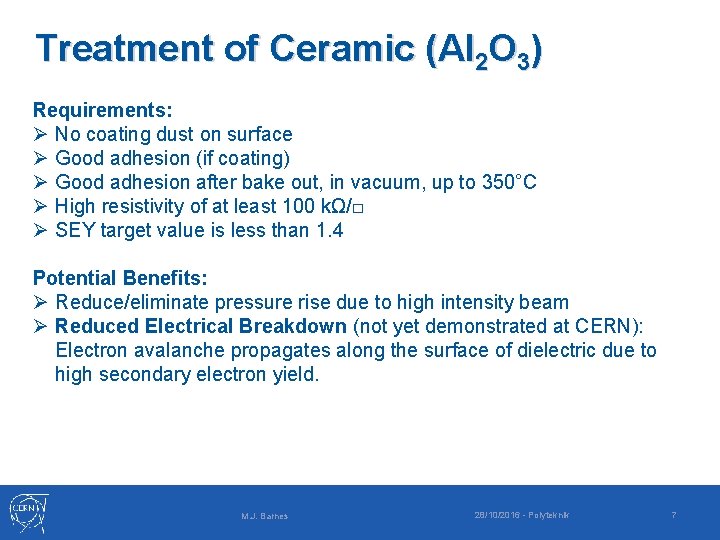
Treatment of Ceramic (Al 2 O 3) Requirements: Ø No coating dust on surface Ø Good adhesion (if coating) Ø Good adhesion after bake out, in vacuum, up to 350°C Ø High resistivity of at least 100 kΩ/□ Ø SEY target value is less than 1. 4 Potential Benefits: Ø Reduce/eliminate pressure rise due to high intensity beam Ø Reduced Electrical Breakdown (not yet demonstrated at CERN): Electron avalanche propagates along the surface of dielectric due to high secondary electron yield. M. J. Barnes 28/10/2016 - Polyteknik 7
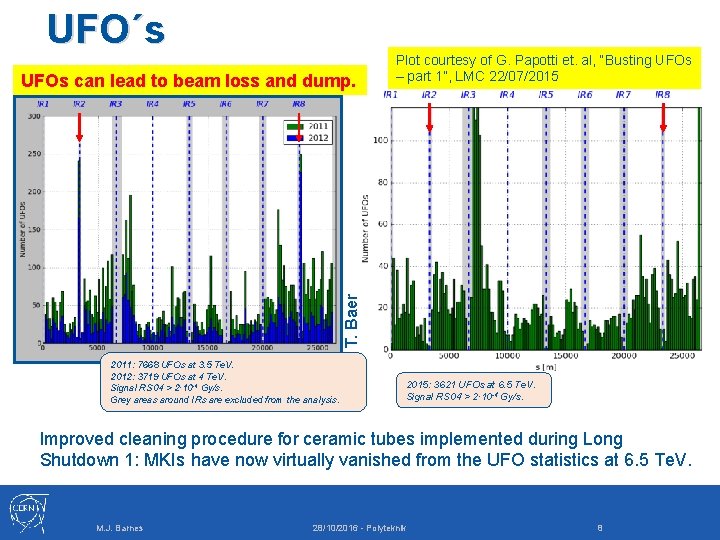
UFO´s T. Baer UFOs can lead to beam loss and dump. Plot courtesy of G. Papotti et. al, “Busting UFOs – part 1”, LMC 22/07/2015 2011: 7668 UFOs at 3. 5 Te. V. 2012: 3719 UFOs at 4 Te. V. Signal RS 04 > 2∙ 10 -4 Gy/s. Grey areas around IRs are excluded from the analysis. 2015: 3621 UFOs at 6. 5 Te. V. Signal RS 04 > 2∙ 10 -4 Gy/s. Improved cleaning procedure for ceramic tubes implemented during Long Shutdown 1: MKIs have now virtually vanished from the UFO statistics at 6. 5 Te. V. M. J. Barnes 28/10/2016 - Polyteknik 8
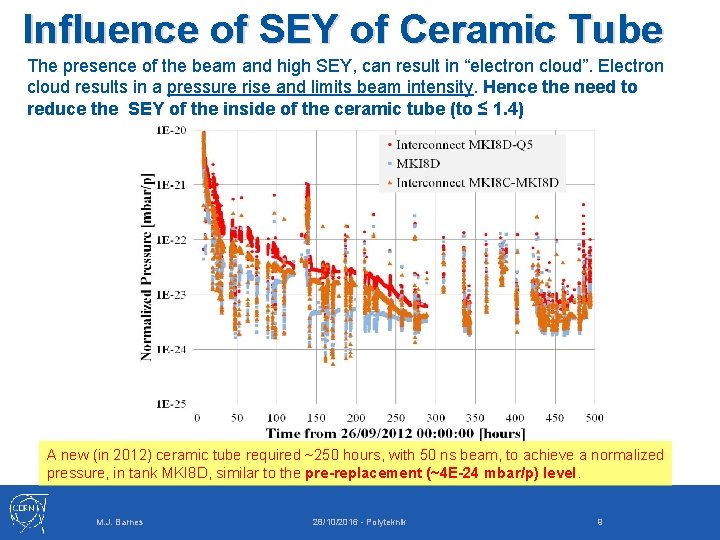
Influence of SEY of Ceramic Tube The presence of the beam and high SEY, can result in “electron cloud”. Electron cloud results in a pressure rise and limits beam intensity. Hence the need to reduce the SEY of the inside of the ceramic tube (to ≤ 1. 4) A new (in 2012) ceramic tube required ~250 hours, with 50 ns beam, to achieve a normalized pressure, in tank MKI 8 D, similar to the pre-replacement (~4 E-24 mbar/p) level. M. J. Barnes 28/10/2016 - Polyteknik 9
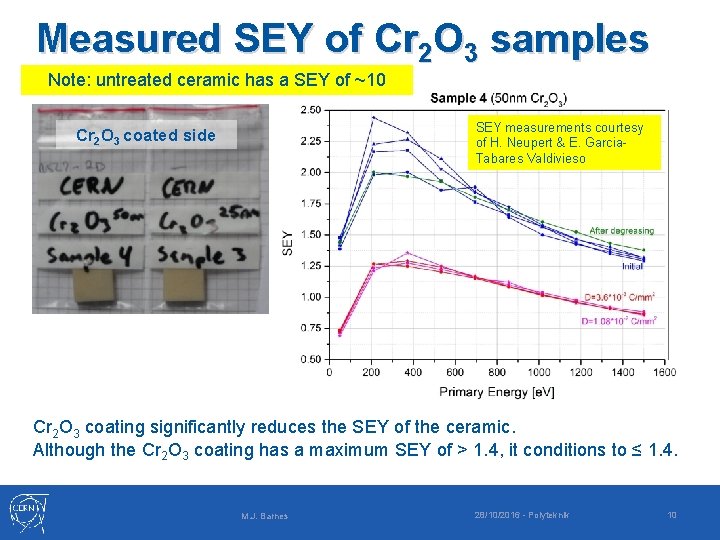
Measured SEY of Cr 2 O 3 samples Note: untreated ceramic has a SEY of ~10 SEY measurements courtesy of H. Neupert & E. Garcia. Tabares Valdivieso Cr 2 O 3 coated side Cr 2 O 3 coating significantly reduces the SEY of the ceramic. Although the Cr 2 O 3 coating has a maximum SEY of > 1. 4, it conditions to ≤ 1. 4. M. J. Barnes 28/10/2016 - Polyteknik 10
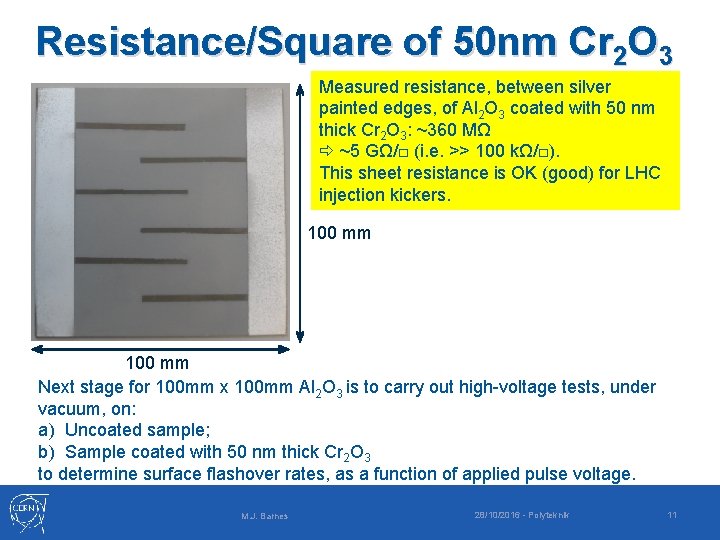
Resistance/Square of 50 nm Cr 2 O 3 Measured resistance, between silver painted edges, of Al 2 O 3 coated with 50 nm thick Cr 2 O 3: ~360 MΩ ~5 GΩ/□ (i. e. >> 100 kΩ/□). This sheet resistance is OK (good) for LHC injection kickers. 100 mm Next stage for 100 mm x 100 mm Al 2 O 3 is to carry out high-voltage tests, under vacuum, on: a) Uncoated sample; b) Sample coated with 50 nm thick Cr 2 O 3 to determine surface flashover rates, as a function of applied pulse voltage. M. J. Barnes 28/10/2016 - Polyteknik 11
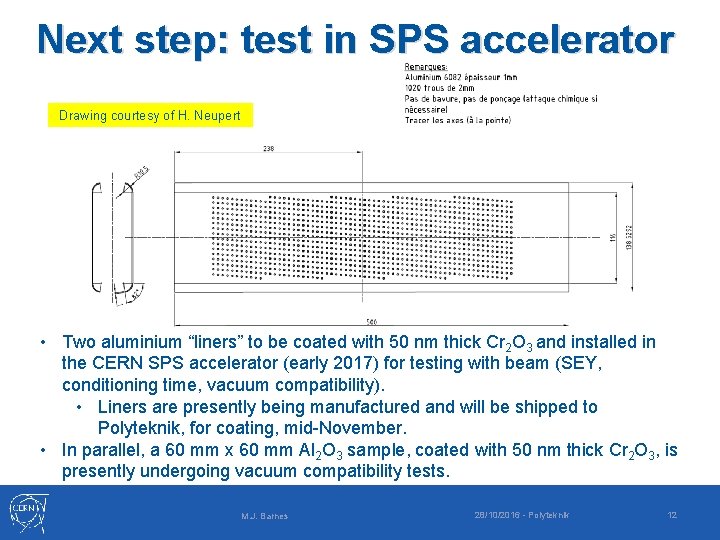
Next step: test in SPS accelerator Drawing courtesy of H. Neupert • Two aluminium “liners” to be coated with 50 nm thick Cr 2 O 3 and installed in the CERN SPS accelerator (early 2017) for testing with beam (SEY, conditioning time, vacuum compatibility). • Liners are presently being manufactured and will be shipped to Polyteknik, for coating, mid-November. • In parallel, a 60 mm x 60 mm Al 2 O 3 sample, coated with 50 nm thick Cr 2 O 3, is presently undergoing vacuum compatibility tests. M. J. Barnes 28/10/2016 - Polyteknik 12
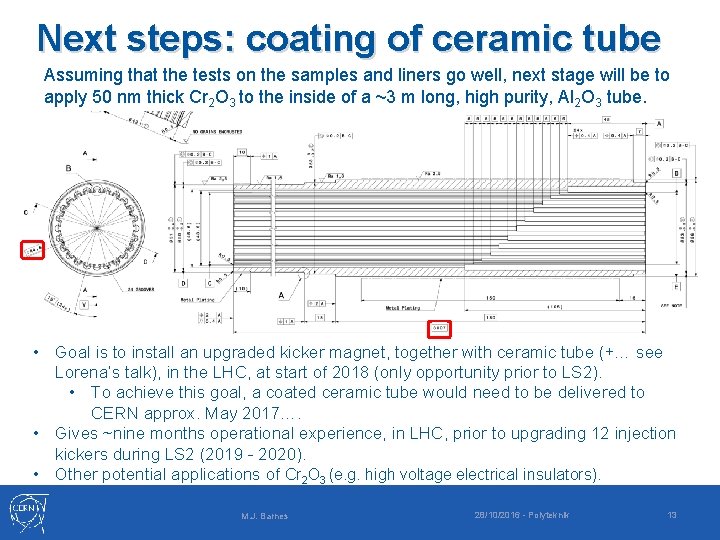
Next steps: coating of ceramic tube Assuming that the tests on the samples and liners go well, next stage will be to apply 50 nm thick Cr 2 O 3 to the inside of a ~3 m long, high purity, Al 2 O 3 tube. • Goal is to install an upgraded kicker magnet, together with ceramic tube (+… see Lorena’s talk), in the LHC, at start of 2018 (only opportunity prior to LS 2). • To achieve this goal, a coated ceramic tube would need to be delivered to CERN approx. May 2017…. • Gives ~nine months operational experience, in LHC, prior to upgrading 12 injection kickers during LS 2 (2019 - 2020). • Other potential applications of Cr 2 O 3 (e. g. high voltage electrical insulators). M. J. Barnes 28/10/2016 - Polyteknik 13