
LHC construction and operation Jrg Wenninger CERN Beams
LHC : construction and operation Jörg Wenninger CERN Beams Department / Operation group LNF Spring School 'Bruno Touschek' - May 2010 Part 1: • Introduction to accelerator physics • LHC magnet and layout • Luminosity and interaction regions • Injection and filling schemes J. Wenninger LNF Spring School, May 2010 1
Outline • The LHC challenges • Introduction to magnets and particle focusing • LHC magnets and arc layout Part 1 • LHC luminosity and interaction regions • Injection and filling schemes • Machine protection • Incident 19 th Sept. 2008 and consequences Part 2 • LHC operation J. Wenninger LNF Spring School, May 2010 2
LHC History 1982 : First studies for the LHC project 1983 : Z 0/W discovered at SPS proton antiproton collider (Sppbar. S) 1989 : Start of LEP operation (Z/W boson-factory) 1994 : Approval of the LHC by the CERN Council 1996 : Final decision to start the LHC construction 2000 : Last year of LEP operation above 100 Ge. V 2002 : LEP equipment removed 2003 : Start of LHC installation 2005 : Start of LHC hardware commissioning 2008 : Start of (short) beam commissioning Powering incident on 19 th Sept. 2009 : Repair, re-commissioning and beam commissioning 2010 : Start of a 2 year run at 3. 5 Te. V/beam J. Wenninger LNF Spring School, May 2010 3
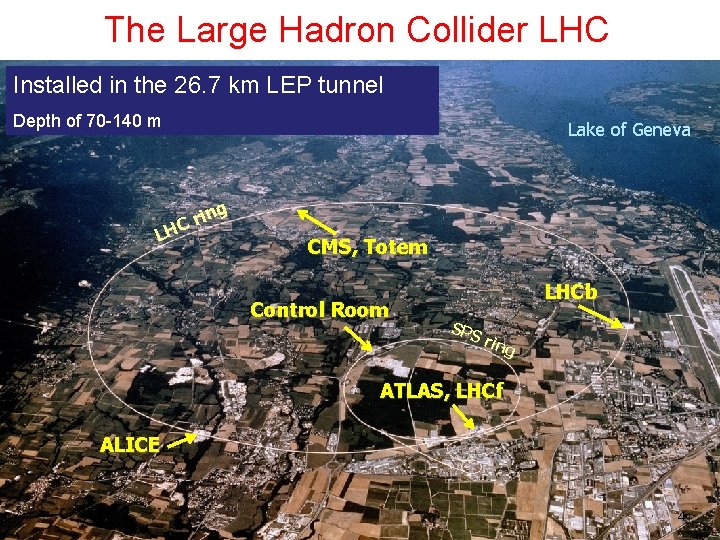
The Large Hadron Collider LHC Installed in the 26. 7 km LEP tunnel Depth of 70 -140 m ing r C LH Lake of Geneva CMS, Totem Control Room LHCb SPS rin g ATLAS, LHCf ALICE 17. 03. 2010 4 Der LHC
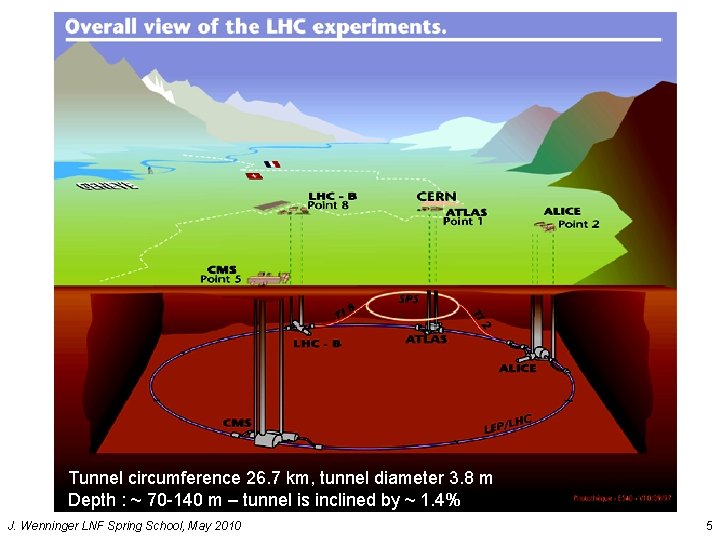
Tunnel circumference 26. 7 km, tunnel diameter 3. 8 m Depth : ~ 70 -140 m – tunnel is inclined by ~ 1. 4% J. Wenninger LNF Spring School, May 2010 5
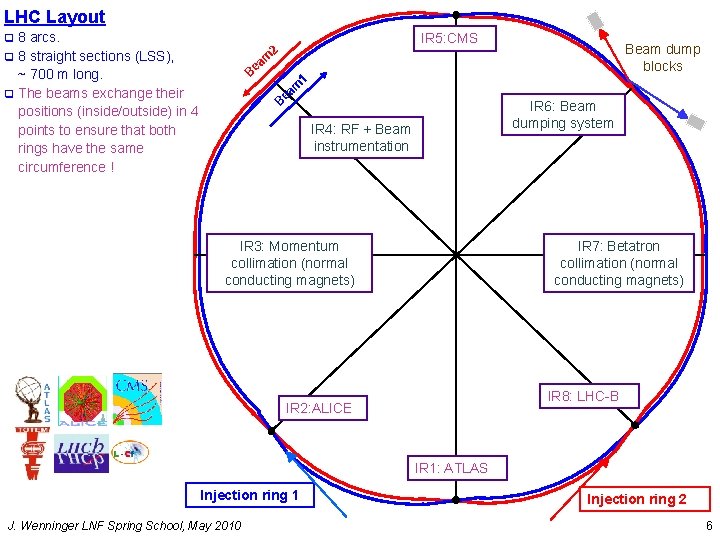
LHC Layout 8 arcs. q 8 straight sections (LSS), ~ 700 m long. q The beams exchange their positions (inside/outside) in 4 points to ensure that both rings have the same circumference ! q IR 5: CMS 2 m ea B 1 m a e B Beam dump blocks IR 6: Beam dumping system IR 4: RF + Beam instrumentation IR 3: Momentum collimation (normal conducting magnets) IR 7: Betatron collimation (normal conducting magnets) IR 8: LHC-B IR 2: ALICE IR 1: ATLAS Injection ring 1 J. Wenninger LNF Spring School, May 2010 Injection ring 2 6

LHC – yet another collider? The LHC surpasses existing accelerators/colliders in 2 aspects : q The energy of the beam of 7 Te. V that is achieved within the size constraints of the existing 26. 7 km LEP tunnel. LHC dipole field 8. 3 T A factor 2 in field HERA/Tevatron ~4 T A factor 4 in size q The luminosity of the collider that will reach unprecedented values for a hadron machine: LHC pp ~ 1034 cm-2 s-1 Tevatron pp 3 x 1032 cm-2 s-1 Sppbar. S pp 6 x 1030 cm-2 s-1 A factor 30 in luminosity The combination of very high field magnets and very high beam intensities required to reach the luminosity targets makes operation of the LHC a great challenge ! J. Wenninger LNF Spring School, May 2010 7
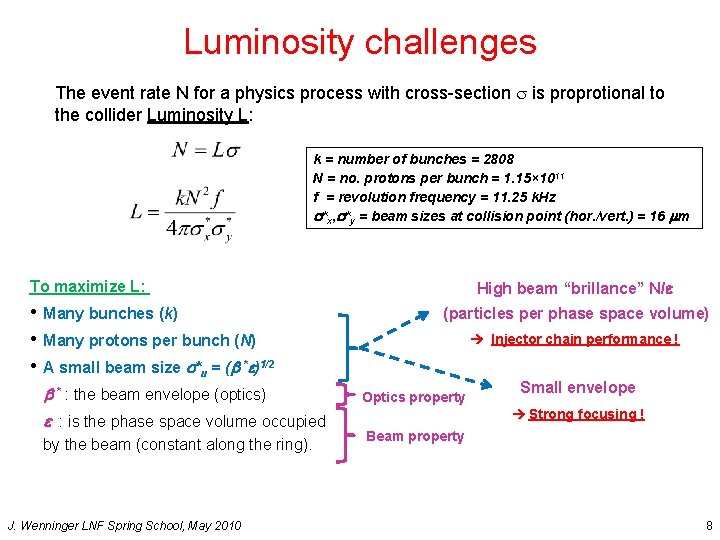
Luminosity challenges The event rate N for a physics process with cross-section s is proprotional to the collider Luminosity L: k = number of bunches = 2808 N = no. protons per bunch = 1. 15× 1011 f = revolution frequency = 11. 25 k. Hz s*x, s*y = beam sizes at collision point (hor. /vert. ) = 16 mm To maximize L: • Many bunches (k) • Many protons per bunch (N) • A small beam size s*u = (b *e)1/2 b * : the beam envelope (optics) e : is the phase space volume occupied by the beam (constant along the ring). J. Wenninger LNF Spring School, May 2010 High beam “brillance” N/e (particles per phase space volume) Injector chain performance ! Optics property Small envelope Strong focusing ! Beam property 8
Basics of accelerator physics J. Wenninger LNF Spring School, May 2010 9
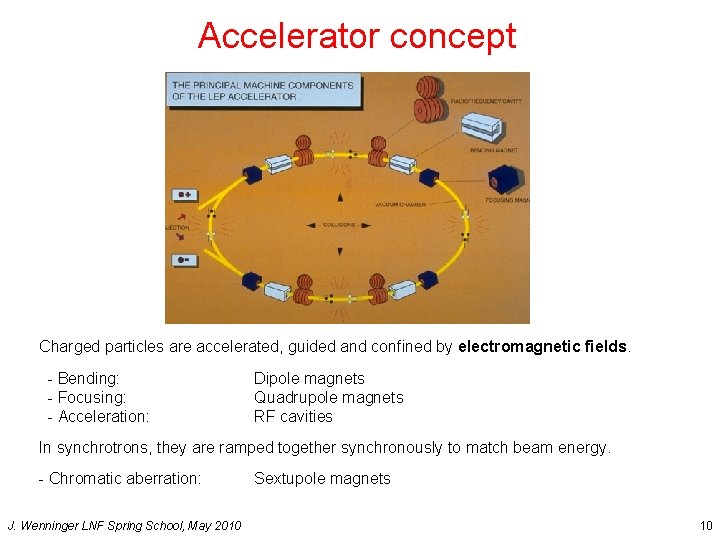
Accelerator concept Charged particles are accelerated, guided and confined by electromagnetic fields. - Bending: - Focusing: - Acceleration: Dipole magnets Quadrupole magnets RF cavities In synchrotrons, they are ramped together synchronously to match beam energy. - Chromatic aberration: J. Wenninger LNF Spring School, May 2010 Sextupole magnets 10
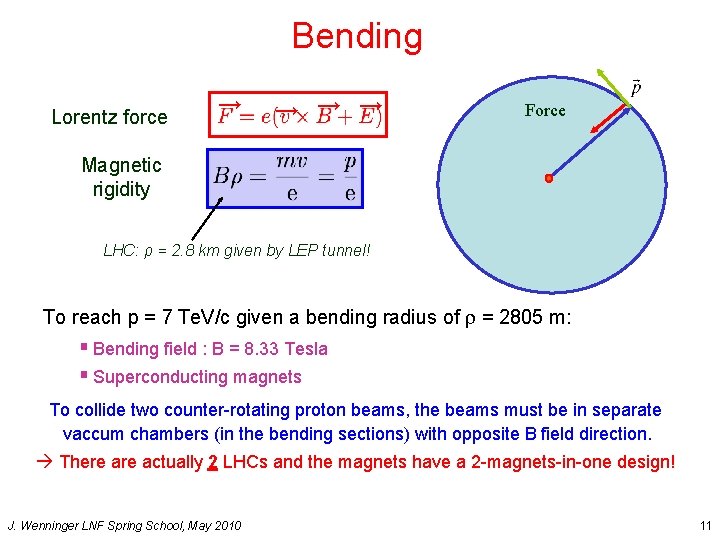
Bending Lorentz force → → Force Magnetic rigidity LHC: ρ = 2. 8 km given by LEP tunnel! To reach p = 7 Te. V/c given a bending radius of r = 2805 m: § Bending field : B = 8. 33 Tesla § Superconducting magnets To collide two counter-rotating proton beams, the beams must be in separate vaccum chambers (in the bending sections) with opposite B field direction. There actually 2 LHCs and the magnets have a 2 -magnets-in-one design! J. Wenninger LNF Spring School, May 2010 11
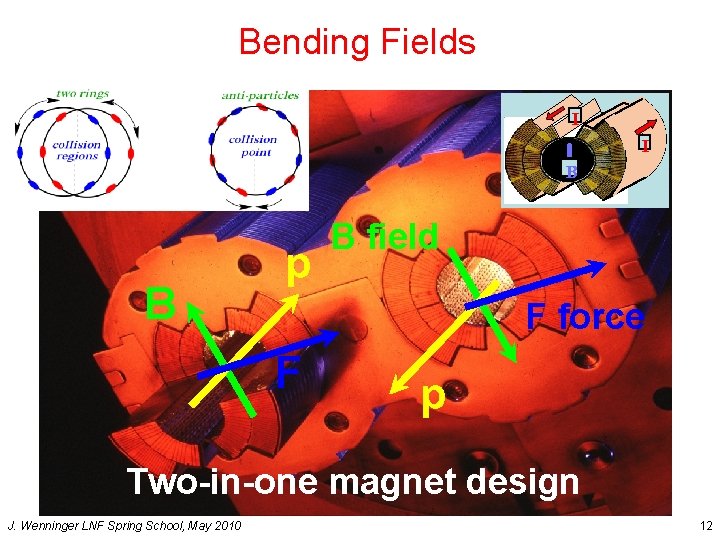
Bending Fields I II B B p B field F force F p Two-in-one magnet design J. Wenninger LNF Spring School, May 2010 12
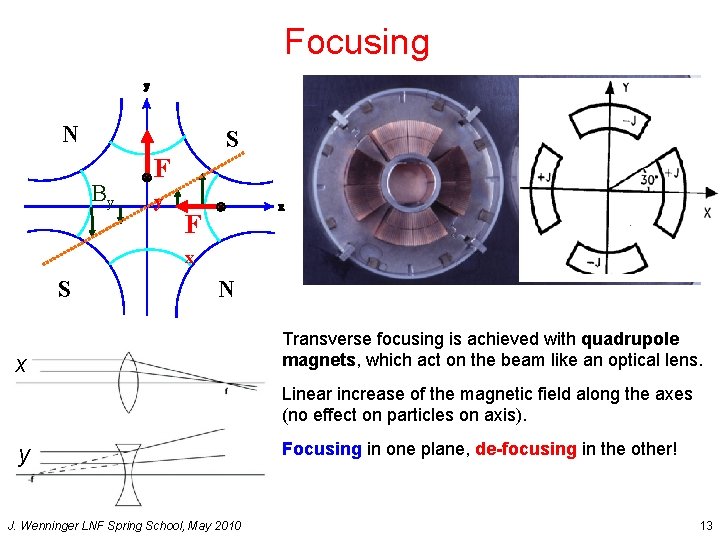
Focusing N S By F x S N x Transverse focusing is achieved with quadrupole magnets, which act on the beam like an optical lens. Linear increase of the magnetic field along the axes (no effect on particles on axis). y J. Wenninger LNF Spring School, May 2010 Focusing in one plane, de-focusing in the other! 13
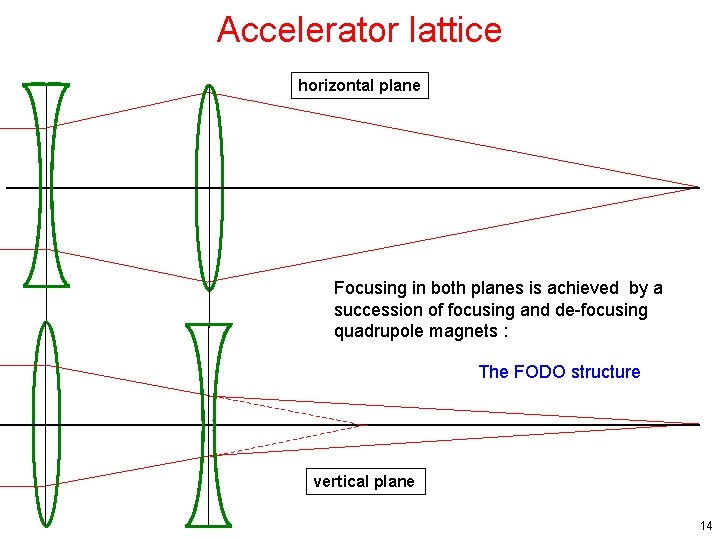
Accelerator lattice horizontal plane Focusing in both planes is achieved by a succession of focusing and de-focusing quadrupole magnets : The FODO structure vertical plane 14
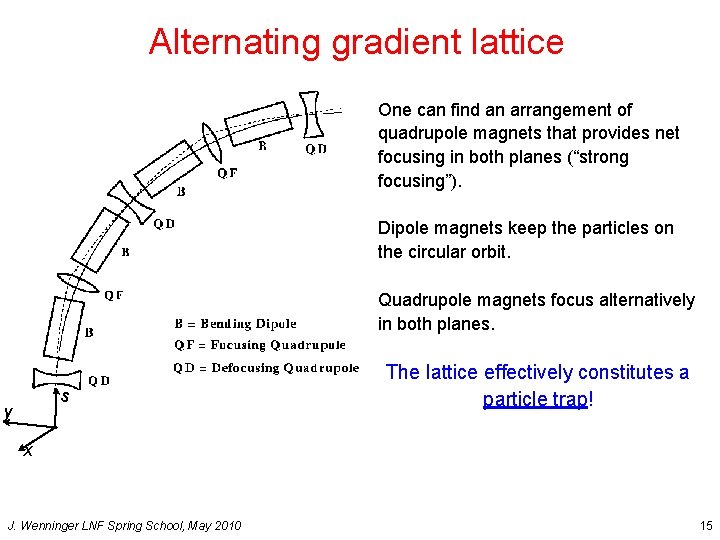
Alternating gradient lattice One can find an arrangement of quadrupole magnets that provides net focusing in both planes (“strong focusing”). Dipole magnets keep the particles on the circular orbit. Quadrupole magnets focus alternatively in both planes. s y The lattice effectively constitutes a particle trap! x J. Wenninger LNF Spring School, May 2010 15
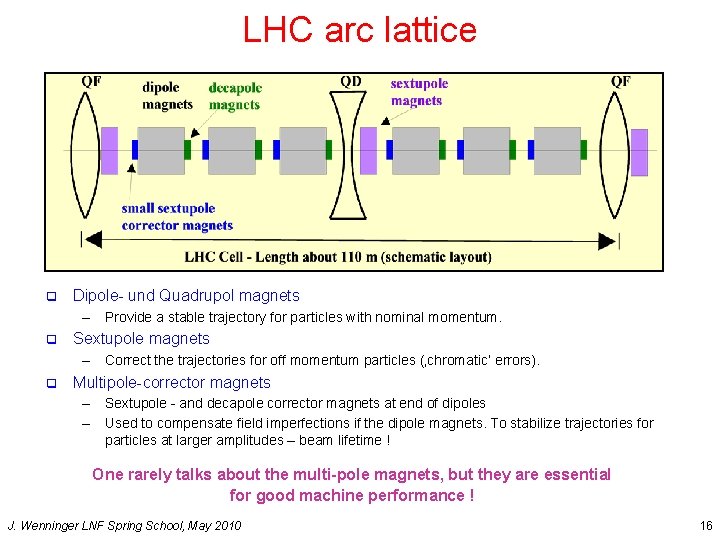
LHC arc lattice q Dipole- und Quadrupol magnets – Provide a stable trajectory for particles with nominal momentum. q Sextupole magnets – Correct the trajectories for off momentum particles (‚chromatic‘ errors). q Multipole-corrector magnets – Sextupole - and decapole corrector magnets at end of dipoles – Used to compensate field imperfections if the dipole magnets. To stabilize trajectories for particles at larger amplitudes – beam lifetime ! One rarely talks about the multi-pole magnets, but they are essential for good machine performance ! J. Wenninger LNF Spring School, May 2010 16
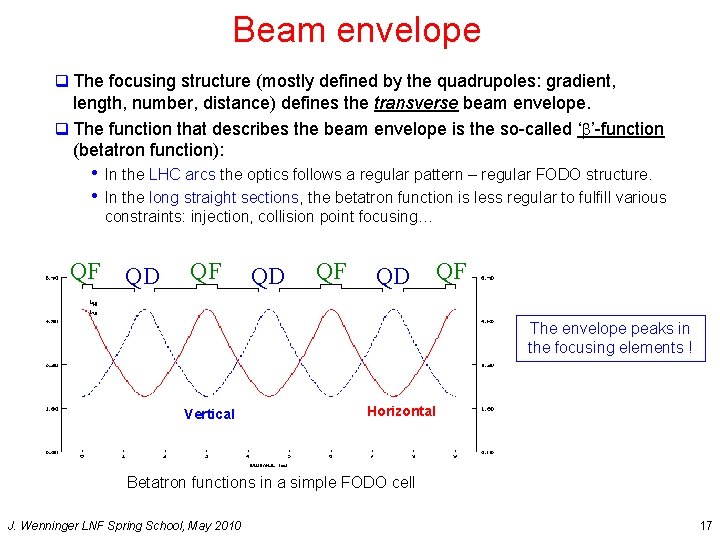
Beam envelope q The focusing structure (mostly defined by the quadrupoles: gradient, length, number, distance) defines the transverse beam envelope. q The function that describes the beam envelope is the so-called ‘b’-function (betatron function): • In the LHC arcs the optics follows a regular pattern – regular FODO structure. • In the long straight sections, the betatron function is less regular to fulfill various constraints: injection, collision point focusing… QF QD QF The envelope peaks in the focusing elements ! Vertical Horizontal Betatron functions in a simple FODO cell J. Wenninger LNF Spring School, May 2010 17
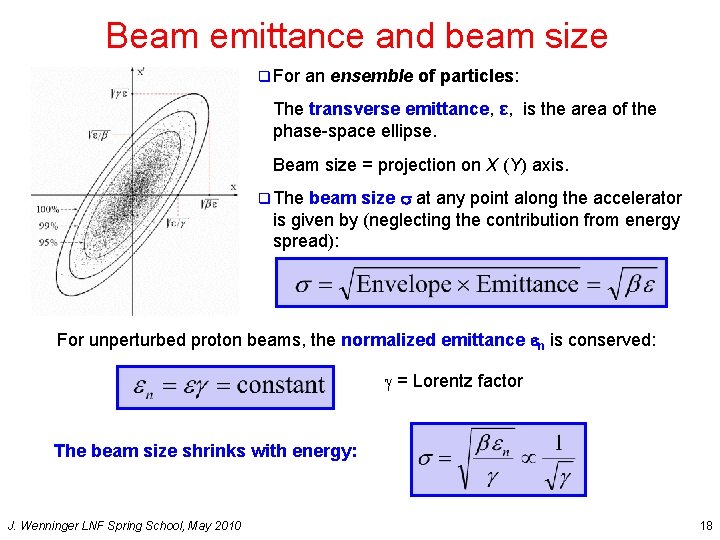
Beam emittance and beam size q For an ensemble of particles: The transverse emittance, ε, is the area of the phase-space ellipse. Beam size = projection on X (Y) axis. beam size s at any point along the accelerator is given by (neglecting the contribution from energy spread): q The For unperturbed proton beams, the normalized emittance en is conserved: g = Lorentz factor The beam size shrinks with energy: J. Wenninger LNF Spring School, May 2010 18
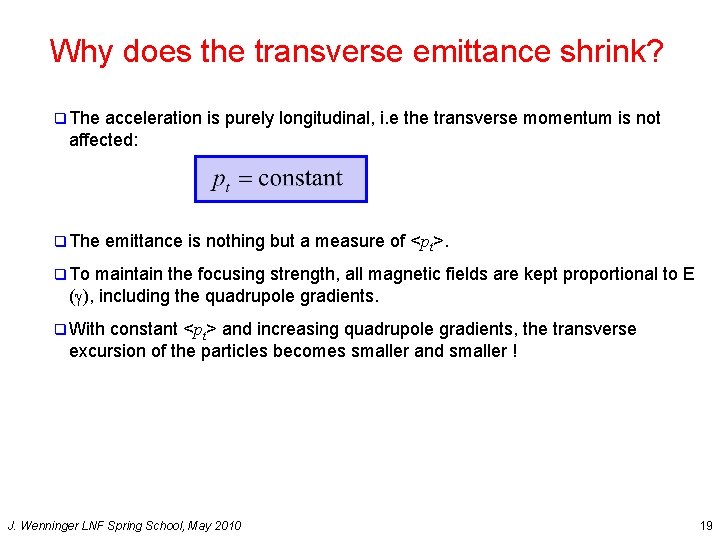
Why does the transverse emittance shrink? q The acceleration is purely longitudinal, i. e the transverse momentum is not affected: q The emittance is nothing but a measure of <pt>. q To maintain the focusing strength, all magnetic fields are kept proportional to E (g), including the quadrupole gradients. q With constant <pt> and increasing quadrupole gradients, the transverse excursion of the particles becomes smaller and smaller ! J. Wenninger LNF Spring School, May 2010 19
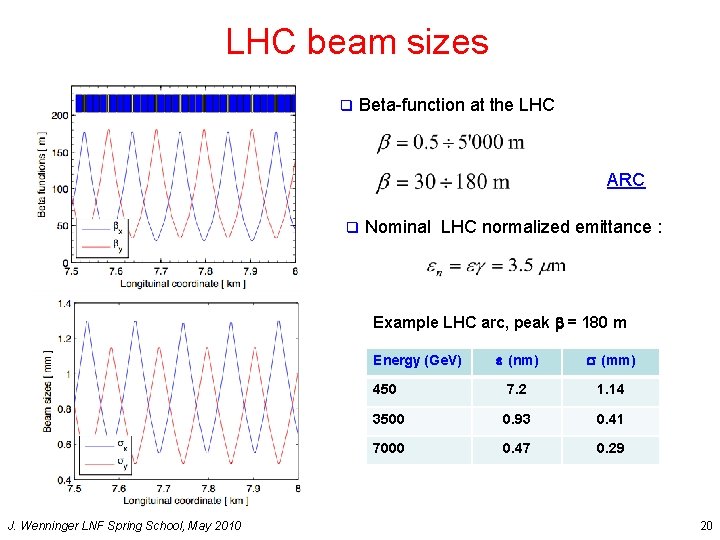
LHC beam sizes q Beta-function at the LHC ARC q Nominal LHC normalized emittance : Example LHC arc, peak b = 180 m e (nm) s (mm) 450 7. 2 1. 14 3500 0. 93 0. 41 7000 0. 47 0. 29 Energy (Ge. V) J. Wenninger LNF Spring School, May 2010 20
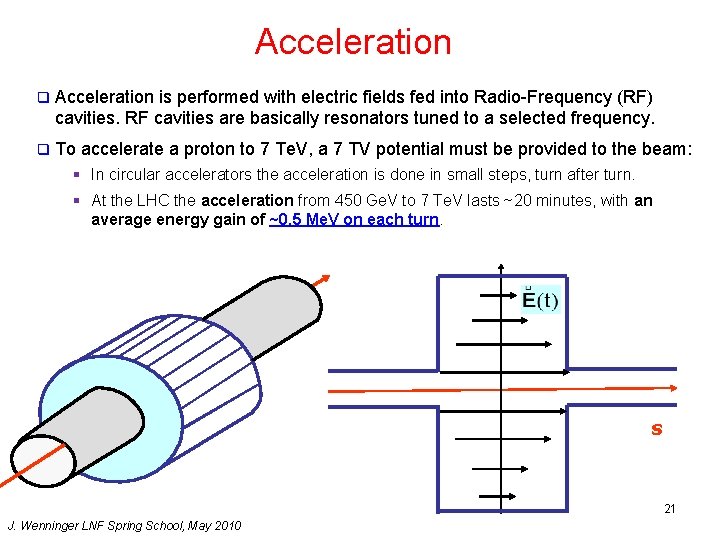
Acceleration q Acceleration is performed with electric fields fed into Radio-Frequency (RF) cavities. RF cavities are basically resonators tuned to a selected frequency. q To accelerate a proton to 7 Te. V, a 7 TV potential must be provided to the beam: § In circular accelerators the acceleration is done in small steps, turn after turn. § At the LHC the acceleration from 450 Ge. V to 7 Te. V lasts ~20 minutes, with an average energy gain of ~0. 5 Me. V on each turn. s 21 J. Wenninger LNF Spring School, May 2010
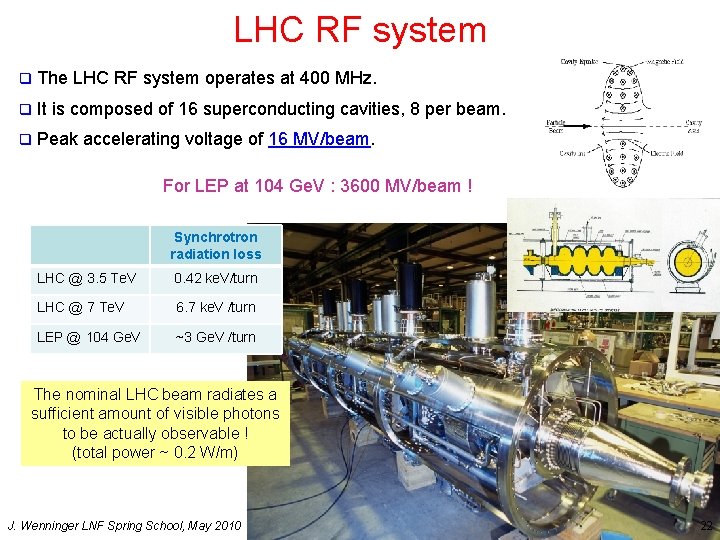
LHC RF system q The LHC RF system operates at 400 MHz. q It is composed of 16 superconducting cavities, 8 per beam. q Peak accelerating voltage of 16 MV/beam. For LEP at 104 Ge. V : 3600 MV/beam ! Synchrotron radiation loss LHC @ 3. 5 Te. V 0. 42 ke. V/turn LHC @ 7 Te. V 6. 7 ke. V /turn LEP @ 104 Ge. V ~3 Ge. V /turn The nominal LHC beam radiates a sufficient amount of visible photons to be actually observable ! (total power ~ 0. 2 W/m) J. Wenninger LNF Spring School, May 2010 22
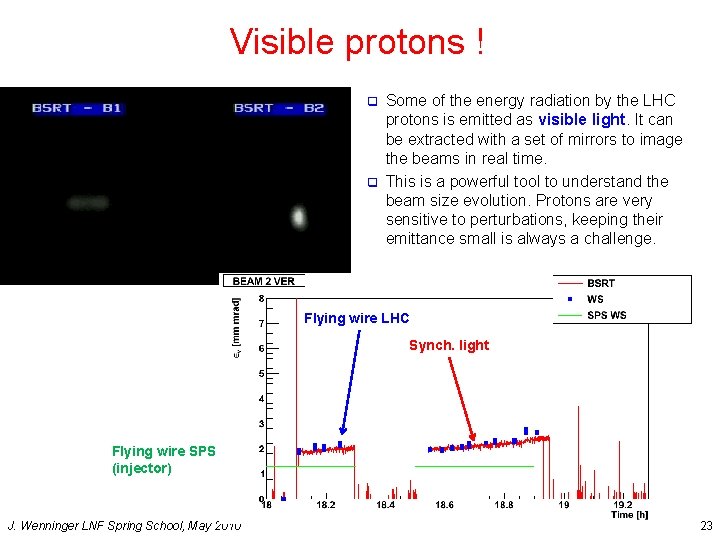
Visible protons ! Some of the energy radiation by the LHC protons is emitted as visible light. It can be extracted with a set of mirrors to image the beams in real time. q This is a powerful tool to understand the beam size evolution. Protons are very sensitive to perturbations, keeping their emittance small is always a challenge. q Flying wire LHC Synch. light Flying wire SPS (injector) J. Wenninger LNF Spring School, May 2010 23
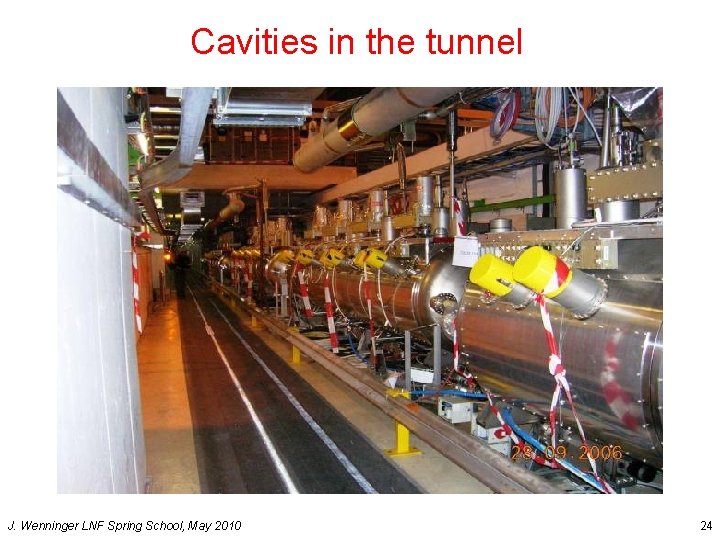
Cavities in the tunnel J. Wenninger LNF Spring School, May 2010 24
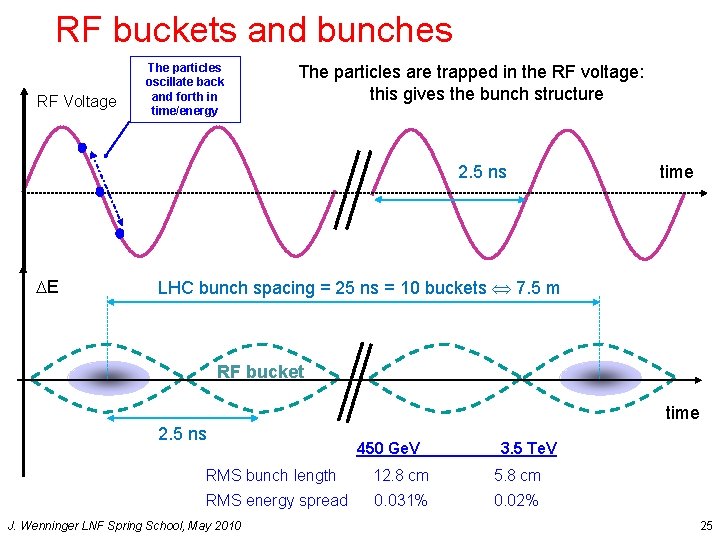
RF buckets and bunches RF Voltage The particles oscillate back and forth in time/energy The particles are trapped in the RF voltage: this gives the bunch structure 2. 5 ns E time LHC bunch spacing = 25 ns = 10 buckets 7. 5 m RF bucket time 2. 5 ns 450 Ge. V 3. 5 Te. V RMS bunch length 12. 8 cm 5. 8 cm RMS energy spread 0. 031% 0. 02% J. Wenninger LNF Spring School, May 2010 25
Magnets & Tunnel J. Wenninger LNF Spring School, May 2010 26
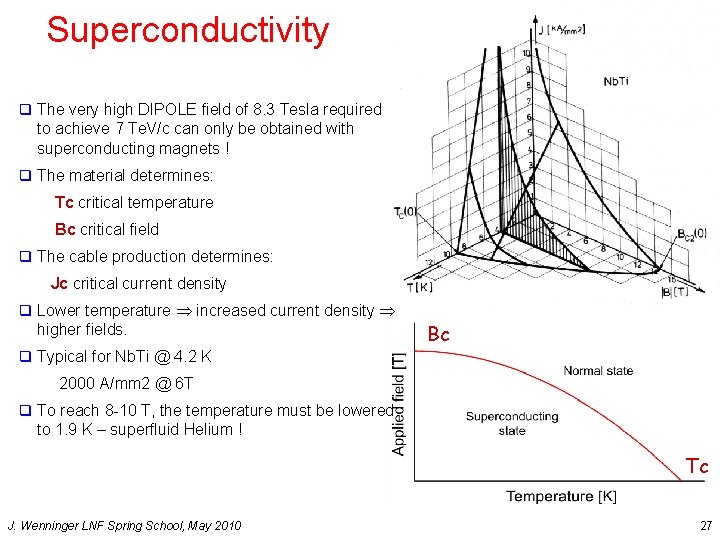
Superconductivity q The very high DIPOLE field of 8. 3 Tesla required to achieve 7 Te. V/c can only be obtained with superconducting magnets ! q The material determines: Tc critical temperature Bc critical field q The cable production determines: Jc critical current density q Lower temperature increased current density higher fields. Bc q Typical for Nb. Ti @ 4. 2 K 2000 A/mm 2 @ 6 T q To reach 8 -10 T, the temperature must be lowered to 1. 9 K – superfluid Helium ! Tc J. Wenninger LNF Spring School, May 2010 27
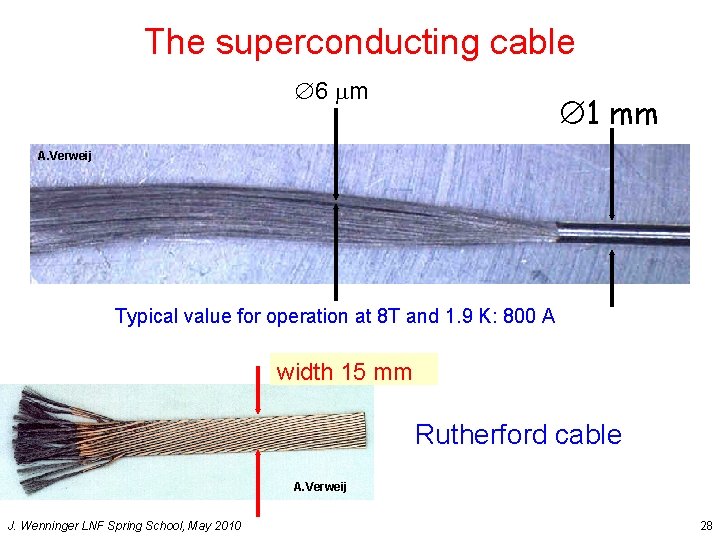
The superconducting cable 6 m 1 mm A. Verweij Typical value for operation at 8 T and 1. 9 K: 800 A width 15 mm Rutherford cable A. Verweij J. Wenninger LNF Spring School, May 2010 28
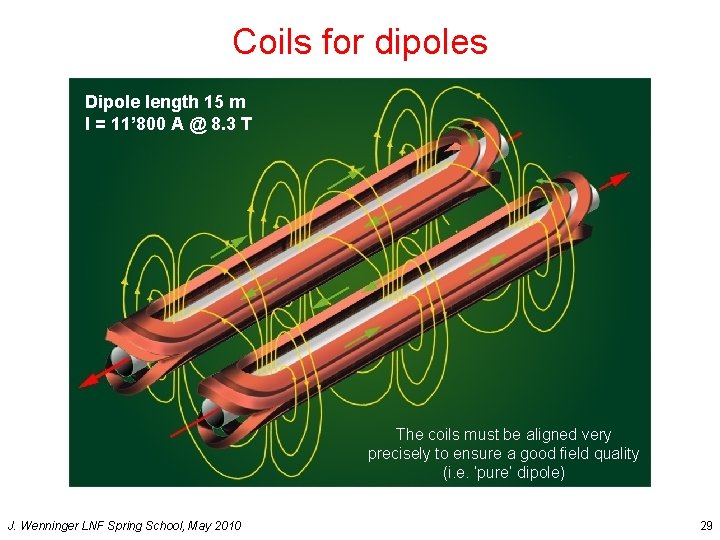
Coils for dipoles Dipole length 15 m I = 11’ 800 A @ 8. 3 T The coils must be aligned very precisely to ensure a good field quality (i. e. ‘pure’ dipole) J. Wenninger LNF Spring School, May 2010 29
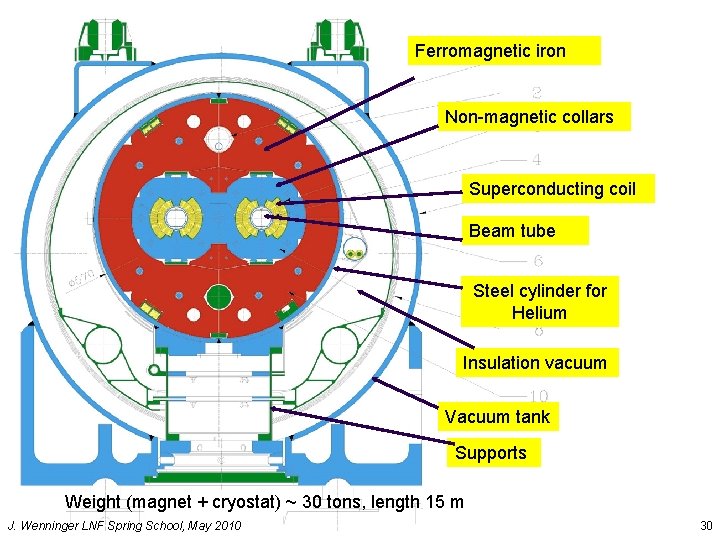
Ferromagnetic iron Non-magnetic collars Superconducting coil Beam tube Steel cylinder for Helium Insulation vacuum Vacuum tank Supports Weight (magnet + cryostat) ~ 30 tons, length 15 m J. Wenninger LNF Spring School, May 2010 Rüdiger Schmidt 30 30
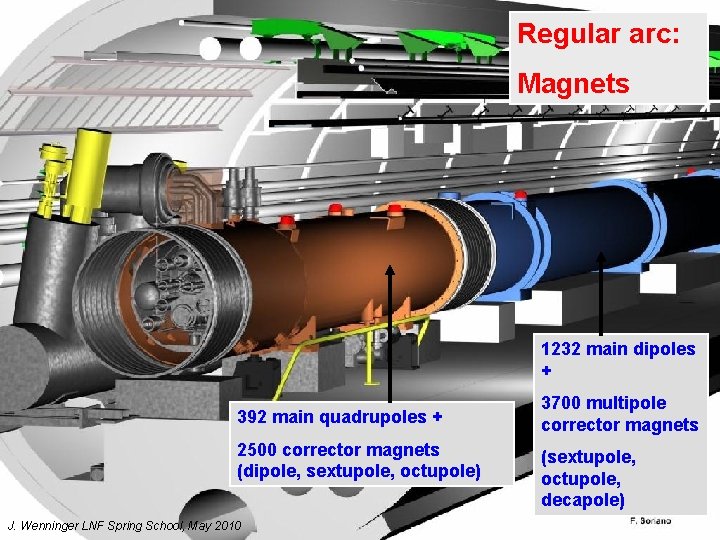
Regular arc: Magnets 1232 main dipoles + 392 main quadrupoles + 2500 corrector magnets (dipole, sextupole, octupole) J. Wenninger LNF Spring School, May 2010 3700 multipole corrector magnets (sextupole, octupole, decapole) J. Wenninger - ETHZ - December 2005 31 31
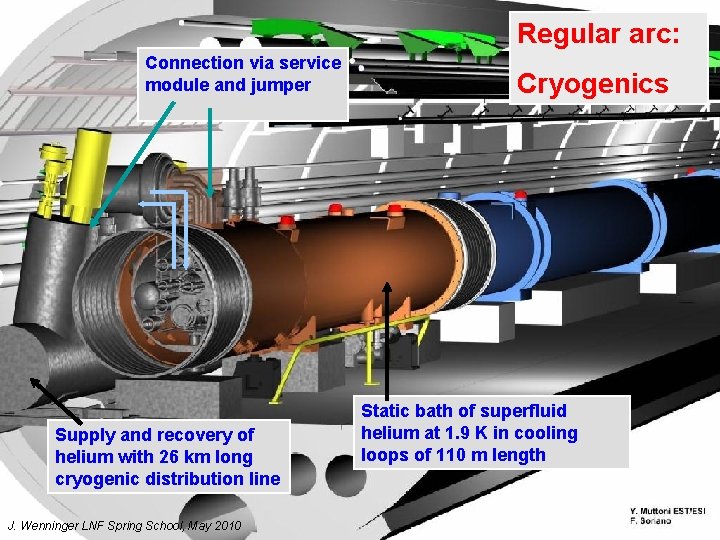
Regular arc: Connection via service module and jumper Supply and recovery of helium with 26 km long cryogenic distribution line J. Wenninger LNF Spring School, May 2010 Cryogenics Static bath of superfluid helium at 1. 9 K in cooling loops of 110 m length J. Wenninger - ETHZ - December 2005 32 32
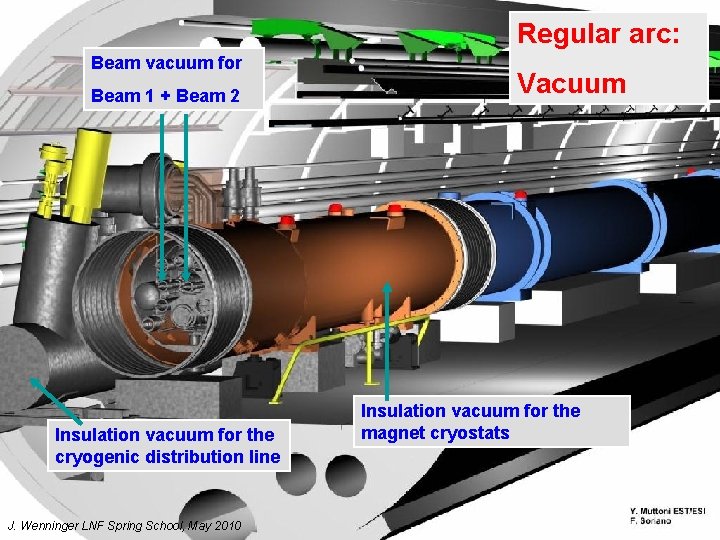
Regular arc: Beam vacuum for Beam 1 + Beam 2 Insulation vacuum for the cryogenic distribution line J. Wenninger LNF Spring School, May 2010 Vacuum Insulation vacuum for the magnet cryostats J. Wenninger - ETHZ - December 2005 33 33
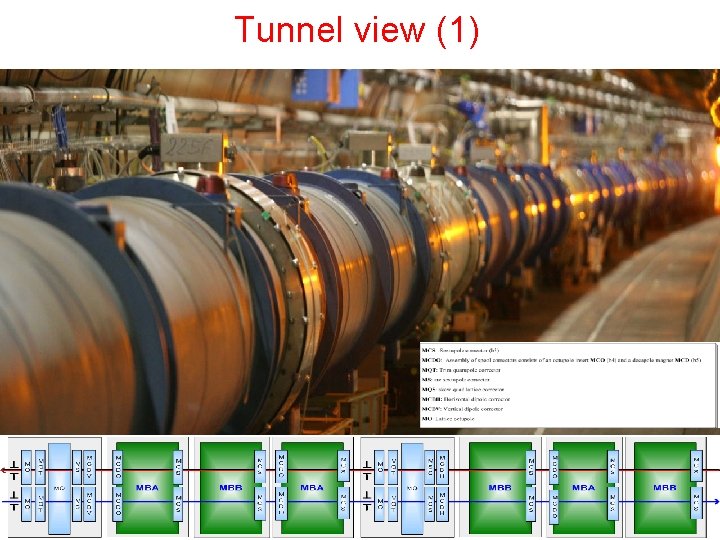
Tunnel view (1) J. Wenninger LNF Spring School, May 2010 34
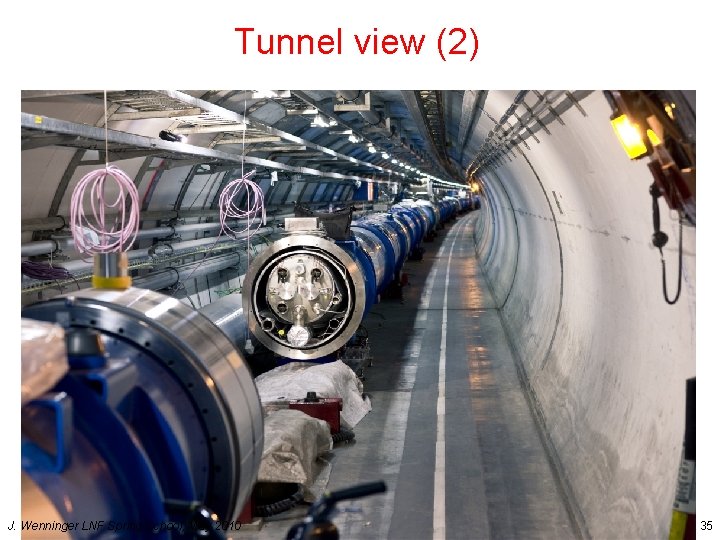
Tunnel view (2) J. Wenninger LNF Spring School, May 2010 35
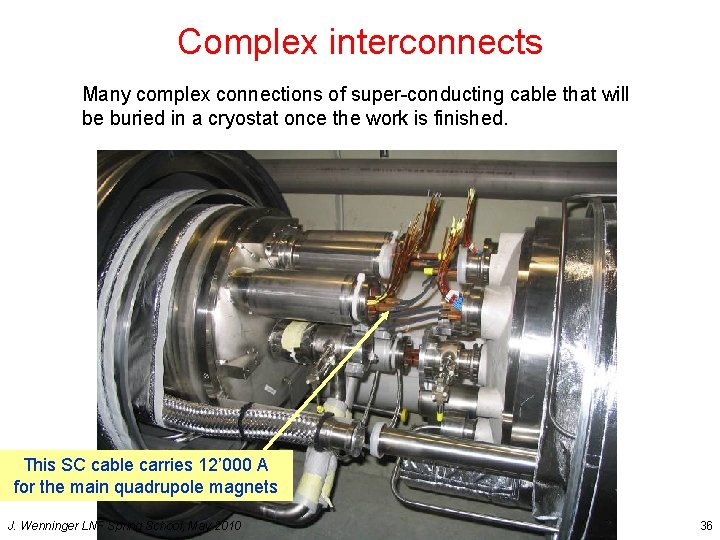
Complex interconnects Many complex connections of super-conducting cable that will be buried in a cryostat once the work is finished. This SC cable carries 12’ 000 A for the main quadrupole magnets J. Wenninger LNF Spring School, May 2010 CERN visit Mc. Ewen 36
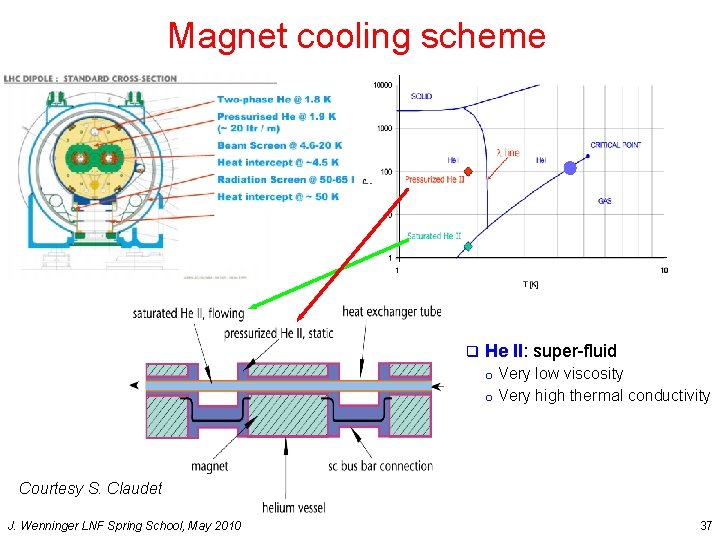
Magnet cooling scheme q He II: super-fluid Very low viscosity o Very high thermal conductivity o Courtesy S. Claudet J. Wenninger LNF Spring School, May 2010 37
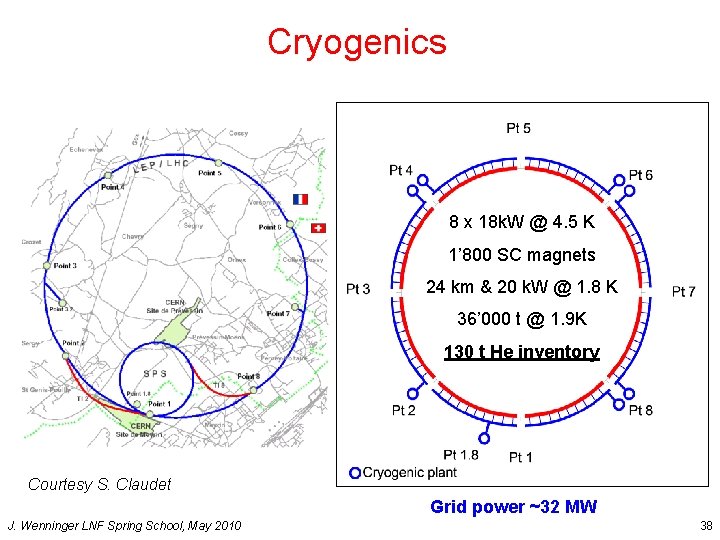
Cryogenics 8 x 18 k. W @ 4. 5 K 1’ 800 SC magnets 24 km & 20 k. W @ 1. 8 K 36’ 000 t @ 1. 9 K 130 t He inventory Courtesy S. Claudet Grid power ~32 MW J. Wenninger LNF Spring School, May 2010 38
Cool down Cool-down time to 1. 9 K is nowadays ~4 weeks/sector [sector = 1/8 LHC] J. Wenninger LNF Spring School, May 2010 39
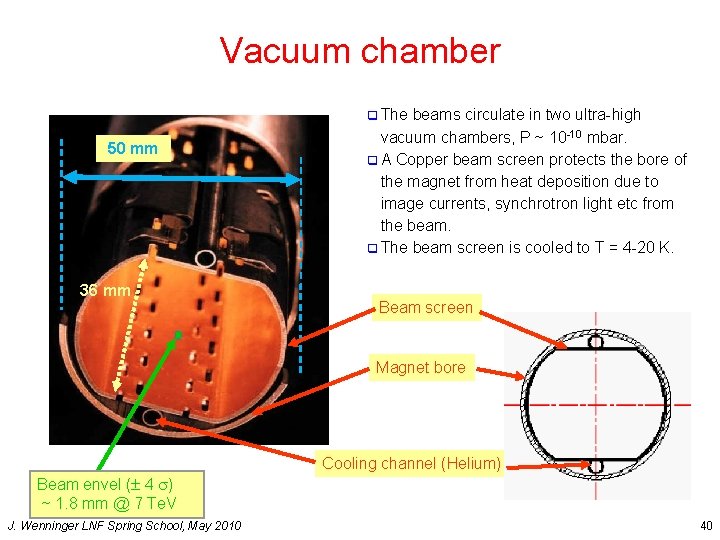
Vacuum chamber q The 50 mm 36 mm beams circulate in two ultra-high vacuum chambers, P ~ 10 -10 mbar. q A Copper beam screen protects the bore of the magnet from heat deposition due to image currents, synchrotron light etc from the beam. q The beam screen is cooled to T = 4 -20 K. Beam screen Magnet bore Cooling channel (Helium) Beam envel ( 4 s) ~ 1. 8 mm @ 7 Te. V J. Wenninger LNF Spring School, May 2010 40
Luminosity and interaction regions J. Wenninger LNF Spring School, May 2010 41
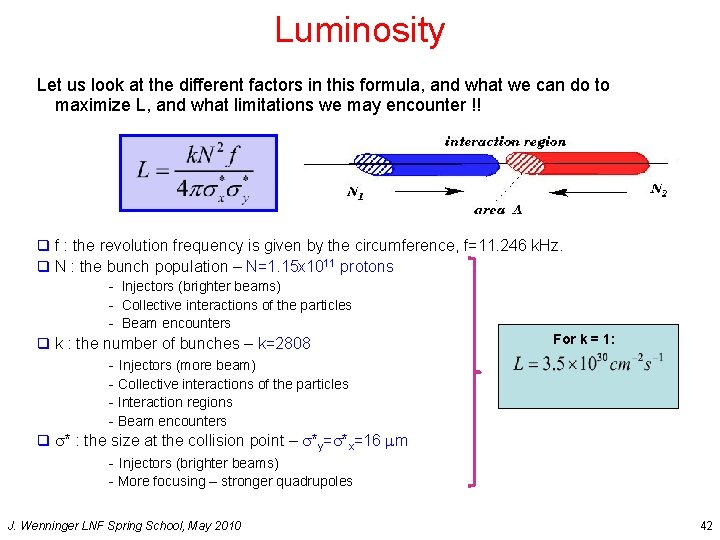
Luminosity Let us look at the different factors in this formula, and what we can do to maximize L, and what limitations we may encounter !! q f : the revolution frequency is given by the circumference, f=11. 246 k. Hz. q N : the bunch population – N=1. 15 x 1011 protons - Injectors (brighter beams) - Collective interactions of the particles - Beam encounters q k : the number of bunches – k=2808 For k = 1: - Injectors (more beam) - Collective interactions of the particles - Interaction regions - Beam encounters q s* : the size at the collision point – s*y=s*x=16 m - Injectors (brighter beams) - More focusing – stronger quadrupoles J. Wenninger LNF Spring School, May 2010 42
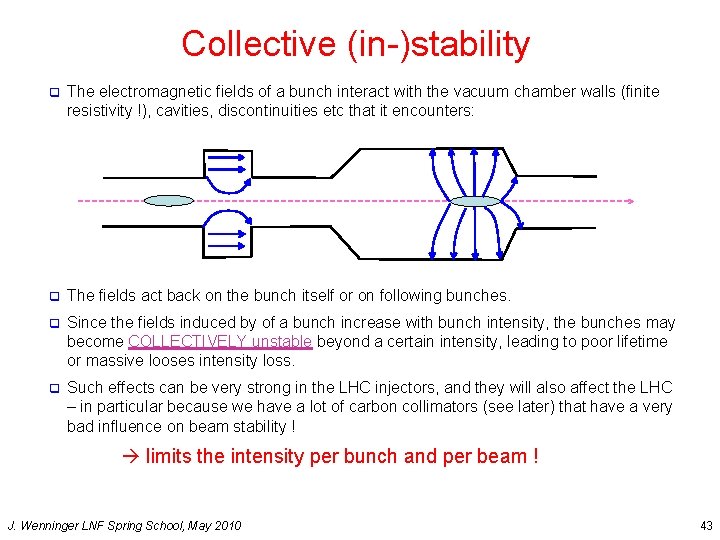
Collective (in-)stability q The electromagnetic fields of a bunch interact with the vacuum chamber walls (finite resistivity !), cavities, discontinuities etc that it encounters: q The fields act back on the bunch itself or on following bunches. q Since the fields induced by of a bunch increase with bunch intensity, the bunches may become COLLECTIVELY unstable beyond a certain intensity, leading to poor lifetime or massive looses intensity loss. q Such effects can be very strong in the LHC injectors, and they will also affect the LHC – in particular because we have a lot of carbon collimators (see later) that have a very bad influence on beam stability ! limits the intensity per bunch and per beam ! J. Wenninger LNF Spring School, May 2010 43
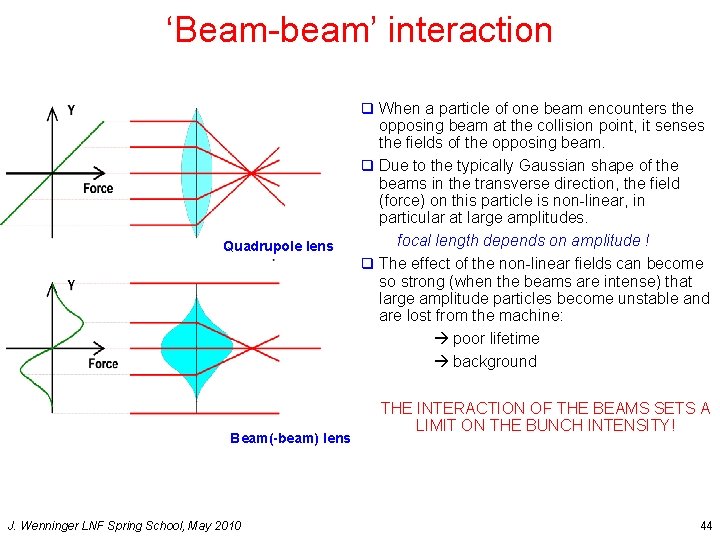
‘Beam-beam’ interaction q When a particle of one beam encounters the Quadrupole lens Beam(-beam) lens J. Wenninger LNF Spring School, May 2010 opposing beam at the collision point, it senses the fields of the opposing beam. q Due to the typically Gaussian shape of the beams in the transverse direction, the field (force) on this particle is non-linear, in particular at large amplitudes. focal length depends on amplitude ! q The effect of the non-linear fields can become so strong (when the beams are intense) that large amplitude particles become unstable and are lost from the machine: poor lifetime background THE INTERACTION OF THE BEAMS SETS A LIMIT ON THE BUNCH INTENSITY! 44
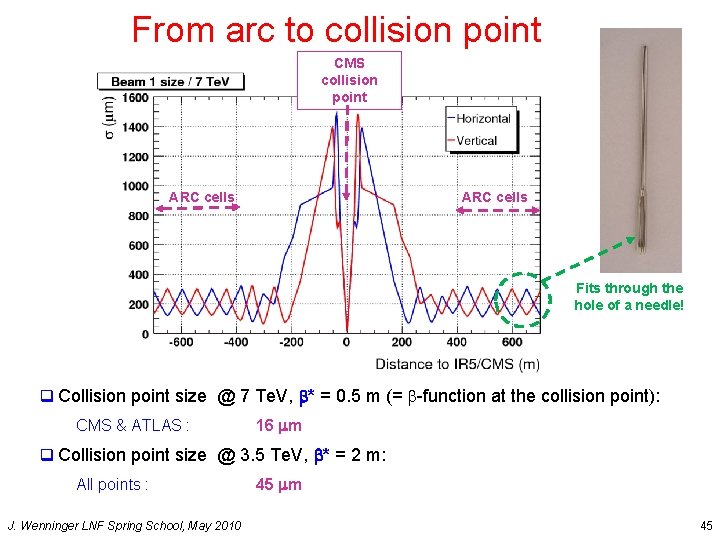
From arc to collision point CMS collision point ARC cells Fits through the hole of a needle! q Collision point size @ 7 Te. V, b* = 0. 5 m (= b-function at the collision point): CMS & ATLAS : 16 mm q Collision point size @ 3. 5 Te. V, b* = 2 m: All points : J. Wenninger LNF Spring School, May 2010 45 mm 45
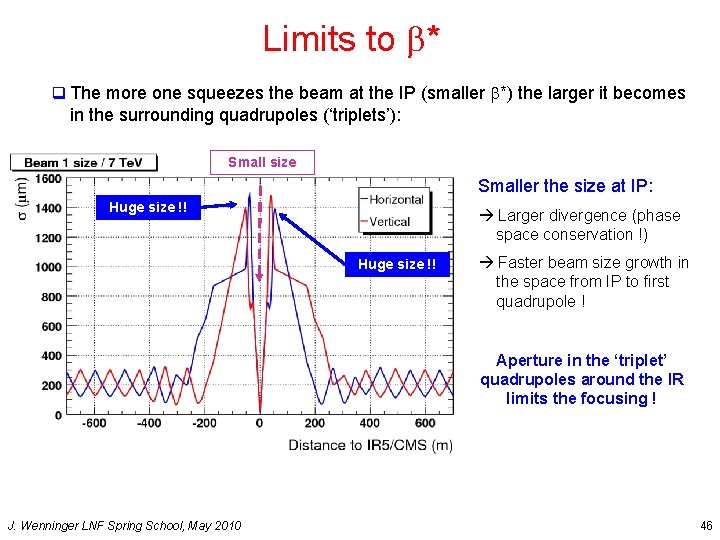
Limits to b* q The more one squeezes the beam at the IP (smaller b*) the larger it becomes in the surrounding quadrupoles (‘triplets’): Small size Smaller the size at IP: Huge size !! Larger divergence (phase space conservation !) Huge size !! Faster beam size growth in the space from IP to first quadrupole ! Aperture in the ‘triplet’ quadrupoles around the IR limits the focusing ! J. Wenninger LNF Spring School, May 2010 46
Combining the beams for collisions q The 2 LHC beams must be brought together to collide. q Over ~260 m, the beams circulate in the same vacuum chamber. They are ~120 long distance beam encounters in total in the 4 IRs. J. Wenninger LNF Spring School, May 2010 47
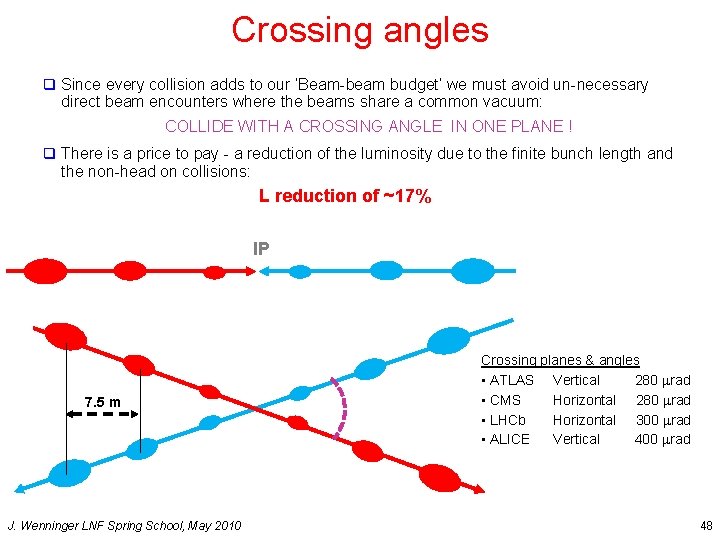
Crossing angles q Since every collision adds to our ‘Beam-beam budget’ we must avoid un-necessary direct beam encounters where the beams share a common vacuum: COLLIDE WITH A CROSSING ANGLE IN ONE PLANE ! q There is a price to pay - a reduction of the luminosity due to the finite bunch length and the non-head on collisions: L reduction of ~17% IP 7. 5 m J. Wenninger LNF Spring School, May 2010 Crossing planes & angles • ATLAS Vertical 280 rad • CMS Horizontal 280 rad • LHCb Horizontal 300 rad • ALICE Vertical 400 rad 48
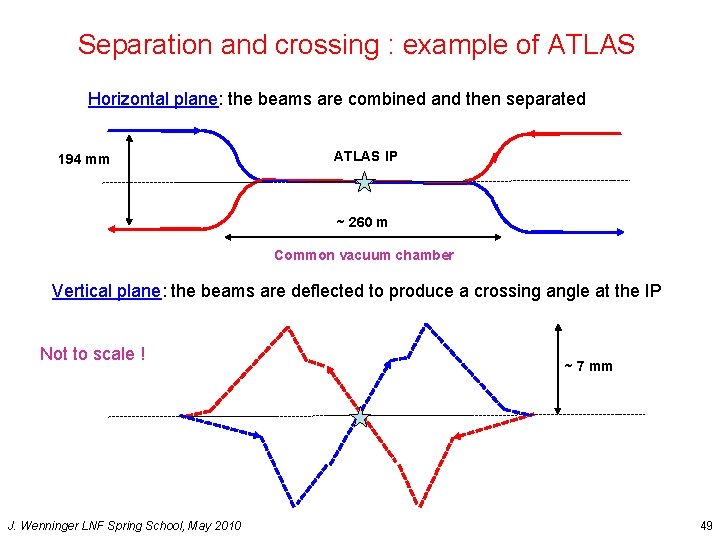
Separation and crossing : example of ATLAS Horizontal plane: the beams are combined and then separated 194 mm ATLAS IP ~ 260 m Common vacuum chamber Vertical plane: the beams are deflected to produce a crossing angle at the IP Not to scale ! J. Wenninger LNF Spring School, May 2010 ~ 7 mm 49
Tevatron J. Wenninger LNF Spring School, May 2010 50
Tevatron CDF D 0
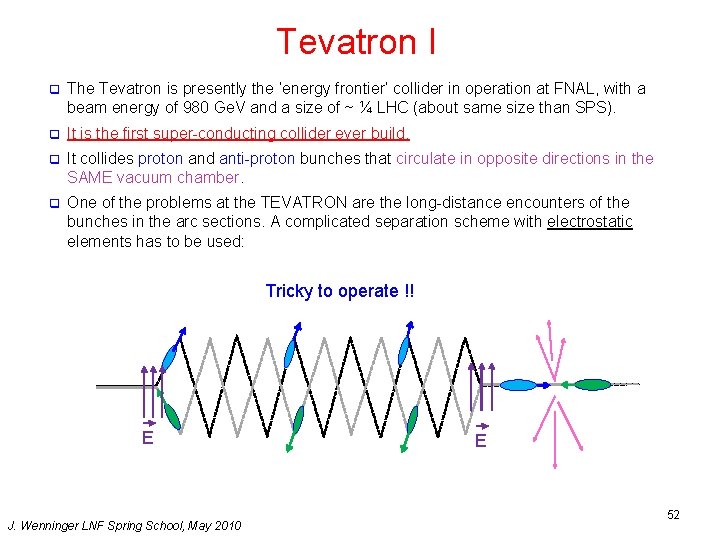
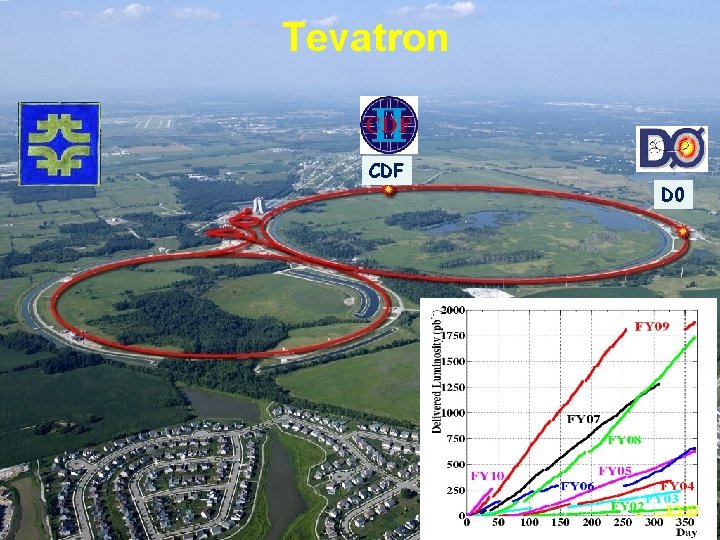
Tevatron I q The Tevatron is presently the ‘energy frontier’ collider in operation at FNAL, with a beam energy of 980 Ge. V and a size of ~ ¼ LHC (about same size than SPS). q It is the first super-conducting collider ever build. q It collides proton and anti-proton bunches that circulate in opposite directions in the SAME vacuum chamber. q One of the problems at the TEVATRON are the long-distance encounters of the bunches in the arc sections. A complicated separation scheme with electrostatic elements has to be used: Tricky to operate !! E J. Wenninger LNF Spring School, May 2010 E 52
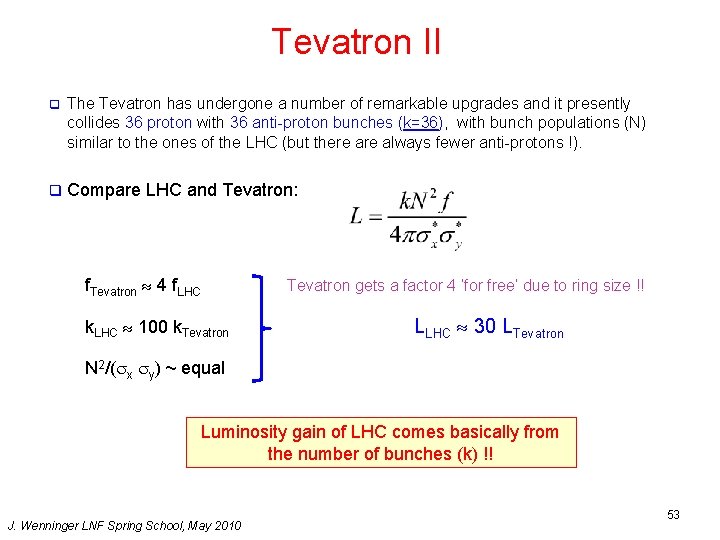
Tevatron II q The Tevatron has undergone a number of remarkable upgrades and it presently collides 36 proton with 36 anti-proton bunches (k=36), with bunch populations (N) similar to the ones of the LHC (but there always fewer anti-protons !). q Compare LHC and Tevatron: f. Tevatron 4 f. LHC Tevatron gets a factor 4 ‘for free’ due to ring size !! k. LHC 100 k. Tevatron LLHC 30 LTevatron N 2/(sx sy) ~ equal Luminosity gain of LHC comes basically from the number of bunches (k) !! J. Wenninger LNF Spring School, May 2010 53
Injection and injector complex J. Wenninger LNF Spring School, May 2010 54
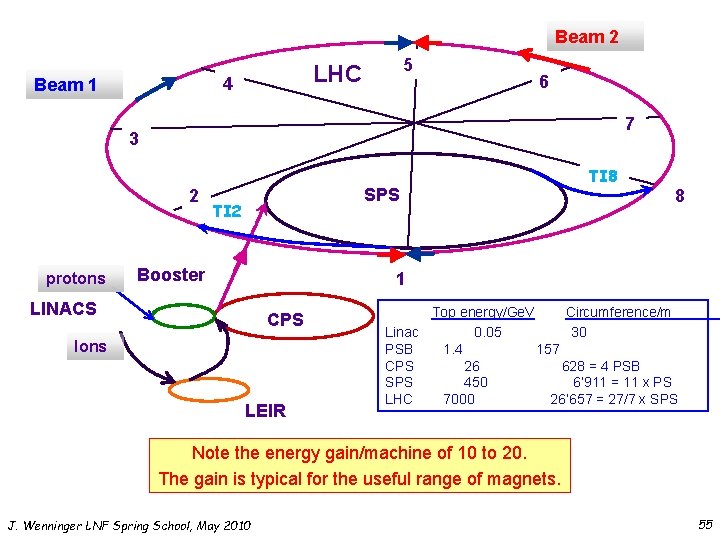
Beam 2 4 Beam 1 5 LHC 6 7 3 2 protons SPS TI 2 Booster TI 8 8 1 LINACS CPS Ions LEIR Top energy/Ge. V Circumference/m Linac 0. 05 30 PSB 1. 4 157 CPS 26 628 = 4 PSB SPS 450 6’ 911 = 11 x PS LHC 7000 26’ 657 = 27/7 x SPS Note the energy gain/machine of 10 to 20. The gain is typical for the useful range of magnets. J. Wenninger LNF Spring School, May 2010 55
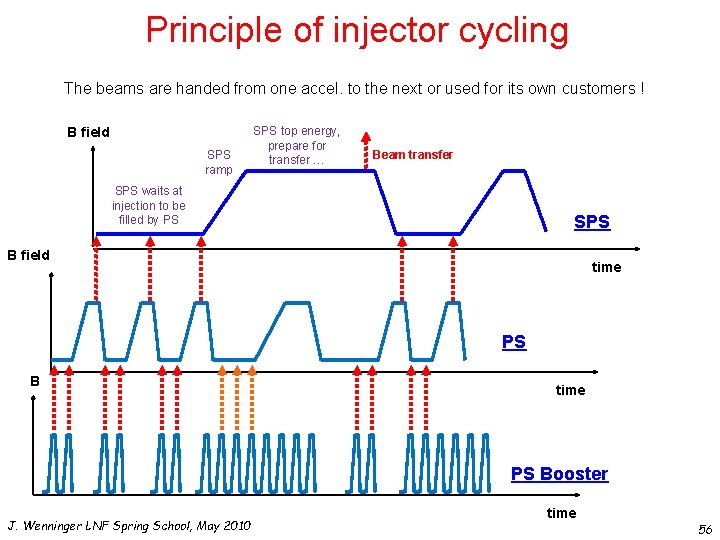
Principle of injector cycling The beams are handed from one accel. to the next or used for its own customers ! B field SPS ramp SPS top energy, prepare for transfer … Beam transfer SPS waits at injection to be filled by PS SPS B field time PS Booster J. Wenninger LNF Spring School, May 2010 time 56
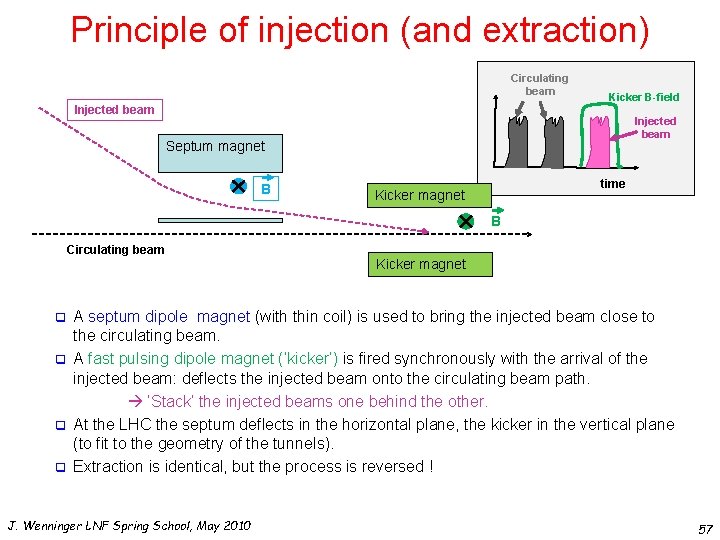
Principle of injection (and extraction) Circulating beam Kicker B-field Injected beam Septum magnet B time Kicker magnet B Circulating beam Kicker magnet A septum dipole magnet (with thin coil) is used to bring the injected beam close to the circulating beam. q A fast pulsing dipole magnet (‘kicker’) is fired synchronously with the arrival of the injected beam: deflects the injected beam onto the circulating beam path. ‘Stack’ the injected beams one behind the other. q At the LHC the septum deflects in the horizontal plane, the kicker in the vertical plane (to fit to the geometry of the tunnels). q Extraction is identical, but the process is reversed ! q J. Wenninger LNF Spring School, May 2010 57
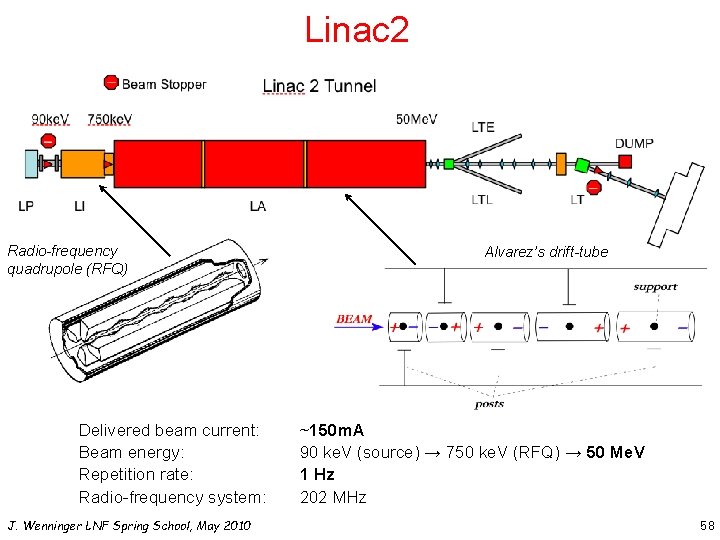
Linac 2 Radio-frequency quadrupole (RFQ) Delivered beam current: Beam energy: Repetition rate: Radio-frequency system: J. Wenninger LNF Spring School, May 2010 Alvarez’s drift-tube ~150 m. A 90 ke. V (source) → 750 ke. V (RFQ) → 50 Me. V 1 Hz 202 MHz 58
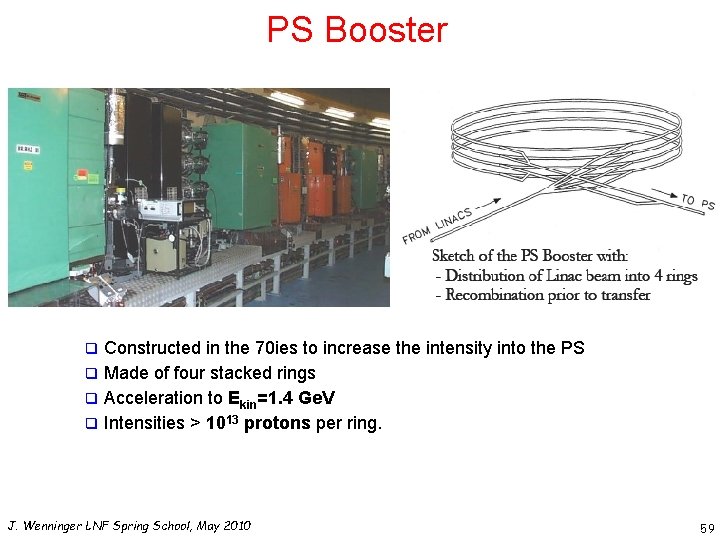
PS Booster Constructed in the 70 ies to increase the intensity into the PS q Made of four stacked rings q Acceleration to Ekin=1. 4 Ge. V q Intensities > 1013 protons per ring. q J. Wenninger LNF Spring School, May 2010 59
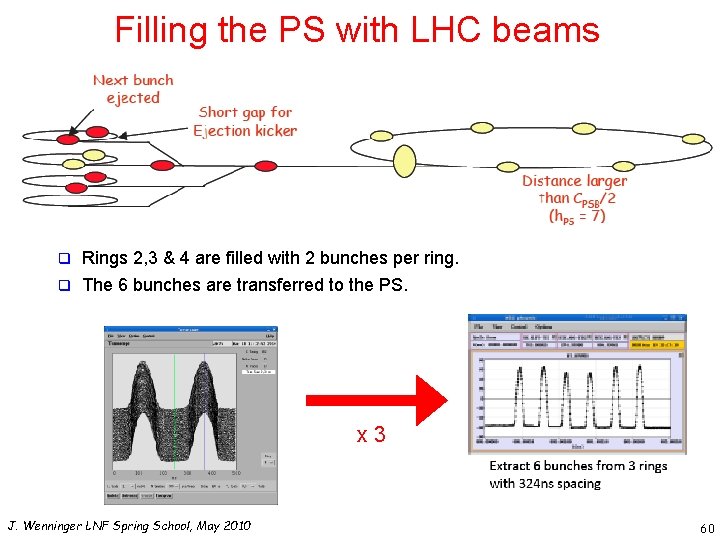
Filling the PS with LHC beams Rings 2, 3 & 4 are filled with 2 bunches per ring. q The 6 bunches are transferred to the PS. q x 3 J. Wenninger LNF Spring School, May 2010 60
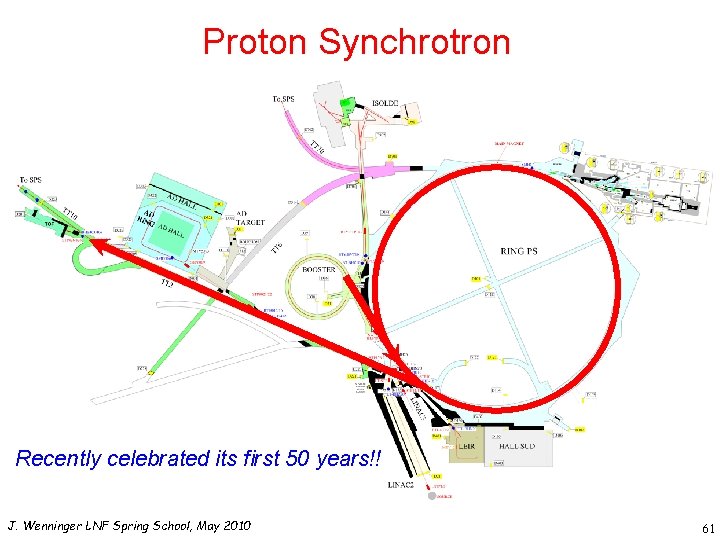
Proton Synchrotron Recently celebrated its first 50 years!! J. Wenninger LNF Spring School, May 2010 61
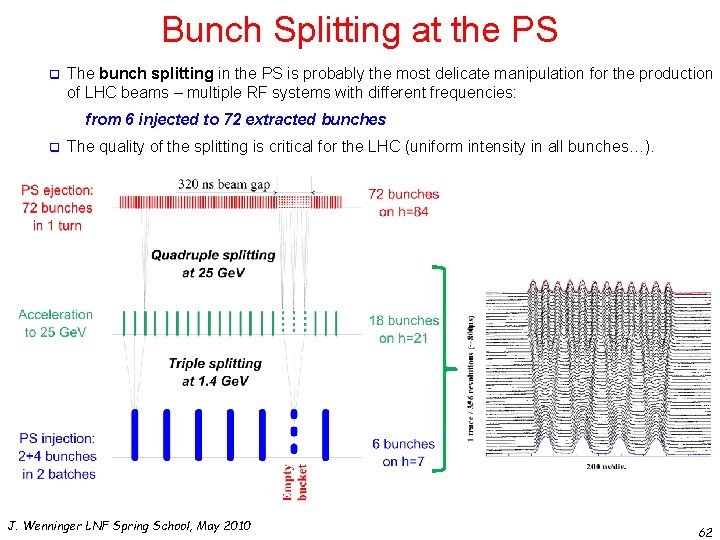
Bunch Splitting at the PS q The bunch splitting in the PS is probably the most delicate manipulation for the production of LHC beams – multiple RF systems with different frequencies: from 6 injected to 72 extracted bunches q The quality of the splitting is critical for the LHC (uniform intensity in all bunches…). J. Wenninger LNF Spring School, May 2010 62
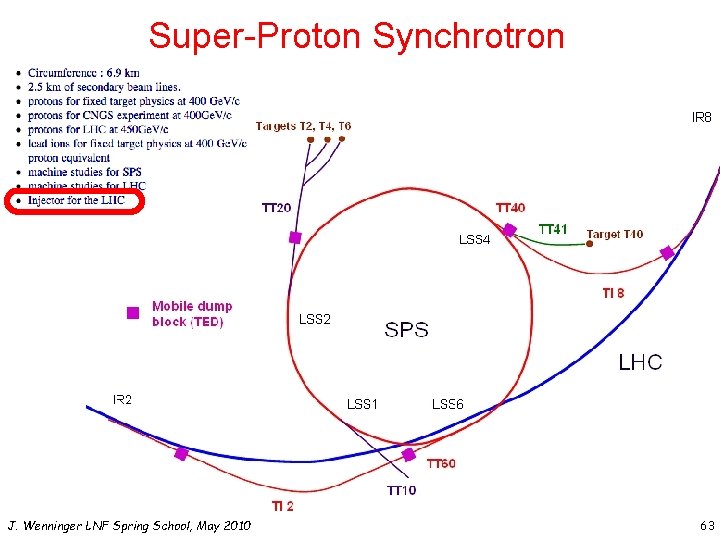
Super-Proton Synchrotron J. Wenninger LNF Spring School, May 2010 63
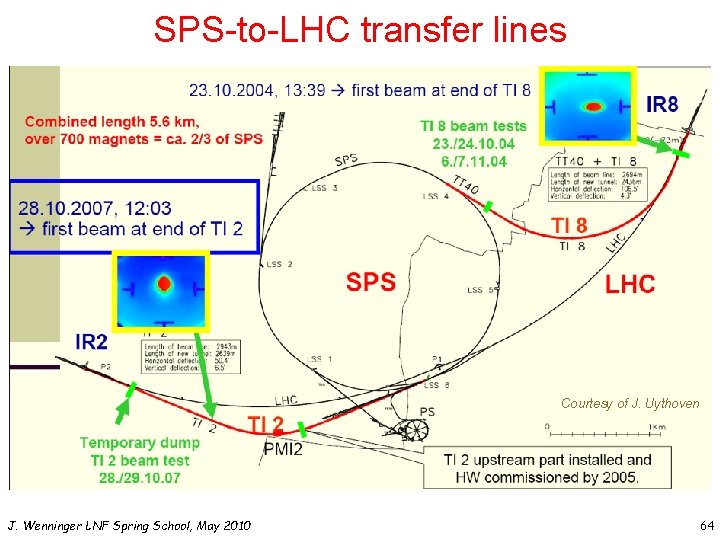
SPS-to-LHC transfer lines Courtesy of J. Uythoven J. Wenninger LNF Spring School, May 2010 64
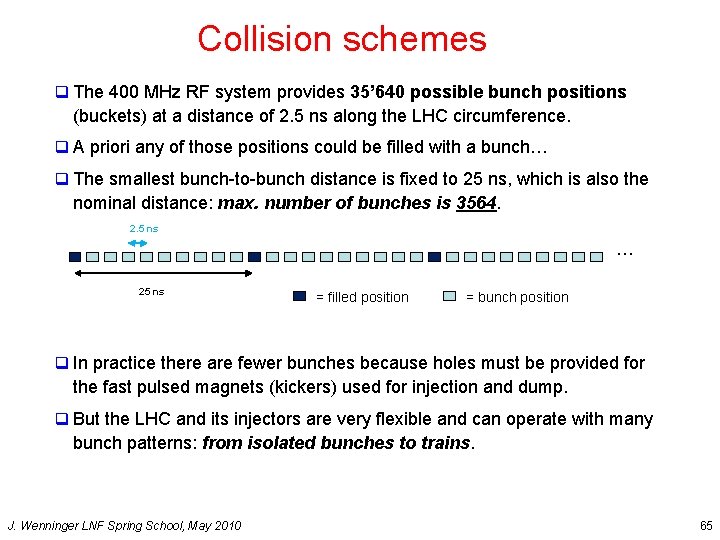
Collision schemes q The 400 MHz RF system provides 35’ 640 possible bunch positions (buckets) at a distance of 2. 5 ns along the LHC circumference. q A priori any of those positions could be filled with a bunch… q The smallest bunch-to-bunch distance is fixed to 25 ns, which is also the nominal distance: max. number of bunches is 3564. 2. 5 ns … 25 ns = filled position = bunch position q In practice there are fewer bunches because holes must be provided for the fast pulsed magnets (kickers) used for injection and dump. q But the LHC and its injectors are very flexible and can operate with many bunch patterns: from isolated bunches to trains. J. Wenninger LNF Spring School, May 2010 65
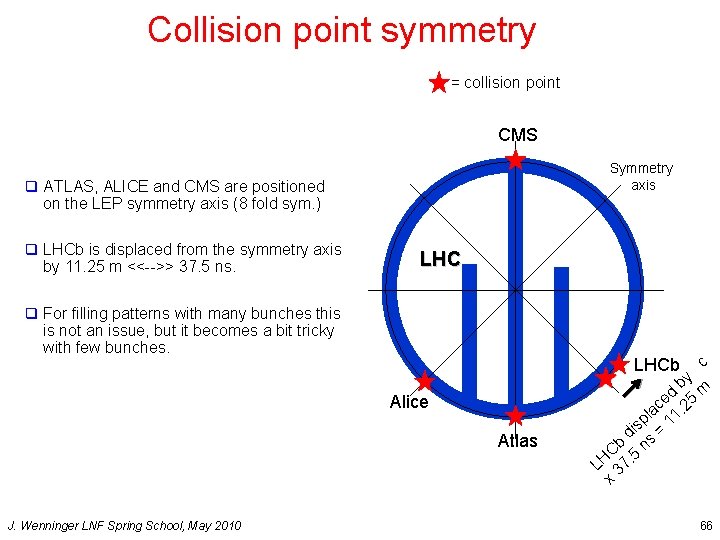
Collision point symmetry = collision point CMS Symmetry axis q ATLAS, ALICE and CMS are positioned on the LEP symmetry axis (8 fold sym. ) q LHCb is displaced from the symmetry axis by 11. 25 m <<-->> 37. 5 ns. LHC q For filling patterns with many bunches this is not an issue, but it becomes a bit tricky with few bunches. Alice Atlas J. Wenninger LNF Spring School, May 2010 c y b m d e 5 ac 1. 2 l sp 1 di s = b C. 5 n LH 37 x LHCb 66
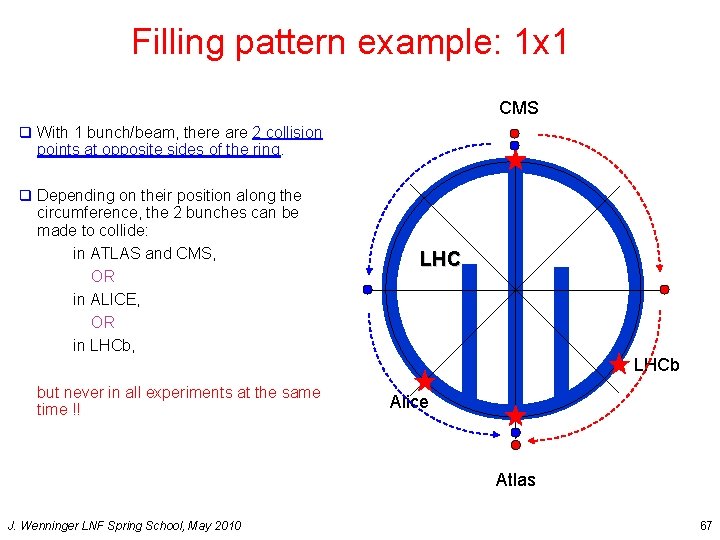
Filling pattern example: 1 x 1 CMS q With 1 bunch/beam, there are 2 collision points at opposite sides of the ring. q Depending on their position along the circumference, the 2 bunches can be made to collide: in ATLAS and CMS, OR in ALICE, OR in LHCb, but never in all experiments at the same time !! LHCb Alice Atlas J. Wenninger LNF Spring School, May 2010 67
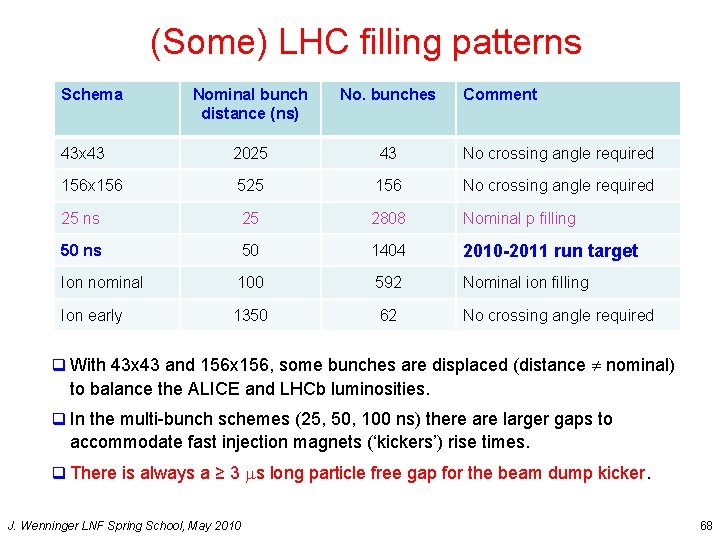
(Some) LHC filling patterns Schema Nominal bunch distance (ns) No. bunches Comment 43 x 43 2025 43 No crossing angle required 156 x 156 525 156 No crossing angle required 25 ns 25 2808 Nominal p filling 50 ns 50 1404 2010 -2011 run target Ion nominal 100 592 Nominal ion filling Ion early 1350 62 No crossing angle required q With 43 x 43 and 156 x 156, some bunches are displaced (distance nominal) to balance the ALICE and LHCb luminosities. q In the multi-bunch schemes (25, 50, 100 ns) there are larger gaps to accommodate fast injection magnets (‘kickers’) rise times. q There is always a ≥ 3 s long particle free gap for the beam dump kicker. J. Wenninger LNF Spring School, May 2010 68
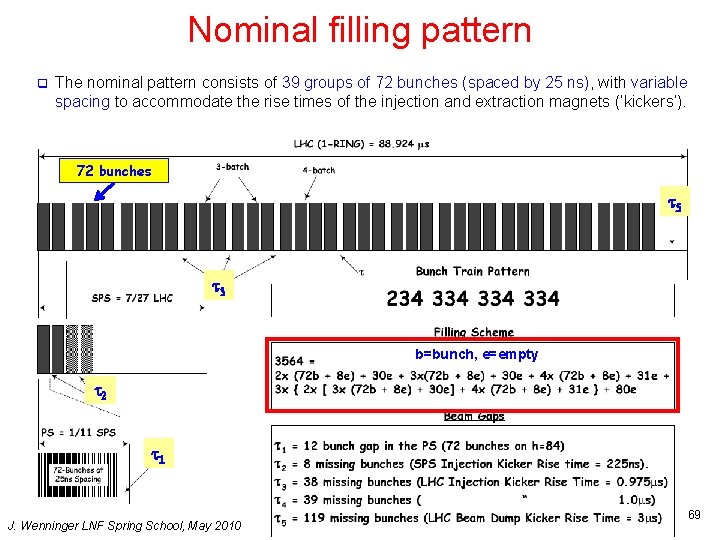
Nominal filling pattern q The nominal pattern consists of 39 groups of 72 bunches (spaced by 25 ns), with variable spacing to accommodate the rise times of the injection and extraction magnets (‘kickers’). 72 bunches t 5 t 3 b=bunch, e=empty t 2 t 1 J. Wenninger LNF Spring School, May 2010 69
Spare slides J. Wenninger LNF Spring School, May 2010 70
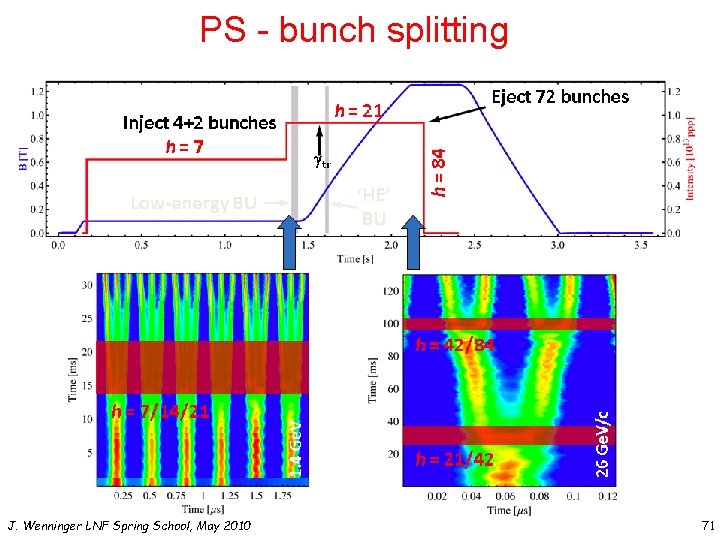
PS - bunch splitting J. Wenninger LNF Spring School, May 2010 71
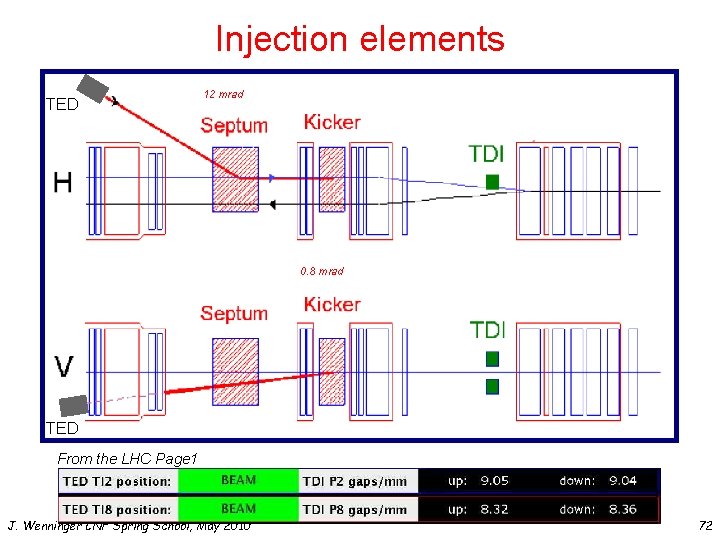
Injection elements TED 12 mrad 0. 8 mrad TED From the LHC Page 1 J. Wenninger LNF Spring School, May 2010 72
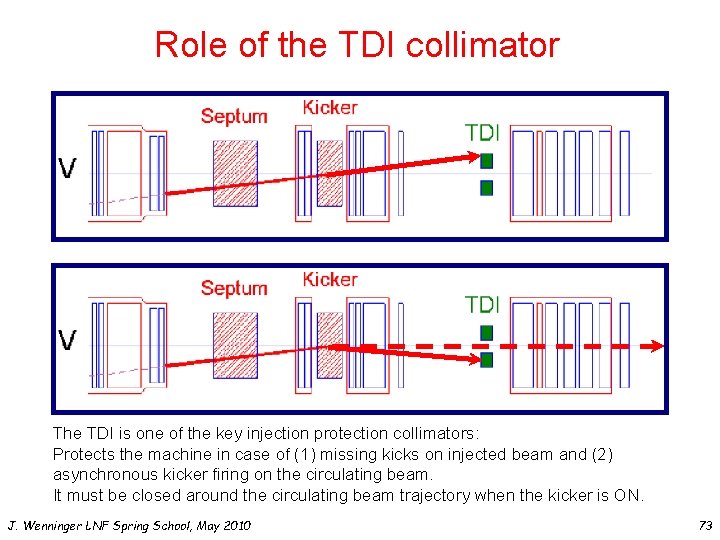
Role of the TDI collimator The TDI is one of the key injection protection collimators: Protects the machine in case of (1) missing kicks on injected beam and (2) asynchronous kicker firing on the circulating beam. It must be closed around the circulating beam trajectory when the kicker is ON. J. Wenninger LNF Spring School, May 2010 73
- Slides: 73