
LGs 4 Identify and use phrases correctly 3
- Slides: 31
LG’s 4: Identify and use phrases correctly 3: Understand differences among phrase, clause, sentence.
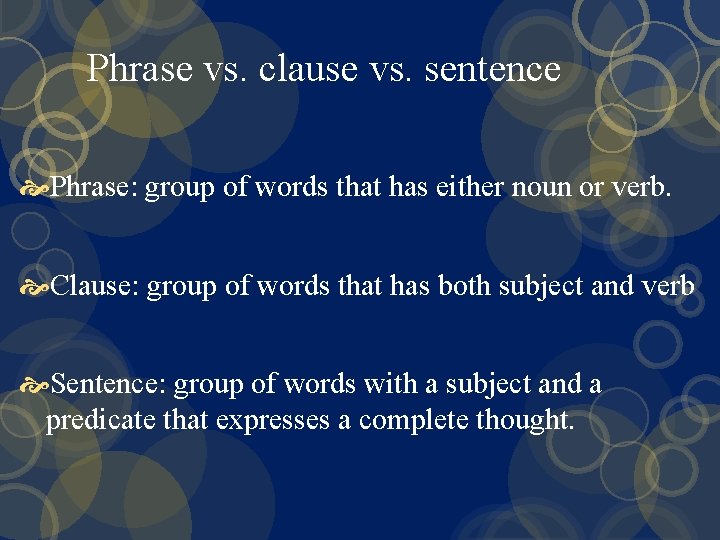
Phrase vs. clause vs. sentence Phrase: group of words that has either noun or verb. Clause: group of words that has both subject and verb Sentence: group of words with a subject and a predicate that expresses a complete thought.
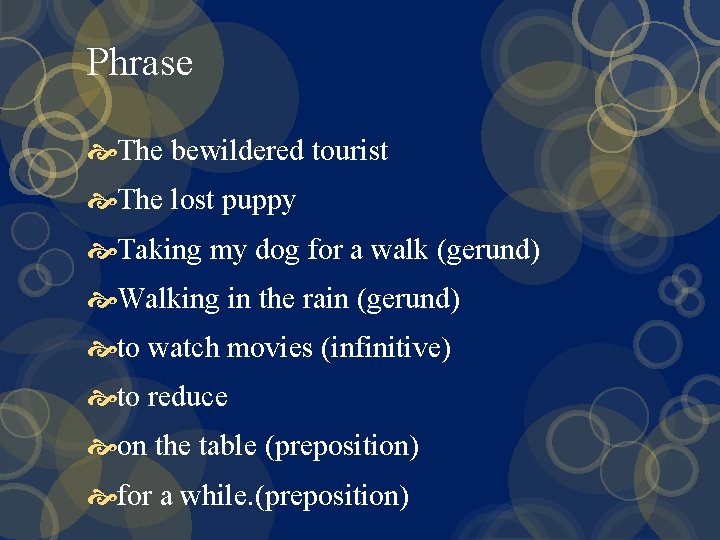
Phrase The bewildered tourist The lost puppy Taking my dog for a walk (gerund) Walking in the rain (gerund) to watch movies (infinitive) to reduce on the table (preposition) for a while. (preposition)
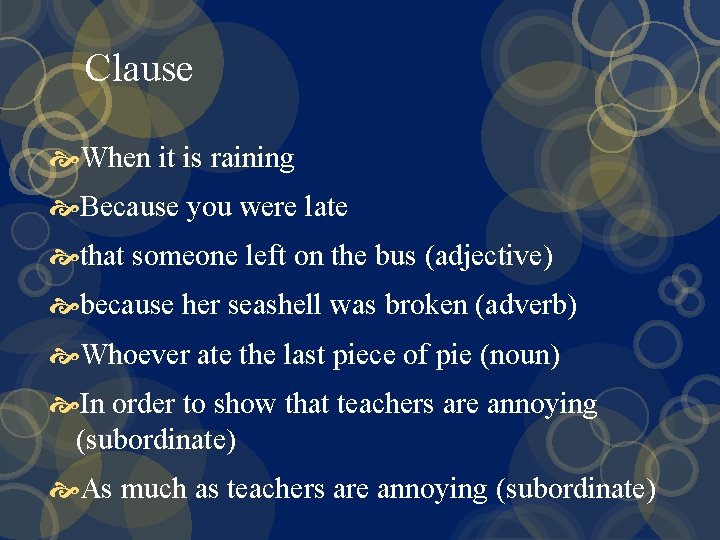
Clause When it is raining Because you were late that someone left on the bus (adjective) because her seashell was broken (adverb) Whoever ate the last piece of pie (noun) In order to show that teachers are annoying (subordinate) As much as teachers are annoying (subordinate)
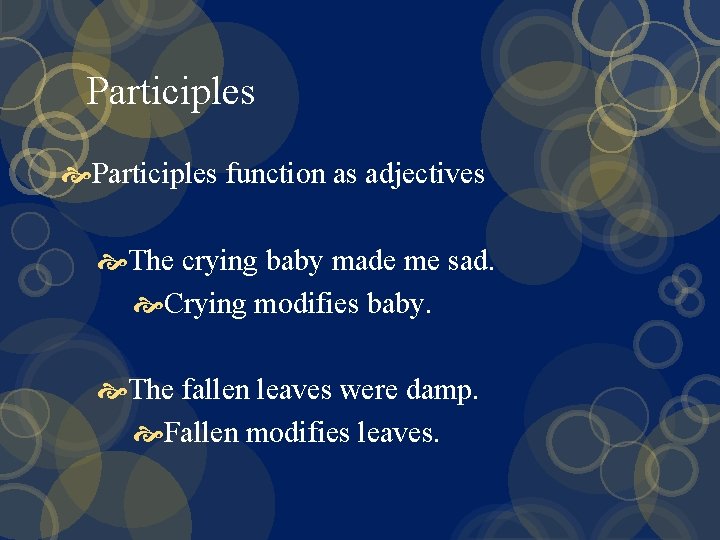
Participles function as adjectives The crying baby made me sad. Crying modifies baby. The fallen leaves were damp. Fallen modifies leaves.
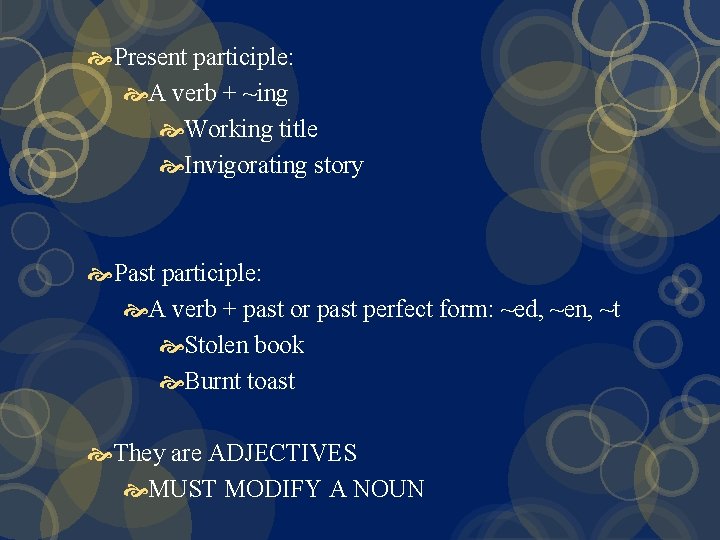
Present participle: A verb + ~ing Working title Invigorating story Past participle: A verb + past or past perfect form: ~ed, ~en, ~t Stolen book Burnt toast They are ADJECTIVES MUST MODIFY A NOUN
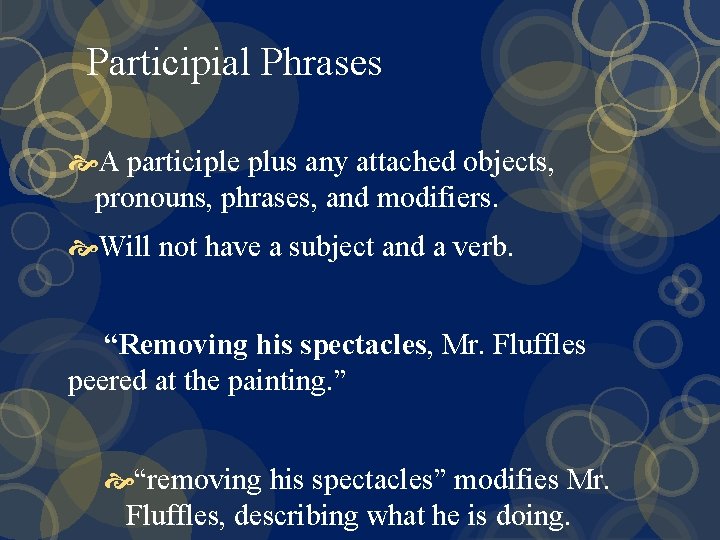
Participial Phrases A participle plus any attached objects, pronouns, phrases, and modifiers. Will not have a subject and a verb. “Removing his spectacles, Mr. Fluffles peered at the painting. ” “removing his spectacles” modifies Mr. Fluffles, describing what he is doing.
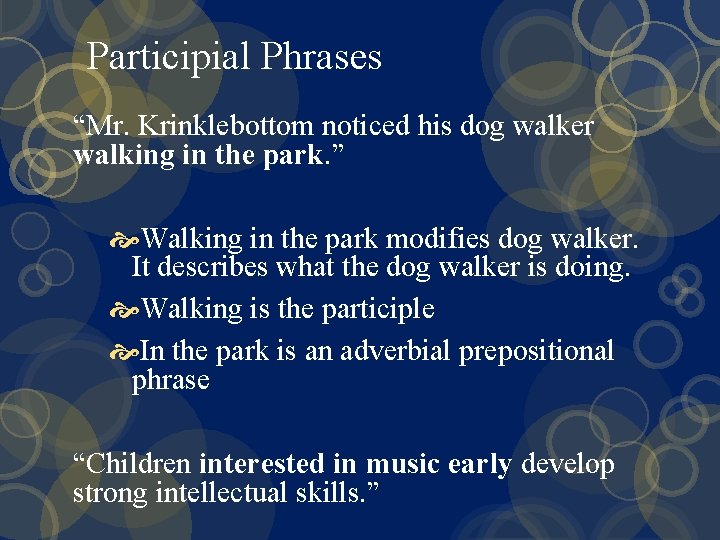
Participial Phrases “Mr. Krinklebottom noticed his dog walker walking in the park. ” Walking in the park modifies dog walker. It describes what the dog walker is doing. Walking is the participle In the park is an adverbial prepositional phrase “Children interested in music early develop strong intellectual skills. ”
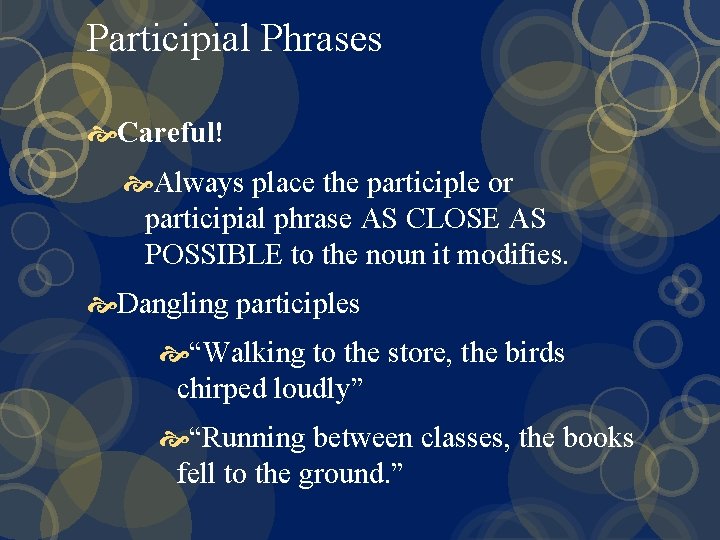
Participial Phrases Careful! Always place the participle or participial phrase AS CLOSE AS POSSIBLE to the noun it modifies. Dangling participles “Walking to the store, the birds chirped loudly” “Running between classes, the books fell to the ground. ”
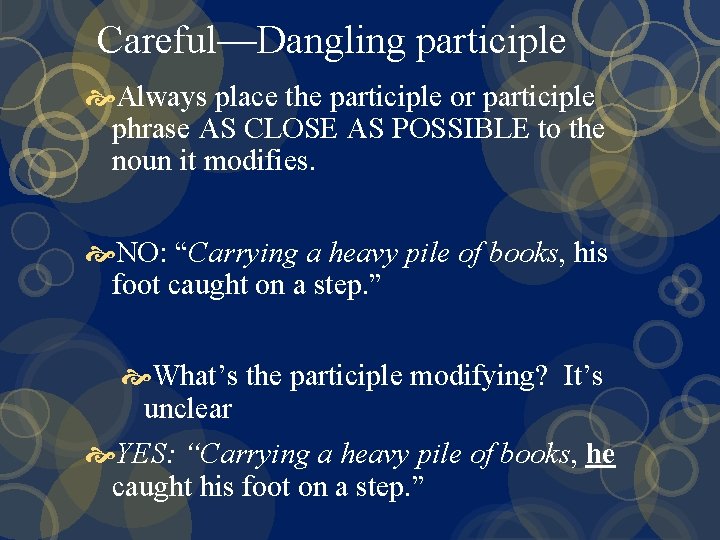
Careful—Dangling participle Always place the participle or participle phrase AS CLOSE AS POSSIBLE to the noun it modifies. NO: “Carrying a heavy pile of books, his foot caught on a step. ” What’s the participle modifying? It’s unclear YES: “Carrying a heavy pile of books, he caught his foot on a step. ”
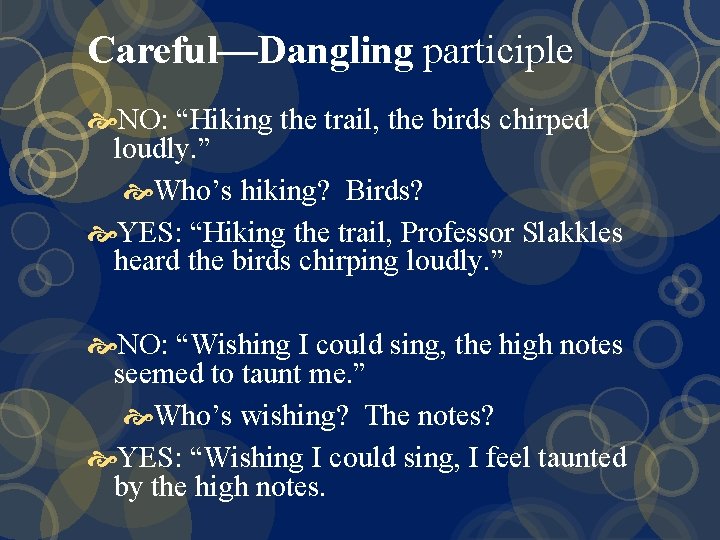
Careful—Dangling participle NO: “Hiking the trail, the birds chirped loudly. ” Who’s hiking? Birds? YES: “Hiking the trail, Professor Slakkles heard the birds chirping loudly. ” NO: “Wishing I could sing, the high notes seemed to taunt me. ” Who’s wishing? The notes? YES: “Wishing I could sing, I feel taunted by the high notes.
LGs 4: Identify and correct problems with subject-verb agreement. 3: Understand how phrases and clauses impact subject-verb agreement.
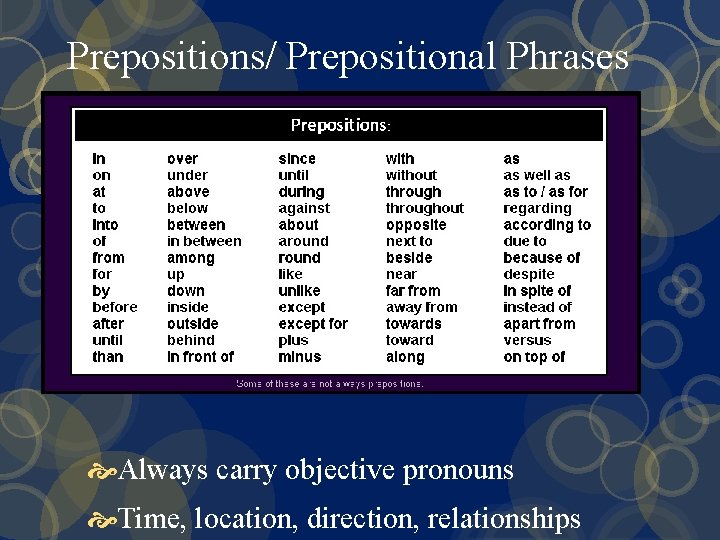
Prepositions/ Prepositional Phrases Always carry objective pronouns Time, location, direction, relationships
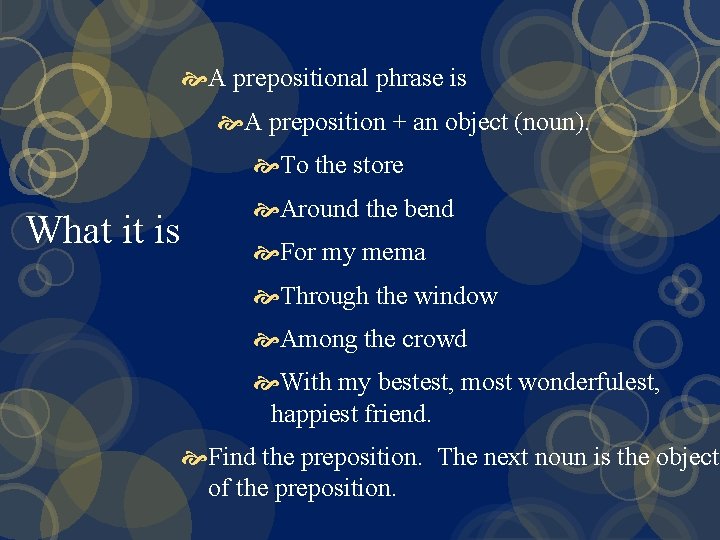
A prepositional phrase is A preposition + an object (noun). To the store What it is Around the bend For my mema Through the window Among the crowd With my bestest, most wonderfulest, happiest friend. Find the preposition. The next noun is the object of the preposition.
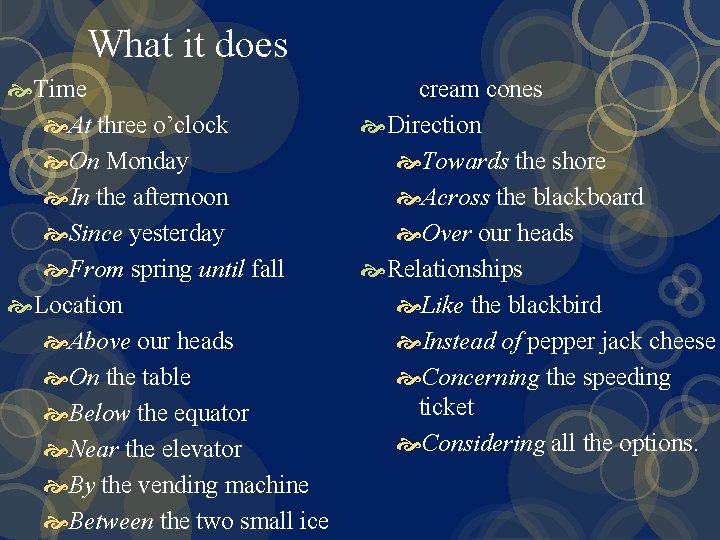
What it does Time At three o’clock On Monday In the afternoon Since yesterday From spring until fall Location Above our heads On the table Below the equator Near the elevator By the vending machine Between the two small ice cream cones Direction Towards the shore Across the blackboard Over our heads Relationships Like the blackbird Instead of pepper jack cheese Concerning the speeding ticket Considering all the options.
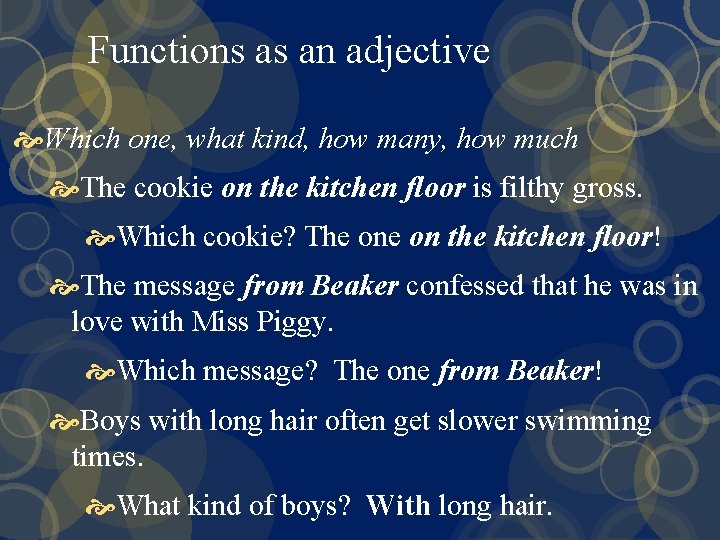
Functions as an adjective Which one, what kind, how many, how much The cookie on the kitchen floor is filthy gross. Which cookie? The on the kitchen floor! The message from Beaker confessed that he was in love with Miss Piggy. Which message? The one from Beaker! Boys with long hair often get slower swimming times. What kind of boys? With long hair.
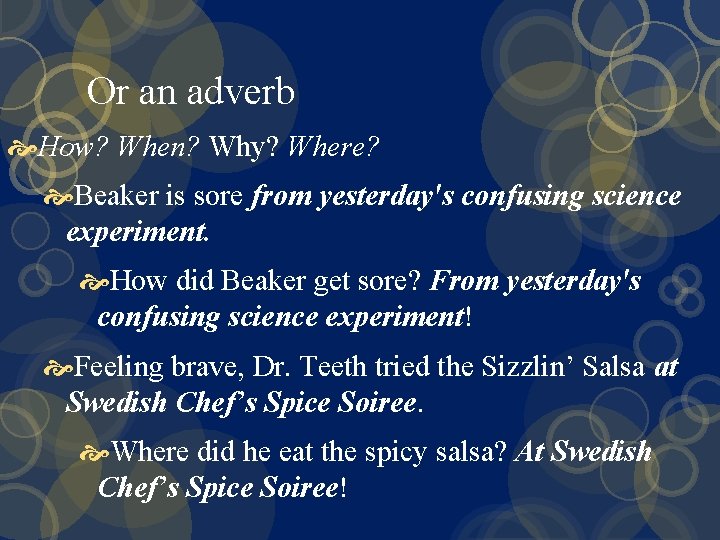
Or an adverb How? When? Why? Where? Beaker is sore from yesterday's confusing science experiment. How did Beaker get sore? From yesterday's confusing science experiment! Feeling brave, Dr. Teeth tried the Sizzlin’ Salsa at Swedish Chef’s Spice Soiree. Where did he eat the spicy salsa? At Swedish Chef’s Spice Soiree!
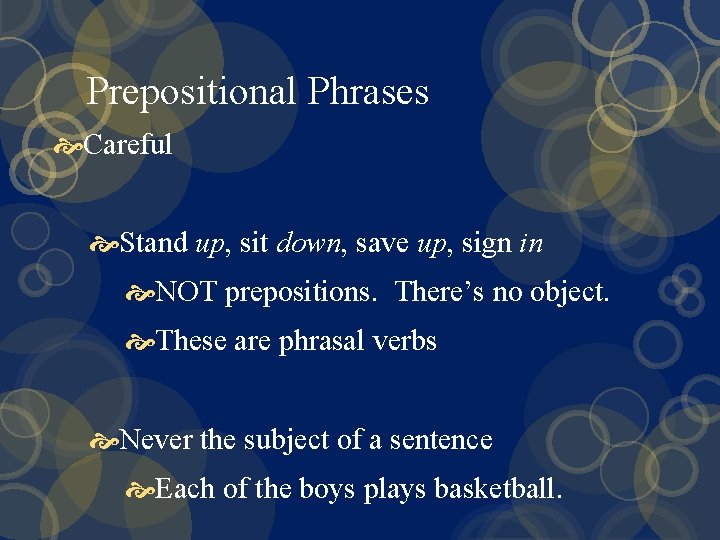
Prepositional Phrases Careful Stand up, sit down, save up, sign in NOT prepositions. There’s no object. These are phrasal verbs Never the subject of a sentence Each of the boys plays basketball.
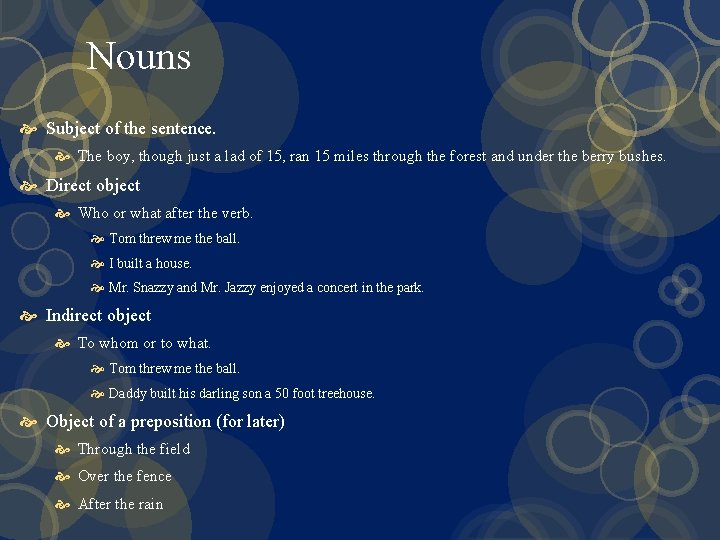
Nouns Subject of the sentence. The boy, though just a lad of 15, ran 15 miles through the forest and under the berry bushes. Direct object Who or what after the verb. Tom threw me the ball. I built a house. Mr. Snazzy and Mr. Jazzy enjoyed a concert in the park. Indirect object To whom or to what. Tom threw me the ball. Daddy built his darling son a 50 foot treehouse. Object of a preposition (for later) Through the field Over the fence After the rain
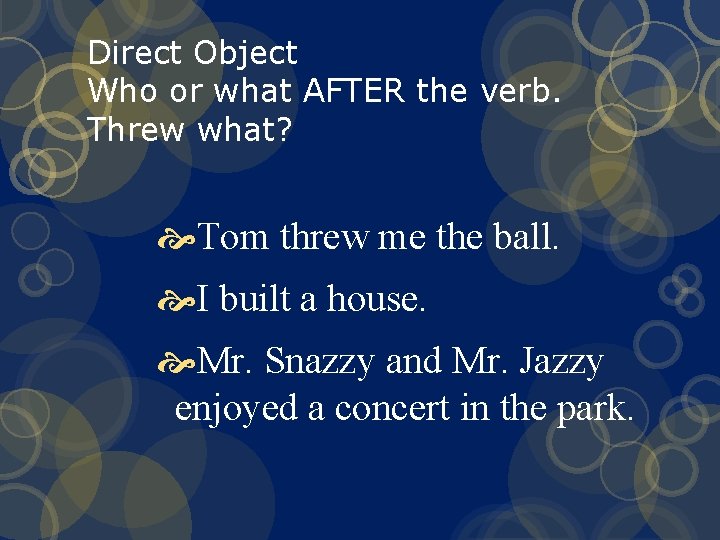
Direct Object Who or what AFTER the verb. Threw what? Tom threw me the ball. I built a house. Mr. Snazzy and Mr. Jazzy enjoyed a concert in the park.
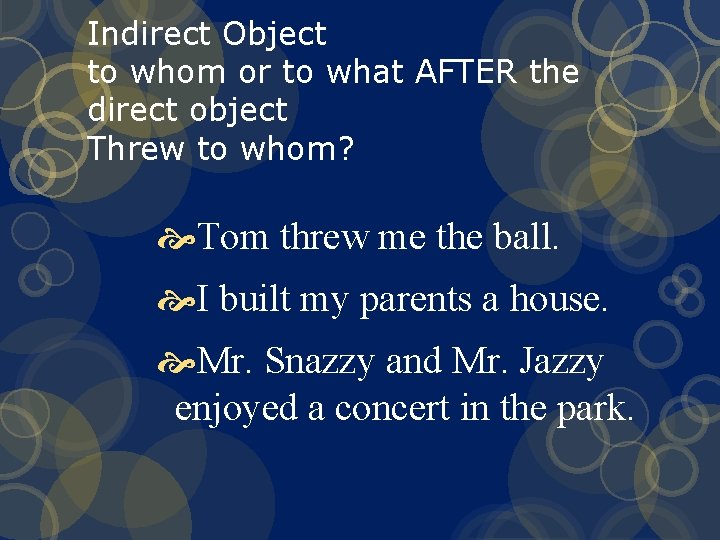
Indirect Object to whom or to what AFTER the direct object Threw to whom? Tom threw me the ball. I built my parents a house. Mr. Snazzy and Mr. Jazzy enjoyed a concert in the park.
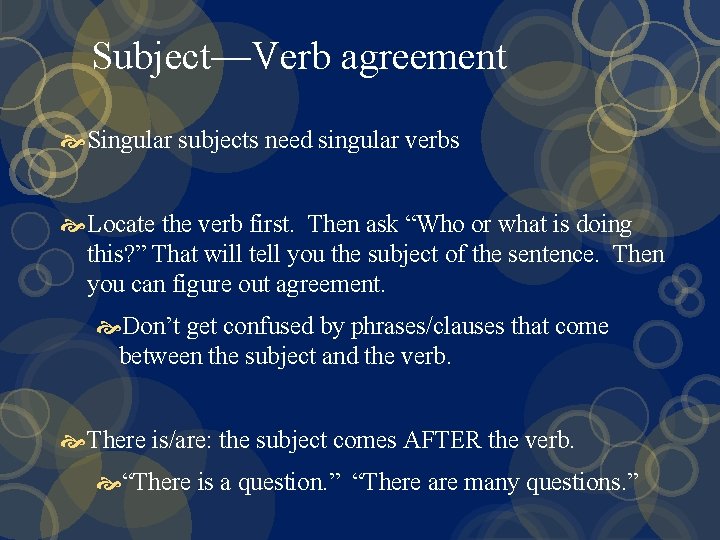
Subject—Verb agreement Singular subjects need singular verbs Locate the verb first. Then ask “Who or what is doing this? ” That will tell you the subject of the sentence. Then you can figure out agreement. Don’t get confused by phrases/clauses that come between the subject and the verb. There is/are: the subject comes AFTER the verb. “There is a question. ” “There are many questions. ”
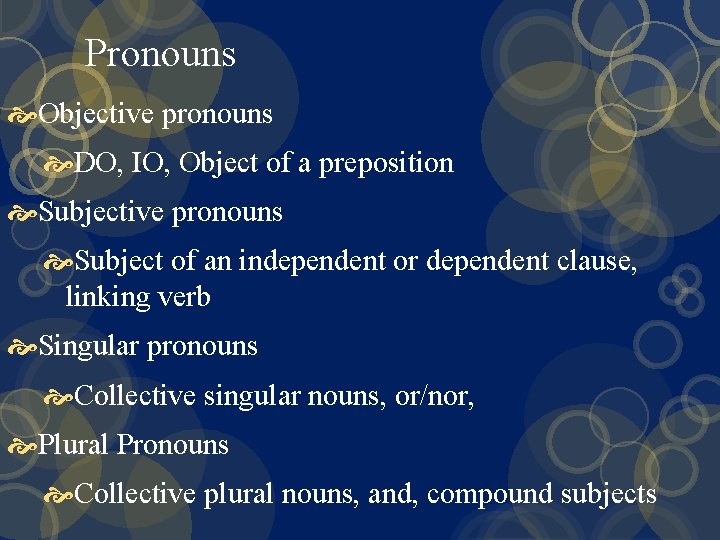
Pronouns Objective pronouns DO, IO, Object of a preposition Subjective pronouns Subject of an independent or dependent clause, linking verb Singular pronouns Collective singular nouns, or/nor, Plural Pronouns Collective plural nouns, and, compound subjects
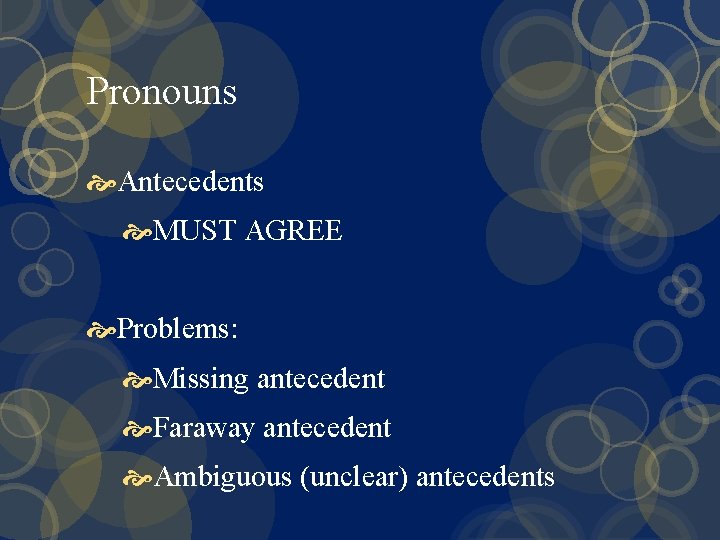
Pronouns Antecedents MUST AGREE Problems: Missing antecedent Faraway antecedent Ambiguous (unclear) antecedents
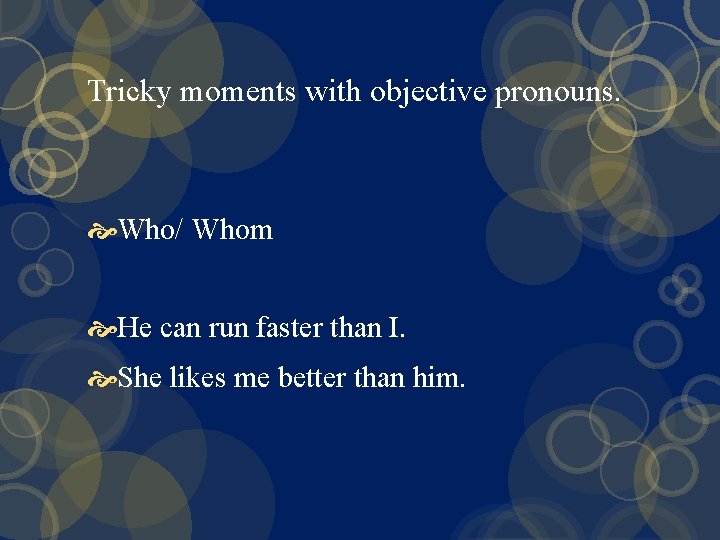
Tricky moments with objective pronouns. Who/ Whom He can run faster than I. She likes me better than him.
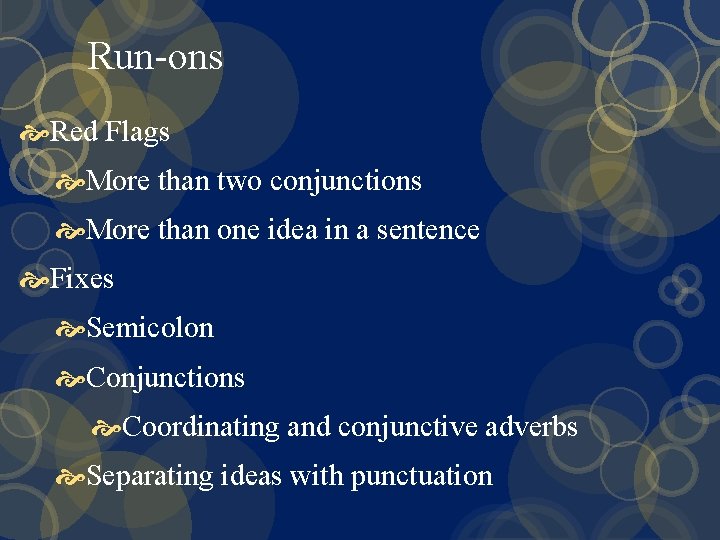
Run-ons Red Flags More than two conjunctions More than one idea in a sentence Fixes Semicolon Conjunctions Coordinating and conjunctive adverbs Separating ideas with punctuation
Commas Appositives
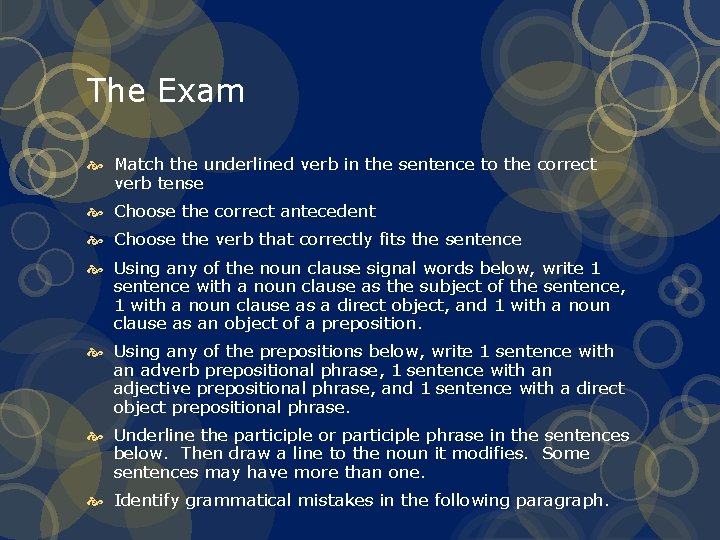
The Exam Match the underlined verb in the sentence to the correct verb tense Choose the correct antecedent Choose the verb that correctly fits the sentence Using any of the noun clause signal words below, write 1 sentence with a noun clause as the subject of the sentence, 1 with a noun clause as a direct object, and 1 with a noun clause as an object of a preposition. Using any of the prepositions below, write 1 sentence with an adverb prepositional phrase, 1 sentence with an adjective prepositional phrase, and 1 sentence with a direct object prepositional phrase. Underline the participle or participle phrase in the sentences below. Then draw a line to the noun it modifies. Some sentences may have more than one. Identify grammatical mistakes in the following paragraph.
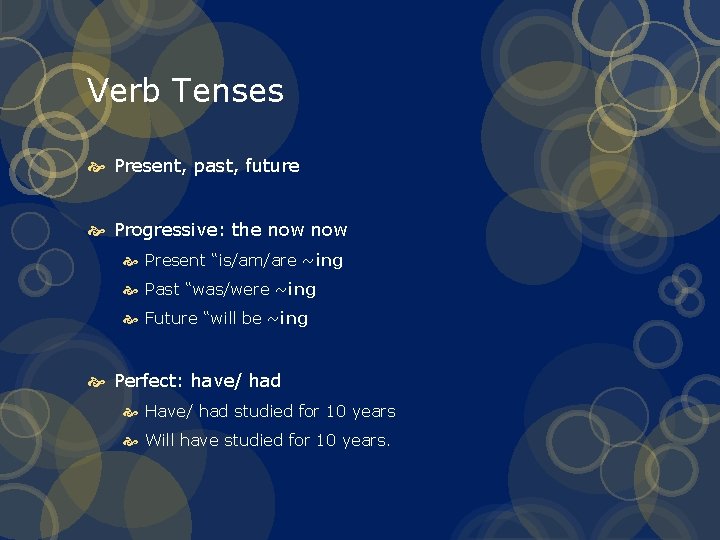
Verb Tenses Present, past, future Progressive: the now Present “is/am/are ~ing Past “was/were ~ing Future “will be ~ing Perfect: have/ had Have/ had studied for 10 years Will have studied for 10 years.
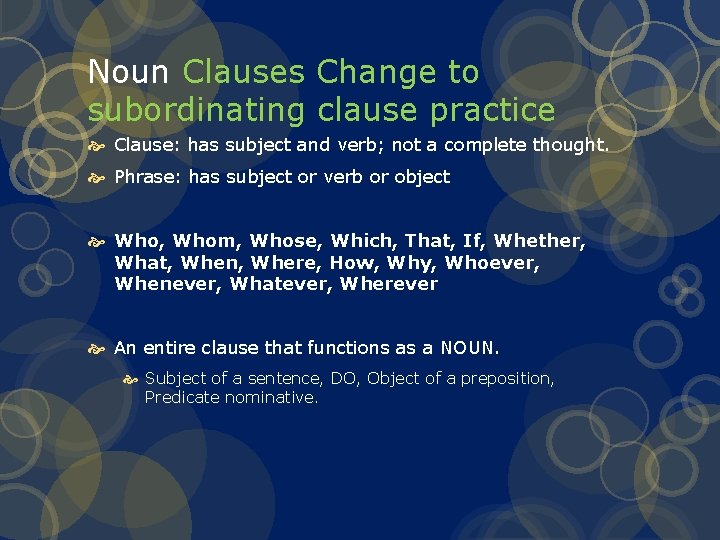
Noun Clauses Change to subordinating clause practice Clause: has subject and verb; not a complete thought. Phrase: has subject or verb or object Who, Whom, Whose, Which, That, If, Whether, What, When, Where, How, Why, Whoever, Whenever, Whatever, Wherever An entire clause that functions as a NOUN. Subject of a sentence, DO, Object of a preposition, Predicate nominative.