
LG 1 Logic A Closer Look at Reasoning

- Slides: 13
LG 1: Logic A Closer Look at Reasoning
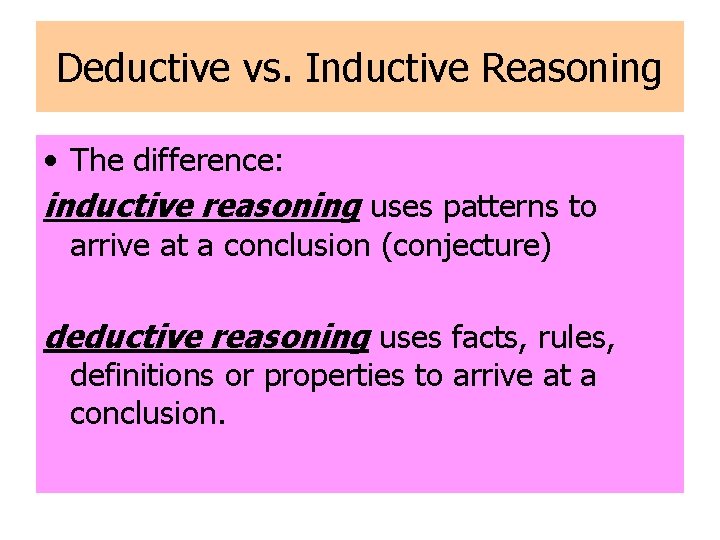
Deductive vs. Inductive Reasoning • The difference: inductive reasoning uses patterns to arrive at a conclusion (conjecture) deductive reasoning uses facts, rules, definitions or properties to arrive at a conclusion.
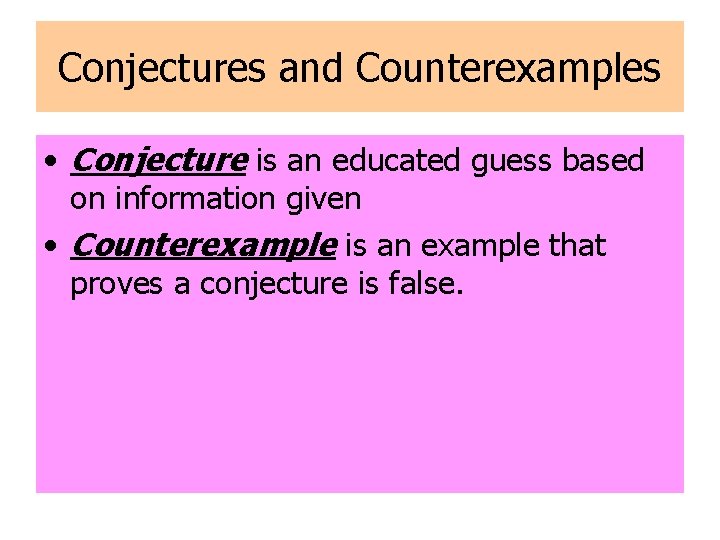
Conjectures and Counterexamples • Conjecture is an educated guess based on information given • Counterexample is an example that proves a conjecture is false.
Examples of Inductive Reasoning Some examples – What is conjecture and can you think of a counterexample? 1) Every quiz has been easy. Therefore, the test will be easy. 2) The teacher used Power. Point in the last few classes. Therefore, the teacher will use Power. Point tomorrow. 3) Every bird I have seen flies. Therefore all birds must fly.
Two Types of Deductive Reasoning 1) Law of Detachment 2) Law of Syllogism
Deductive Reasoning LAW OF DETACHMENT This law states that if a conditional statement is true, and Its hypothesis is true, then its conclusion is true. Example: If it is raining outside, then I will use my umbrella. What can you conclude? It is raining outside I will use my umbrella.
Law of Detachment Another Example: All sophomores must take Geometry. You are sophomore Conclusion: You will take Geometry.
Law of Syllogism If the conclusion of one statement is the same as the hypothesis of the next statement, you can eliminate these statements. If A, then B If B, then C If A, then C
Law of Syllogism Example: If it rains outside, the walkway will get wet. If the walkway is wet, the walkway will be slippery. What can we conclude from the Law of Syllogism? If it is raining, the walkway will be slippery.
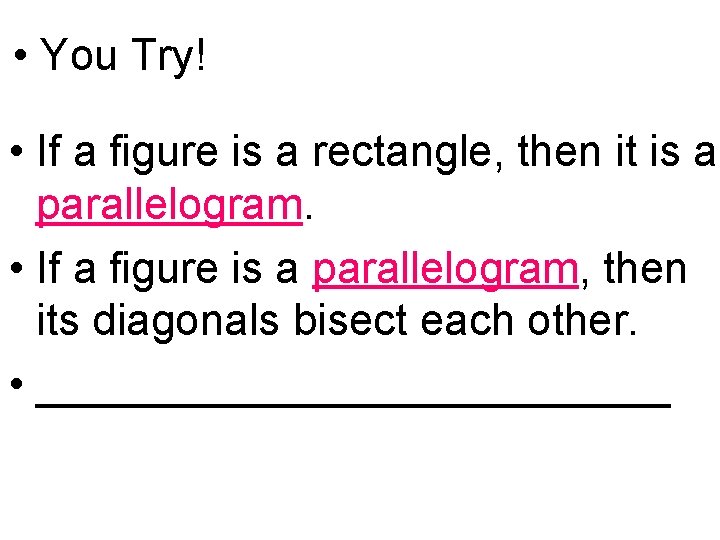
• You Try! • If a figure is a rectangle, then it is a parallelogram. • If a figure is a parallelogram, then its diagonals bisect each other. • _____________
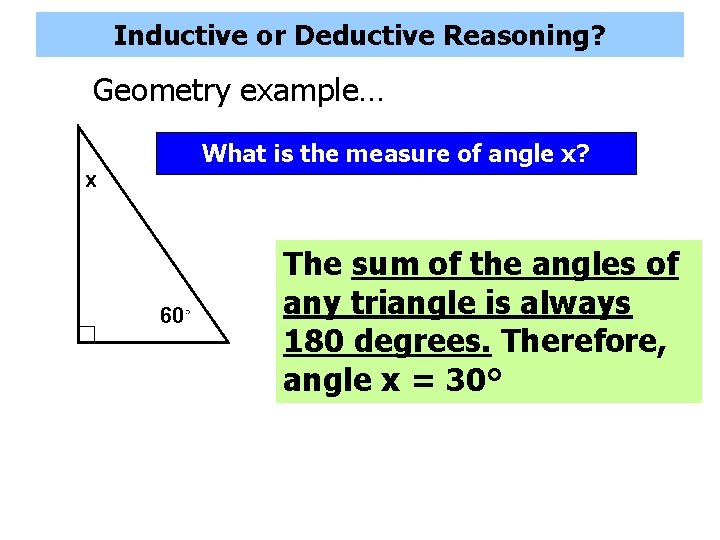
Inductive or Deductive Reasoning? Geometry example… What is the measure of angle x? x 60◦ The sum of the angles of any triangle is always 180 degrees. Therefore, angle x = 30°
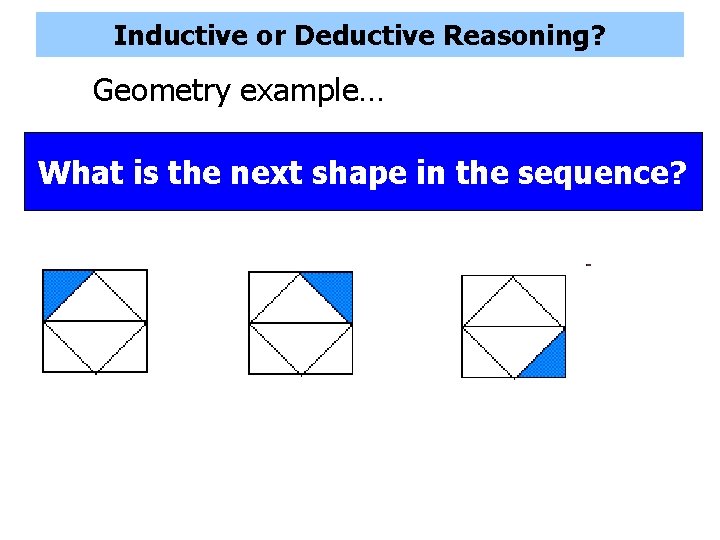
Inductive or Deductive Reasoning? Geometry example… What is the next shape in the sequence?