
OH 1 Humidity Control Applications Flakt Dryers Airborne
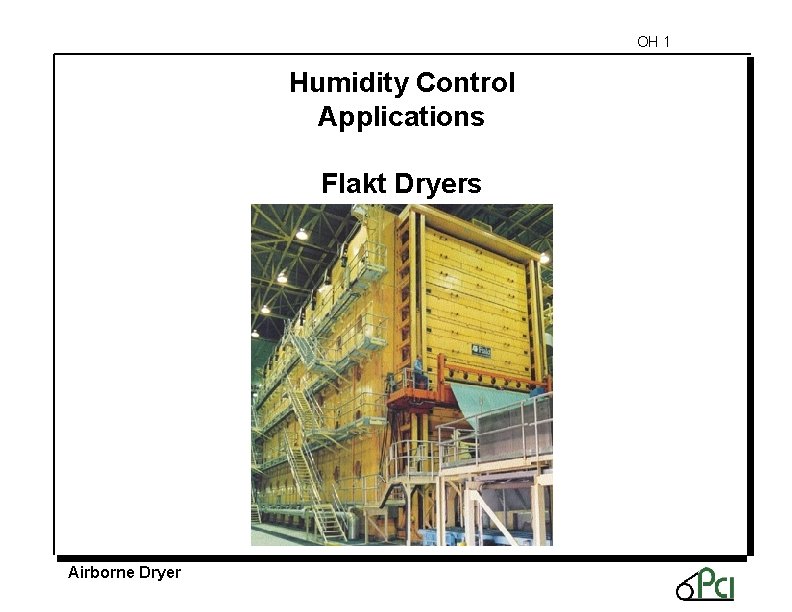
OH 1 Humidity Control Applications Flakt Dryers Airborne Dryer
OH 2 Humidity Control - Pulp and Paper Humidity control can help to optimize the performance of the hot air / direct contact drying processes used in the pulp and paper industry. These processes include Yankee Hoods and Through Air Dryers used in tissue manufacturing and Air Float dryers and Flash Dryers used to dry pulp. Humidity control has the potential to improve their thermal efficiency, sheet moisture control, and can assist in process diagnostics. In the past, a fundamental impediment to success has been sensor accuracy and reliability in high temperature/particulate exhaust streams. Our recent experiences with the H 2 O Humidity sensor have been very positive. Airborne Dryer
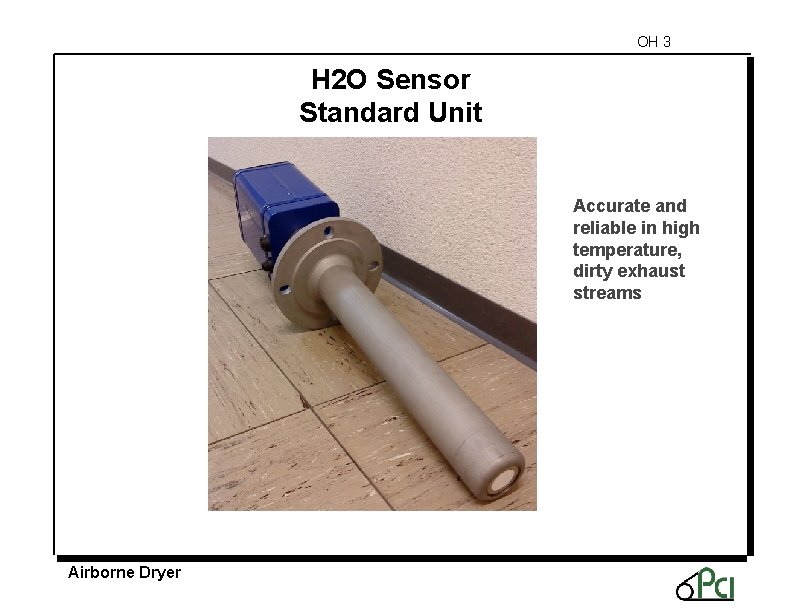
OH 3 H 2 O Sensor Standard Unit Accurate and reliable in high temperature, dirty exhaust streams Airborne Dryer
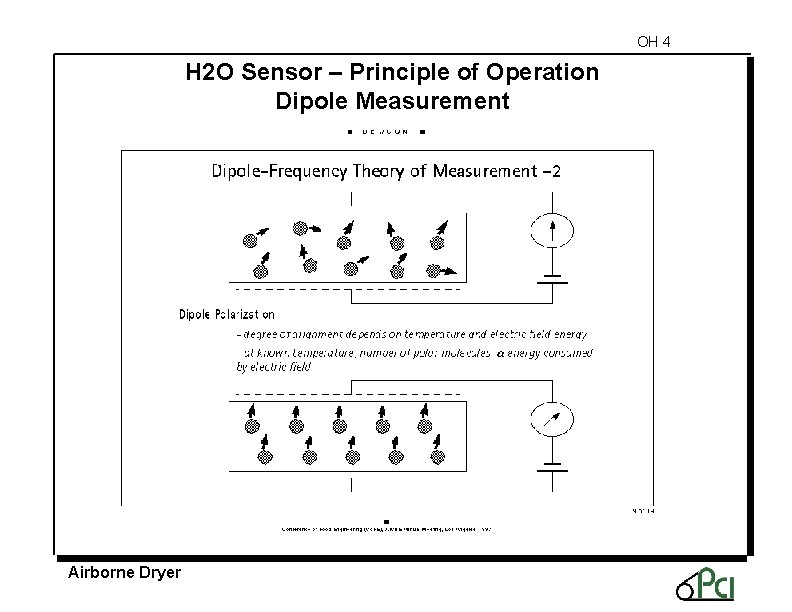
OH 4 H 2 O Sensor – Principle of Operation Dipole Measurement Airborne Dryer
OH 5 Humidity Control Impact on Thermal Efficiency The exhaust humidity is one of the most important factors determining dryer thermal efficiency. Increasing the exhaust humidity reduces the dry air flowrate into/out of the dryer. The energy required to heat up dry air to the exhaust temperature is reduced proportionately. In the majority of dryers, the dry air feed-rate is maintained relatively constant over the entire operating range. The Makeup Air/ Exhaust Air damper positions are rarely adjusted. This approach means that the exhaust humidity will vary with the evaporation rate. At high production rates the evaporation rate is high (achieved by increasing the drying air temperature) and the exhaust humidity will also be high. The reverse is also true. If the production rate is constant but the incoming sheet moisture content decreases, the evaporation rate will decrease and the exhaust humidity will decrease. In most mills, the makeup and exhaust damper positions are set conservatively and the average humidity is substantially lower than necessary. Airborne Dryer
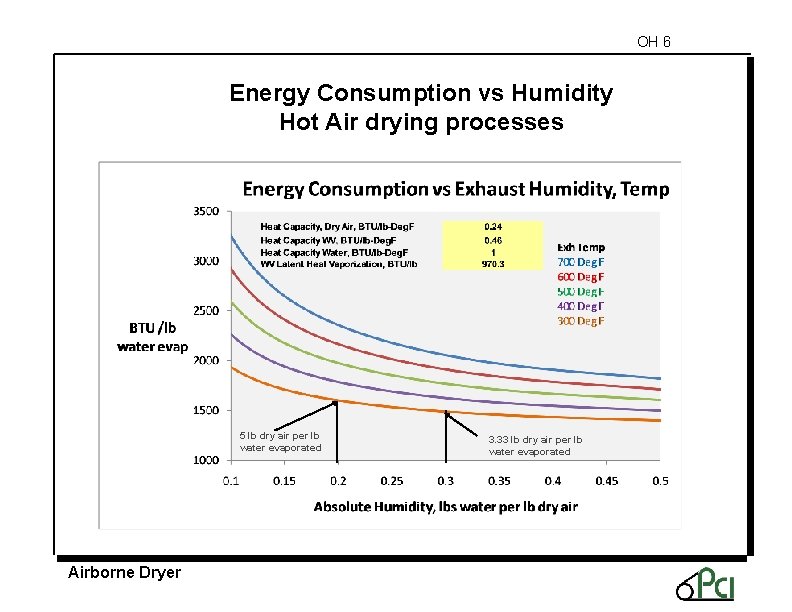
OH 6 Energy Consumption vs Humidity Hot Air drying processes 5 lb dry air per lb water evaporated Airborne Dryer 3. 33 lb dry air per lb water evaporated
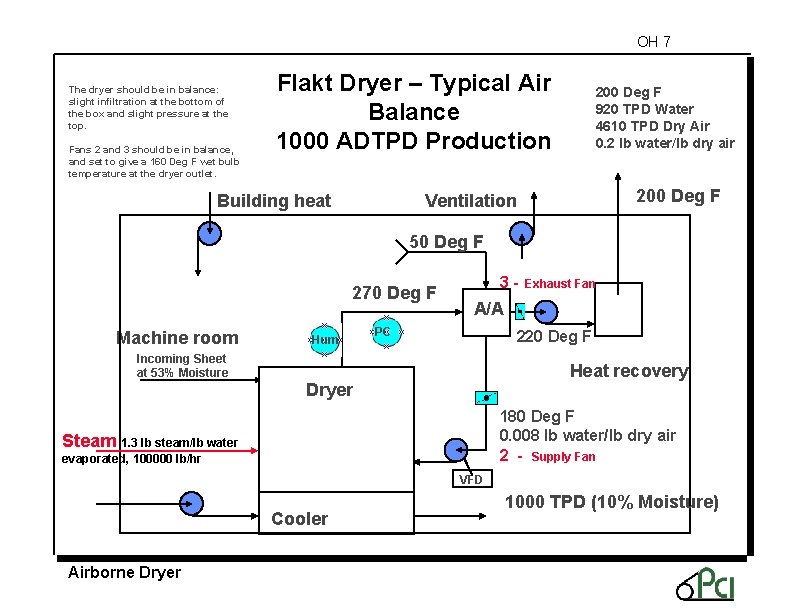
OH 7 The dryer should be in balance: slight infiltration at the bottom of the box and slight pressure at the top. Fans 2 and 3 should be in balance, and set to give a 160 Deg F wet bulb temperature at the dryer outlet. Flakt Dryer – Typical Air Balance 1000 ADTPD Production Building heat 200 Deg F 920 TPD Water 4610 TPD Dry Air 0. 2 lb water/lb dry air 200 Deg F Ventilation 50 Deg F 270 Deg F Machine room Hum 3 - Exhaust Fan A/A PC 220 Deg F Incoming Sheet at 53% Moisture Heat recovery Dryer 180 Deg F 0. 008 lb water/lb dry air 2 - Supply Fan Steam 1. 3 lb steam/lb water evaporated, 100000 lb/hr VFD Cooler Airborne Dryer 1000 TPD (10% Moisture)
OH 8 Flakt Dryer – Humidity Control • Humidity controller to adjust Supply Fan Damper or VFD • Discharge Pressure controller to adjust Exhaust Fan Damper • A primary disturbance to exhaust Humidity is incoming sheet moisture. An increase in the sheet moisture content will increase dryer exhaust humidity. The Humidity controller will increase Supply Fan Flowrate and the Discharge pressure controller will increase Exhaust Air Flowrate. • The Humidity sensor can be used as a feedforward signal to adjust energy input (steam pressure) to the dryer. Airborne Dryer
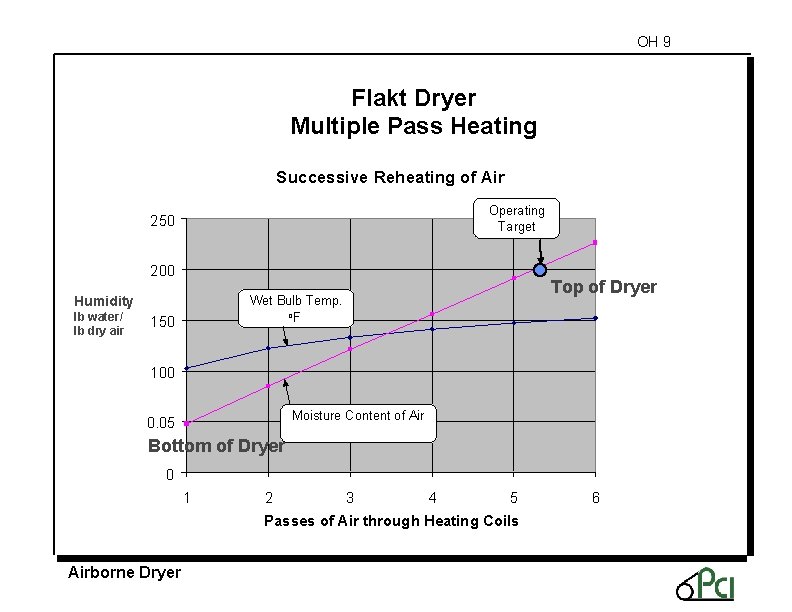
OH 9 Flakt Dryer Multiple Pass Heating Successive Reheating of Air Operating Target 250 200 Humidity lb water/ lb dry air Top of Dryer Wet Bulb Temp. o. F 150 100 Moisture Content of Air 0. 05 Bottom of Dryer 0 1 2 3 4 5 Passes of Air through Heating Coils Airborne Dryer 6
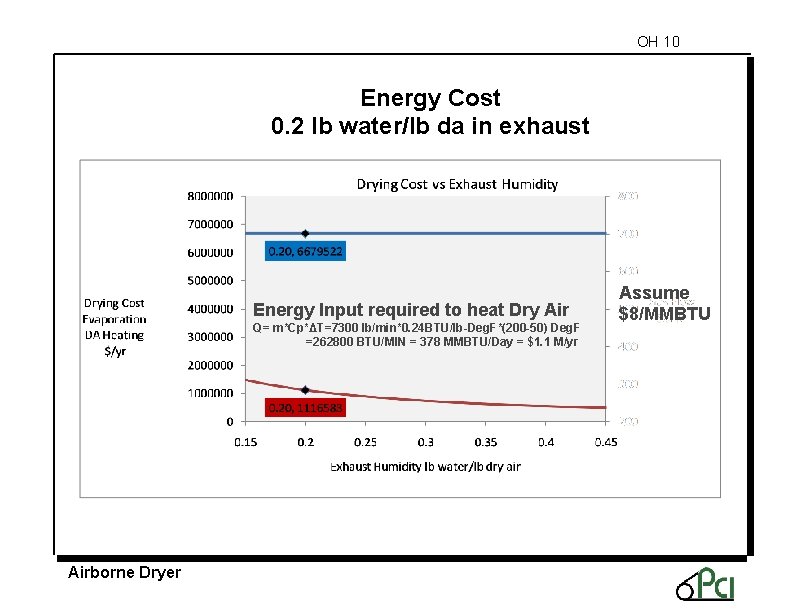
OH 10 Energy Cost 0. 2 lb water/lb da in exhaust Energy Input required to heat Dry Air Q= m*Cp*ΔT=7300 lb/min*0. 24 BTU/lb-Deg. F*(200 -50) Deg. F =262800 BTU/MIN = 378 MMBTU/Day = $1. 1 M/yr Airborne Dryer Assume $8/MMBTU
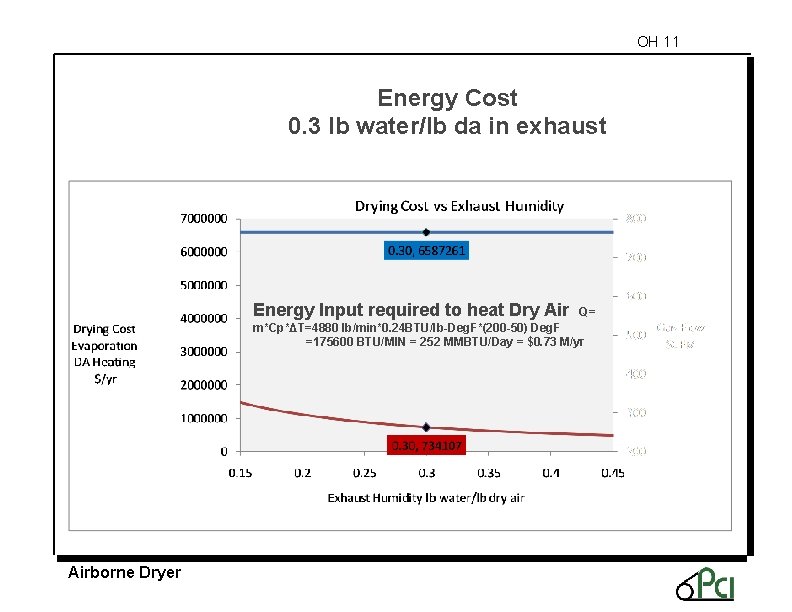
OH 11 Energy Cost 0. 3 lb water/lb da in exhaust Energy Input required to heat Dry Air Q= m*Cp*ΔT=4880 lb/min*0. 24 BTU/lb-Deg. F*(200 -50) Deg. F =175600 BTU/MIN = 252 MMBTU/Day = $0. 73 M/yr Airborne Dryer
OH 12 Flakt Dryer – Humidity Control • The H 2 O humidity sensor can help to optimize Flakt Dryers • The potential energy savings is significant and can easily justify the cost of the sensor (approx $25000) • The exhaust humidity is an indication of the evaporation load, and can be used to signal changes in the sheet moisture content at the dryer inlet. • The humidity sensor can be an important diagnostic tool for operators and engineers. Airborne Dryer
- Slides: 12