
Lexis Once upon a time vocabulary Two advantages

Lexis: Once upon a time: vocabulary. Two advantages: Adjectival form – lexical. More specific meaning than “vocabulary. ” Lexis refers to “meaning” words rather than grammatical – or “glue” – words. (E. g. , “people, ” “purple” are lexical; “in, ” “might” are grammatical. )
• • • Key words Root/Base word: what is left when all affixes are removed Morpheme: The smallest component of a word that carries meaning Affix: Morpheme attached before or after base word to change its meaning Prefix: Affix before a base word Suffix: Affix after a base word Inflectional suffix: Suffix that changes the grammar of a noun, verb, adjective Derivational suffix: Suffix that changes the word class (e. g. adjective to noun: slow – slowness. Derivational prefix: Prefix that changes the meaning of a word – e. g. pick/unpick Absolute/Comparative/Superlative: Many adjectives have three forms. – Tall (absolute) – Taller (comparative – “taller than…”) – Tallest (superlative – the most tall)
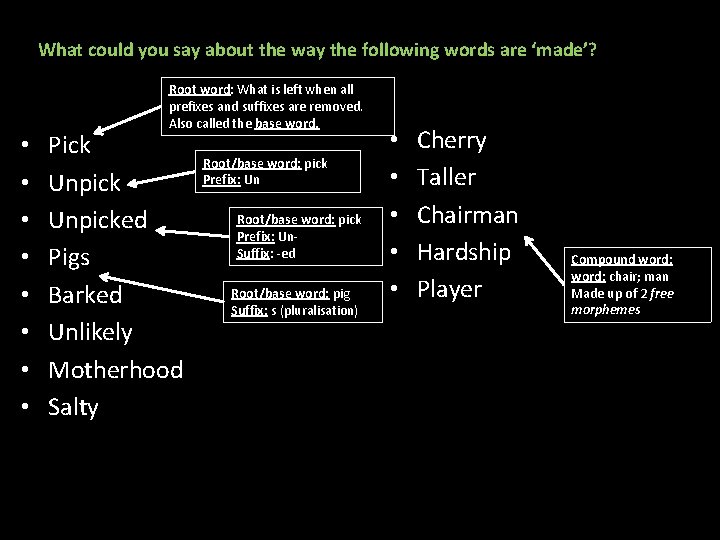
What could you say about the way the following words are ‘made’? • • Root word: What is left when all prefixes and suffixes are removed. Also called the base word. Pick Unpicked Pigs Barked Unlikely Motherhood Salty Root/base word: pick Prefix: Un. Suffix: -ed Root/base word: pig Suffix: s (pluralisation) • • • Cherry Taller Chairman Hardship Player Compound word: chair; man Made up of 2 free morphemes
Emerging meanings • Portmanteaus & compounds – Portmanteau: blend of parts from two words (“slithey” = slimy + lithe) – Compound: two complete words joined to make a single word (chairman) • Neologisms – Also “coinages”: new words • Antonomasia – Use of proper nouns in broad/generic/figurative sense (e. g. , “Shakespeare” = writer; Hoover = any vacuum cleaner) • Polysemy – Multiple or many meanings
Key words • Synonym – two words which have the same meaning • Antonym – the opposite to another word • Polyseme – a word with more than one meaning.
Polysemes & idioms can affect lexical/semantic clarity. Idiom: Phrase or sentence that cannot be understood by a literal, word-by-word definition/“translation”; often metaphorical; functions as complete lexical unit, or lexeme.
• Semantic Field: An area, or field, of meaning, and the words associated with that field. Semantic fields contains words with related senses. E. g. “Red, ” “blue, ” “purple” all belong to the semantic field of…
• Hyponym (“hypo-” under): A word whose sense/meaning is included in that of a broader, “umbrella” term. E. g. , “daisy” is a hyponym of “flower. ” The abstract noun form is “hyponymy. ” • Hypernym (“hyper-” over): A term that includes the senses/meanings of its hyponyms. • Meronym: A term which is included in a larger, inclusive term, because the meronym is a part of the whole. E. g. “page, ” “cover, ” “spine” are meronyms of “book. ” Abstract noun: meronymy.
Denotation: The meaning/reference of a word. Connotation: The associations/suggestions of a word. Usage: This word has connotations of… This word denotes… This word is connotative of…
What is sociolinguistics? Key Words • What is sociolinguistics? • Sociolinguistics: the study of the relationship between language and society. Social factors can affect language, just as language can shape the ways we think about, or construct, society.
Dialect A way of speaking, particular to an area or region, which has distinct syntax and vocabulary. Sociolect A way of speaking, particular to a social group (e. g. , the difference between adults and teenagers, within the same region; a way of speaking associated with a social class). Idiolect The way of speaking particular to an individual.
What is sociolinguistics? Ways of speaking (not necessarily to do only/primarily with dialect, sociolect, idiolect): • Change from above: deliberately changing certain habits of speech (“h” dropping) • Change from below: the “natural”/“accidental” change in language habits – change from below often leads to stereotype. . .
• • • Phoneme – basic units of sound from which language is built. (NOT the same as saying “letter”; different letters may represent the same phoneme Alliteration – deliberate use of words beginning with the same sound Assonance – repetition of vowel sounds for effect Onomatopoeia – the sound of the word itself resembles the sound/event described. (Lexical onomatopoeia – meaningful onomatopoeic words [“bang, ” “clatter”]; non-lexical – e. g. , “vroom”) Rhyme – repetition/correspondence of words’ final sounds (“behold, ” “cold”) Rhythm – pattern or flow created by the arrangement of stressed and unstressed syllables
• Graphology: Any layout/presentational features • Comment on how graphological features impact on/affect meaning. • Avoid saying: “This text has lots of graphology. ” Instead: “This text has several significant/interesting graphological features. . . ”
- Slides: 15