
Lexicon 1 2 has two different meanings All
- Slides: 12
� Lexicon 1. 2. has two different meanings: All the vocabulary of a language The dictionary The English suffix -graphy means either "writing" or a "field of study“ � Lexicography is used in two different senses: * Practical lexicography is the art or craft of writing dictionaries. * Theoretical lexicography is theory or scholarly discipline of analyzing and describing dictionaries.
� The term lexicology is variously used. Some use it as a synonym for theoretical lexicography, others use it for a branch of linguistics pertaining to the treasure of words in a particular language i. e. the study of forms, meanings and behaviors of words.
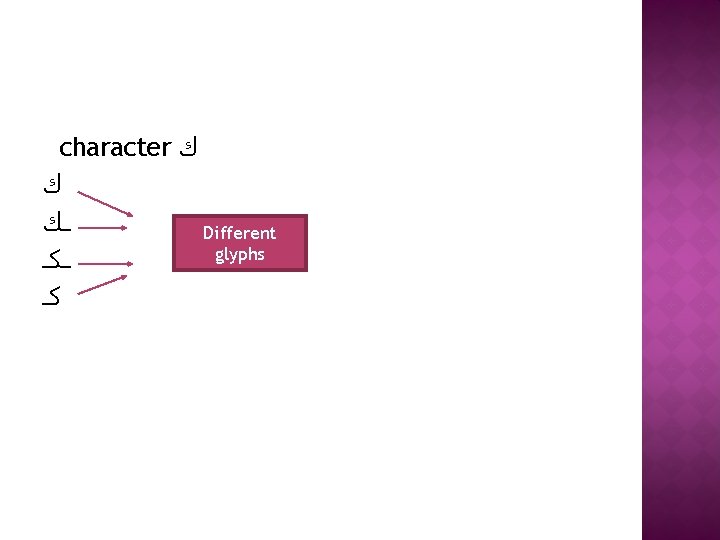
�A dictionary is a list of words with their definitions, a list of characters with their glyphs or a list of words with corresponding words in other languages. Many dictionaries also provide pronunciation information, word derivations, histories, or etymologies, illustrations, usage guidance, and examples in sentences.
character ﻙ ﻙ ـﻚ Different glyphs ـﻜـ ﻛـ
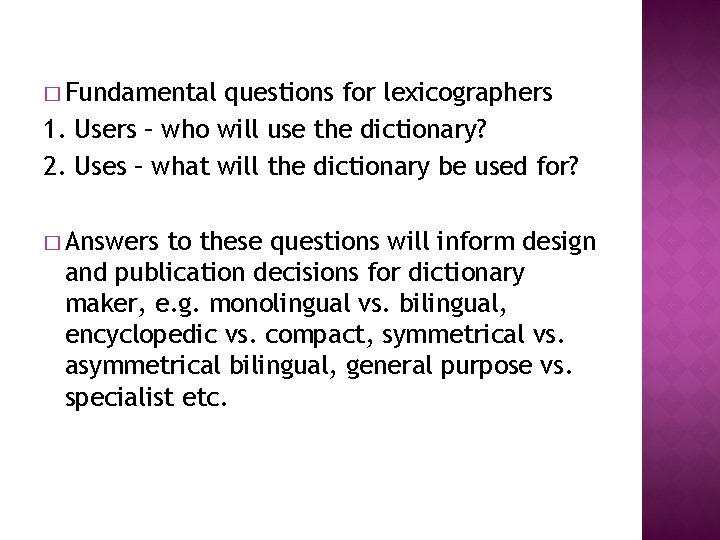
� Fundamental questions for lexicographers 1. Users – who will use the dictionary? 2. Uses – what will the dictionary be used for? � Answers to these questions will inform design and publication decisions for dictionary maker, e. g. monolingual vs. bilingual, encyclopedic vs. compact, symmetrical vs. asymmetrical bilingual, general purpose vs. specialist etc.
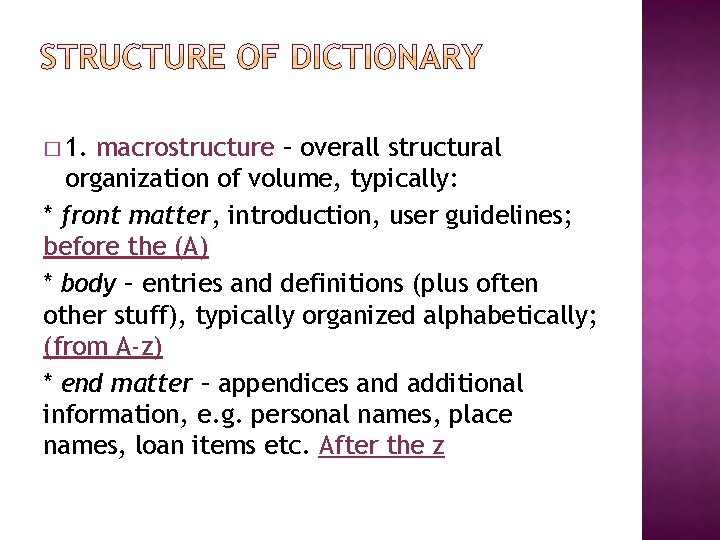
� 1. macrostructure – overall structural organization of volume, typically: * front matter, introduction, user guidelines; before the (A) * body – entries and definitions (plus often other stuff), typically organized alphabetically; (from A-z) * end matter – appendices and additional information, e. g. personal names, place names, loan items etc. After the z
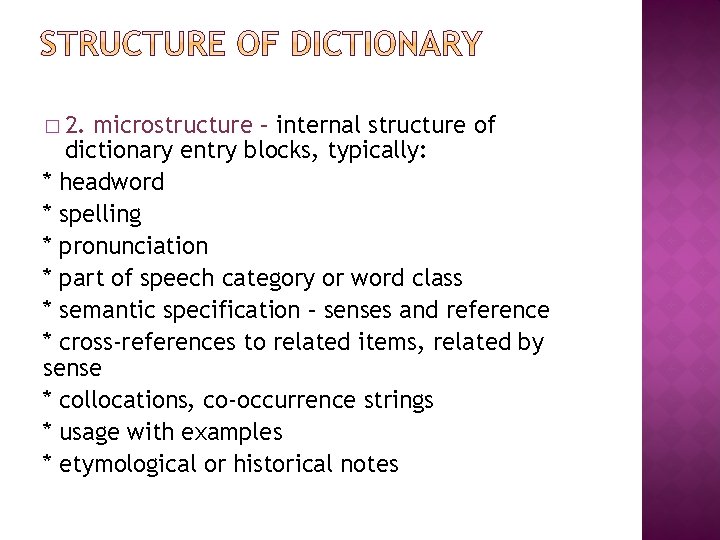
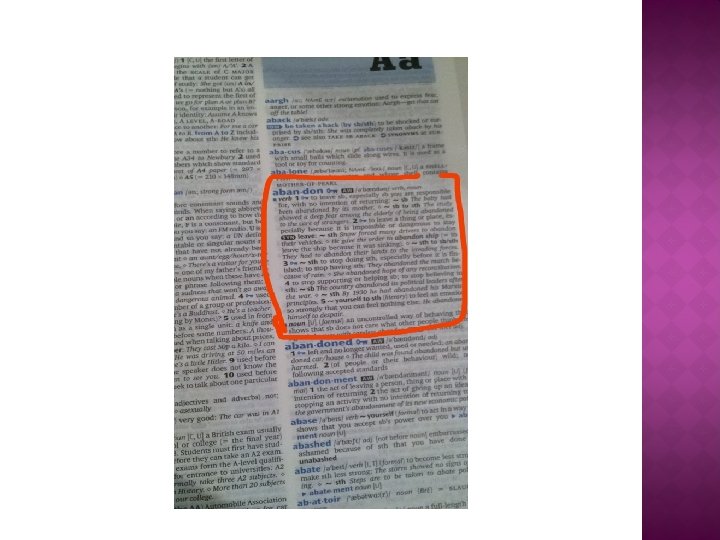
� 2. microstructure – internal structure of dictionary entry blocks, typically: * headword * spelling * pronunciation * part of speech category or word class * semantic specification – senses and reference * cross-references to related items, related by sense * collocations, co-occurrence strings * usage with examples * etymological or historical notes
� What is a word: are the following words? want, wanting, wanted, war chest, war crime, courthouse, wannabe, half-baked � Distinguish: � 1. Orthographic word – (of or relating to spelling) written word surrounded by spaces; but what about compounds, hyphenated forms etc. Distinguish � 2. Phonological word – sequence of sounds that forms phonological unit (determined by rules of syllable structure, stress, etc)
� 3. Lexeme – item of vocabulary that may occur as dictionary headword. Lexemes can be more than one orthographic word i. e. a word or several words that have a meaning that is not expressed by any of its separate parts * Lexeme is an abstract concept – it is the set of word forms that comprise a paradigm of related words forms, eg. sing – sings – singing - sang – sung (cf. talk – talks – talking – talked) – regular and irregular paradigms; � a lexeme can have many different forms. � � * Word-form is inflectional variant of lexeme i. e. word forms have the same lexeme e. g. runs, ran, running are forms of the same lexeme (run). However, the derivative (runner ) has a different lexeme. � * A headword is typically a citation form of a lexeme i. e. represents a lexeme.
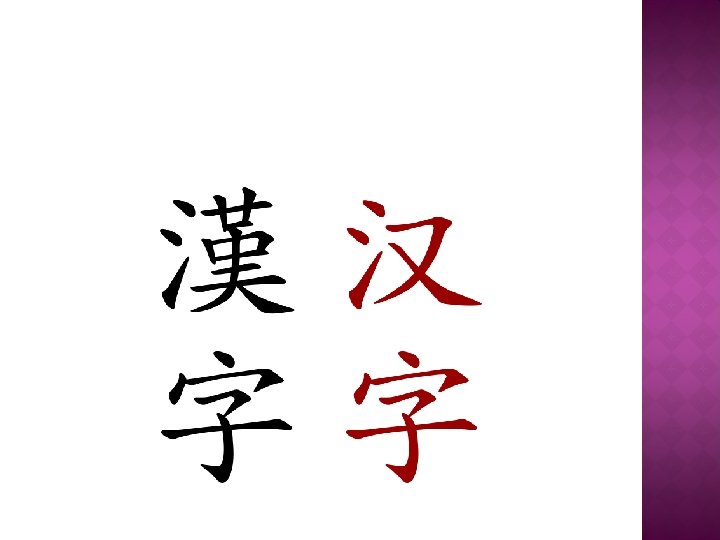
� Dictionaries of alphabetic languages list words in alphabetical order. With nonalphabetic languages, it may be different. The order in a dictionary with ideographic entries i. e. graphic symbols that represent an idea rather than a group of letters; such as Chinese character is often troublesome and controversial because each character has different readings.