Lexical Transformations in Translation 1 Transformations in Translation

- Slides: 38
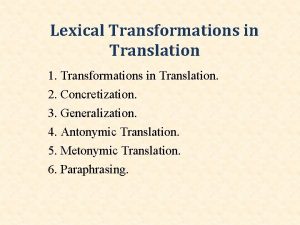
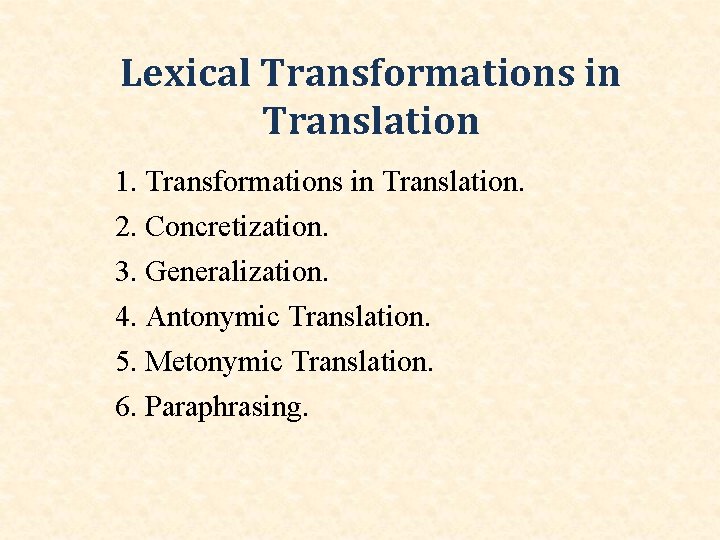
Lexical Transformations in Translation 1. Transformations in Translation. 2. Concretization. 3. Generalization. 4. Antonymic Translation. 5. Metonymic Translation. 6. Paraphrasing.
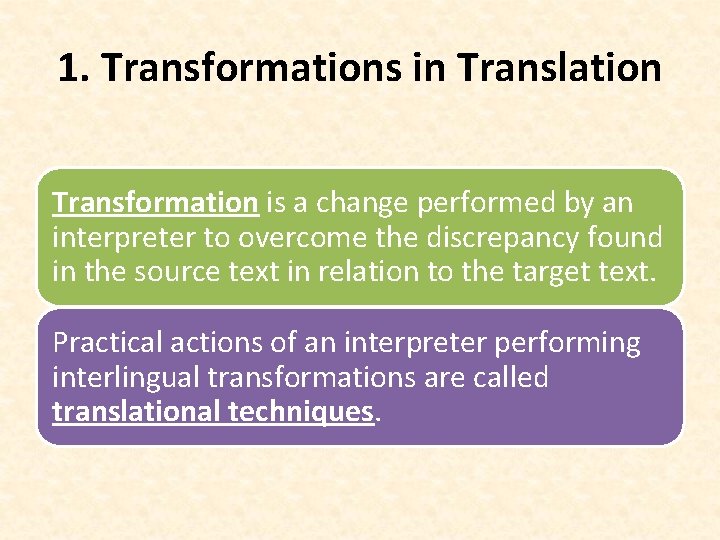
1. Transformations in Translation Transformation is a change performed by an interpreter to overcome the discrepancy found in the source text in relation to the target text. Practical actions of an interpreter performing interlingual transformations are called translational techniques.
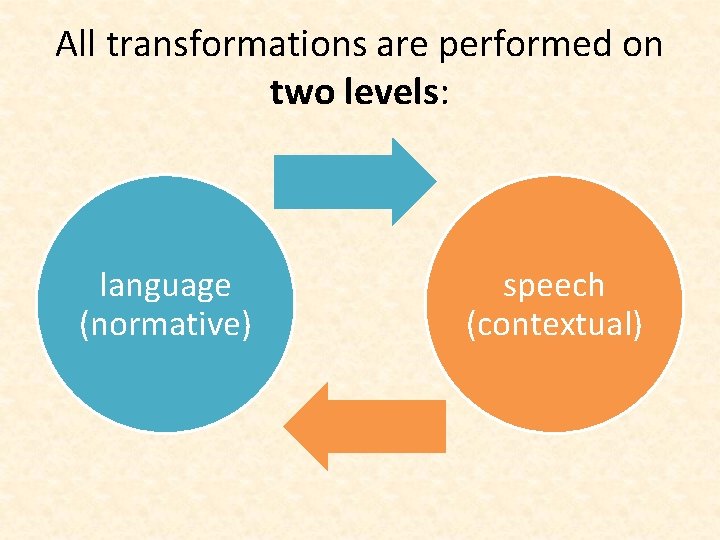
All transformations are performed on two levels: language (normative) speech (contextual)
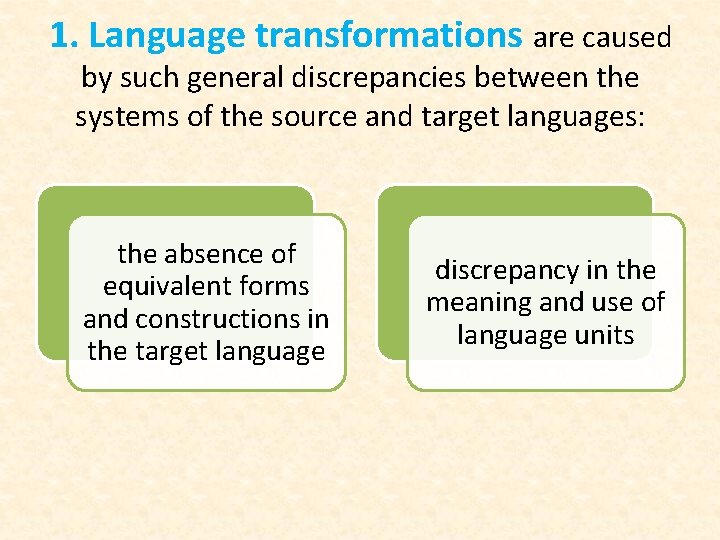
1. Language transformations are caused by such general discrepancies between the systems of the source and target languages: the absence of equivalent forms and constructions in the target language discrepancy in the meaning and use of language units
2. Speech transformations are caused by discrepancies that arise only in a specific context. E. g. : My heart will go on. – Ти назавжди залишишся в моєму серці. / Я тебе ніколи не забуду.
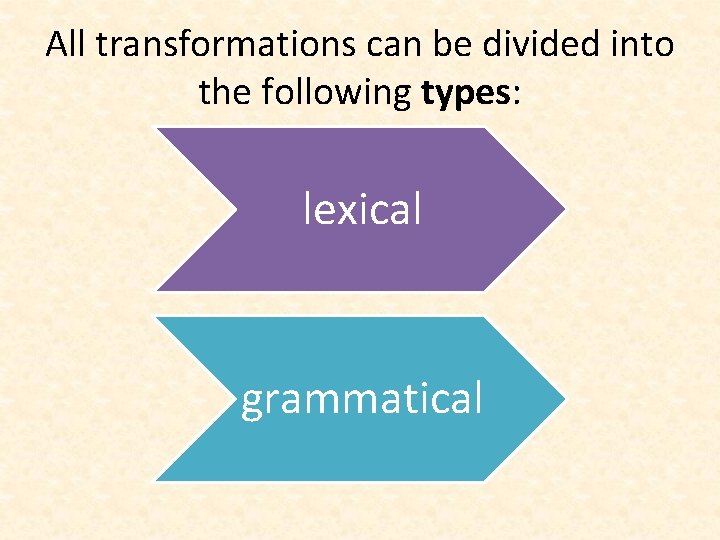
All transformations can be divided into the following types: lexical grammatical
Lexical transformations are methods of logical thinking, with the help of which we reveal the meaning of an English word in the context and find a Ukrainian correspondence that does not coincide with the dictionary one.
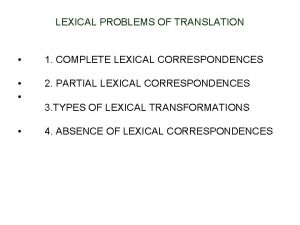
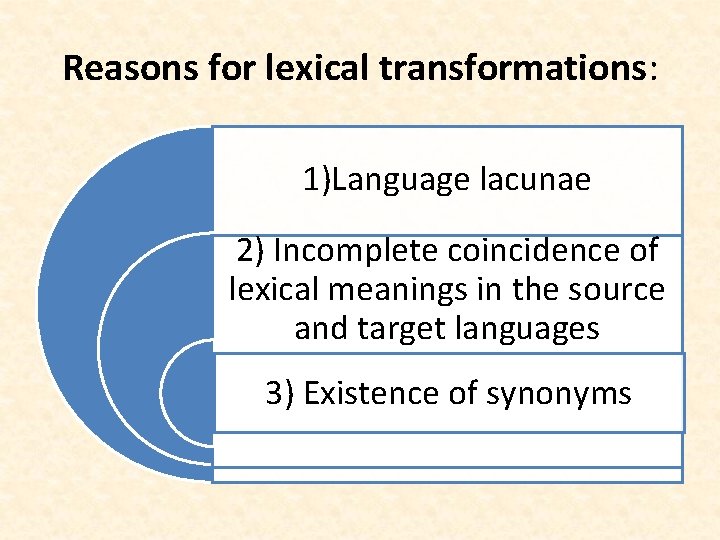
Reasons for lexical transformations: 1)Language lacunae 2) Incomplete coincidence of lexical meanings in the source and target languages 3) Existence of synonyms
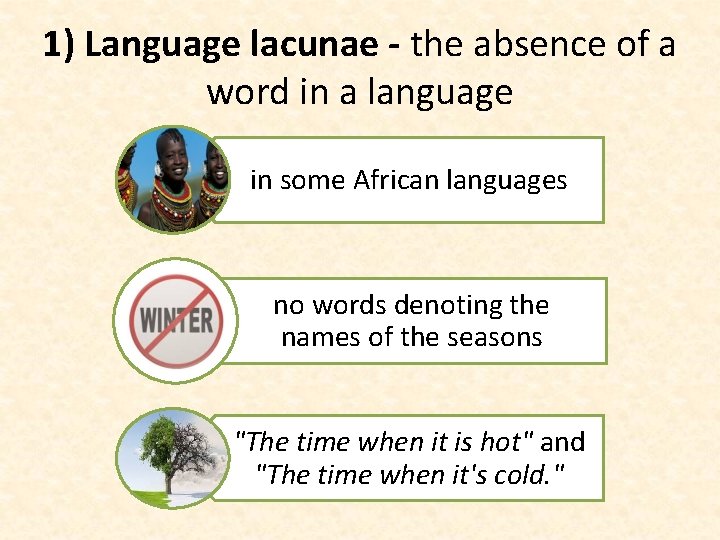
1) Language lacunae - the absence of a word in a language in some African languages no words denoting the names of the seasons "The time when it is hot" and "The time when it's cold. "
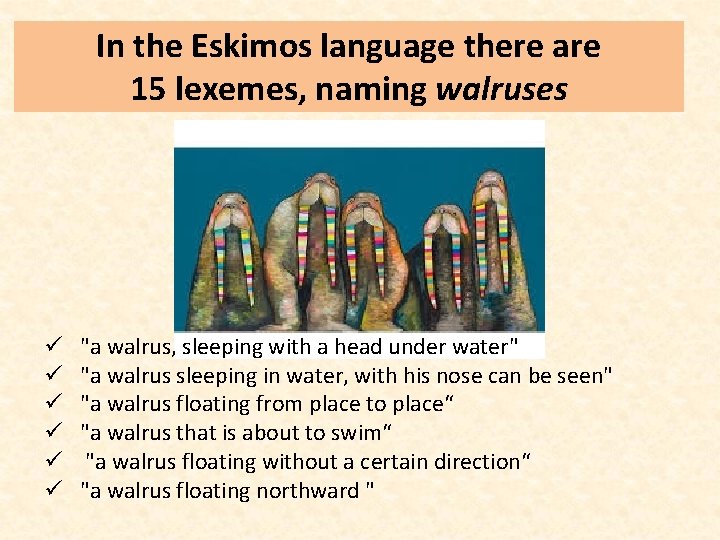
In the Eskimos language there are 15 lexemes, naming walruses ü ü ü "a walrus, sleeping with a head under water" "a walrus sleeping in water, with his nose can be seen" "a walrus floating from place to place“ "a walrus that is about to swim“ "a walrus floating without a certain direction“ "a walrus floating northward "
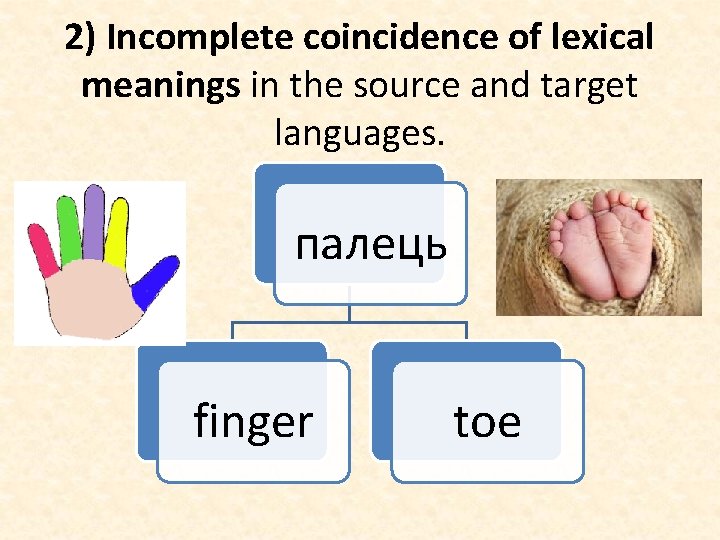
2) Incomplete coincidence of lexical meanings in the source and target languages. палець finger toe
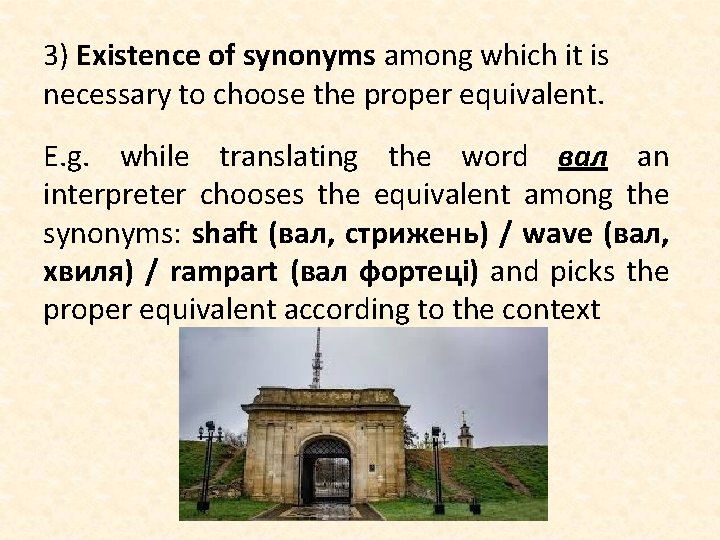
3) Existence of synonyms among which it is necessary to choose the proper equivalent. E. g. while translating the word вал an interpreter chooses the equivalent among the synonyms: shaft (вал, стрижень) / wave (вал, хвиля) / rampart (вал фортеці) and picks the proper equivalent according to the context
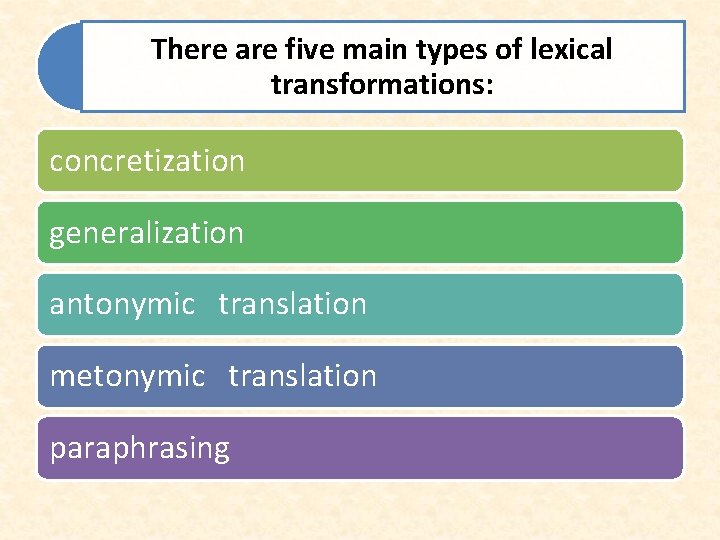
There are five main types of lexical transformations: concretization generalization antonymic translation metonymic translation paraphrasing
2. Concretization Some groups of lexical units require concretization in translation. This is due to the difference in the proportion between abstract / desemantized and concrete words in the source and target languages.
Concretization can be of 2 types: 1. Concretization conditioned by the properties of the source language (normative concretization) e. g. mother-in-law: а) теща; б) свекруха; 2. Concretization conditioned by the context or the necessity of compliance with the norms of lexical compatibility in the target language (contextual concretization).
Contextual concretization is applied to: A. Nouns formed by the suffixes of abstract meaning (-ship, -cy, -ate, -hood). E. g. : Food security and livelihood projects have increased dramatically in Africa. – Істотно збільшилася кількість проектів в галузі забезпечення продовольчої безпеки і засобів існування в Африці.
B. Some words which have no equivalents in Ukrainian (lacuna) Words of abstract meaning which have no equivalents in the Ukrainian language are translated by concrete words depending on the context. He is heavily built. – У нього огрядна фігура. Each occupant is responsible for his own seatbelt wearing. – Кожна особа, яка знаходиться в транспортному засобі, несе відповідальність за використання ременя безпеки.
C. Verbs with wide meaning like be, get, take, give, have, make, do, say, come, go, turn. They usually are translated by means of more specific words and expressions, e. g. : • He is in the Army. - Він служить в армії. • He is in prison. - Він сидить у в'язниці. • He is in hospital. - Він лежить в лікарні. First he was terrified, then he was sick, then he was in Paris. – Спочатку він злякався, потім його знудило, потім він опинився в Парижі. (J. Tey).
D. Expressions with THERE IS There were pictures on all the walls of his office. На всіх стінах його кабінету висіли картини. There was an ancient vase on the chest of drawers. - На комоді стояла старовинна ваза. There is a restaurant of national cuisine with 100 places functioning in the territory of the complex. – На території комплексу функціонує ресторан національної кухні на 100 місць.
Some desemantized English words are: • thing – річ, предмет, річ, факт, випадок, істота There are many things which need to be reformed. These are entirely different things. • matter – діло, матеріал, зміст, суть, матерія, речовина What’s the matter? No matter how hard Joseph tried to convince me, I didn’t believe him.
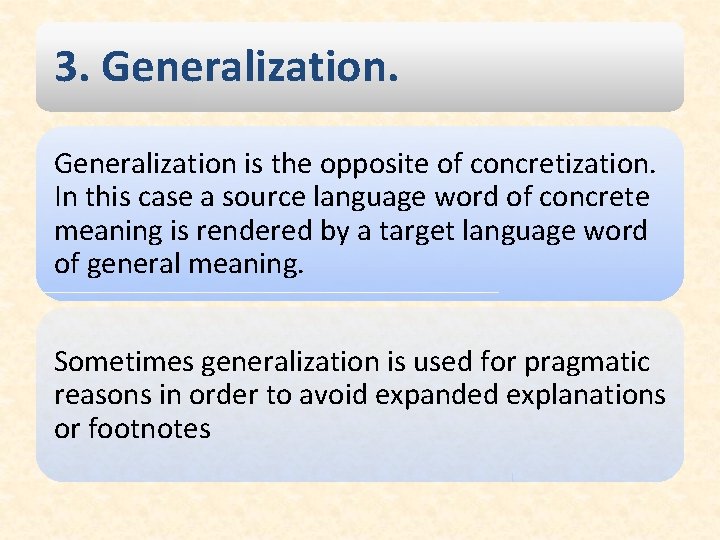
3. Generalization is the opposite of concretization. In this case a source language word of concrete meaning is rendered by a target language word of general meaning. Sometimes generalization is used for pragmatic reasons in order to avoid expanded explanations or footnotes
There is a tendency in the English language to use nouns denoting measures of weight, distance, length, etc. in describing people and things. • He was a young man of 6 feet 2 inches. – Це був високий юнак. • It enabled him to win every ounce of advantage. – Це надавало йому можливості скористатися всіма перевагами.
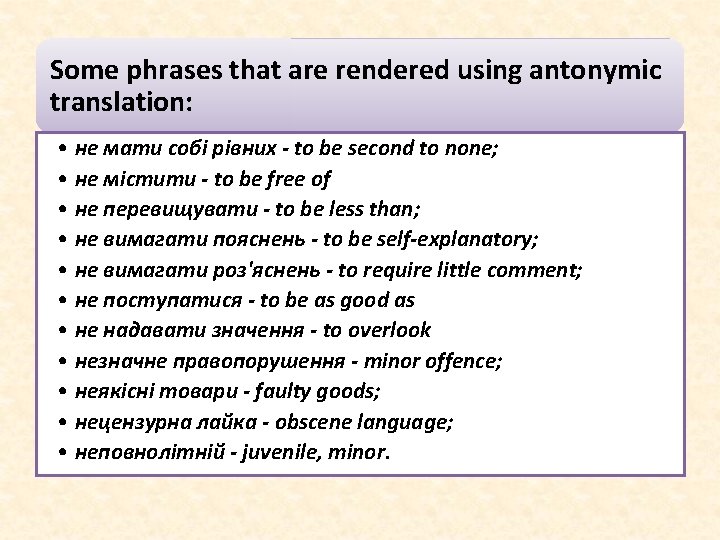
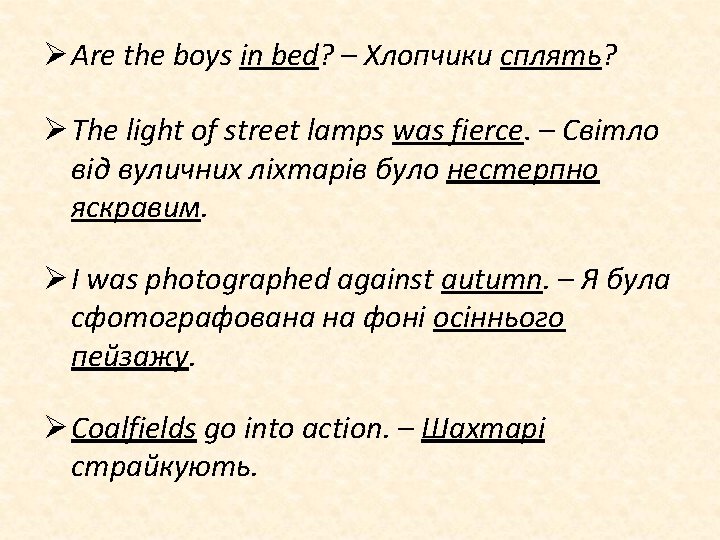
4. Antonymic Translation. Antonymic translation is such type of transformation which implies changing an affirmative construction in translation by a negative one or a negative construction – by an affirmative one. E. g. : • the undead past – ще живе минуле. • Let a sleeping dog lie. – Не буди сплячого собаку. • Nobody was ever sorry to see him. – Всі завжди були раді його бачити.
Typical cases of antonymic translation usage: 1) the absence of a lexical equivalent in Ukrainian: He is a pro-lifer. - Він противник абортів. 2) translation of some phrasal verbs: Stay away. - Не наближайся. Hang on, please. - Не кладіть трубку, будь ласка. Keep the child out of the sun. - Не тримайте дитину на сонці.
3) translation of some set expressions (correspondences can be found in the dictionaries): It’s out of the question. - Про це не може бути й мови. Take your time. - Не поспішай. I beg to differ. - Дозвольте не погодитися.
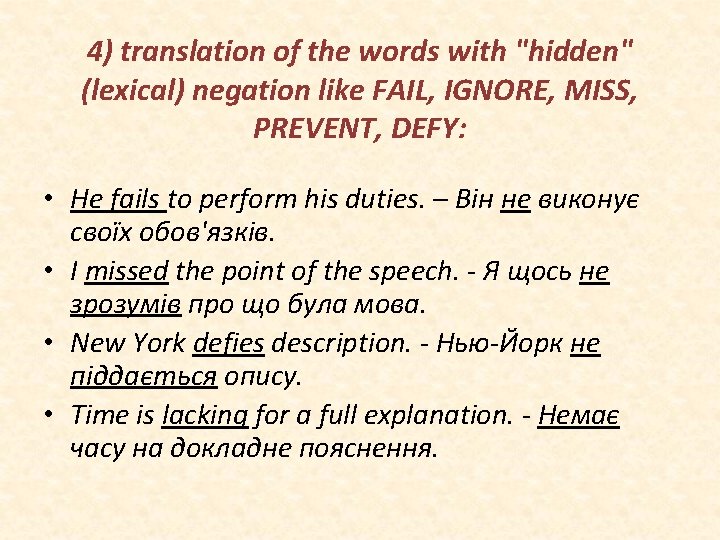
4) translation of the words with "hidden" (lexical) negation like FAIL, IGNORE, MISS, PREVENT, DEFY: • He fails to perform his duties. – Він не виконує своїх обов'язків. • I missed the point of the speech. - Я щось не зрозумів про що була мова. • New York defies description. - Нью-Йорк не піддається опису. • Time is lacking for a full explanation. - Немає часу на докладне пояснення.
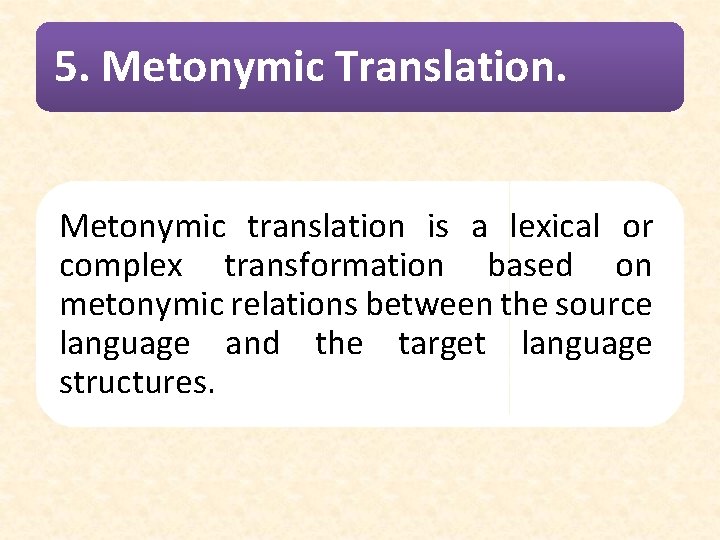
5. Metonymic Translation. Metonymic translation is a lexical or complex transformation based on metonymic relations between the source language and the target language structures.
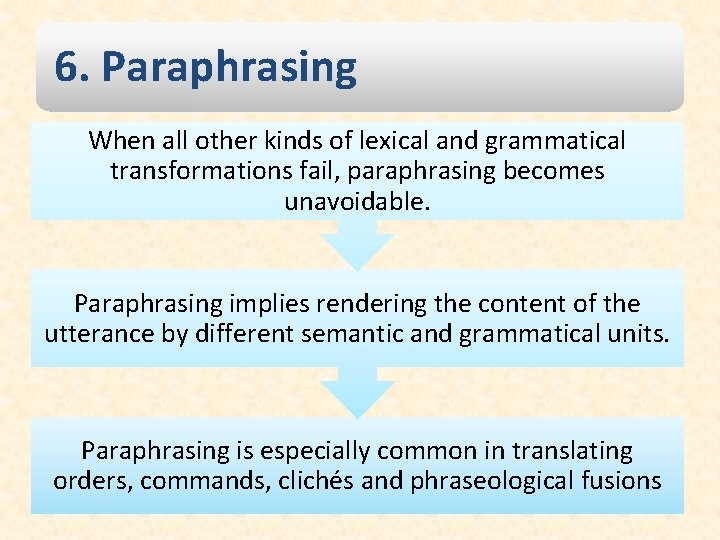
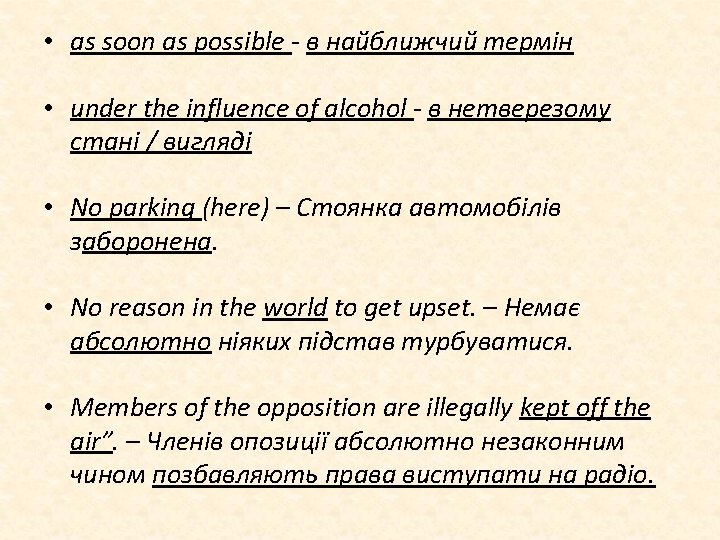
6. Paraphrasing When all other kinds of lexical and grammatical transformations fail, paraphrasing becomes unavoidable. Paraphrasing implies rendering the content of the utterance by different semantic and grammatical units. Paraphrasing is especially common in translating orders, commands, clichés and phraseological fusions